






Key Takeaways
- Visibility alone doesn’t create control—response speed does. Event-driven agents reduce the time between disruption detection and operational action.
- Supply chain control tower AI becomes valuable only when it orchestrates decisions, not just visualizes problems.
- Event-driven architectures allow autonomous micro-decisions, such as inventory reallocation or expedited shipping, before disruptions escalate.
- Most ROI comes from preventing small, frequent operational leaks, not from avoiding rare catastrophic failures.
- Human planners remain essential—but their role shifts upward, from reacting to disruptions toward defining policies, optimizing thresholds, and managing systemic risk.
Manufacturers have spent two decades trying to “gain visibility”. Dashboards improved. ERPs became faster. Planning engines grew more sophisticated. Yet when a shipment slips in Shenzhen or a supplier in Pune misses a dispatch window, the response still often begins with a phone call and an email thread.
That gap—between knowing something has happened and acting on it— is where most operational pain lives.
Near-real-time supply chain control isn’t about prettier dashboards. It’s about compressing the time between disruption and response. And increasingly, manufacturers are achieving that compression through event-driven agents operating inside what many now describe as a supply chain control tower AI architecture.
But let’s be honest. The term “control tower” has been abused. Plenty of organizations claim to have one. Few actually operate one.
The Illusion of Control
Most mid-to-large manufacturers run some combination of:
- ERP (often SAP or Oracle)
- A transportation management system
- Warehouse execution platforms
- Forecasting or APS tools
- Supplier portals
- There are dozens of Excel files that lack official ownership.
Data exists everywhere. Control doesn’t. Traditional control towers aggregate information into a central dashboard. They show you delayed shipments, inventory levels, and projected stockouts. That’s helpful. But they don’t act. They rely on humans to interpret signals, prioritize issues, and trigger workflows.
And here’s where things slow down:
- Someone must notice the alert.
- They must validate it.
- They email or call stakeholders.
- A meeting gets scheduled.
- A decision is made.
- Someone executes it manually.
In volatile supply environments, that latency is fatal. It’s not a dramatic delay but rather a silent expense.
Near-real-time control means reducing this loop from hours (or days) to minutes. Sometimes seconds.
Also read: Supply Chain Shock Prediction Agents in Manufacturing
Event-Driven Thinking: A Shift in Architecture
Most legacy planning systems operate in batches. Nightly runs. Scheduled recalculations. Periodic refresh cycles.
The real world doesn’t. Events happen continuously:
- A port congestion update.
- The arrival of a supplier’s ASN is delayed.
- A sudden change in fuel surcharge rates.
- A machine’s IoT telemetry indicates the risk of downtime.
- Weather warnings have an impact on inbound lanes.
An event-driven architecture treats each of these as triggers — not just data points.
Instead of asking, “What does the dashboard say this morning?” the system asks, “What just happened—and what needs to be responded to?”
This is where event-driven agents come in.
What Are Event-Driven Agents?
Not chatbots. Not static workflows.
Event-driven agents are autonomous logic components that:
- Subscribe to operational signals.
- Interpret contextual impact.
- Execute predefined or learned responses.
- Escalate only when necessary.
Think of them as digital operations managers, but narrow in scope and relentless in attention. They don’t “monitor dashboards”. They wait for triggers and act. That difference is subtle. And transformative.
Anatomy of a Modern Supply Chain Control Tower AI
When manufacturers implement a true supply chain control tower AI, it typically includes:
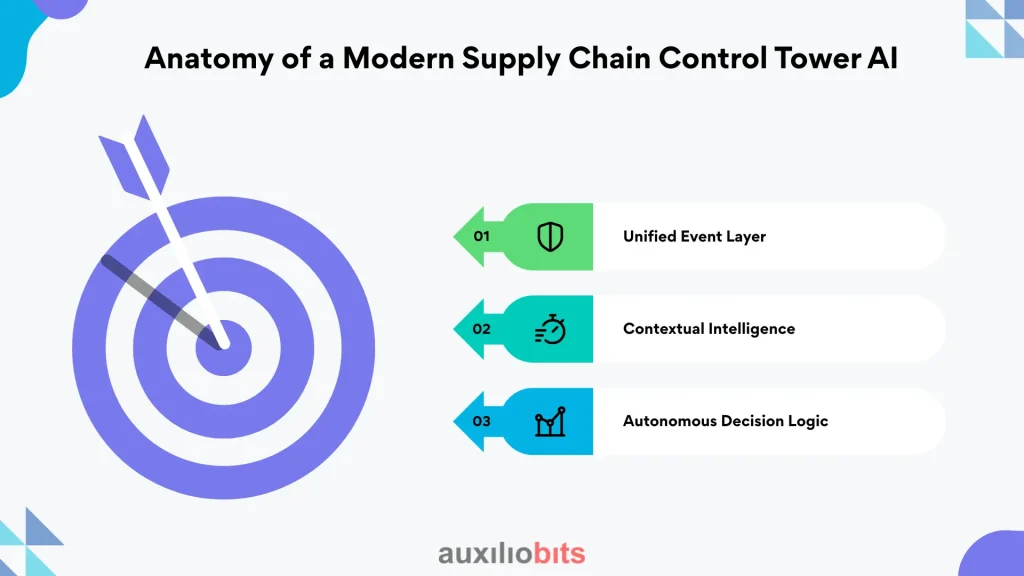
1. Unified Event Layer
Data streams from:
- ERP transactions
- TMS updates
- Warehouse scans
- Supplier EDI feeds
- IoT devices
- External risk APIs, such as those for weather, geopolitical risk, and freight indices, are utilised.
Instead of pushing everything into static reports, events are published to a streaming layer — Kafka, Azure Event Hub, or similar platforms. The architecture matters here. Without a proper event backbone, agents have nothing to respond to.
2. Contextual Intelligence
Raw events are useless without context. A late shipment for safety stock inventory is annoying. A late shipment for a single-source critical component is existential.
Context layers typically include:
- BOM dependencies
- Production schedules
- Customer service level agreements
- Margin impact models
- Lead-time variability history
Event-driven agents don’t just react to “delay”. They assess materiality.
3. Autonomous Decision Logic
This is where organizations hesitate. Automation that merely notifies is safe. Automation that decides feels risky.
Yet mature deployments allow agents to:
- Reallocate inventory across plants.
- Trigger expedited freight bookings.
- Adjust safety stock buffers dynamically.
- Re-sequence production orders.
- Notify customers proactively when delivery windows shift.
With guardrails, of course. No one is giving full autonomy without thresholds. But partial autonomy already reduces reaction cycles dramatically.
A Real Example: Tier-1 Automotive Manufacturer
A Tier-1 supplier in the automotive sector implemented event-driven control mechanisms across its inbound logistics.
Previously, shipment delays were discovered during daily planning reviews. By then, it was often too late to avoid line adjustments.
After deploying event-driven agents:
- ASN discrepancies triggered immediate reconciliation workflows.
- If the inbound ETA crossed a risk threshold relative to the production consumption rate, the system automatically checked alternate inventory pools.
- If no internal stock was available, it initiated a pre-approved expedite workflow with freight partners.
- Only when cost thresholds exceeded preset bands did humans intervene.
The result?
- 38% reduction in line stoppage incidents.
- Faster response to variability.
- Ironically, lower emergency freight costs resulted from earlier detection of problems.
Was it perfect? No. Early in deployment, the system over-triggered expediting actions. Too sensitive. They tuned thresholds. That tuning phase is inevitable.
Why Traditional Planning Alone Fails
Planning systems assume stability with variance. Modern supply chains operate in volatility with micro-shocks. Monthly S&OP cycles cannot absorb:
- Sudden supplier labor strikes.
- Real-time fuel surcharges.
- Border clearance slowdowns.
- Promotional campaigns can cause dynamic demand spikes.
Event-driven agents complement planning. They don’t replace it. Think of planning as strategy. Agents handle tactics in motion. Manufacturers who treat their control tower as merely a reporting tool remain reactive.
What Enables Near-Real-Time Control
It’s tempting to assume better software alone solves this. It doesn’t. Based on field experience, four factors determine success:
Data Integrity
If lead-time master data is wrong, agents make wrong decisions faster. Companies often underestimate the cleanup phase. Garbage in; automated garbage out— just at scale.
Clear Decision Rights
Who approves reallocation? At what margin loss is expediting allowed? When does customer communication trigger automatically? Without codified policies, automation stalls.
Gradual Autonomy Scaling
Successful firms do not simply turn on a switch.
They typically:
- Start with notification-only mode.
- Move to assisted decision recommendations.
- Then allow low-risk automated actions.
- Expand the autonomy band gradually.
Control is earned, not assumed.
Cultural Readiness
Some planners resist automation. Not because they dislike efficiency — but because it threatens tacit knowledge. In one electronics manufacturer, planners initially bypassed the agent recommendations. Trust grew only after the system correctly predicted and mitigated two potential stockouts faster than manual escalation could. Trust isn’t installed. It’s proven.
Event-Driven Agents in Specific Supply Chain Domains
Near-real-time control doesn’t manifest uniformly. It varies by function.
1. Inbound Logistics
- Real-time lane risk scoring.
- Predictive carrier reliability assessment.
- Auto-booking alternate routes when ETA variance exceeds tolerance.
2. Inventory Management
- Dynamic safety stock recalibration.
- Autonomous inter-plant transfers.
- Shelf-life monitoring with automated disposition decisions.
3. Production Scheduling
- Micro-rescheduling triggered by material shortages.
- Machine health telemetry triggering preventive adjustments.
- Constraint balancing when bottlenecks shift.
4. Customer Fulfillment
- Immediate ATP recalculation.
- Automated order reprioritization based on margin and SLA.
- Proactive customer notifications — not reactive apologies.
Each of these is event-triggered. Not periodic.
Where It Breaks Down
Let’s not oversell it.
Event-driven systems can fail when:
- Event noise overwhelms signal (too many triggers).
- Thresholds are poorly calibrated.
- Organizational silos block cross-functional responses.
- External partners lack digital integration maturity.
Integrating Predictive + Event-Driven Models
Pure reactivity isn’t enough. The best implementations combine:
- Predictive risk scoring (likelihood of disruption).
- Event-triggered response (when disruption begins manifesting).
- Feedback loops (learning from outcome effectiveness).
Example: A predictive model flags a supplier with increasing variability. There is currently no action taken, only an elevated watch status. Then an event triggers: ASN short-shipped. The agent recognizes this supplier already carries elevated risk and escalates faster than it would for a historically stable vendor.
Context layering matters.
The Human Role Doesn’t Disappear
There’s a misconception that near-real-time automation sidelines planners.
In practice, it shifts them upward.
Instead of firefighting:
- They refine policies.
- Adjust thresholds.
- Evaluate systemic risk.
- Focus on strategic sourcing.
- Design resilience models.
Ironically, automation increases the need for higher-order thinking. It removes noise. It doesn’t remove judgment.
Why the Term “Control Tower” Makes Sense
For years, “control tower” meant a dashboard on a big screen. Today, with event-driven agents and AI-driven orchestration, it actually resembles air traffic control:
- Continuous monitoring.
- Automated collision avoidance.
- Human oversight for critical exceptions.
- Coordinated response across nodes.
A true supply chain control tower AI doesn’t just inform. It orchestrates. If it only visualizes, it’s a reporting layer.
Implementation Realities
Some uncomfortable truths:
- Integration costs often exceed license costs.
- Data harmonization takes longer than expected.
- Early wins usually come from narrow use cases (critical SKUs, high-margin lanes).
- Organization redesign sometimes matters more than technology.
A phased rollout often works best:
- Identify high-impact volatility zones.
- Deploy event-driven agents narrowly.
- Measure compression in response time.
- Expand horizontally.
Attempting full enterprise rollout on day one usually creates fatigue.
What Near-Real-Time Means
Let’s clarify something. “Real-time” is often marketing exaggeration.
In manufacturing environments:
- Sub-minute responses may not be necessary.
- 15–30 minute response cycles can be transformative.
- Even 2-hour compression might eliminate entire layers of escalation.
Near-real-time is contextual. The objective isn’t speed for its own sake. It’s decision velocity aligned with operational risk.
There’s no medal for reacting in five seconds to something that doesn’t matter.
The Subtle Competitive Edge
When manufacturers operate with event-driven control:
- Inventory buffers shrink — carefully.
- Service levels stabilize.
- Expedite costs decline.
- Supplier conversations become data-backed, not anecdotal.
- Leadership meetings shift from reactive reporting to forward-looking mitigation.
Competitors relying on static planning cycles don’t notice the advantage immediately.
It shows up gradually—in margins.
Final Thought
Near-real-time supply chain control isn’t about chasing buzzwords. It’s about architectural alignment between events and action. Event-driven agents close the gap between detection and execution. A well-designed supply chain control tower AI provides the orchestration layer. Policies define autonomy boundaries. Humans retain oversight where judgment truly matters.
The manufacturers achieving this level of autonomy aren’t necessarily the largest or most digitally mature. They’re the ones willing to rewire how decisions flow.
And once that wiring changes, going back to email chains feels… primitive.
Not impossible. Just unnecessarily slow.