







Key Takeaways
- It’s a full‑stack discipline—combining process mining, AI‑infused orchestration, self‑healing bots, and real‑time observability—to create continuously self‑optimising workflows rather than one‑off task automation.
- Exception snowballing, API‑gap taxes, compliance drift, and shadow‑IT macros quietly erode margins. HyperAutomation eliminates these “stealth fees,” freeing capacity that rarely appears in conventional ROI models.
- From one‑day financial closes and 63 % faster hiring to double‑digit OEE boosts and 28 % shorter call‑handle times, every function sees measurable uplifts—often inside a single quarter.
- Leveraging IDocs, BAPIs, async RFCs, and Fiori gateways lets bots cut up to 80 % of manual keystrokes, proving you can layer intelligence around existing ERP cores instead of funding costly rip‑and‑replace projects.
- KPIs like Autonomous Coverage Ratio, Learning‑Cycle Half‑Life, and Resilience Yield keep teams focused on compounding autonomy and resilience—not just throughput—ensuring HyperAutomation delivers sustained competitive advantage.
Digital transformation budgets keep swelling, but executives still complain that cross‑functional processes crawl. Manual hand‑offs, swivel‑chair data entry, and after‑hours spreadsheet gymnastics devour margin that never shows up on the profit and loss statement.
HyperAutomation—an architecture that chains discovery, analytics, AI, and autonomous execution—cuts this invisible tax at the root. By replacing brittle, departmental macros with enterprise‑grade decision loops, organisations unlock throughput they never realised was possible. Crucially, the strategy starts by automating the work that lives around core platforms rather than inside them, proving to sceptics that value can be released without a multimillion‑dollar rip‑and‑replace. The result is not a shinier dashboard—it is a self‑optimising enterprise where every transaction feeds the next round of improvement.
Also read: Role of Process Mining in Scaling HyperAutomation
What Exactly Is HyperAutomation?
Think of business operations as a highway system. Traditional RPA adds a few extra lanes: traffic moves faster until volume overwhelms it again. HyperAutomation digs deeper: it maps every on‑ramp, installs smart sensors, builds adaptive toll gates, and finally deploys autonomous vehicles that learn from each trip. Concretely, a modern HyperAutomation stack blends:
- Process Mining & Task Mining – passive desktop agents and server logs reveal granular keystroke‑level bottlenecks that BPM workshops miss.
- AI‑infused Orchestration – low‑code platforms listen to Kafka, IoT, and SaaS webhooks, triggering workflows in milliseconds without polling.
- Self‑Healing Bots – computer‑vision anchoring and semantic locators keep UI automations alive despite cosmetic changes.
- Generative AI Agents – large‑language‑model workers interpret policies, hold multi‑turn conversations, and take action inside guardrails.
- Observability Fabric – real‑time telemetry streams performance, compliance, and cost metrics to a single control tower.
The magic emerges when each layer feeds the next: every completed transaction enriches the training corpus, shortens exception cycles, and improves prediction accuracy. HyperAutomation, therefore, is less a toolkit than a discipline—one that scales learning faster than manual governance can keep up.
The Hidden Cost Drivers of HyperAutomation Eliminate
Organisations rarely notice the stealth fees embedded in legacy workflows—fees that scale exponentially with growth. Four stand out:
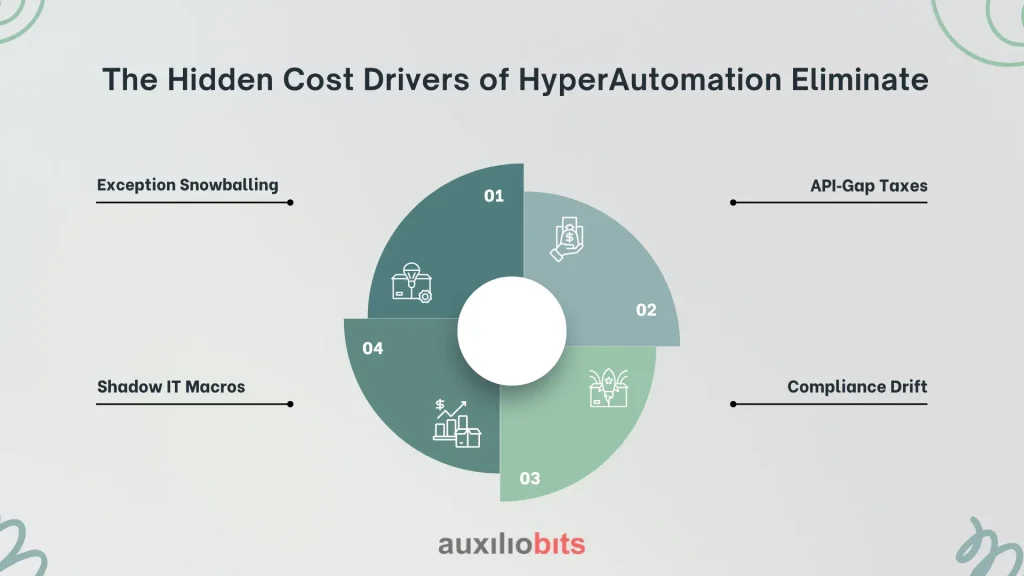
- Exception Snowballing – An invoicemismatch triggers a manual ticket; the delay forces an expedited shipment; the rush fee spawns a credit‑memo cascade. HyperAutomation inserts an ML classifier at the first anomaly, auto‑resolving 70 % of cases before they cascade.
- API‑Gap Taxes – Vendors charge premium modules for integration. Screen‑centric bots bridge non‑API systems temporarily, giving IT breathing room to prioritise strategic APIs.
- Compliance Drift – Regulations change quarterly, but hard‑coded scripts change yearly. Rule engines ingest legal bulletins and regenerate logic nightly, slashing audit findings.
- Shadow IT Macros – Finance analysts build Excel monsters that no one backs up. HyperAutomation funnels that creativity into governed low‑code components, preserving agility without risking data loss.
Eliminating these drains unlocks capacity that accountants normally attribute to “business as usual.”
Department‑by‑Department Productivity Gains
HyperAutomation isn’t a one‑hit wonder in finance or IT; it systematically removes friction wherever work happens. Here’s how that plays out across every major function:
1. Finance & Accounting
End‑to‑end invoice automation is the classic starting point, but mature finance teams push further. Event‑based bots now run a three‑way match within minutes of goods receipt, flagging price variance before it hits GL. LLM‑powered cost‑allocation agents read unstructured shipping documents and propose journal entries with confidence scores. Month‑end close shifts from a ‘black‑box freeze’ to a rolling ledger that never sleeps, cutting the close cycle from 13 days to one. Critically, the bots transact through BAPI, IDoc, and Fiori APIs—proving that deep SAP automation is possible without touching a line of custom ABAP.
2. Human Resources
Recruiters lose half their day juggling calendars and chasing incomplete paperwork. HyperAutomation swaps those chores for:
- CV parsers that normalise résumé formats into searchable JSON in under a second.
- Negotiation agents that scan interviewer calendars, propose time slots, and confirm via Teams or Gmail, eliminating fifteen back‑and‑forth emails.
- Onboarding journeys that tap identity APIs, generate role‑based access in IAM, and ship laptop orders automatically.
The result: time‑to‑hire shrinks 63 %, and new hires hit productivity targets a week earlier.
3. Supply‑Chain & Operations
Predictive maintenance was once the playground of data‑science PhDs. HyperAutomation commoditises it. Edge‑AI cameras detect lubrication anomalies; a bot opens a PM order in SAP, reserves spares, and schedules a technician before vibration passes the threshold. Plants report double‑digit OEE improvements and 30 % spare‑parts inventory reduction. When a supplier delays a component, a multi‑agent planner re‑optimises production sequences overnight, publishing new work orders by dawn.
4. Customer Service & Revenue Ops
Contact centres drown in after‑call work. Now, generative copilots summarise conversations, populate CRM, and trigger fulfilment tasks in real time. Sentiment analysis monitors tone mid‑interaction, nudging agents with dynamic scripts. Over six months, companies gain 12 NPS points and trim handle time by 28 %. Refund policies stay firm because smart escalation bots ensure exceptions are documented and pre‑approved, protecting margin without frustrating loyal customers.
5. IT & Cyber‑Resilience
Zero‑day exploits wait for no change window. HyperAutomation builds a self‑patching pipeline: vulnerability scanners publish to a queue; sandbox bots spin up canary VMs, apply patches, run smoke tests, and, if clean, deploy to prod—all without pager fatigue. Mean‑time‑to‑remediate tumbles from ten days to four hours. Meanwhile, observability agents track bot health, alerting maintainers before end‑users notice a lag.
6. Sales & Marketing
Marketing teams love data but hate plumbing. HyperAutomation stitches MAP, web analytics, and ERP price books into a unified graph. Hourly, a reinforcement‑learning model recalculates lead scores, feeding reps a ranked call list that adapts to real‑time behaviour. Campaign bots ingest competitor pricing scraped from public catalogues, proposing discount levers that safeguard gross margin. Sales engineers reclaim Fridays formerly spent reconciling CSV uploads; that’s thirty hours per week reinvested in pipeline generation.
7. Legal & Contract Management
Clause‑library intelligence offers policy‑compliant fallback text the moment a counterparty redlines. Workflows route approvals dynamically: low‑risk NDAs auto‑sign, mid‑risk SaaS deals trigger AI summaries with risk flags, and high‑risk master agreements land on a senior attorney’s desk—complete with diligence briefing—without paralegal triage. Contract cycle time plummets from three weeks to four days, and renewal notices are drafted by a bot the moment usage‑based thresholds are breached.
Key Performance Indicators You Probably Aren’t Tracking Yet
Most dashboards celebrate throughput and SLA compliance. HyperAutomation leaders focus on deeper signals:
- Autonomous Coverage Ratio (ACR) – fraction of process steps executed without human touch.
- Learning‑Cycle Half‑Life – time for a discovered optimisation to graduate from experiment to production.
- Bot‑Triggered Policy Updates – count of compliance rules drafted by AI and ratified by risk councils.
- Cognitive‑Load Index – average window‑switches per employee session; declining values indicate healthier UX.
- Resilience Yield – percentage of automated steps that self‑recover from failure within five minutes, converting downtime minutes into seconds and demonstrating how autonomous retries absorb infrastructure hiccups before users open an ITSM ticket.
These metrics discourage vanity automation and focus teams on compounding autonomy.
ROI Math: A 12‑Month Scenario
Consider a mid‑market manufacturer processing 100,000 invoices and 15,000 service tickets annually. Pre‑automation, invoice cost averaged USD 5.50, downtime 11 hours per month, and ticket resolution 36 hours. After deploying 28 bots and six AI agents:
| Metric | Before | After | Gain |
| Working‑Capital Days | 52 | 35 | +USD 11 m FCF |
| Invoice Cost | USD 5.50 | USD 1.90 | −65 % |
| Downtime | 11 h/mo | 4 h/mo | +USD 4 m capacity |
| Issue Resolution | 36 h | 9 h | +3 % retention |
The firm added USD 23 m to EBITDA—a 7× payback—paying for the programme in seven months. Intangibles compounded: voluntary attrition dropped 14 %, ESG audits passed in half the time, and the CFO’s forecast accuracy improved by eight points.
Implementation Roadmap: From Pilot to Autonomous Enterprise
Launching ten bots at once rarely works. Follow a telescoping roadmap:
- Value Telescope Workshops – align pains with OKRs; score opportunities on feasibility and impact.
- Digital Process Twin – a two‑week mining sprint produces a living BPMN model; simulation quantifies what‑ifs before code.
- Pilot with Learning Loop – pick a process that finishes within a week; embed feedback signals so the bot learns, not just executes.
- Governance Fabric – stand up source control, secrets management, unit tests, and auto‑generated documentation; auditors love it.
- Center of Enablement – coach citizen developers, publish component libraries, and enforce design patterns through templates.
- Autonomy Audits – every quarter, classify flows from Assisted (L1) to Adaptive (L4), then retire technical debt that blocks progression.
By month seven, most organisations see a volunteer queue of teams begging to onboard.
Common Myths Debunked
Despite growing awareness, many businesses still hesitate to pursue HyperAutomation because of persistent misconceptions. Let’s clear the fog by addressing some of the most common myths that stall transformation before it begins.
Myth 1: HyperAutomation is just amped‑up RPA
Reality: RPA is a widget; HyperAutomation is an ecosystem weaving discovery, analytics, AI, and execution into a closed loop.
Myth 2: You must rip out legacy systems
Reality: Screen overlays, event interceptors, and API shims let you automate around legacy until budgets allow modernisation.
Myth 3: Savings equal layoffs
Reality: Leaders redeploy capacity to new digital revenue streams; studies show headcount often rises.
Myth 4: SAP is too rigid for bots
Reality: IDocs, asynchronous RFCs, and Fiori gateways provide durable hooks. A disciplined approach to SAP automation respects change management yet removes 80 % of keystrokes.
The Future: Agentic AI, Digital Twins & Autonomous Decision‑Loops
Next‑wave HyperAutomation introduces specialised AI coworkers:
- Margin Guardian – monitors input‑cost swings, reprices offers, and notifies sales before quotes expire.
- Regulation Sentinel – scrapes fresh legislation, simulates impact in a sandbox, and drafts control updates by morning.
- Wellness Custodian – tracks cognitive load, reroutes tickets away from fatigued staff, and suggests break slots.
All agents act inside a cloud‑native digital twin—an executable replica of supply chain, finance, and workforce states. Strategies run in silico first, exposing trade‑offs before capital is committed. Early adopters report algorithmic governance balancing profitability, fairness, and sustainability without human micro‑management.
Conclusion
Cost pressure and talent scarcity force enterprises to do more with less. HyperAutomation attacks both fronts: it erases hidden friction and liberates teams to focus on innovation. Whether you begin with invoice reconciliation, predictive maintenance, or the low‑hanging fruit of SAP automation for repetitive master‑data updates, the destination is the same: a self‑optimising enterprise where productivity scales faster than headcount. Auxiliobits specialises in automating the manual steps around your existing systems—turning disconnected tasks into autonomous value streams.
Frequently Asked Questions
Q1 How long does a pilot take?
Four to eight weeks, including discovery, build, and user acceptance testing.
Q2 What skills do we need?
Process analysts to model flows, citizen developers to stitch components, and MLOps engineers to productionise AI—plus a change‑management lead to socialise wins continuously.
Q3 Will auditors accept AI‑driven controls?
Yes. HyperAutomation platforms produce immutable logs, versioned test cases, and auto‑generated risk maps, trimming audit prep time by 60 %.