







Key Takeaways
- KPI integrity determines the credibility of Sustainability-Linked Lending. Without trustworthy metrics, loan incentives tied to sustainability performance lose their meaning.
- AI agents enable continuous monitoring of sustainability KPIs. Instead of relying on annual ESG reporting cycles, organizations can validate performance signals in near real time.
- Data context matters as much as the data itself. AI agents help reconcile sustainability metrics with operational signals like production levels, equipment usage, and supply chain disruptions.
- Lenders increasingly rely on automated oversight. Continuous verification reduces reputation risk, regulatory scrutiny, and uncertainty around sustainability-linked loan portfolios.
- Better KPI monitoring often uncovers operational inefficiencies. Companies frequently discover energy waste, water loss, or reporting inconsistencies once sustainability data is monitored continuously.
Sustainability-Linked Lending (SLL) has grown quickly over the past few years. Banks like HSBC, BNP Paribas, and ING Group have all expanded portfolios tied to sustainability performance targets. Corporates increasingly prefer these facilities because the structure is flexible—borrowers are not required to finance a specific green project. Instead, loan pricing adjusts depending on whether the borrower achieves defined sustainability KPIs.
In theory, such an arrangement creates a powerful incentive: perform better on environmental or social targets, and financing becomes cheaper.
In practice, things are messier.
The credibility of sustainability-linked lending depends almost entirely on KPI integrity. If the metrics are poorly defined, manipulated, delayed, or unverifiable, the entire mechanism collapses, resulting in what critics often call “greenwashing with spreadsheets.”
And that’s exactly where AI agents are beginning to change the equation.
Not because they magically make sustainability They don’t. But they dramatically improve the continuous verification, monitoring, and contextual analysis required to keep these financial instruments trustworthy.
The Structural Problem in Sustainability-Linked Lending
Most sustainability-linked lending ai conversations focus on automation or reporting efficiency. That’s not the real issue.
The real problem is data credibility across complex operational environments.
Consider a typical SLL structure. A manufacturing borrower might commit to targets such as:
- Reducing Scope 1 and Scope 2 emissions by 30% within five years
- Increasing renewable energy consumption to 50%
- Improving water efficiency across plants
- Reducing workplace incidents
These are reasonable goals. But they depend on dozens—sometimes hundreds—of underlying operational signals.
Where do those numbers actually come from?
Often from fragmented systems:
- Energy monitoring platforms
- ERP modules
- ESG reporting tools
- supplier disclosures
- plant-level spreadsheets (still surprisingly common)
Now imagine a global manufacturer with facilities across India, Vietnam, and Mexico.
Each site measures energy slightly differently. Emissions conversion factors vary. Reporting timelines don’t align. One plant upgrades equipment mid-year, and suddenly its data structure changes.
By the time the sustainability KPI reaches the lending bank, it has passed through multiple transformations. The number may technically be correct. But the traceability of how it was derived is often weak.
This is the truth many lenders quietly acknowledge.
Why KPI Integrity Is the Core Risk
Sustainability-linked loans rely on Key Performance Indicators (KPIs) that determine whether loan margins increase or decrease.
These KPIs must satisfy three conditions:
- Material to the borrower’s operations
- Measurable and verifiable
- Difficult to manipulate
Meeting all three consistently is harder than it sounds.
Take carbon intensity metrics as an example. If a company expands production, total emissions may rise even while intensity improves. Should that count as success?
Or consider renewable energy targets. Does purchasing renewable certificates qualify? Some frameworks say yes, others don’t.
Even well-intentioned borrowers struggle with interpretation.
And lenders face another problem: verification lag.
Many SLL agreements rely on annual reporting cycles reviewed by third-party auditors such as KPMG or PwC.
That means the KPI adjustment affecting loan pricing might depend on data that is:
- 12 months old
- manually aggregated
- verified retrospectively
In a world where financial risk models operate in near real-time, the approach feels… oddly outdated.
Also read: From Reactive Support to Predictive Service Operations
The Role AI Agents Are Starting to Play
AI agents in sustainability-linked lending ai environments do something subtle but powerful.
They act as persistent observers across data ecosystems. Not a single dashboard. Not a one-time automation script. A network of intelligent agents continuously monitors KPI inputs.
Imagine a typical deployment scenario. One agent monitors energy data ingestion from industrial IoT sensors. Another cross-checks emissions conversion factors against updated regulatory frameworks. A third watches for abnormal variance across facilities.
If a plant suddenly reports a 25% drop in emissions without corresponding operational changes, the system doesn’t quietly accept the number.
It asks questions. Sometimes it happens automatically, and at other times it is triggered by review workflows. That alone significantly improves KPI integrity.
Continuous KPI Verification Instead of Annual Validation
Traditional ESG reporting operates in periodic snapshots. AI agents introduce continuous validation loops.
What does that look like in practice?
- Monitoring real-time energy consumption patterns
- Flagging missing or inconsistent environmental data
- Reconciling operational signals against sustainability targets
- Triggering alerts when KPIs drift from expected ranges
A global manufacturer we worked with—let’s call them “Atlas Materials”—ran into exactly this problem. Their sustainability-linked loan tied pricing adjustments to water intensity reductions across production plants. The KPI itself was reasonable. The data infrastructure was not.
Half their plants measured water consumption hourly. Others reported monthly totals. A few relied on manual meter readings. AI agents were introduced primarily to standardize monitoring logic. What happened next was interesting. The system discovered that several facilities were reporting improvements that were actually measurement artifacts—not operational gains.
Without continuous monitoring, the company would have reported incorrect KPI progress to its lenders. And the lenders likely wouldn’t have noticed.
The Hidden Value: Contextual Data Reconciliation
KPI integrity problems rarely arise from deliberate manipulation. Most come from context loss.
Data without operational context can be misleading.
For example: A factory installs new energy-efficient equipment. Electricity usage drops. Emissions KPI improves.
Good news, right? Except production output also fell during the same period because demand slowed. The improvement is real but misleading if interpreted incorrectly.
AI agents can reconcile these signals by correlating sustainability data with operational datasets such as:
- production volumes
- equipment utilization
- supply chain disruptions
- maintenance events
Instead of simply tracking “emissions per unit”, the system understands why emissions changed. That distinction matters in sustainability-linked lending ai structures where KPI performance influences financial outcomes.
Detecting KPI Drift Before It Becomes a Compliance Issue
There’s another dynamic lenders increasingly worry about: KPI drift.
This happens when a borrower initially sets ambitious sustainability targets but gradually shifts operational assumptions to make them easier to achieve.
Sometimes the shift is subtle.
- baseline adjustments
- methodology updates
- boundary changes in emissions reporting
None of these are necessarily fraudulent. But they can erode the intent of sustainability-linked financing.
AI agents can detect drift patterns by comparing KPI methodologies against historical structures and external frameworks such as the standards defined by the International Capital Market Association.
If the calculation method changes significantly year-to-year, the system flags it.
That kind of oversight used to require extensive manual review.
Now it happens continuously.
Real-Time Sustainability Monitoring Across Global Operations
Global companies rarely operate in uniform regulatory environments.
Emissions reporting rules differ across regions. Water standards vary. Renewable energy definitions are inconsistent. This complicates sustainability-linked lending AI implementations.
An AI agent monitoring sustainability KPIs must understand regulatory context.
For instance:
- European emissions frameworks referencing European Environment Agency guidelines
- regional renewable definitions in India
- evolving disclosure requirements influenced by the Task Force on Climate-related Financial Disclosures
Agents trained on regulatory datasets can adjust KPI validation rules automatically when frameworks change.
Otherwise, companies face a constant risk of reporting metrics that are technically correct but non-compliant with evolving sustainability standards.
Where AI Agents Actually Fail
There’s a tendency to portray AI agents as flawless governance tools.
Reality check: they are not. Several failure modes appear in early deployments.
First, data quality limits everything. If IoT sensors are unreliable or reporting gaps exist, AI systems cannot magically correct the underlying signal.
Second, organizational resistance slows adoption. Operational teams sometimes view sustainability monitoring as external oversight rather than operational improvement. That cultural friction matters more than the technology.
Third, agents occasionally produce false anomaly alerts. For example, seasonal production cycles might appear as sustainability KPI volatility. Without proper contextual modeling, the system flags normal operations as risks.
Early implementations often go through months of tuning before stabilizing. But despite these imperfections, the overall impact on KPI reliability is significant.
The Banking Perspective: Why Lenders Care
From a lender’s perspective, sustainability-linked lending ai capabilities reduce three major risks.
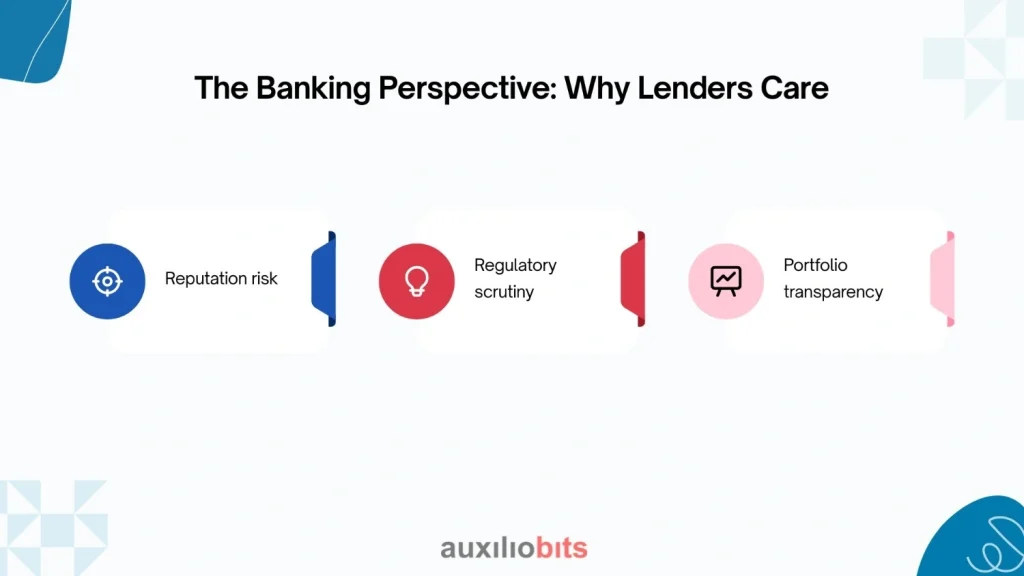
1. Reputation risk
If a high-profile borrower fails sustainability commitments but continues receiving favorable loan pricing, the lender faces scrutiny.
Banks like Standard Chartered and Citi have learned this lesson the hard way in public debates around ESG credibility.
2. Regulatory scrutiny
Financial regulators increasingly examine whether sustainability-linked instruments genuinely drive environmental outcomes.
Weak KPI verification could eventually lead to regulatory penalties.
3. Portfolio transparency
Banks managing large sustainability-linked portfolios need aggregated insight into borrower performance.
AI agents provide structured KPI monitoring across multiple borrowers simultaneously. Not perfectly—but far more efficiently than manual ESG reporting.
The Operational Benefits Borrowers Often Don’t Expect
Borrowers sometimes approach sustainability-linked lending purely as a financing strategy.
Once AI agents begin monitoring sustainability KPIs continuously, companies often discover operational insights they weren’t expecting.
For example:
- Facilities consuming energy inefficiently during off-peak production windows
- Water leakage patterns detectable through anomaly detection
- Suppliers with inconsistent emissions reporting
These discoveries don’t just help satisfy loan covenants. They reduce operating costs. Which, ironically, is often a stronger incentive than sustainability commitments alone.
Why KPI Integrity Will Define the Next Phase of SLL Growth
The growth trajectory of sustainability-linked lending depends less on loan volume and more on credibility.
If investors begin to question whether KPIs genuinely reflect sustainability progress, the entire structure weakens. AI agents won’t solve sustainability measurement challenges entirely.
But they do introduce something that the market has lacked for years: continuous accountability.
Instead of trusting annual ESG disclosures, lenders and borrowers can monitor sustainability performance as an ongoing operational signal. That changes the relationship between finance and environmental performance.
Quietly, but fundamentally. And in the world of sustainability linked lending AI, KPI integrity is the foundation everything else depends on.
Not reporting sophistication and marketing narratives.
Just reliable data, consistently verified.