






Key Takeaways
- Variability is more damaging than slow execution. Predictable timelines improve planning, inventory efficiency, and operational reliability—even if average speed remains similar.
- Most delays originate from coordination gaps, not structural limitations. Approvals, handoffs, and communication timing introduce far more variability than physical constraints.
- Predictive adjustment prevents delays before they fully develop. Agentic systems act on early trajectory signals rather than waiting for execution failure.
- Stability improves progressively as agentic systems learn execution patterns. Predictive accuracy strengthens over time, leading to sustained operational consistency.5. The real benefit is execution stability, not just automation speed. Agentic AI enables controlled, predictable operations by continuously correcting execution drift
Most operations leaders obsess over average lead time. They track it weekly. They present it in reviews. They celebrate when it drops. But average lead time is a misleading metric.
What actually breaks operations isn’t the average. It’s the spread. If a procurement cycle averages 8 days but randomly takes anywhere between 5 and 16, planning becomes guesswork. Production buffers grow. Expedites increase. Customer commitments become riskier than they appear on paper.
Variability—not duration—is the real operational tax. Agentic AI doesn’t just make processes faster. In many cases, speed improvement is modest. What it does far more effectively is compress variability. It narrows the band between best-case and worst-case execution by continuously making predictive adjustments while work is still in motion.
That distinction is easy to miss unless you’ve spent time inside real execution environments.
Also read: AI Agents for Critical Parts Inventory Monitoring
Variability Doesn’t Come From Where Most People Think
When teams investigate lead time instability, they often blame structural constraints first. Supplier capacity. System limitations. Staffing levels.
Sometimes those are real issues. Often they’re not. More commonly, variability emerges from micro-coordination failures.
Approvals sit idle because someone is in meetings all afternoon. A supplier receives a PO but delays acknowledgement because their internal planner hasn’t reviewed demand yet. Production waits three hours for material that was technically “available” but not staged. None of these events trigger alerts immediately. They exist in a grey zone—visible, but not urgent enough to force intervention. Humans notice them late. By the time someone steps in, variability is already baked into the cycle. Agentic systems operate earlier—while these signals are still weak.
The Operational Reality: Most Delays Start Small
Delays usually start as slowdowns. They begin as slight slowdowns. A requisition that normally gets approved in four hours takes six. Not alarming. Just slower.
But those extra two hours push supplier acknowledgement to the next working day. That pushes confirmation. That shifts material arrival. Now production reschedules. The schedule change creates downstream adjustments.
One small slowdown propagates across multiple systems. Traditional automation doesn’t intervene here. It executes defined steps. It doesn’t question timing drift.
Agentic systems do. They track trajectory, not just milestones. There’s an important nuance in that difference.
Predictive Adjustment Means Acting on Direction, Not Just State
Most enterprise systems operate based on state. What has happened? What is complete? What is pending?
Agentic AI pays attention to direction. Is something trending toward delay—even if it isn’t late yet?
That’s the key question. For example, suppose an approval has been pending for two hours. That’s normal. No action required.
But suppose the system also knows that:
- The approver has 47 pending approvals today
- Their average response time increases sharply beyond 30 daily approvals
- It’s already mid-afternoon
Now the trajectory changes.
The approval isn’t late yet. But it’s trending toward becoming late. Agentic intervention may reroute approval to an alternate authorized reviewer or escalate earlier than a static rule would allow.
This prevents variability from forming in the first place. Not perfectly. However, it occurs often enough to significantly stabilize execution.
This Is Where Most Planning Systems Fall Short
ERP systems are excellent record keepers. MES platforms capture detailed production telemetry. Workflow tools enforce structure. But none of them were designed to continuously adjust execution pathways autonomously. They assume humans will intervene. The problem is humans intervene inconsistently. Sometimes immediately. Sometimes hours later. Sometimes not at all. It depends on workload, visibility, experience, and attention. Agentic systems eliminate that inconsistency. They don’t get distracted. They don’t forget to follow up. They don’t wait for someone to notice emerging drift. They continuously intervene based on predictive signals. This action alone significantly reduces execution spread.
A Procurement Case That Illustrates the Point Clearly
One manufacturer had a strange procurement pattern. Average lead time was reasonable—about 10 days. But the variability was painful. Some orders were completed in 6 days. Others stretched to nearly 18. Planning teams didn’t trust procurement timelines. They added safety stock to compensate. Inventory costs rose steadily over two years. Upon examining the workflow, we found no obvious breaks. Approvals existed. Supplier contracts were in place. Systems were digitized. The instability came from inconsistent approval timing and inconsistent supplier acknowledgment behavior. Agentic monitoring introduced two types of predictive adjustments:
- Early escalation when approval delay probability increased—not when delay occurred, but when it became likely
- Supplier follow-ups are triggered based on predicted acknowledgement delay patterns rather than fixed reminder intervals.
The results weren’t dramatic overnight. But within a quarter, the lead time spread narrowed significantly. Orders usually take more than 6 days now, but they also take less than 18. They were consistently completed within a tighter 9- to 12- day band. Planning accuracy improved immediately. That’s the kind of improvement operations teams actually feel.
Stability Changes Planning Behavior More Than Speed Does
Predictable execution enables leaner planning. Unpredictable execution forces defensive planning. There’s no middle ground. When timelines stabilize, planners reduce buffers. Inventory drops. Expedites decline. Confidence increases. Teams stop building contingency layers everywhere. Agentic AI contributes here by removing hidden instability drivers. This is achieved not by enforcing rigid execution, but by continuously nudging workflows back towards expected trajectories.
Production Scheduling Becomes Much More Stable
Production environments benefit heavily from predictive adjustment.
Minor disruptions occur constantly:
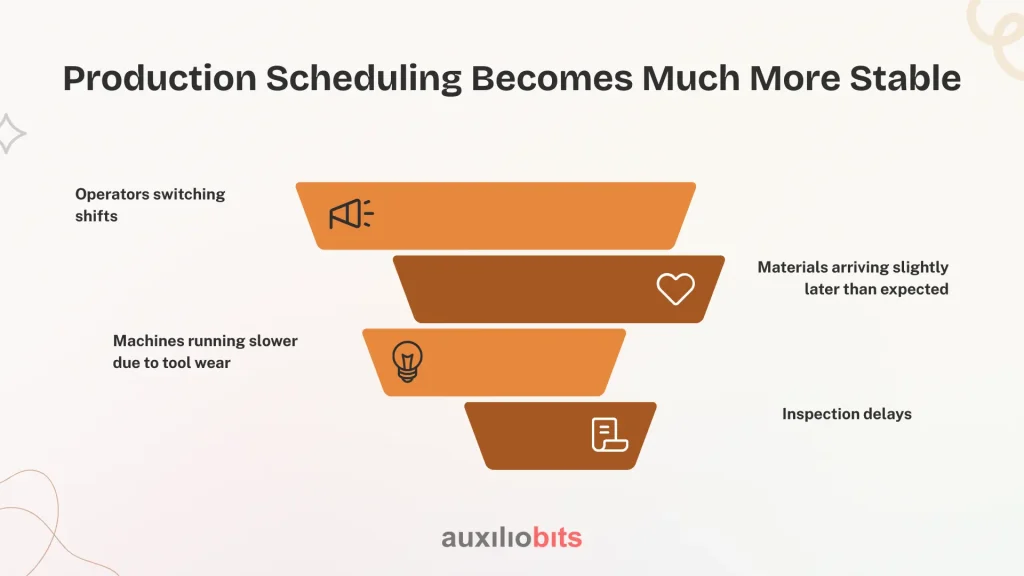
- Operators switching shifts
- Materials arriving slightly later than expected
- Machines running slower due to tool wear
- Inspection delays
These rarely halt production completely. They alter flow rates. Without intervention, flow rate changes propagate downstream. Agentic systems detect throughput drift early.
Then make adjustments such as:
- Reordering production sequences
- Prioritizing jobs at risk of delay
- Triggering earlier material staging
- Adjusting downstream scheduling expectations
These interventions are subtle. Most operators don’t even realize they’re happening. But the cumulative effect is significant. Production timelines stop fluctuating as wildly.
Supplier Coordination Improves When Follow-Up Timing Becomes Intelligent
Supplier responsiveness is notoriously inconsistent. This is not due to the unreliability of suppliers but rather to the variability of their internal workload. Traditional follow-ups happen on fixed schedules. The follow-ups typically take place two days after the dispatch of a purchase order. The process repeats itself after a period of five days. Agentic follow-ups occur based on predicted responsiveness behavior. Some suppliers need reminders earlier. Others don’t. Agentic systems learn these patterns over time. They intervene selectively, not uniformly. This reduces unnecessary noise while improving response consistency. Suppliers often perceive these interactions as more reasonable—not more aggressive. Interestingly, supplier relationships often improve rather than degrade.
Human Teams Already Do This—But Inconsistently
Experienced operations professionals intuitively anticipate delays. They follow up early. They reroute work. They intervene when something feels off. Agentic systems replicate this anticipatory behavior at scale. They apply it across thousands of concurrent workflows simultaneously. Humans cannot do that consistently. This limitation is not due to a lack of skill but rather a lack of bandwidth. Agentic systems don’t replace human judgment. They extend it. They handle the detection layer continuously. Humans handle exceptions and strategy. That division works well in practice.
Predictive Adjustment Is Most Effective in Coordination-Heavy Processes
Not all variability is reducible.
Agentic systems cannot prevent:
- Supplier raw material shortages
- Physical equipment breakdowns
- Regulatory delays
But many delays aren’t physical constraints. They’re coordination constraints. Approvals. Handoffs. Scheduling alignment. Communication timing. These are highly adjustable. Agentic intervention reduces variability most effectively here. Coincidentally, this is where the majority of enterprise variability stems from.
Agentic Systems Improve Gradually
Initial disappointment may occur for organizations expecting instant stability. Predictive accuracy improves with observation. Early intervention effectiveness is modest. After observing several execution cycles, patterns emerge clearly. Interventions become more precise. Variability reduction accelerates. Operational stability improves progressively—not instantly. This gradual improvement is normal. And honestly, it’s preferable. Abrupt intervention changes can disrupt workflows unnecessarily.
The Real Value Is Trajectory Control, Not Task Automation
Traditional automation focuses on completing tasks faster. Agentic systems focus on controlling execution trajectory. They prevent drift. They stabilize flow. They maintain operational momentum. This procedure is a fundamentally different approach. It doesn’t eliminate variability entirely. That would be unrealistic. But it reduces its amplitude significantly. Lead times stop swinging unpredictably. Planning becomes more reliable. Operations become more controllable. It’s not because humans intervene more, but rather because systems intervene earlier. And timing, in operations, is often the difference between stability and chaos.