






Key Takeaways
- Audit readiness depends on evidence quality, not just defined controls
- Agentic AI captures and structures evidence in real time, not post-process
- Cross-system traceability is essential for audit automation in manufacturing
- Handling exceptions properly is what separates strong vs weak audit trails
- Evidence automation turns audit readiness into a continuous state, not an event
Audit readiness is one of those things that every manufacturing organization claims to have under control—right up until the auditors show up.
On paper, everything looks structured. ERP systems are in place. Policies are documented. Controls are defined. And yet, when audit season begins, teams scramble. Emails get dug up. Screenshots are taken as proof. Someone from finance is chasing procurement for a missing approval trail. IT is asked to pull logs they didn’t know would be needed.
The gap isn’t compliance. It’s evidence.
And that’s exactly where audit readiness AI—specifically in the form of agentic systems—is starting to shift the equation. Not by replacing audits or auditors, but by fundamentally changing how audit evidence is generated, tracked, and validated.
The Reality of Audit Readiness in Manufacturing
If you’ve spent time inside a manufacturing finance or compliance team, you already know the truth: audit readiness is less about controls and more about proving those controls happened.
Take a simple example—vendor onboarding.
- The process exists (often well-defined)
- ERP entries are made
- Approvals are supposedly captured
But when auditors ask the following:
- “Show me who approved this vendor.”
- “Was due diligence completed before activation?”
- “Where is the timestamped evidence?”
That’s where things get messy.
Because the evidence is the following:
- Scattered across emails, shared drives, ERP logs
- Sometimes manual (Excel trackers, PDFs)
- Occasionally reconstructed after the fact (which auditors hate)
This represents the core inefficiency in audit automation within manufacturing environments. The system records transactions, but the story behind the transaction—the evidence trail—is fragmented.
Also read: How AI Agents Deliver a 360° Customer View in Manufacturing
Why Traditional Audit Automation Falls Short
Many organizations believe they’ve already “automated” audits.
They have:
- Workflow systems
- Rule-based alerts
- Periodic compliance reports
But here’s the truth: most of these systems automate monitoring, not evidence creation.
There’s a difference. Monitoring tells you something went wrong (or right). Evidence proves how and why it happened.
And traditional automation struggles with this because the following
- It depends on structured inputs
If someone bypasses a workflow or uses email instead, the system loses visibility.
- It’s reactive by design
Reports are generated after transactions occur, not during.
- Context is missing
A log entry might show “approved” but doesn’t capture supporting documents, reasoning, or exceptions.
- Human dependency remains high
Teams still compile audit evidence manually—especially for edge cases.
So even with automation in place, audit readiness remains a periodic firefighting exercise.
Agentic AI: A Different Approach to Evidence
Agentic AI doesn’t just automate tasks—it operates with intent.
Instead of waiting for humans to
- Attach documents
- Log approvals
- Maintain audit trails
Agentic systems actively orchestrate evidence collection as processes unfold. Think of it less like a workflow engine and more like a persistent digital auditor embedded within operations.
Here’s what that looks like in practice:
1. Continuous Evidence Capture
An AI agent monitoring a procurement workflow doesn’t just check if approvals happen. It:
- Captures the approval artifact (email, system log, digital signature)
- Links it to the transaction
- Validates whether the approval meets policy conditions
No one needs to “prepare” for an audit later—the evidence is already structured. And importantly, it’s captured in context.
2. Multi-System Correlation
Manufacturing environments are messy. A single transaction might involve:
- ERP systems (SAP, Oracle)
- Email approvals
- Supplier portals
- Document management systems
Agentic AI bridges these silos.
Instead of relying on a single system of record, it:
- Pulls data across systems
- Matches entities (vendor IDs, invoice numbers, timestamps)
- Builds a unified evidence trail
This area is where traditional automation usually breaks—it wasn’t designed for cross-system reasoning.
3. Exception-Aware Evidence Handling
Not all processes follow the “happy path.”
A successful audit doesn’t just verify standard cases—it focuses on exceptions.
Agentic systems handle such cases better because they:
- Detect deviations in real time
- Capture additional context when exceptions occur
- Flag incomplete or weak evidence proactively
For example: If a payment is approved outside the standard workflow, the agent doesn’t just log it—it asks the following:
- Was there a valid override reason?
- Is there supporting documentation?
- Does this align with policy thresholds?
That level of nuance is difficult to achieve with rule-based systems alone.
Evidence Automation: The Real Value Layer
Most discussions around AI in audits focus on analytics—fraud detection, anomaly detection, and predictive insights.
Useful? Absolutely. But the real bottleneck in audit readiness isn’t insight. It’s documentation.
Evidence automation changes that by ensuring:
- Every control has a traceable proof
- Every transaction is audit-ready by default
- Every exception is documented with context
And it does so without adding more work for teams.
That last part matters.
Because if your “automation” requires users to:
- Upload more files
- Fill additional forms
- Follow stricter workflows
…it won’t scale. People will find ways around it. Agentic AI works because it reduces friction, not increases it.
A Practical Use Case: GR/IR Reconciliation
Let’s take something closer to manufacturing finance—GR/IR (Goods Receipt / Invoice Receipt) reconciliation.
This process is notoriously audit-sensitive.
Auditors typically ask:
- Was the goods receipt matched with the invoice?
- Were discrepancies resolved properly?
- Who approved the adjustments?
In a traditional setup:
- Data sits in ERP
- Adjustments may involve emails or offline discussions
- Evidence is manually compiled during audits
With agentic AI:
- The agent monitors GR/IR mismatches as they occur
- Captures resolution steps (system updates, approvals, comments)
- Links all artifacts to the transaction
- Flags cases where evidence is incomplete
So when auditors review the process, they don’t see a reconstructed story—they see a live, verifiable trail.
Where Agentic AI Struggles
It’s tempting to present this as a silver bullet. It isn’t. There are real challenges.
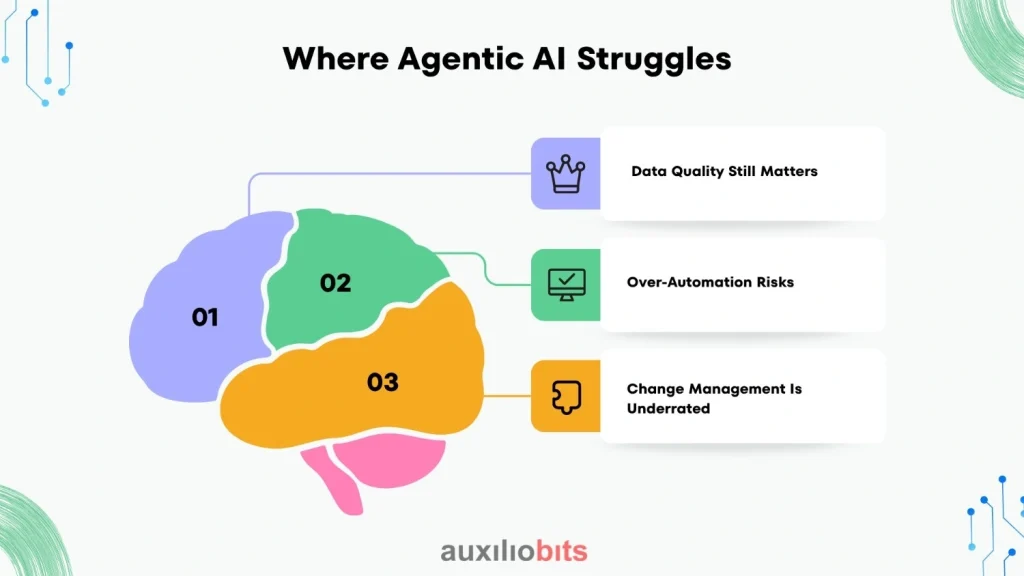
1. Data Quality Still Matters
If your underlying systems are inconsistent, AI won’t magically fix that. It might even amplify confusion.
2. Over-Automation Risks
Not every piece of evidence needs to be captured. Excessive data collection can:
- Slow down systems
- Create noise for the auditors.
- Increase storage and compliance overhead
3. Change Management Is Underrated
Teams are used to “preparing for audits.” Shifting to continuous audit readiness requires a mindset change.
Some resistance is inevitable:
- “Why is the system tracking this?”
- “Do we really need this level of detail?”
Fair questions, honestly.
What Works (From Real Implementations)
Across manufacturing clients, a few patterns consistently deliver results:
1. Start with High-Risk Processes
Don’t try to automate everything.
Focus on areas like:
- Vendor onboarding
- Invoice approvals
- Payment processing
- Inventory adjustments
These are audit-heavy and evidence-sensitive.
2. Design for Auditors, Not Just Operators
A lot of automation is built for process efficiency.
Audit readiness requires thinking differently:
- Can an external auditor understand this trail?
- Is the evidence self-explanatory?
- Are exceptions clearly documented?
If not, the system isn’t doing its job.
3. Blend AI with RPA (Not Replace It)
RPA still plays a role:
- Extracting data
- Triggering workflows
- Integrating systems
Agentic AI sits on top, adding the following:
- Context
- reasoning
- evidence orchestration
The combination is far more effective than either alone.
The Shift: From Audit Preparation to Audit Design
This is where things get interesting. Organizations using audit-readiness AI aren’t just improving audits—they’re redesigning how processes are audited.
Instead of asking, “How do we prepare for audits?” They start asking: “How do we design processes that are always audit-ready?” It’s a subtle shift, but it changes everything.
Because once evidence is embedded in operations:
- Audit cycles become shorter
- Compliance risk decreases
- Internal teams spend less time on manual documentation
And perhaps most importantly, audits become less adversarial.
A Note on Manufacturing Complexity
Manufacturing isn’t like other industries.
You’re dealing with:
- High transaction volumes
- Complex supply chains
- Multiple systems and stakeholders
Which means audit readiness isn’t just a finance problem. It’s operational. Agentic AI works well here because it doesn’t rely on a single system or team. It operates across the ecosystem.
That said, implementation needs to be pragmatic. Trying to enforce perfect traceability across every process will fail. The goal isn’t perfection—it’s sufficient, reliable evidence where it matters most.
Where This Is Heading
There’s a quiet shift happening in how audits are approached.
Auditors themselves are starting to expect the following:
- Real-time access to evidence
- System-generated audit trails
- Reduced reliance on manual documentation
In some cases, they trust system-generated evidence more than human-prepared reports. That may sound surprising, but it makes sense—systems are harder to “massage”.
Agentic AI aligns well with this direction.
Not because it’s trendy, but because it solves a very specific, very persistent problem: the gap between process execution and proof.
Final Thought
If you strip away the buzzwords, audit readiness comes down to one question: Can you prove what happened—clearly, completely, and without scrambling?
Most organizations can eventually answer “yes” after weeks of effort.
Agentic AI changes the timeline. It makes that answer available instantly—or at least close enough that audits stop feeling like a separate event altogether.
And once that happens, something interesting follows: Audit readiness stops being a compliance requirement. It becomes a byproduct of well-designed operations.
That’s a different mindset. And frankly, a more sustainable one.