

Key Takeaways
- Agentic AI scales operational capacity before it reduces headcount The earliest and most reliable gains show up in throughput, stability, and responsiveness—not payroll reduction.
- The real ROI is in eliminated waiting, not eliminated roles Removing manual queues, follow-ups, and exceptions unlocks productivity that traditional FTE metrics fail to capture.
- Virtual workforces succeed where volume, exceptions, and system fragmentation coexist. Manufacturing operations offer the exact conditions where agentic systems outperform traditional automation.
- Governance matters more than intelligence. Without clear ownership, rules, and escalation paths, agents don’t fail quietly—they fail faster.
- The best manufacturers don’t ask who to replace—they ask what work should never exist. Agentic AI shifts the conversation from cost cutting to operational maturity, where scale becomes manageable rather than painful.
Manufacturing leaders usually wake up thinking, “How can we do more with the team we have?” What they usually think is something closer to: “Why does this still take so many people?”
Order backlogs increase, customer expectations become more stringent, and compliance overhead increases—all while the headcount chart remains stagnant. In many firms, it already has. The quiet reality is that manufacturing has been running a “do more with the same” experiment for over a decade. Agentic AI is not the start of that experiment. It’s the first time it might actually work at scale.
This isn’t just another automation narrative about human replacement or cost reduction through brute force efficiency. It’s about building a virtual workforce—one that expands operational capacity without expanding payroll, floor space, or management overhead. And it forces a more uncomfortable conversation: are we actually saving FTEs, or are we finally unlocking productivity that headcount metrics never captured well in the first place?
The Virtual Workforce: More Than Just a Concept
In manufacturing, the use of metaphors can often lead to misunderstandings. For instance, when leaders hear the term “digital worker,” their initial mental model often defaults to an RPA bot that merely clicks through screens or a dashboard that issues ignored alerts. Agentic AI, however, fundamentally reshapes this conventional mental model.
A virtual workforce is not a collection of scripts. It behaves more like a junior operations team that:
- Knows its scope
- Operates continuously
- Coordinates across systems
- Escalates only when judgment or accountability is needed
These agents don’t just execute steps; they own outcomes within narrow but meaningful boundaries.
Consider a mid-sized automotive supplier managing thousands of supplier invoices across plants. Before agentic systems, the process looked roughly like this:
- Clerks reconcile invoices against POs
- Exceptions are emailed to procurement
- Follow-ups happen when someone remembers
- Month-end becomes a mild emergency
After introducing agentic invoice-resolution agents, the process didn’t eliminate finance roles. It removed the waiting. Agents:
- Monitored invoice ingestion continuously
- Checked tolerance thresholds dynamically
- Contacted suppliers automatically when data mismatched
- Logged clean exceptions for human approval
The result wasn’t fewer finance employees. It was finance employees who stopped spending mornings chasing missing PDFs and started focusing on vendor negotiations and cash forecasting. Headcount stayed the same. Throughput didn’t.
That distinction matters.
Also read: Using Agentic AI for Dynamic Pricing and Repricing in Logistics
FTE Savings vs. Productivity Gains: A Subtle but Critical Difference
Many AI business cases collapse under their own ambition because they promise FTE reduction as the primary ROI lever. Manufacturing, especially, is skeptical of that framing—and for good reason.
FTE savings imply:
- Roles disappear
- Costs are removed
- Organizational structures shrink
Productivity gains imply something less tidy:
- The same roles handle more volume
- Bottlenecks move (sometimes uncomfortably)
- Performance metrics must change
Agentic AI tends to deliver the second long before it delivers the first.
This creates an awkward accounting problem. If a planning team processes 2× the number of change orders with the same staff, where does that show up? Not in payroll. Not immediately in EBIT. It shows up in:
- Faster response times
- Lower expediting costs
- Fewer line stoppages
- Better OTIF metrics
These are second-order effects. CFOs notice them eventually. COOs feel them almost immediately.
There’s also a political nuance. Declaring “we saved 20 FTEs” tends to trigger defensive behavior. Declaring “we eliminated three weeks of manual backlog every month” tends to trigger curiosity. Same underlying capability. Very different reception.
Where Agentic AI Fits in Manufacturing Operations
Agentic systems work best in environments with:
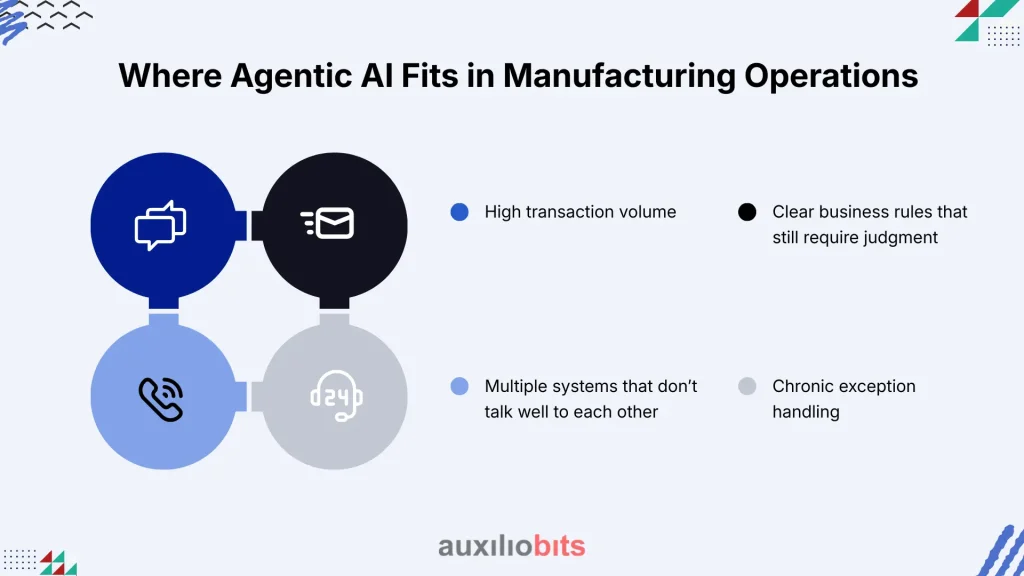
- High transaction volume
- Clear business rules that still require judgment
- Multiple systems that don’t talk well to each other
- Chronic exception handling
Manufacturing checks all four boxes more often than leaders admit.
Common Virtual Workforce Roles Emerging Today
Not all agents look impressive on architecture diagrams, but they earn their keep quietly.
Production planning agents
- Monitor demand signals across ERP, MES, and customer portals
- Simulate schedule adjustments when constraints shift
- Flag feasible vs. risky plan changes before humans intervene
Procurement coordination agents
- Track supplier confirmations
- Detect pattern-based delivery risks (not just late dates)
- Initiate renegotiation workflows when conditions drift
Quality documentation agents
- Assemble audit trails continuously
- Validate compliance artifacts before audits, not during
- Reduce the ritual panic before customer or regulatory reviews
Order management agents
- Handle change requests
- Assess downstream impact automatically
- Approve low-risk changes without human routing
Notice what’s missing: fully autonomous decision-making in safety-critical contexts. That’s deliberate. Agentic AI scales work, not liability.
Why Virtual Workforces Scale Better Than Human Ones
It’s tempting to say agents scale infinitely. They don’t. They scale differently.
Humans scale linearly and expensively:
- Hiring takes months
- Training takes longer
- Context-switching degrades performance
Agentic systems scale operationally:
- More volume doesn’t mean more onboarding
- Peak loads don’t require overtime
- Consistency doesn’t fatigue
But there are real limits.
Agents struggle when:
- Processes are politically ambiguous
- Data semantics are unstable
- Accountability is unclear
A virtual workforce will happily execute a bad policy at scale if governance is sloppy. Humans, for all their inefficiency, sometimes act as circuit breakers. Remove that without redesigning controls, and you don’t get efficiency—you get faster failure.
This is why mature manufacturers deploy agents inside guardrails, not as replacements for governance.
The Quiet Impact on Middle Management
One side effect that rarely makes it into glossy presentations: agentic AI changes the role of middle managers.
When agents take over:
- Task assignment
- Progress tracking
- Routine escalation
Managers stop being traffic controllers. Some adapt quickly. Others don’t.
In one electronics manufacturer, supervisors initially resisted production agents that auto-adjusted shift priorities. This resistance wasn’t due to the system’s inaccuracy, but rather because it rendered previously invisible tasks suddenly visible. Decisions that used to happen informally are now logged, timestamped, and explained.
That discomfort fades when leaders realize something important: fewer fire drills mean more time for actual leadership. This includes activities such as coaching, implementing improvement initiatives, and fostering relationships with suppliers. These are the aspects of management that people profess to love but seldom find the time for.
Measuring Value Without Lying to Yourself
Agentic AI programs fail quietly when success metrics are dishonest.
If you measure only:
- Cost takeout
- Headcount reduction
- License consolidation
You’ll miss most of the value—and eventually question whether it exists.
Better indicators include:
- Cycle time compression across functions
- Reduction in manual exception queues
- Stability of output under volume spikes
- Decrease in escalations per transaction
One packaging manufacturer discovered that after deploying agentic order handling, their customer service headcount stayed flat—but customer complaints dropped by 18%. That doesn’t fit neatly into an FTE model. It fits perfectly into an operational one.
Virtual Workforces and the Myth of “Set and Forget”
There’s an assumption that once agents are deployed, they quietly hum along. In reality, they require stewardship.
Agents learn patterns. Manufacturing patterns change.
- New suppliers behave differently
- Product mixes shift
- Regulatory interpretations evolve
The organizations that succeed treat agent tuning the way they treat process engineering: ongoing, boring, essential. Not glamorous. Not optional.
This is also where many early pilots stall. Leaders expect intelligence to self-correct endlessly. It doesn’t. It amplifies what you reinforce.
When FTE Reduction Does Happen
There are cases where headcount reduction follows agentic adoption. But it’s usually indirect.
For example:
- A plant consolidates two planning teams after standardizing workflows through agents
- Shared service centers absorb volume growth without expanding
- Seasonal staffing becomes unnecessary
The difference is intent. These reductions happen after stability, not before. And they often come from consolidation rather than replacement.
Framing this honestly builds trust. Overpromising savings destroys it.
The Last Thoughts
Scaling without adding headcount doesn’t mean freezing people in place. It means:
- Removing work that never should have required humans
- Letting expertise compound instead of being diluted
- Designing systems that absorb growth quietly
Agentic AI enables that by acting less like a tool and more like a capacity layer. One that doesn’t show up on org charts but reshapes them anyway.
The manufacturers who get this right don’t ask, “How many people can we replace?” They ask, “What work would we stop tolerating if capacity weren’t scarce?”
That question is harder. It’s also more useful.
And it’s where the virtual workforce quietly earns its place—not as a cost-cutting weapon, but as an operational multiplier that makes scale feel… manageable again.