

Key Takeaways
- Predictive Service replaces breakdown-driven support with failure anticipation, allowing manufacturers to address issues before production disruptions occur.
- Failure prediction is the core engine of predictive service manufacturing, using patterns across sensor data and historical failures to detect early warning signals.
- Service teams move from emergency repair to proactive maintenance planning, improving technician productivity and reducing operational stress.
- Technology alone doesn’t deliver predictive service, success depends on integrating sensors, data models, and operational workflows.
- Manufacturers adopting predictive service gain measurable advantages, including reduced downtime, smarter spare-parts planning, and stronger equipment reliability
For decades, manufacturing service operations have adhered to a simple principle: wait for something to break, then fix it.
The process is familiar. A machine fails on the production floor, a technician is dispatched, a replacement part is ordered, and production resumes once the repair is complete. The model functions effectively, at least in the sense that it eventually resolves issues.
But it also creates a quiet drain on operational efficiency.
Downtime interrupts production schedules. Spare parts inventories balloon because organizations don’t know exactly which component will fail next. Technicians spend large portions of their time reacting to urgent breakdowns rather than performing structured maintenance. And perhaps most frustrating of all, service teams often know the same failures will happen again — they just don’t know when.
This is precisely where predictive service changes the equation.
Rather than waiting for machines to fail, organizations are increasingly using data, pattern recognition, and AI-driven analysis to anticipate failures before they occur. In the world of predictive service manufacturing, the goal is not simply faster repairs. The goal is preventing the repair from being necessary in the first place.
It sounds straightforward. In practice, however, failure prediction introduces an entirely different way of running service operations, shifting the focus from responding to failures after they occur to proactively maintaining equipment to prevent issues before they arise.
The Problem with Reactive Service Models
Most manufacturing service departments still operate within a reactive structure. Even companies with modern ERP systems, field service tools, and digital documentation often fall back on the same operational rhythm.
A typical breakdown scenario looks something like this:
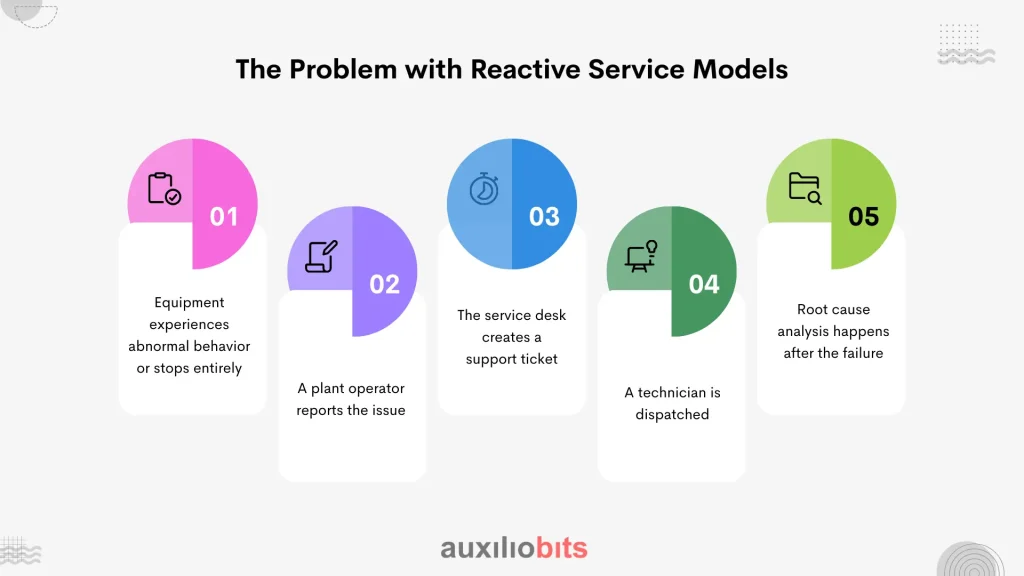
- Equipment experiences abnormal behavior or stops entirely
- A plant operator reports the issue
- The service desk creates a support ticket
- A technician is dispatched
- Root cause analysis happens after the failure
There are variations, of course. Some organizations attempt preventative maintenance schedules. Others run regular inspections. But those approaches still rely heavily on time-based assumptions rather than real operational conditions.
Consider a simple example from heavy equipment manufacturing.
A hydraulic pump might be replaced every six months because historical records suggest that failure rates increase after that period. But this method ignores several variables:
- The machine might operate under heavier loads than expected
- Environmental conditions may accelerate wear
- Maintenance quality varies across facilities
- Some pumps might continue operating perfectly for another year
Replacing components too early wastes resources. Replacing them too late causes downtime. Reactive service models are efficient because they require little effort. They’re inefficient because they lack foresight.
Also read: Automating Service Request Management in Manufacturing
What Predictive Service Means in Manufacturing
Predictive service is often described in marketing language that sounds overly futuristic. Words like “intelligent maintenance” or “self-healing operations” get thrown around without much explanation.
Strip away the hype and the concept becomes clearer.
Predictive Service uses operational data to estimate the probability of equipment failure before it occurs.
Instead of reacting to breakdowns, organizations monitor signals that indicate deterioration or abnormal behavior. These signals might include:
- Temperature deviations
- Vibration anomalies
- Power consumption patterns
- Pressure fluctuations
- Performance degradation over time
Individually, these metrics might not look alarming. Together, however, they create a behavioral signature of failure.
The idea behind predictive service manufacturing is that machines usually give warning before failing. Subtle indicators often appear days or weeks beforehand — assuming someone is paying attention.
Failure Prediction: Where the Real Value Lives
The phrase “predictive maintenance” has existed for years, but failure prediction pushes the concept further.
Traditional predictive maintenance often relies on statistical thresholds. For example:
- Replace a bearing when vibration exceeds a specific level
- Trigger inspection when temperature crosses a defined limit
Failure prediction goes deeper. Instead of reacting to individual thresholds, modern predictive systems analyze patterns of change across multiple signals simultaneously.
A bearing might fail not because vibration is high, but because noise, temperature, and rotational speed all shifted in a specific way over several days.
Predictive models learn these patterns from historical failure data. And here’s where things get interesting. Machines that appear healthy in isolation may show early-stage degradation patterns when compared against historical behavior across an entire fleet. It’s similar to medical diagnostics. A single symptom might be meaningless, but a cluster of small signals can reveal a developing problem.
The Operational Shift Inside Service Organizations
Moving toward predictive service operations isn’t simply a technology upgrade. It forces service teams to rethink how work gets scheduled and executed.
In a reactive model, priorities are clear:
- Broken equipment gets fixed first
- Preventive tasks fill the remaining time
Predictive environments introduce a new category of work: anticipated failures.
Technicians might receive alerts indicating that a machine is likely to fail within the next 72 hours. That doesn’t necessarily mean immediate intervention is required. Sometimes monitoring is sufficient. Sometimes a small adjustment prevents the issue entirely.
The service team suddenly faces decisions that didn’t exist before:
- Should the machine be serviced immediately?
- Can the repair wait until the next planned shutdown?
- Is the risk significant enough to justify downtime?
Predictive systems provide insights. Humans still decide how to act on them.
What Failure Prediction Looks Like in Practice
Manufacturers implementing predictive service usually start with a limited set of high-value assets. The goal is to learn which signals correlate with real failures.
Over time, patterns emerge. For example, in a turbine manufacturing plant, engineers noticed that minor vibration increases in compressor units often preceded seal failures by approximately 10 days. The signal wasn’t dramatic — barely noticeable during routine monitoring.
But once identified, the pattern became reliable.
Technicians began scheduling seal replacements during planned maintenance windows rather than waiting for emergency shutdowns.
The results were surprisingly substantial:
- Emergency repairs dropped significantly
- Spare parts inventory stabilized
- Production disruptions decreased
Small predictive insights tend to produce disproportionate operational benefits.
Technologies That Enable Predictive Service Manufacturing
Predictive service environments rely on several layers of technology working together. None of them are particularly revolutionary on their own.
What matters is how they interact.
Key components typically include:
1. Industrial IoT Sensors
Sensors continuously capture operational data from machines.
These devices measure parameters such as:
- vibration levels
- motor current
- temperature fluctuations
- pressure readings
Without these signals, failure prediction is impossible.
2. Historical Failure Data
Past breakdowns provide the training material for predictive models. Organizations that maintain detailed service logs gain a significant advantage here. Unfortunately, many manufacturers still rely on fragmented maintenance records scattered across spreadsheets and ERP notes.
Data quality becomes a surprisingly big challenge.
3. Machine Learning Models
Predictive algorithms analyze patterns that humans might overlook. Some models focus on anomaly detection. Others estimate remaining useful life (RUL) for components. There is no single “correct” approach. Different equipment types require different analytical methods.
4. Operational Workflow Automation
Prediction alone doesn’t improve service operations.
Alerts must trigger workflows:
- maintenance requests
- technician scheduling
- spare part procurement
Without automation, predictive insights remain trapped in dashboards.
Where Predictive Service Often Fails
Despite the promise, predictive initiatives sometimes stall. The reasons are rarely technological. They’re operational.
Three issues appear frequently in early deployments.
1. Too Many Alerts
Early predictive systems often generate an overwhelming number of warnings. Engineers quickly become skeptical if half the alerts lead nowhere.
False positives erode trust faster than missing predictions.
Refining prediction thresholds takes time — and a fair amount of experimentation.
2. Limited Data History
Many organizations underestimate how much historical data is required. Failure prediction improves dramatically when models can analyze years of operational behavior. New sensor deployments often lack that historical depth.
During early phases, predictions may remain tentative.
3. Organizational Resistance
Technicians who have maintained machines for decades often rely on intuition. Being told that an algorithm predicts a failure can feel… questionable. Interestingly, the most successful predictive programs combine technician expertise with data models rather than replacing human judgment.
Experienced engineers often help interpret signals that algorithms flag.
The Gradual Transition Toward Predictive Service
Manufacturers usually transition gradually from reactive operations to predictive environments. The transition happens gradually.
Service maturity often progresses through stages:
Stage 1: Reactive Support
Breakdowns trigger service activity. Monitoring is minimal.
Stage 2: Preventive Maintenance
Regular maintenance schedules reduce some failures but still rely on fixed intervals.
Stage 3: Condition Monitoring h3
Sensors track machine health indicators, but responses remain manual.
Stage 4: Predictive Service Operations
Failure prediction models anticipate breakdowns and trigger maintenance planning.
Stage 5: Autonomous Service Coordination
AI agents coordinate maintenance actions across systems, automatically scheduling repairs and ordering parts.
Not every organization reaches the final stage immediately. In fact, most operate somewhere between stages three and four.
Why Predictive Service Manufacturing Is Becoming a Competitive Advantage
Downtime has always been expensive. What’s changing is how visible those costs have become.
Modern manufacturing environments rely on tightly integrated production schedules. Delays ripple across supply chains, affecting distributors, logistics partners, and customers.
Predictive service, which uses data analysis to anticipate and prevent equipment failures, addresses several long-standing operational issues simultaneously:
- Reduced unplanned downtime
- More accurate spare parts planning
- Improved technician utilization
- Longer equipment lifespan
But there’s another, less obvious benefit. Predictive insights create a feedback loop between product design and field performance. When service teams understand how equipment fails in real environments, engineering teams gain invaluable design insights.
Over time, this data-driven feedback improves product reliability itself.
A Quiet but Significant Shift in Service Thinking
For years, people primarily viewed service departments as cost centers. Their job was to keep equipment running and respond quickly when problems occurred.
Predictive service changes that perception. Failure prediction transforms service teams into operational intelligence hubs.
Instead of reacting to problems, they begin identifying systemic reliability patterns across entire fleets of equipment, which allows for proactive maintenance and improved overall efficiency in service operations. This shift has broader implications for manufacturing organizations.
Service operations start influencing:
- product engineering decisions
- spare parts strategy
- maintenance planning
- operational forecasting
And that’s where predictive service manufacturing becomes more than a maintenance strategy. It becomes an operational philosophy.
The Direction Things Are Heading
Failure prediction will continue improving as industrial data volumes grow and AI models mature. But even today, the most successful predictive service environments share a few characteristics.
They don’t chase perfect predictions. They focus on actionable insights.
Sometimes identifying a failure a few hours early is enough to prevent a production disruption. In other cases, detecting a pattern weeks in advance allows maintenance teams to coordinate repairs during planned downtime.
Predictive systems don’t eliminate uncertainty entirely. Machines remain machines — complex, mechanical systems that occasionally behave unpredictably.
But the gap between unexpected failure and informed anticipation is narrowing.
And in modern manufacturing environments, that gap can mean the difference between reactive firefighting and genuinely intelligent service operations.