

Key Takeaways
- Autonomous Maintenance shifts maintenance from time-based scheduling to condition-based action. Machines generate work orders when behavior changes—not when the calendar says so.
- Self-triggered work orders are the operational backbone of autonomy. Without automated task creation inside CMMS, sensors only produce better dashboards—not better outcomes.
- Calibration determines success or failure. Poor thresholds and excessive false positives can erode technician trust faster than any technical flaw.
- The biggest savings often come from eliminating unnecessary maintenance—not just preventing breakdowns. Condition-based replacement reduces over-maintenance and extends asset life.
- True autonomy requires decision automation, not just alerts. The maturity jump happens when systems move from notifying humans to initiating structured, risk-aware action.
For years, preventive maintenance has been treated as the grown-up alternative to reactive firefighting. And to be fair, it was. Compared to waiting for a gearbox to seize or a spindle to snap mid-shift, scheduled lubrication and quarterly inspections felt almost visionary.
However, most plants that solely depend on time-based schedules eventually encounter similar challenges.
Machines don’t fail according to calendar invites.
A compressor doesn’t care that it’s only been 28 days since its last inspection. A servo motor winding won’t politely degrade after 90 days. And yet, preventive programs still revolve around fixed intervals—30 days, 500 hours, once per quarter—because that’s how CMMS templates were originally configured.
Autonomous Maintenance changes that equation. And at the center of that shift sits something deceptively simple: self-triggered work orders.
Not manual tickets. Not planner-driven schedules. Not supervisor escalations.
Machine-initiated tasks.
That’s where things start to get intriguing.
Also read: Agents as Frontline Advisors in Retail Loyalty Programs
The Limits of Preventive Maintenance
Time-based maintenance was a breakthrough in the 1980s and 90s. It brought structure to chaos. It reduced catastrophic failures. It introduced planning.
But walk into any mid-sized manufacturing facility today and you’ll find:
- Over-maintenance on stable assets
- Under-maintenance on high-stress equipment
- Planners drowning in repetitive PM tickets
- Technicians closing work orders that didn’t need to exist
What Autonomous Maintenance Means
Many people still associate “Autonomous Maintenance” with Total Productive Maintenance (TPM) checklists—operators cleaning, inspecting, and tightening bolts. That’s part of the story, but it’s not the modern interpretation.
Today, Autonomous Maintenance means the system itself participates in maintenance decision-making.
Not through static alarms.
The system participates in maintenance decision-making through contextual, threshold-aware, and condition-driven triggers.
A modern autonomous environment doesn’t wait for someone to notice abnormal vibration. It doesn’t rely on a weekly report. It recognizes deviation in real time and initiates a structured response.
The real shift happens when:
- Equipment health data is continuously evaluated
- Degradation patterns are recognized early
- Threshold breaches automatically generate work orders
- The right technician is assigned based on skill and availability
No email. No manual logging. No whiteboard. The system acts.
That’s where self-triggered work orders come in.
The Anatomy of a Self-Triggered Work Order
A self-triggered work order isn’t just an alert that becomes a task. If that’s all it is, you’ve only automated the notification layer.
A properly engineered autonomous workflow includes:
- Condition monitoring input (vibration, temperature, oil analysis, current draw)
- Context logic: (Is production running? Is it a safety-critical asset?
- Failure probability scoring
- Automated work order creation in CMMS
- Priority classification
- Resource assignment logic
- Escalation if ignored
Most plants stop at step one or two.
They install sensors. They build dashboards. And then they still rely on someone to interpret the data.
Which defeats the point.
The real power comes from translating the machine’s state directly into structured action.
Why Self-Triggered Work Orders Change the Game
work because asset behavior demands it.
That difference matters.
Here’s what changes operationally:
- Maintenance becomes event-driven, not time-driven.
- Planners shift from scheduling routine inspections to managing risk-based interventions.
- Technicians work on assets that actually need attention.
- Downtime becomes shorter because degradation is caught earlier.
But there’s another shift that’s less obvious.
Trust.
When technicians see that a work order was generated because vibration crossed a statistically meaningful threshold—not because “it’s Tuesday”—they approach the job differently. It feels justified.
And yes, that cultural shift is subtle. But it’s real.
A Real-World Example: CNC Spindle Degradation
In one automotive machining plant I worked with, spindle failure was a recurring problem. Preventive inspections were scheduled every 600 operating hours. On paper, that seemed reasonable.
In reality:
- Some spindles degraded in 450 hours.
- Others ran perfectly for 900+ hours.
- Inspections rarely caught early bearing wear.
The plant implemented condition monitoring tied directly to their CMMS. When vibration amplitude exceeded a dynamic baseline (not just a fixed threshold), the system:
- Generated a corrective work order
- Flagged production planning
- Suggested a maintenance window during the next tool change cycle
Results over 12 months:
- 38% reduction in unplanned spindle failures
- 22% reduction in maintenance labor hours
- Fewer emergency part orders
What made the difference wasn’t just sensors. It was autonomous task creation.
Without that, they would have just had better graphs.
When Autonomous Maintenance Fails
There’s a tendency to oversell autonomy. Let’s temper that.
Autonomous systems fail when:
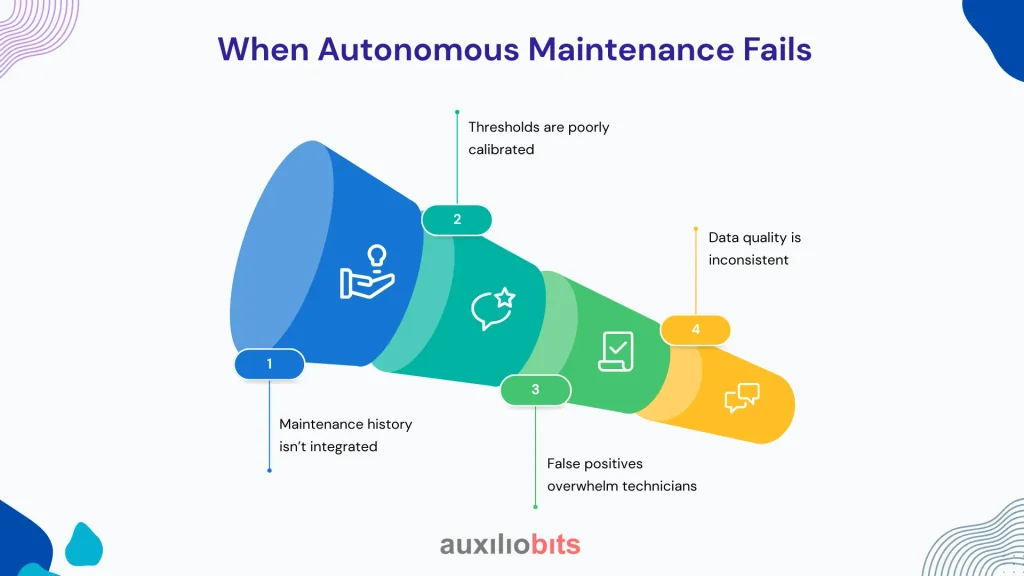
- Thresholds are poorly calibrated
- Data quality is inconsistent
- Maintenance history isn’t integrated
- False positives overwhelm technicians
Autonomous Maintenance requires disciplined configuration:
- Use rolling baselines, not fixed thresholds.
- Integrate failure mode history into trigger logic.
- Combine multiple signals before generating high-priority tasks.
- Build suppression rules during planned shutdowns.
Otherwise, you create alarm fatigue—just with better software.
Moving from Preventive to Autonomous: What Changes
The shift isn’t just technical. It’s structural.
Here’s what organizations typically need to rethink:
1. Maintenance Planning Philosophy
Instead of asking, “How often should we inspect this asset?”
The question becomes: “What signals indicate meaningful degradation?”
That’s a different mindset.
2. Role of the Planner
Planners in preventive environments focus on volume—closing scheduled PMs.
In autonomous setups, planners focus on:
- Reviewing machine-generated risk scores
- Coordinating predictive interventions
- Balancing production constraints
It’s less administrative. More analytical.
3. Work Order Lifecycle
Traditional:
- Planner creates PM.
- Technician executes.
- Findings logged.
Autonomous:
- Asset health deteriorates.
- System evaluates the probability of failure.
- Work orders auto-generate.
- Technician intervenes earlier.
- System recalibrates based on the outcome.
Notice the feedback loop. That’s essential.
Without learning mechanisms, autonomy stagnates.
Self-Triggered Work Orders in Practice: How They’re Built
A functional architecture typically includes:
- Edge sensors capturing real-time condition data
- A health scoring engine
- Rules engine tied to asset criticality
- CMMS integration via API
- Automated prioritization model
The nuance lies in how triggers are defined.
Some plants use:
- Vibration RMS exceeding 2.5 mm/s above baseline
- Oil contamination exceeding ISO 4406 limits
- Temperature delta >15% relative to historical median
Others combine metrics:
- Rising vibration + rising temperature + load increase
Multi-variable triggers dramatically reduce false positives. But they’re harder to design.
You need maintenance engineers and data specialists working together—not in silos.
Financial Implications Most Plants Underestimate
Autonomous Maintenance doesn’t just reduce downtime. It changes cost structure.
- Spare parts inventory drops because interventions are earlier and planned.
- Overtime decreases due to fewer emergency repairs.
- Asset lifespan extends—sometimes significantly.
One packaging facility reduced annual bearing consumption by nearly 18%. This was not due to the installation of superior bearings. This reduction was achieved by replacing the bearings based on their condition, not their schedule.
It’s easy to assume the savings come from fewer breakdowns. Often, they result from eliminating unnecessary maintenance.
That’s harder to measure—and often overlooked.
The Evolution: From Alerts to Decisions
We’ve had alerts for decades. SCADA systems have been alarming operators since the 90s.
The difference now is decision automation.
There’s a hierarchy:
- Alerting
- Analysis
- Recommendation
- Action generation
- Closed-loop learning
Most organizations operate at level one or two.
Autonomous Maintenance—true Autonomous Maintenance—lives at levels four and five.
Self-triggered work orders sit at that fourth level.
They represent the moment when machines stop just informing and start initiating structured responses.
That’s not trivial.
The Bigger Operational Impact
When maintenance becomes autonomous:
- Production planning gains predictability.
- Safety incidents decline because interventions happen earlier.
- Technicians spend less time inspecting healthy assets.
- Data quality improves due to structured feedback loops.
There’s also a psychological shift. Teams move from reacting to managing.
And while that sounds like a cliché, it feels different on the floor. You can sense it in fewer frantic calls and fewer emergency shutdowns.
Final thoughts
Autonomous maintenance isn’t dramatic. It doesn’t produce flashy dashboards for executives.
What it produces is fewer 2 a.m. phone calls.
It produces maintenance teams that spend more time improving assets and less time rescuing them.
It also generates stability, a concept rarely emphasised in ROI slides.
Self-triggered work orders are the operational backbone of that stability. They convert machine conditions into disciplined actions without waiting for human intervention.
Not perfectly. Not instantly. It’s also important to note that this process requires calibration.
But when implemented thoughtfully, they move maintenance from calendar-driven habit to data-driven responsiveness.
And once you operate that way for a year or two, going back to purely preventive scheduling feels… primitive.
Not wrong. Just outdated.
That’s the difference between maintaining machines and allowing machines to participate in maintaining themselves.