






- Agentic AI moves beyond predictive models, enabling autonomous decision-making and self-action based on real-time data, streamlining operations across finance, supply chain, IT, and customer service.
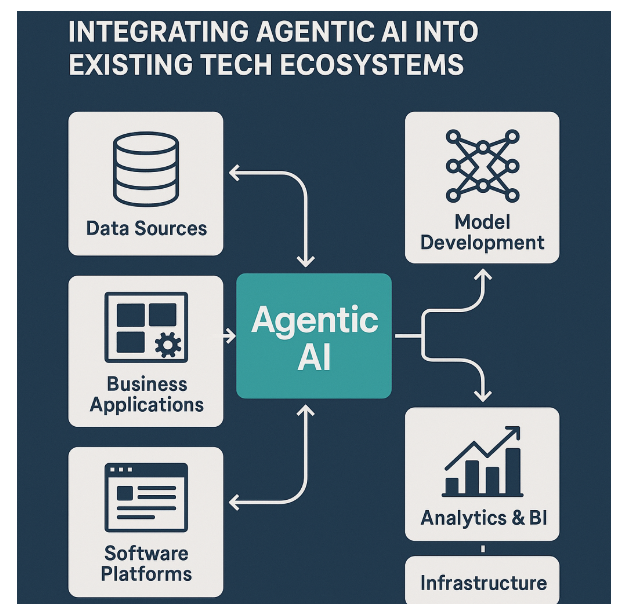
- Agentic AI agents integrate into existing systems via APIs, event-driven frameworks, and microservices, ensuring seamless collaboration without disrupting enterprise infrastructure.
- Enterprises benefit from enhanced scalability, reduced costs, and continuous improvement, as agents learn from data and human feedback to optimize performance.
- Governance and compliance frameworks like XAI and HIPAA ensure ethical, explainable AI behavior, maintaining trust and legal conformity in regulated industries.
- With always-on availability and goal-oriented behavior, Agentic AI agents deliver rapid, intelligent responses, unlocking new competitive advantages in dynamic business environments.
The future of business innovation extends beyond AI—it’s autonomous AI. Agentic AI, with autonomous reasoning abilities for decision-making and action, is transitioning from research to practical enterprise uses. From self-managing supply chains to AI-based IT management and adaptive customer interactions, intelligent agents will revolutionize efficiency, agility, and competitiveness.
Understanding Agentic AI in Enterprise Context
Agentic AI refers to AI agents that:
1. Work independently on processes (e.g., IT management, supply chain optimization, financial reconciliation).
2. Make dynamic adjustments to real-time information (reinforcement learning, LLM-based reasoning).
3. Coordinate processes between numerous systems (APIs, databases, legacy systems).
Why Introduce Agentic AI into Enterprise Ecosystems?
While traditional AI helps decision-making through recommendations, Agentic AI goes one step further. It makes decisions, acts on its account, and adapts itself based on feedback to enhance its performance. That’s where businesses can and must make that leap:
1. Operational Efficiency:
Simplify complex operations using little or no human effort.
2. Better Decisions:
Mine unstructured data (e.g., market reports, social media comments) for strategic insights.
3. Scalability:
Manage dynamic business environments with auto-optimizing AI agents.
4. Continual Improvement:
AI agents continuously learn and adapt to evolving environments, keeping up with the times.
5. Goal-Oriented Behavior:
AI agents follow their particular aim instead of blindly following the path.
6. Cost-Benefit Analysis:
Conduct a thorough cost-benefit analysis to compare the Total Cost of Ownership (TCO) of Agentic AI and traditional automation. We can directly check the cost savings from automation, the removal of operational defects, and the cost required for adaption and learning.
Roadmap for Agentic AI Integration
Following is a step-by-step guide for companies to integrate agentic AI into their tech stacks successfully:
Phase 1: Assess and Prepare the Existing Ecosystem
1.1. System Audit and Data Analysis
- Perform a comprehensive audit of enterprise systems such as ERPs, CRMs, data warehouses, and operational databases.
- Review data pipelines, APIs, and data interoperability.
- Assess data quality with tools.
Example: In finance operations, AI agents may be married with SAP or Oracle ERPs to feed on live financial data and automatically reconcile it.
1.2. Infrastructure Evaluation
- Check if existing cloud providers (AWS, Azure, GCP) and on-premise infrastructures can support AI workloads.
- Offer sufficient GPU/TPU resource availability to train AI models and inference.
Example: Evaluating Amazon S3 storage for processing large volumes of financial data.
Phase 2: Identify Agentic AI Use Cases
2.1. Business Process Mapping
- Identify the business processes where Agentic AI will bring incredible benefits. We can start by targeting slow or error-prone activities.
- We can focus on the tasks that include dynamic decision-making and adaptation.
Example: Finance teams can leverage AI agents for transaction matching, fraud detection, and financial reporting.
Phase 3: Build the Agentic AI Framework
Design an architecture consisting of:
- The Perception Layer consumes data through APIs, webhooks, or ETL pipelines.
Example: An AI agent picks up transaction data via API for reconciliation.
- Cognitive Layer: This layer processes the data with LLMs, reinforcement learning models, and graph neural networks.
Example: Flags suspicious transfers and flags them for investigation
- Action Layer: It acts on tasks via Robotic Process Automation (RPA) or API-based services.
Example: Automate a refund for duplicate payments via RPA.
3.2. Agent Roles and Responsibilities
Following are the roles and responsibilities of different Agents:
- Data Agent: It extracts and preprocesses the data.
Example: Extracts financial database transaction records
- Decision Agent: It utilizes logic and recommends action according to AI models.
Example: Identifies duplicate payments and recommends corrective action.
- Execution Agent: Executes transactions using APIs or RPA engines.
Example: Issue payment refund for duplicate transaction
- Monitoring Agent: It tracks decisions and actions for compliance and auditing.
Example: Audit all actions for compliance reasons and trigger anomalies to be investigated by human users.
Phase 4: Integration with Existing Systems
To ensure smooth integration of Agentic AI into existing systems, the following steps are to be taken care of :
- API Integration: Integrate APIs through API gateways to support secure communication and horizontally scale data transfer between systems.
- Event-Driven Architectures: Use event-driven systems to support near real-time response to data change or triggers.
- Microservices Orchestration: Utilize Istio or AWS Step Functions as tools to orchestrate and govern work among services.
- Real-Time Monitoring: Use Prometheus or Grafana as instruments to observe system performance, detect anomalies, and create insights to inform agent behavior.
Example: In banking, AI agents could monitor real-time transactional data from ERP systems. If an anomaly or inconsistency is found, the agent automatically sends alarms.
Phase 5: Implement AI Governance and Compliance
5.1. Establish Guardrails and Compliance Management
Implement some strong governance structures to ensure ethical and responsible AI deployment.
- Utilize explainable AI (XAI) for transparency and accountability.
- Detect and prevent bias and offer equitable decision-making.
- Implement AI systems in conformance with policy and compliance directives such as HIPAA.
Example: In finance, AI agents such as SOX and IFRS can promote policy conformance by providing sophisticated audit logs.
Phase 6: Continuous Optimization
AI agents need ongoing monitoring and successive enhancements to achieve ideal performance levels.
- Collect real-time feedback and incorporate human-in-the-loop feedback to make enhancements.
- Use reinforcement learning techniques for self-optimization.
- Track the KPIs to record the impact of AI.
Example: ROI Calculation: Less reconciliation errors save $2M annually in a medium-sized bank.
Benefits
The incorporation of Agentic AI provides users with the following benefits:
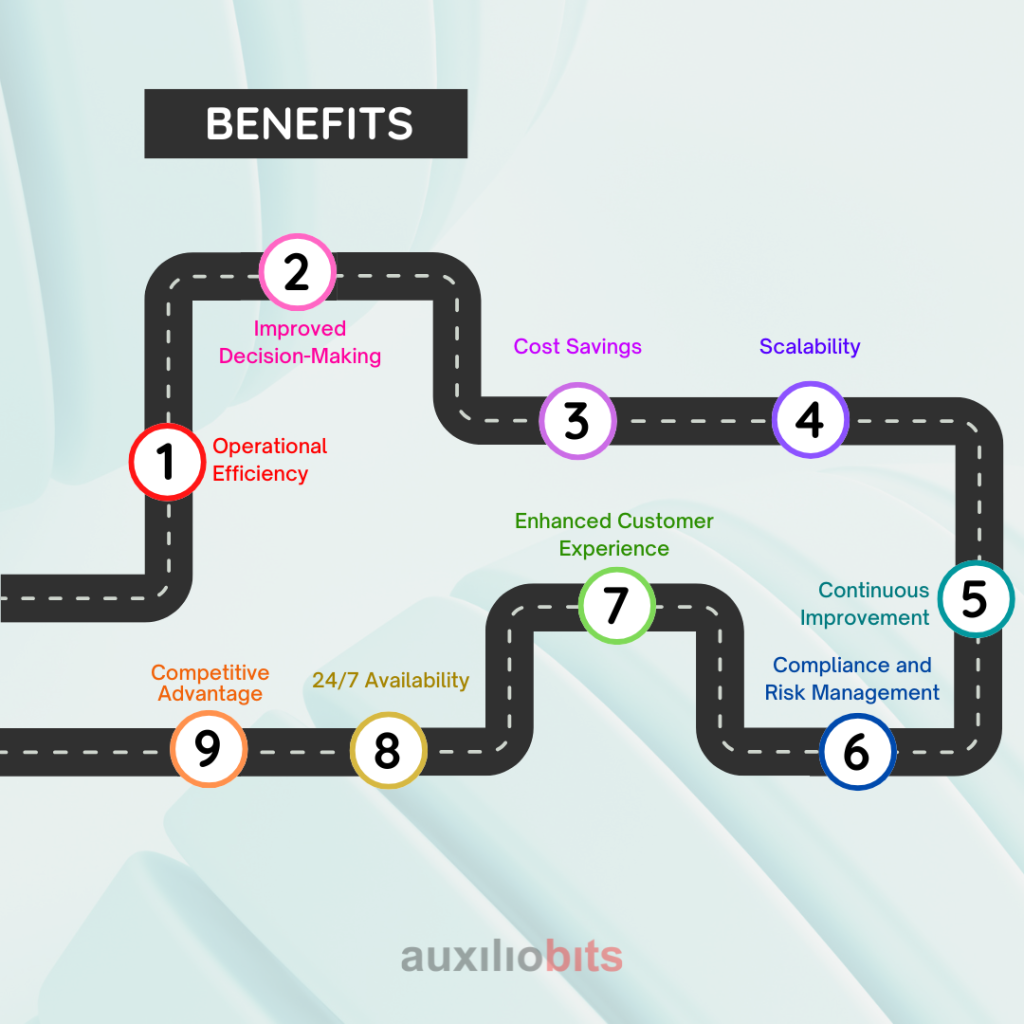
- Operational Efficiency: It reduces labor and speeds up procedures.
- Improved Decision-Making: Provides timely insights for good decision-making through continuous learning.
- Cost Savings: Saves operational costs by reducing errors and maximizing resource utilization.
- Scalability: Scales dynamically to adapt to variable workloads and assimilates into current systems.
- Continuous Improvement: Continuously improves through learning from feedback, refining accuracy, and performance.
- Compliance and Risk Management: Facilitates regulatory compliance through transparent decision-making and anomaly detection.
- Enhanced Customer Experience: Delivers personalized support and faster response times.
- 24/7 Availability: Operates 24/7 for continuous monitoring and resolution of problems.
- Competitive Advantage: Enhances agility, innovation, and responsiveness in uncertain markets.
Conclusion
Agentic AI transforms companies from data-based to action-based, unleashing new levels of productivity and flexibility. Automating, real-time adapting, and continually optimizing empower companies to take the lead in a constantly shifting space. Implementing Agentic AI isn’t innovation — it’s a jump toward intelligent, self-directed innovation.