





The HR department has always been the backbone of any organization, bridging the gap between business goals and people’s needs. Traditionally, HR has relied on personal interactions, intuition, and manual processes to manage hiring, onboarding, and employee engagement. But in today’s fast-paced, digital-first world, these manual systems can quickly become overwhelming and inefficient.
With increasing pressure to hire faster, onboard smoother, and deliver better employee experiences, HR teams are turning to technology for help. And among the most powerful tools transforming the field is Artificial Intelligence (AI).
But let’s be clear that AI isn’t here to take the human out of Human Resources. Instead, it’s acting as a support system, enabling HR professionals to do what they do best and connect with people. By automating repetitive tasks, streamlining workflows, and delivering data-driven insights, AI is helping HR teams work smarter, act faster, and build stronger, more inclusive workplaces.
This blog dives into how AI is reshaping every stage of the employee journey from the moment a resume is submitted to the day a new hire walks through the virtual or physical door.
Also read: Using AI to Continuously Optimize Automated Workflows
Smarter Hiring, Better Decisions
Hiring has always been one of HR’s most critical and time-intensive functions. Sorting through hundreds of applications, coordinating interviews, and ensuring a good fit takes time, effort, and attention to detail.
Today, AI is bringing much-needed relief to this process.
Resume Screening, Reimagined:
Traditional resume screening can be time-consuming and inconsistent. AI-powered applicant tracking systems (ATS) can scan and filter resumes in seconds, highlighting candidates whose experience and skills closely match the job description. These tools do more than match keywords; they understand context, identify transferable skills, and even detect patterns in career progression.
Intelligent Candidate Matching:
Advanced AI tools now use predictive algorithms to match candidates with roles where they are most likely to succeed. By analyzing past hiring data, team dynamics, and candidate behavior, AI helps recruiters make more accurate hiring decisions and reduce early attrition.
Interview Scheduling Made Effortless:
Coordinating interviews across multiple calendars often creates delays. AI steps in by automating this process and finding suitable time slots, sending reminders, and even rescheduling when conflicts arise.
24/7 Candidate Support:
Chatbots powered by AI are available around the clock to answer candidate queries, provide application updates, and guide them through next steps, and create a seamless, professional experience even before the first human interaction.
Fairer, More Inclusive Hiring Practices
Unconscious bias is an unfortunate reality in traditional recruitment. Even with the best intentions, human decisions can be influenced by names, photos, or backgrounds.
AI is helping to level the playing field by:
- Removing identifying information from resumes during initial screening
- Using consistent, role-specific criteria to assess candidates
- Standardizing interview questions and scoring methods
- Analyzing only performance-related data for shortlisting
This approach promotes a more inclusive hiring process, where candidates are judged on their abilities, not their appearance or background. It also supports companies in building diverse, equitable, and high-performing teams.
Onboarding That Feels Seamless and Personal
Once the offer is accepted, the onboarding process sets the tone for the employee’s journey within the organization. A smooth and engaging onboarding experience builds confidence and drives early engagement. And here too, AI is making a big impact.
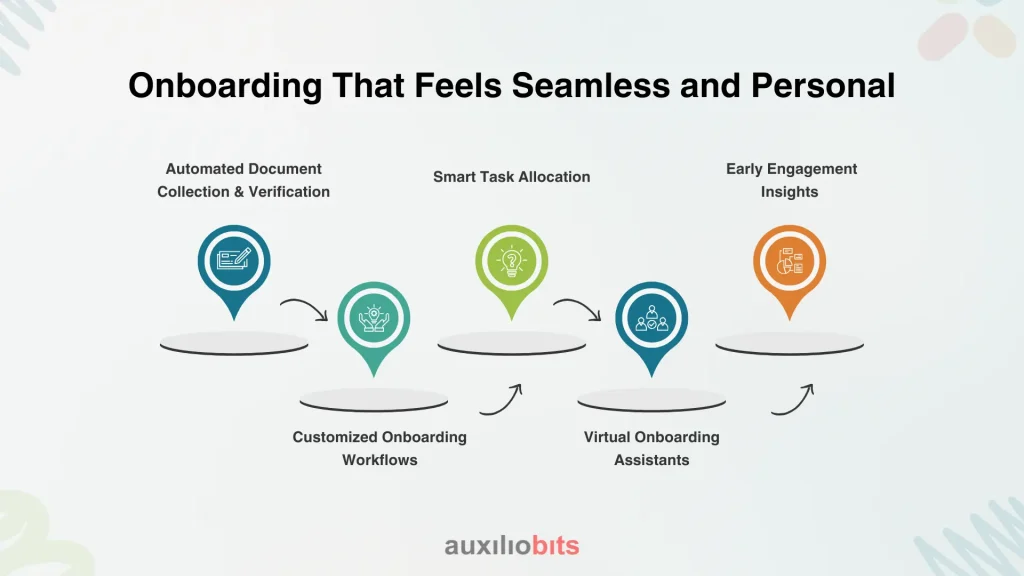
Automated Document Collection & Verification:
From ID proofs to tax forms, AI tools can collect, verify, and securely store essential documents without the need for constant follow-up.
Customized Onboarding Workflows:
Instead of using a one-size-fits-all approach, AI personalizes the onboarding experience based on the new hire’s role, location, and experience level. Relevant tasks, policies, and training modules are delivered at the right time and create a sense of clarity and momentum.
Smart Task Allocation:
AI ensures IT, Admin, HR, and Reporting Managers of all teams are notified and assigned responsibilities ahead of the join date. This guarantees laptops are configured, access credentials are ready, and welcome kits are in place
Virtual Onboarding Assistants:
AI chatbots act as guides for new employees, answering common questions, walking them through company policies, and helping them navigate the first few weeks, reducing anxiety, and creating a sense of support.
Early Engagement Insights:
AI can monitor how new hires are interacting with onboarding material and track task completions. If someone is falling behind or showing signs of disengagement, HR can intervene early to provide support and prevent early turnover.
What This Means for HR Professionals
The biggest misconception about AI in HR is that it makes the human role less important. In reality, it does the opposite.
By automating time-consuming administrative tasks, AI allows HR professionals to focus on high-impact tasks like strengthening company culture, resolving conflicts, coaching managers, and designing programs that elevate employee experience.
With AI in their toolkit, HR teams can:
- Make faster, more informed decisions
- Scale their efforts without sacrificing quality
- Build stronger relationships with employees and candidates
- Move from a reactive to a proactive mode of operation
In essence, AI takes care of the busy work, so HR can focus on the human work.”
Conclusion
The evolution of HR through AI isn’t a futuristic idea; it’s already reshaping how companies attract, hire, and support their people today. From streamlining hiring to creating seamless onboarding experiences, AI is redefining what’s possible in Human Resources.
But the true power of this transformation lies not just in speed or automation, but in freeing HR teams to focus on what they do best, building relationships, nurturing culture, and empowering people.
By embracing AI-driven tools, organizations are no longer just improving workflows; they are reimagining the entire employee journey and making it more inclusive, data-informed, and human-centric. Employees feel more supported, candidates feel more engaged, and HR professionals feel more empowered.
In a world where competition for top talent is fiercer than ever, businesses that invest in smart, scalable, and human-first HR technology are positioning themselves to lead. They are not just adapting to the future, but they are actively shaping it.
Yes, the future of HR is powered by intelligent tools, predictive analytics, and automation. At its core, it will always be about people, purpose, and connection. AI may drive the engine, but people will always steer the journey.