






Key Takeaways
- Reporting shows what went wrong; Compliance Intelligence shows what’s about to
- Predictive risk detection depends more on context than raw data
- Most compliance risks build gradually, not suddenly
- Too many alerts can be as dangerous as no alerts
- Visibility into risk doesn’t remove responsibility—it increases it
Most compliance teams don’t realize they’re working with a time lag. It was a large one. Sometimes weeks. Sometimes an entire quarter.
By the time a compliance report is reviewed, signed off, and circulated, the underlying issue has already played out. Money has moved. Goods have shipped. Emissions have been recorded. If something went wrong, you’re no longer preventing it—you’re documenting it for someone else to review later.
That’s the uncomfortable reality behind a lot of “mature” compliance setups in manufacturing.
And honestly, the problem isn’t effort. Teams are doing the work. There are dashboards, audit trails, control frameworks—everything you’d expect. But the model itself is reactive. It was built for a slower operating environment.
Manufacturing today doesn’t wait for compliance cycles anymore.
Reporting Works—Until It Doesn’t
Let’s be fair for a second. Reporting-based compliance didn’t fail overnight.
It still holds up in certain areas:
- Regulatory disclosures (you need structured outputs)
- Financial audits (traceability matters more than timing)
- Post-incident analysis (you’re reconstructing events anyway)
But once you move into operational compliance, things start slipping. Take a fairly common scenario: duplicate payments in procure-to-pay.
A traditional compliance report might catch such issues after reconciliation. Maybe at month-end. Maybe later if volumes are high. The issue gets flagged, investigated, and corrected.
But here’s what doesn’t get talked about enough:
- Why did the pattern start in the first place?
- Why wasn’t it visible earlier?
- And more importantly—how many similar transactions didn’t get caught?
This is where the shift toward compliance intelligence starts making sense. This shift is not merely a trendy term but rather a practical solution to a pressing issue.
The Real Shift: From Detection to Anticipation
The most significant difference isn’t automation. It’s timing. Traditional compliance asks: Did something go wrong?
Compliance intelligence, especially in AI compliance manufacturing setups, asks: What is starting to look off? That distinction matters more than it sounds. Because risks don’t usually appear fully formed. They build up, quietly.
A supplier doesn’t suddenly become non-compliant overnight. You’ll see:
- Slight delivery inconsistencies
- Minor deviations in documentation
- Small pricing irregularities
Individually, none of these trigger alarms. Together, they tell a story. The problem is, reporting systems aren’t designed to read stories. They’re designed to validate rules.
Also read: Why Manufacturing Marketing Still Struggles with Data Silos
Predictive Risk Detection
Given the amount of over-promising in this sector, it’s important to provide some context. Predictive risk detection is not about “AI knowing the future”; rather, it’s about identifying patterns early enough to allow for intervention.
Effective predictive risk detection typically relies on three elements—none of which are particularly exciting.
1. A Moving Definition of “Normal”
Most systems try to define a baseline. The tricky part? In manufacturing, “normal” keeps shifting. Production cycles change. Suppliers rotate. Demand fluctuates. Even internal processes evolve faster than people admit. So if your baseline is static, your alerts will be useless within weeks.
Good implementations continuously adjust:
- Approval timelines aren’t fixed—they’re contextual
- Transaction volumes are compared seasonally, not globally
- Vendor behavior is evaluated relative to similar suppliers, not in isolation
2. Context Matters More Than Detection
A spike in invoice volume could mean fraud. Or it could mean a plant just ramped up production. Without context, both look identical.
This is where a lot of AI compliance manufacturing initiatives quietly fail. They detect anomalies—but don’t explain them.
And once users stop trusting the signals, the system becomes background noise.
In practice, teams that get these signals right tend to:
- Tie compliance signals to operational data (production, logistics, scheduling)
- Layer business rules on top of model outputs
- Allow human overrides without breaking the system
Because sometimes, the model is wrong. And that’s fine—as long as it learns.
3. Risk Isn’t Binary (Even If Audits Are)
Compliance has traditionally been binary:
- Either you’re compliant
- Or you’re not
Predictive systems don’t work that way. They deal in probabilities.
You’ll see outputs like:
- High likelihood of delayed compliance from this vendor
- Rising probability of control bypass in approval workflows
- Early indicators of environmental threshold breach
None of these are violations. Yet. And that creates a grey area: Do you act now, or wait for certainty?
Different organizations answer that differently. Some act early. Others wait—and deal with consequences later.
Where Things Start Getting Interesting
The real value of compliance intelligence shows up when you connect signals across systems. This value extends beyond the confines of a single workflow.
For example: A manufacturing client (mid-sized, automotive components) noticed a recurring issue with quality deviations. Nothing major—just enough to trigger internal reviews.
Initially, they treated it as a quality control problem. But when they layered in additional data, a pattern emerged:
- Deviations were higher during specific shifts
- Those shifts had higher overtime
- Overtime correlated with delayed supplier deliveries
So what looked like a quality issue was actually a supply chain + workforce + scheduling problem. No compliance report would have caught that. At least not in time to do anything about it. That’s the difference. Not better reporting—better visibility into relationships.
Why Predictive Compliance Still Struggles in Practice
If this all sounds obvious, it’s because the idea is straightforward. The execution isn’t.
A few things tend to get in the way:
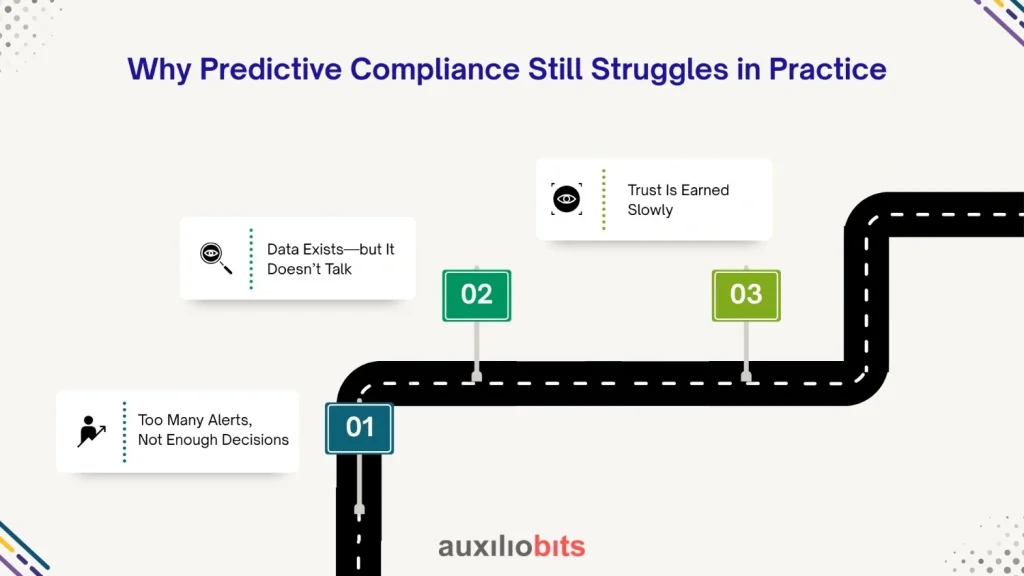
1. Too Many Alerts, Not Enough Decisions
Early implementations almost always over-alert.
Everything looks like a risk:
- Minor deviations
- Temporary spikes
- One-off anomalies
Teams get overwhelmed. Then they start ignoring signals. And once that happens, even real risks slip through.
There’s no elegant fix here. It usually takes:
- Iteration
- Feedback loops
- And frankly, a bit of patience
2. Data Exists—but It Doesn’t Talk
Most manufacturing environments already have the data needed for predictive compliance.
The issue is fragmentation. ERP, MES, supplier portals, spreadsheets, email approvals—it’s all there. Just not connected in a meaningful way.
And integrating it isn’t just technical. It’s political.
- Who owns supplier data?
- Who defines compliance thresholds?
- Who gets notified when something looks wrong?
These questions slow things down more than any model ever will.
3. Trust Is Earned Slowly
Compliance teams are trained to rely on certainty. Predictive systems don’t offer that. They offer signals.
So there’s always hesitation:
- Can we justify this during an audit?
- What if this turns out to be nothing?
And honestly, that skepticism is healthy. The organizations that succeed here don’t replace existing controls overnight. They layer predictive insights alongside them—and let trust build over time.
Where AI Compliance Manufacturing Is Delivering Value
Not everywhere. But in a few areas, the impact is hard to ignore:
- Supplier risk monitoring → spotting instability before contract violations happen
- Environmental compliance → adjusting operations before thresholds are breached
- Procure-to-pay → identifying behavioral anomalies, not just rule violations
- Workforce safety → detecting conditions that increase risk, not just incidents
Notice a pattern? None of these rely on waiting.
A Useful Thought
Moving to compliance intelligence has an underexposed side effect: reduced uncertainty. While this shift sounds positive, it carries a consequence. If a system flags a rising compliance risk, and you opt not to intervene, that decision becomes transparent.
Previously, a common defense was, “We weren’t aware.” That defense is significantly weakened now. This level of transparency makes some organizations hesitant, which is evident in their cautious approach to adopting predictive systems.
So, Is Reporting Dead?
Not really. It’s just no longer the center of the compliance strategy.
It becomes:
- A record
- A validation layer
- A requirement for regulators
But not the primary defense. That role is shifting toward predictive systems—slowly, unevenly, and with plenty of friction.
The Real Takeaway
Most compliance failures don’t happen because controls are missing. They happen because early signals are ignored, misunderstood, or simply not visible. Compliance intelligence, especially in the context of AI compliance manufacturing, doesn’t eliminate risk. It just gives you a chance to see it earlier.
What you do with that visibility is still very much a human decision. And that’s probably not changing anytime soon.