







- Shared services alone no longer drive meaningful finance transformation in manufacturing.
- Agentic AI enables finance teams to monitor operational signals across systems in real time.
- Finance Transformation AI helps detect revenue, procurement, and working capital issues earlier.
- AI agents shift finance roles from transaction processing to operational intelligence and oversight.
- Successful initiatives for finance transformation in manufacturing depend on strong data governance and cross-system integration.
For nearly two decades, the phrase ‘financial transformation in manufacturing’ meant something very specific. It meant consolidating transactional work into shared service centers, implementing large ERP systems, and standardizing processes across plants and regions. The objective was straightforward: reduce cost per transaction and create operational consistency.
That model delivered value. But it also plateaued.
Many manufacturing CFOs quietly acknowledge this now. After ERP upgrades, shared services consolidation, and several waves of automation, the finance function still spends an uncomfortable amount of time reconciling data, chasing missing information, and manually validating transactions across systems.
The reality is that manufacturing finance is structurally complex. Plants run MES systems, procurement runs supplier portals, logistics data lives elsewhere, and customer contracts often sit in CRM platforms. Finance ends up stitching the story together.
This is precisely where finance transformation AI is starting to change the conversation.
Not because AI replaces finance professionals—but because Agentic AI systems can operate across fragmented operational environments in ways traditional automation never could.
And that shifts the definition of finance transformation in manufacturing entirely.
Why Traditional Finance Transformation Hits a Wall in Manufacturing
Shared services and ERP-driven standardization worked well for predictable, repeatable accounting tasks. Accounts payable, invoice processing, and payroll were ideal candidates.
But manufacturing finance isn’t just accounting. It sits at the intersection of operations, procurement, supply chain, and revenue management.
Consider a simple revenue recognition scenario in a manufacturing company selling configurable equipment.
Revenue often depends on:
- Delivery confirmation from logistics systems
- Installation completion at the customer site
- Contract milestone validation
- Customer acceptance documentation
- Compliance with industry accounting standards
These inputs usually exist in multiple systems.
So finance teams still perform work that looks surprisingly manual:
- Validating delivery confirmations against contract milestones
- Investigating mismatches between shipping and billing records
- Following up with operations teams for missing installation confirmations
- Rechecking supplier invoices against purchase order changes
Even highly digitized manufacturers experience these challenges. ERP systems record the transactions—but they rarely interpret the operational context behind them.
Shared services improve efficiency, but they do not solve decision dependency.
That gap is exactly where finance transformation manufacturing initiatives are now evolving toward Agentic AI systems.
What Makes Agentic AI Different from Traditional Automation
Most finance teams are already familiar with automation tools—RPA bots, workflow engines, and rule-based validation systems.
Those tools follow instructions. Agentic AI systems behave differently.
They are designed to interpret context, coordinate across systems, and make bounded operational decisions.
Instead of automating a single task, AI agents orchestrate workflows that span multiple departments.
In a manufacturing finance environment, such an approach might involve:
- Monitoring order fulfillment signals from logistics systems
- Verifying contract milestones in CRM
- Checking installation confirmations from service management platforms
- Validating compliance rules for revenue recognition
- Initiating finance postings when conditions are satisfied
Not every step requires human intervention anymore. But equally important: AI agents can identify anomalies before finance teams even notice them. A few examples illustrate how this process plays out.
Also read: How does RPA help finance teams comply with SOX and IFRS standards?
Use Case: Revenue Recognition in Project-Based Manufacturing
Manufacturers selling complex machinery often operate under milestone-based revenue recognition models.
In theory, the ERP system manages revenue postings once conditions are met. In practice, finance teams still manually validate the actual satisfaction of those conditions.
Why? This is because milestone evidence exists outside of finance systems.
An Agentic AI-driven workflow changes that dynamic.
An AI agent could:
- Monitor project milestones in the CRM system
- Cross-check delivery records in logistics platforms
- Confirm installation completion through service management tools
- Validate acceptance certificates stored in document repositories
If everything aligns, the system triggers revenue recognition entries. If something looks off—say the delivery occurred but installation confirmation is missing—the AI agent flags the discrepancy and routes it to the relevant team.
The finance team doesn’t chase the problem anymore. The system identifies it. That sounds subtle, but operationally it’s a big shift.
Working Capital Management: Where Finance Transformation AI Delivers Immediate Impact
Working capital is one of the most sensitive financial levers in manufacturing. Inventory, receivables, and payables constantly fluctuate with production cycles and supply chain dynamics.
Historically, finance teams review working capital performance retrospectively. By the time a problem appears in financial reports, the operational issue already occurred weeks earlier.
Agentic AI enables something closer to real-time financial awareness.
AI agents monitor operational signals continuously:
- Purchase order changes affecting payables timelines
- Shipment delays impacting invoice cycles
- Supplier payment terms deviations
- Inventory aging patterns across plants
Instead of periodic reporting, finance receives early warnings.
For instance:
- A supplier repeatedly invoicing before goods receipt
- A customer delaying installation confirmation, delaying billing
- Inventory batches approaching obsolescence thresholds
None of these issues originate in finance—but they affect financial outcomes. AI agents surface them before they cascade into financial performance problems.
Procurement Finance: A Quiet Transformation Opportunity
Procurement and finance collaboration often looks efficient on paper. In reality, the two functions frequently operate with different objectives.
Procurement negotiates supplier terms. Finance monitors spend compliance and payment behavior. But manual oversight still dominates supplier invoice verification.
Agentic AI can streamline this by continuously evaluating procurement-finance alignment.
Examples include:
- Verifying invoice prices against negotiated supplier contracts
- Identifying duplicate supplier billing patterns
- Detecting unusual purchase order amendments after invoice submission
- Tracking supplier performance metrics tied to payment terms
When something deviates from contractual or operational norms, the AI agent flags it instantly. This reduces leakage that traditional audits only discover months later.
Manufacturing Plants: Finance Visibility at the Operational Edge
One of the persistent challenges in finance transformation manufacturing initiatives is plant-level financial visibility.
Plant managers focus on production efficiency, throughput, and quality. Finance focuses on cost control and profitability. Those perspectives rarely converge in real time.
Agentic AI systems create a bridge between operational signals and financial implications.
Imagine an AI agent observing plant data streams and identifying:
- Scrap rate increases affecting cost-of-goods projections
- Production schedule shifts impacting revenue timelines
- Supplier delays forcing expedited logistics expenses
The finance team gains visibility into financial implications as they emerge—not after month-end close. This doesn’t replace operational analytics. It connects operational events to financial outcomes.
The Subtle Shift: Finance Moves from Reporting to Operational Intelligence
This is perhaps the most interesting outcome of Finance Transformation AI. Traditionally, finance reports on what already happened.
With AI agents embedded in operational workflows, finance becomes an early observer of financial risk and opportunity.
Consider a few scenarios:
- A contract milestone delay detected before revenue forecasts change
- Supplier pricing anomalies caught before invoices are paid
- Inventory obsolescence predicted before financial write-offs occur
Finance becomes less reactive and more predictive. Not in the abstract AI sense, but in very practical ways.
Where Finance Transformation AI Sometimes Struggles
It would be unrealistic to pretend these systems work perfectly in every environment.
Manufacturing ecosystems are messy.
Common challenges include:
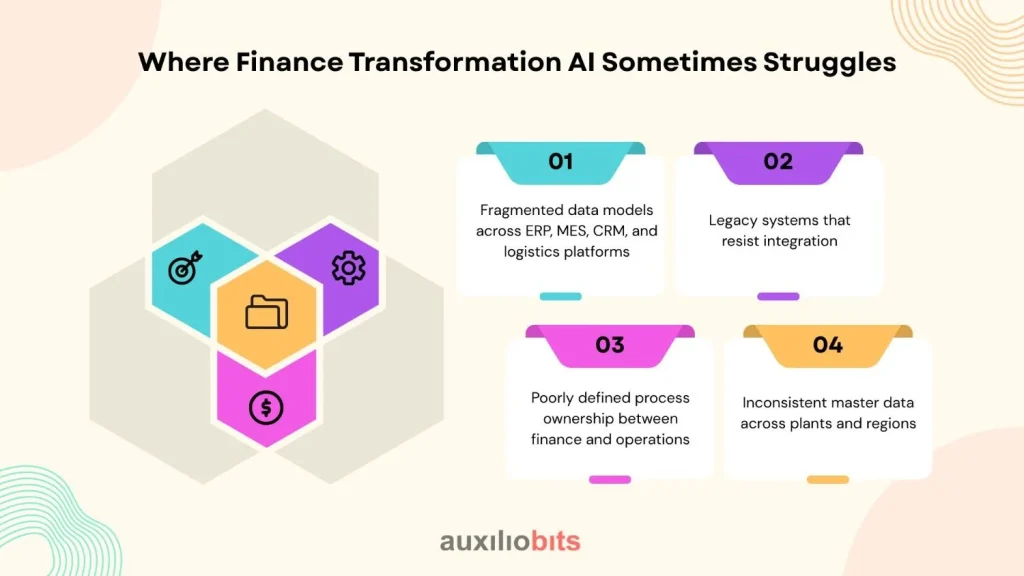
- Fragmented data models across ERP, MES, CRM, and logistics platforms
- Legacy systems that resist integration
- Poorly defined process ownership between finance and operations
- Inconsistent master data across plants and regions
AI agents depend on data consistency. Without it, automation becomes fragile.
Another complication is governance.
AI-driven financial decisions must operate within strict compliance frameworks—particularly for revenue recognition and financial reporting.
Organizations implementing Agentic AI in finance need guardrails such as:
- Human review thresholds
- Audit trails for automated decisions
- Explainability for financial auditors
- Clearly defined exception workflows
Ignoring these realities usually causes early automation projects to stall.
A Real-World Pattern: Finance Teams Becoming Process Architects
An interesting cultural change occurs in organizations adopting Agentic AI for finance transformation.
Finance leaders stop thinking purely about accounting workflows and begin designing cross-functional decision processes.
They start asking questions like:
- What operational signals should trigger financial actions?
- Which financial checks should happen automatically?
- When should humans intervene versus AI agents
Finance effectively becomes the architect of operational-financial intelligence. It’s a broader role than traditional shared services management. And frankly, some finance leaders enjoy this shift more than others.
Beyond Shared Services: The Emerging Finance Architecture
If we step back, the future finance architecture in manufacturing looks different from the shared services model that dominated the last decade.
Instead of centralizing people performing repetitive tasks, organizations are orchestrating networks of AI agents managing operational-financial workflows.
These agents may:
- Validate transactions across systems
- Detect anomalies in procurement and revenue flows
- Monitor operational signals affecting financial performance
- Initiate corrective workflows automatically
Human finance professionals still play a crucial role.
However, their work is directed toward the following:
- Decision oversight
- Financial strategy
- Cross-functional coordination
- Exception resolution
Routine verification work gradually disappears.
A Final Observation from the Field
Manufacturing companies often approach finance transformation manufacturing initiatives cautiously. Finance functions are risk-sensitive, and understandably so.
But something interesting is happening. The organizations experimenting with finance transformation AI are not necessarily the most technologically advanced manufacturers.
They are usually the ones frustrated with the limitations of shared services and traditional automation.
They realize something important: Finance systems record financial outcomes—but operational systems create them. Agentic AI finally allows finance to operate in both worlds simultaneously.
That shift—small as it may sound—is what moves finance transformation beyond shared services and into something far more integrated with how manufacturing businesses actually run.