


- Mobile apps alone don’t create automation. T he real efficiency gains come from backend intelligence that connects data, systems, and decisions.
- Field Service AI improves dispatch, diagnostics, and parts planning by analyzing historical service data and operational patterns.
- Backend intelligence reduces repeat visits by predicting likely issues and ensuring technicians arrive with the right information and components.
- Successful field service automation AI depends heavily on clean data and gradual adoption, not aggressive automation from day one.
- The future of service operations lies in AI-driven backend orchestration, where intelligent systems continuously optimize scheduling, inventory, and service workflows.
For years, field service digitization has mostly meant one thing: giving technicians a mobile app.
Work orders appear on a phone. A technician checks the job, updates the status, maybe uploads a photo, and closes the task. From a distance, that looks like automation. But anyone who has spent time around service operations knows the truth is a bit messier.
The real complexity of field service doesn’t sit on the technician’s screen. It lives behind it.
Scheduling conflicts. Parts availability. Warranty validation. Customer histories are dispersed throughout various CRM systems. Decisions related to dispatching are made under pressure. Data is present everywhere, yet it is often scattered and not consolidated in one location when needed.
That’s where field service AI and deeper field service automation AI capabilities begin to matter. The significance lies not in the mobile layer, but in the backend intelligence that quietly orchestrates everything around it.
And when that backend becomes intelligent, something intriguing happens: the mobile app stops being the center of the system. It becomes just another interface.
The Limits of Mobile-First Field Service Automation
Mobile apps solved a real problem. They eliminated paperwork orders, enabled real-time updates, and gave technicians access to documentation on-site.
But they also created a false sense of automation.
A typical technician workflow still looks something like this:
- Dispatch assigns a work order.
- The technician reviews it on a mobile device.
- Calls the office if something is unclear.
- The individual arrives on-site and discovers a missing context.
- The individual makes requests for additional parts or approvals.
- Manually updates status fields.
- Finance later reviews the job for billing.
Plenty of software is involved, yet the decision-making remains largely manual.
What’s missing is backend intelligence—the layer that connects systems, interprets data, and assists humans in making operational decisions.
Without that layer, mobile tools simply digitize existing inefficiencies, leading to continued operational challenges and missed opportunities for optimisation.
Where Field Service Complexity Lives
Most service organizations underestimate how fragmented their operational data really is.
Customer history may sit in the CRM. Asset maintenance logs might live in an ERP module. Warranty validation is often stored in a separate system. Inventory visibility depends on warehouse platforms.
And then there are the unofficial data sources—emails, spreadsheets, and technician notes.
A mobile app doesn’t fix that fragmentation. It just surfaces pieces of it.
Field service automation becomes powerful only when backend systems start doing the heavy lifting:
- Correlating service history with failure patterns
- Predicting parts demand before dispatch
- Automatically validating warranty claims
- Detecting scheduling conflicts
- Recommending technicians based on skill and geography
That’s where field service AI begins to shift operations from reactive coordination to intelligent orchestration.
Backend Intelligence: The Quiet Engine of Modern Field Service
Backend intelligence often receives little attention because it is invisible. Customers don’t see it, and technicians barely notice it.
But it’s the reason some service organizations resolve cases in hours while others take days.
Consider the dispatch decision alone.
Assigning the “nearest technician” sounds logical. In reality, the optimal assignment depends on far more variables:
- Technician certifications
- Asset familiarity
- Parts availability
- Traffic conditions
- SLA commitments
- Customer priority levels
Manually balancing those variables is unrealistic. Field service automation AI can evaluate them in seconds.
And interestingly, the output often surprises experienced dispatchers. The best technician for a job isn’t always the closest one. Sometimes it’s someone slightly farther away but with deeper equipment familiarity, which can lead to more efficient and effective service outcomes.
These small decisions compound over hundreds of daily service requests, ultimately affecting overall efficiency and customer satisfaction in field service operations.
How Field Service AI Works Behind the Scenes
Most discussions around AI in field service focus on flashy ideas—predictive maintenance, which anticipates equipment failures; autonomous diagnostics, which automatically identifies issues; or IoT-driven alerts, which are notifications generated by Internet of Things devices.
Those capabilities matter, but day-to-day operations benefit more from practical intelligence embedded across backend workflows, such as optimising scheduling, improving resource allocation, and enhancing communication between field technicians and support teams.
Here are some areas where field service AI quietly improves operations.
1. Intelligent Work Order Enrichment
Service requests rarely arrive with complete information. Customers describe symptoms vaguely: “The unit is making a strange noise.”
Backend AI systems can enrich these requests automatically by analyzing:
- Asset installation history
- Previous repair logs
- Known failure patterns for that model
- Recent service activities
The result? A work order that already includes probable root causes and recommended spare parts before a technician is even assigned.
2. AI-Driven Dispatch Optimization
Traditional dispatch rules are static:
- Assign technician by region
- Prioritize high SLA customers
- Avoid overtime if possible
But service environments change constantly. Field service automation AI adapts dispatch decisions dynamically by analyzing factors like:
- technician workload
- equipment specialization
- predicted job duration
- traffic data
- historical repair success rates
Sometimes the system will recommend dispatching a senior technician early to avoid multiple repeat visits later. That may look expensive at first glance—but it often reduces total operational cost by minimising the need for additional visits and ensuring that issues are resolved more efficiently on the first try.
3. Automated Warranty and Entitlement Checks
Warranty verification remains a surprisingly manual process in many companies.
Service coordinators often check multiple systems to confirm whether a repair is covered. It slows down approvals and frustrates customers, leading to longer wait times for service and decreased customer satisfaction.
Backend intelligence can automate this step by connecting service records, product registration data, and contract details, which are the various types of information that help determine if a repair is covered under warranty.
A few things happen automatically:
- Warranty eligibility is validated during work order creation
- Service contracts are checked against asset history
- Billing flags are applied if coverage doesn’t exist
This eliminates a surprising amount of administrative work.
Backend Intelligence Also Reduces Administrative Noise
Another overlooked advantage of field service AI is how it reduces operational noise.
Service teams often deal with dozens of micro-decisions every day:
- Which job should move first in the queue?
- Does this repair require managerial approval?
- Should a replacement unit be offered instead of repair?
- Is this case eligible for escalation?
Individually, each decision seems minor. Collectively, they consume a significant amount of time.
Backend automation can handle many of these tasks quietly:
- Prioritize service requests automatically
- Route escalations based on severity
- Flag high-value customers needing faster resolution
- Detect recurring equipment failure
- Trigger internal alerts when SLA thresholds are at risk
The goal isn’t to replace human judgment. It’s to remove repetitive operational decisions so teams can focus on the complex ones.
Why Backend Intelligence Often Fails
Despite the promise of field service automation AI, implementation usually requires multiple attempts to work well.
There are a few recurring reasons.
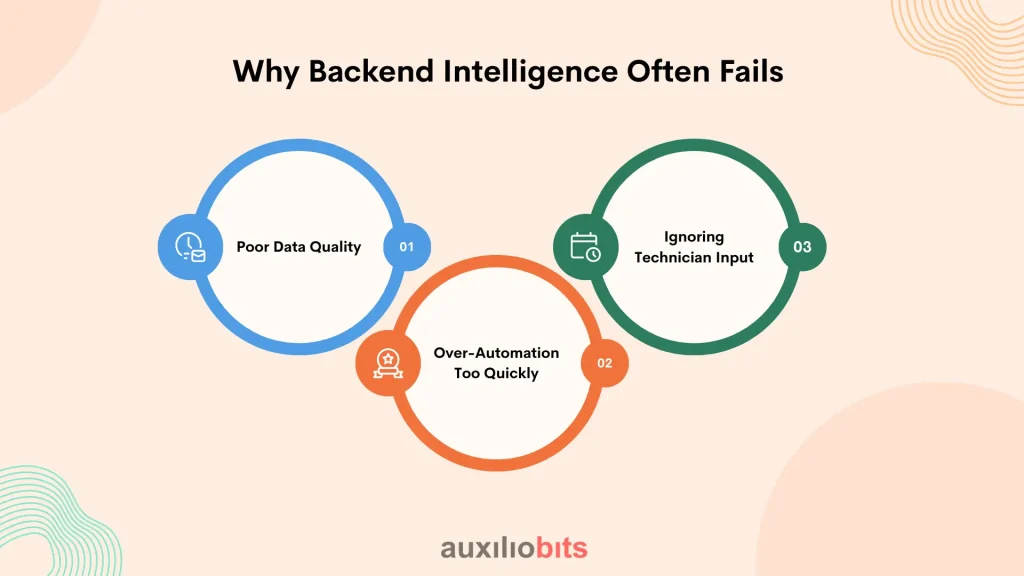
1. Poor Data Quality
AI models depend on historical service data. Unfortunately, many organizations have inconsistent records.
Technicians may describe similar problems using different terms:
- compressor failure
- compressor issue
- unit not cooling
These variations complicate pattern detection. Cleaning and standardizing service data is often the most time-consuming part of implementing backend intelligence.
2. Over-Automation Too Quickly
Some companies try to automate every decision at once. That usually backfires. Backend intelligence, which refers to the use of algorithms and data analysis to support decision-making, works best when introduced gradually—starting with decision support rather than full automation. Dispatch teams, for example, are more likely to trust recommendations before allowing an algorithm to make assignments automatically.
3. Ignoring Technician Input
Field technicians hold a massive amount of operational knowledge. When AI models are developed without incorporating technician feedback, predictions can become unrealistic.
The most successful deployments treat technicians as collaborators, not just users.
The Role of AI Agents in Field Service Operations
The next evolution of backend intelligence involves autonomous agents coordinating service workflows.
Instead of a single centralized system making recommendations, specialized agents handle different operational domains:
- Dispatch optimization agents
- Parts inventory agents
- Warranty validation agents
- Customer communication agents
These agents exchange information continuously, enabling faster decisions without constant human coordination.
For example: A parts inventory agent detects declining stock of a commonly used component. It informs the dispatch agent, which adjusts technician assignments accordingly. Meanwhile, a procurement agent initiates a restocking order.
None of this requires manual intervention. This is where field service automation AI starts moving toward true operational autonomy, enabling systems to operate independently and efficiently without human oversight.
Mobile Apps Still Matter—Just Not as the Core System
This means mobile tools are relevant. Technicians still need intuitive interfaces to access job details, capture diagnostics, and communicate with customers.
But the role of mobile applications is shifting.
Instead of acting as standalone tools, they become endpoints for a much smarter backend ecosystem that integrates various data sources and enhances the overall efficiency of the technicians’ workflow.
Technicians see:
- recommended diagnostics
- likely parts needed
- asset history summarized automatically
- suggested repair procedures
All powered by backend intelligence they may never notice directly.
A Shift in How Service Organizations Operate
The shift from mobile-first digitization to backend intelligence isn’t dramatic on the surface.
Technicians still arrive at sites. Repairs still happen physically. Equipment still breaks.
But internally, operations become far more coordinated. Decisions move faster. Repeat visits decline. Dispatch teams spend less time firefighting.
Perhaps most importantly, service organizations begin learning from their own data.
Every completed job strengthens the intelligence behind the system.
That feedback loop—quietly operating in the background—is what ultimately separates ordinary digital field service from truly intelligent service operations powered by Field Service AI.
And interestingly, customers rarely notice the technology.
They simply notice that problems get solved faster.