







Key Takeaways
- Most dispute delays happen before investigation even begins—creation latency is the hidden bottleneck.
- AI agents compress dispute creation from days to minutes by interpreting, enriching, and routing cases instantly.
- Faster creation doesn’t just save time—it fundamentally changes how resolution teams work.
- The best results come from hybrid models, not full automation—confidence-based routing is key.
- The real impact isn’t speed alone, but shifting operations from reactive workflows to always-ready systems.
If you’ve spent any time around finance ops, order-to-cash teams, or shared service centers, you already know this: disputes rarely fail because people don’t care. They fail because the system around them is too slow, too fragmented, and oddly dependent on manual interpretation.
A customer raises a dispute. Someone logs it. Someone else classifies it. A third person hunts for supporting documents across ERP, email threads, and maybe even spreadsheets that shouldn’t exist anymore—but do. The clock has already been ticking for days by the time the case is formally created and routed.
And here’s the uncomfortable part: most organizations have already “automated” parts of this process. Yet dispute creation—the very first step—remains stubbornly manual.
This stage is where AI agents revolutionise dispute case automation. Not by adding another dashboard. Not by replacing humans entirely. But by collapsing the time between a signal and action,
Why Dispute Creation Is the Real Bottleneck
Everyone talks about resolution SLAs. Very few talk about creation latency.
In many organizations, dispute lifecycle timing looks something like this:
- Day 0: Customer sends email / portal submission
- Day 1–2: Case is manually logged
- Day 3–5: Initial classification and assignment
- Day 6+: Actual investigation begins
So when leadership says, “Why are disputes taking 10 days to resolve?”, the honest answer is: they’re not. They’re taking 4–5 days to resolve after someone finally starts working on them.
The delay sits up front. And that delay exists because:
- Inputs are unstructured (emails, PDFs, screenshots)
- Classification depends on human judgment
- Systems don’t talk to each other cleanly
- Context gathering is painfully manual
You can’t fix resolution speed without fixing creation speed. That’s where dispute management automation starts to matter—not as a buzzword, but as an operational lever.
Also read: Sales Order Processing Without Manual Intervention
What AI Agents Do in Dispute Creation
There’s a tendency to oversimplify AI agents as “smart bots”. That’s not quite right.
A well-designed AI agent for dispute creation behaves more like a junior analyst who:
- Reads incoming communication
- Interprets intent
- Pulls relevant data from multiple systems
- Makes a judgment call (with confidence levels)
- Creates and routes a case
But—unlike a human—it does the job in seconds, not hours.
Typical Workflow with AI Agents
When implemented properly, the flow looks less like a linear process and more like a coordinated system:
Ingest incoming signals
- Emails, EDI messages, portal submissions
- Even voice transcripts in some cases
Interpret intent
- Is this a pricing dispute? Short shipment? Duplicate invoice?
- Or is it not a dispute at all (you’d be surprised how often that happens)
Extract structured data
- Invoice number
- Order ID
- Disputed amount
- Reason codes (even if not explicitly stated)
Enrich context automatically
- Pull invoice details from ERP
- Fetch delivery confirmations
- Retrieve contract terms or pricing agreements
Create the dispute case
- Populate fields accurately
- Assign category and priority
- Route to the right queue or owner
Flag uncertainties
- If confidence is low, escalate for human validation
- If confidence is high, proceed autonomously
This entire sequence often completes in under a minute.
Faster Resolution Isn’t Just About Speed
It’s tempting to frame the process purely as a time-saving exercise. But speed alone isn’t the full story.
Faster dispute creation changes how resolution happens.
1. Context Is Available Earlier
When cases are created manually, context gathering is delayed. Agents spend the first few hours—or days—just assembling information.
With AI-driven creation:
- Supporting documents are attached upfront
- Relevant transaction history is already linked
- Classification is pre-determined (and often more consistent)
So resolution teams start with a near-complete picture.
2. Routing Accuracy Improves
Manual routing tends to rely on:
- Generic queues
- Overloaded inboxes
- Tribal knowledge (“send it to Raj; he handles these.”)
AI agents, on the other hand:
- Use historical patterns
- Analyze dispute type, customer profile, and transaction data
- Route cases to the most appropriate handler immediately
This alone can shave days off resolution time.
3. Parallel Processing Becomes Possible
Here’s something most teams don’t explicitly plan for: parallelism.
When cases are created instantly and enriched automatically:
- Credit teams can review exposure earlier
- Logistics teams can verify delivery simultaneously
- Sales can engage with customers proactively
Instead of sequential handoffs, you get overlapping workstreams.
Where It Works Really Well
Not all dispute scenarios benefit equally from automation. That’s worth acknowledging.
1. Strong Fit Scenarios
- High-volume, repetitive disputes
- Pricing mismatches
- Short shipments
- Duplicate billing
- Structured or semi-structured inputs
- Standardized customer emails
- Portal submissions with defined fields
- Clear historical patterns
- When past cases provide enough training data for classification
2. Less Ideal Scenarios
- Highly ambiguous disputes
- “We’re unhappy with the service.”
- Vague complaints without clear financial impact
- Complex contractual disagreements
- Multi-layered pricing agreements
- Legal interpretations
- Low-volume, high-value disputes
- These often require human judgment from the start
Even in these cases, though, AI agents can still assist—just not fully automate.
A Real-World Example: Manufacturing Distribution
One manufacturing client (mid-sized, global distribution network) had a familiar problem:
- ~3,000 disputes per month
- Average case creation time: 2.5 days
- Resolution SLA: 10 days (often breached)
The root cause wasn’t lack of effort. It was fragmentation:
- Customer emails in shared inboxes
- ERP data spread across modules
- Supporting documents stored in multiple systems
What Changed
They implemented AI-driven dispute case automation focused only on creation—not resolution.
Within 3 months:
- Case creation time dropped from 2.5 days to under 30 minutes
- First-touch resolution improved by ~35%
- SLA breaches reduced significantly (though not eliminated)
Interestingly, resolution teams didn’t suddenly work faster. They just started earlier, with better context.
There was some resistance initially:
- “What if the AI misclassifies cases?”
- “What about edge cases?”
Both valid concerns.
In practice:
- ~80% of cases were handled autonomously
- ~20% were flagged for human review
The hybrid model worked better than expected.
The Challenges Nobody Talks About
It’s easy to focus on the upside. But there are real challenges that show up during implementation.
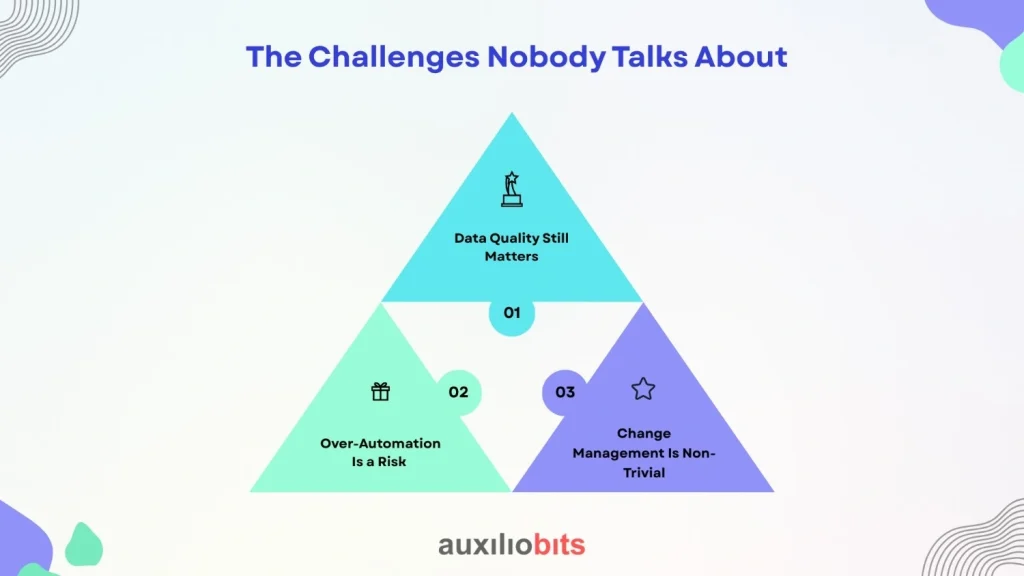
1. Data Quality Still Matters
AI agents are only as effective as the data they access.
If:
- Invoice data is inconsistent
- Customer master data is outdated
- Delivery confirmations are missing
Then even the best models will struggle. Automation doesn’t fix bad data. It just exposes it faster.
2. Over-Automation Is a Risk
There’s a temptation to push for 100% automation. That’s usually a mistake.
Some disputes genuinely require:
- Human judgment
- Customer context
- Relationship sensitivity
Blindly automating these can backfire—especially in high-value accounts.
A better approach:
- Aim for high-confidence automation
- Accept that some cases should remain human-led
3. Change Management Is Non-Trivial
People don’t always trust automated decisions—especially when they’ve been doing the work manually for years.
Common reactions:
- “I want to double-check what the system did.”
- “This doesn’t capture the nuance.”
Over time, trust builds—but only if:
- The system is transparent
- Exceptions are handled gracefully
- Teams are involved in training and feedback loops
Designing AI Agents for Dispute Creation
There’s no shortage of tools in the market. The differentiator isn’t the tool—it’s the design.
A few practical considerations that tend to make or break implementations:
1. Intent Recognition Needs Domain Context
Generic NLP models struggle with domain-specific language.
“Short shipped”, “price variance”, “unauthorized deduction”—these aren’t universal phrases.
Models need:
- Domain training data
- Continuous learning from resolved cases
2. Confidence Scoring Is Critical
Not every decision should be treated equally.
Good systems:
- Assign confidence scores to classifications
- Route low-confidence cases for human review
- Learn from corrections
Bad systems:
- Treat every output as final
3. Integration Depth > Interface Design
A slick dashboard doesn’t matter if:
- ERP integration is shallow
- Data retrieval is slow
- Systems remain siloed
The real value comes from:
- Deep system connectivity
- Real-time data access
4. Feedback Loops Should Be Built-In
Resolution outcomes are gold.
If a dispute is:
- Reclassified
- Reassigned
- Resolved differently than expected
That feedback should:
- Train the model
- Improve future accuracy
Without these updates, the system stagnates.
Why This Matters More Than It Seems
At a surface level, dispute management automation looks like an operational efficiency play.
But there’s a deeper impact.
1. Cash Flow Improves
Faster dispute creation → faster resolution → quicker collections.
It’s not always linear, but the correlation is strong.
2. Customer Experience Changes
Customers don’t necessarily expect disputes to be resolved instantly. But they do expect acknowledgement and progress.
When cases are created immediately:
- Acknowledgments are faster
- Communication improves
- Friction reduces
3. Internal Work Feels Different
This part is harder to quantify.
When teams aren’t spending hours:
- Logging cases
- Copy-pasting data
- Hunting for documents
They can focus on:
- Analysis
- Decision-making
- Customer interaction
And yes, that tends to improve morale—though not overnight.
A Slightly Contrarian Take
Not every organization needs full-scale AI-driven dispute creation.
If you’re dealing with:
- Low volumes
- Highly complex disputes
- Strong existing processes
The ROI might not justify the effort. But for high-volume environments, especially in manufacturing, logistics, and distribution, the impact is difficult to ignore.
The bigger question isn’t whether to adopt dispute case automation.
It’s how far you want to take it:
- Assistive automation?
- Semi-autonomous agents?
- Fully autonomous case creation?
Most successful implementations land somewhere in the middle.
The Real Shift: From Reaction to Readiness
The most intriguing change isn’t speed—it’s posture.
Traditional dispute processes are reactive:
- Wait for input
- Process manually
- Respond eventually
AI-driven systems are closer to being ready by default:
- Inputs are captured instantly
- Context is assembled automatically
- Cases are created proactively
That shift—from reaction to readiness—is subtle but powerful. And it starts with something deceptively simple: creating the case faster.
But if you’ve ever waited two days for a dispute to even show up in the system, you know exactly why it matters.