






Key Takeaways
- Explainability in agentic systems must be architected intentionally, focusing on decision accountability rather than exposing raw internal reasoning traces.
- Decision chains require narrative preservation across agents, time, and context—outcomes alone rarely explain why something actually happened.
- Role clarity, confidence signalling, and timestamps matter more for trust than verbose chains of thought or low-level model introspection.
- Practical explainability balances autonomy and oversight; over-explaining every step often damages usability and operational efficiency.
- Mature teams design explanations for humans first—operators, managers, engineers—letting audit readiness emerge naturally afterward.
Explainability used to be a compliance checkbox. Now it’s an architectural concern.
Once you move from single-model predictions to agentic systems—where multiple autonomous components reason, delegate, revise plans, and sometimes contradict each other—the old ideas of “model interpretability” start to feel inadequate. A SHAP plot won’t tell you why an agent chose to ignore a recommendation from another agent. A feature-importance chart won’t explain why a workflow stalled because an upstream agent decided the confidence threshold “felt off.”
And yet, these are precisely the questions business, risk, and engineering leaders are asking.
“Why did the system do that?”
“Who made the call?”
“What information was available at the time?”
“Would it behave the same way tomorrow?”
Designing for explainability in agentic decision chains is not about making every internal calculation human-readable. That’s unrealistic and, frankly, unnecessary. It’s about designing systems that can account for their behavior in ways that align with human reasoning, organizational accountability, and operational reality.
That’s a harder problem than most teams expect.
Also read: Agents as Frontline Advisors in Retail Loyalty Programs
Why Explainability Breaks Down in Agentic Systems
Traditional explainability techniques assume a relatively simple flow:
Input → Model → Output → Explanation
Agentic architectures violate this assumption almost immediately.
You’re dealing with:
- Multiple agents with overlapping responsibilities
- Recursive reasoning loops (agents revisiting their own conclusions)
- Dynamic tool usage (APIs, databases, external systems)
- Non-deterministic behaviors driven by probabilistic reasoning or LLM sampling
- Context accumulation over time, not just per request
In a real-world procurement automation project, an organisation attempted to identify the reason behind a three-day delay in vendor onboarding. The answer wasn’t a single failure. It was a chain of decisions:
- A compliance agent flagged missing documentation—but with low confidence
- A sourcing agent overrode the flag based on historical vendor trust scores
- A finance agent paused the process anyway due to an unrelated credit signal
- A coordinator agent delayed escalation because the SLA hadn’t technically expired
Each step made sense in isolation. Together, the outcome looked arbitrary.
When leadership asked for an explanation, the system had logs—but not reasons. It recorded actions, not intent. That’s the gap.
Explainability Is a Design Choice, Not a Post-Processing Step
One of the most common mistakes teams make is treating explainability as something you “add later.” Maybe you’ll log prompts. Maybe you’ll store agent messages. Maybe you’ll ask the LLM to summarize its reasoning if someone complains.
That approach works for demos. It collapses in production.
Explainability has to be designed into the decision chain, not layered on top of it.
This means making explicit choices about:
- What counts as a decision versus an internal thought
- Which decisions must be attributable to an agent role
- How confidence, uncertainty, and disagreement are represented
- Where human-readable reasoning is required—and where it isn’t
Not every internal token matters. But some moments absolutely do.
Decision Chains vs. Decision Trees
A subtle but important distinction: agentic systems don’t follow decision trees. They follow decision chains.
A tree implies a branching structure where paths are known in advance. A chain evolves over time. Earlier decisions reshape the context for later ones. Agents may revisit prior conclusions with new information.
This has consequences for explainability.
In a fraud detection use case, for example:
- An intake agent classifies a transaction as “borderline suspicious”
- An investigation agent requests additional data
- A risk agent downgrades severity based on customer tenure
- A policy agent enforces a hard stop due to regulatory constraints
If someone asks, “Why was this transaction blocked?”, the answer isn’t “because of rule X.” It’s the interaction between agents, constraints, and timing.
Designing for explainability here means preserving the narrative of the chain, not just the final trigger.
What Needs to Be Explainable?
Here’s where nuance matters. Not everything in an agentic system deserves the same level of transparency. Trying to explain everything leads to noise, not clarity.
In practice, the following elements matter most:
- Decision boundaries: When did an agent cross from “monitor” to “act”? Why did that moment occur?
- Overrides and conflicts: Which agent overruled another? What was the authority behind the overrule?
- External dependencies: Did a decision rely on stale data, a failed API call, or an estimated value?
- Confidence and uncertainty: Was the agent confident—or simply uncertain?
- Policy enforcement points: Where did business rules or regulatory constraints intervene?
Interestingly, users rarely care about the internal chain of thought. They care about justification. Those aren’t the same thing
Patterns That Work in Practice
Over the last couple of years, a few architectural patterns have emerged that improve explainability without crippling autonomy.
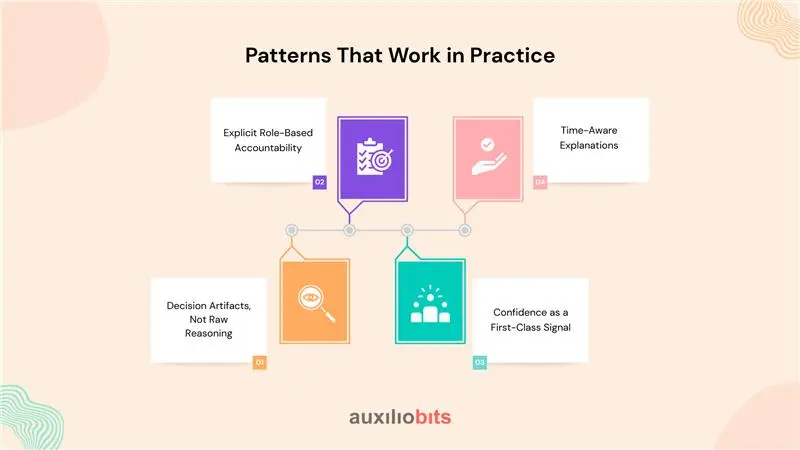
1. Decision Artifacts, Not Raw Reasoning
Instead of storing full internal reasoning traces, some teams generate structured decision artifacts at key moments.
These artifacts capture:
- The decision made
- The alternatives considered
- The primary signals influencing the choice
- The confidence level
- The agent responsible
Think of it as a commit message for agent behavior.
This approach works particularly well in regulated environments. It’s easier to audit, easier to review, and less likely to expose sensitive internal prompts.
2. Explicit Role-Based Accountability
When agents are loosely defined (“helper agent,” “assistant agent”), explainability suffers. When agents have clear mandates, explanations improve almost automatically.
Compare: “The system decided to delay processing.”
Versus: “The Compliance Agent delayed processing due to incomplete KYC documentation, despite the Sourcing Agent recommending continuation.”
Same system. The level of clarity varies significantly.
Naming matters. So does scoping authority.
3. Confidence as a First-Class Signal
Many systems approach confidence as a secondary consideration. In agentic chains, that’s a mistake.
Agents should be able to say:
- “I am confident, proceed automatically.”
- “I am uncertain, escalate.”
- “I disagree, but I lack override authority.”
This not only improves decision quality—it makes explanations more honest. A system that admits uncertainty is often trusted more than one that pretends to be certain.
4. Time-Aware Explanations
Explanations should reflect when a decision was made, not just what was decided.
Context changes. Data freshness matters. Policies evolve.
One logistics firm learnt this the hard way when an AI agent approved shipments based on a pricing rule that had changed earlier that day—but the agent’s context hadn’t refreshed yet. The explanation, without timestamps, looked negligent. With timestamps, it looked like a synchronization issue.
That distinction mattered.
What Mature Teams Do Differently
Teams that get this right tend to share a few habits:
- They argue about explainability early, not after incidents.
- They involve domain experts in defining “acceptable explanations”.
- They treat explanations as products, not logs.
- They accept that some decisions will remain partially opaque—and plan for escalation instead of clarity.
Most importantly, they stop chasing perfection.
Explainability in agentic decision chains is not about full transparency. It’s about sufficient understanding—enough to trust, intervene, and improve the system over time.
That bar is higher than traditional automation. It’s also more human.
And that, in many ways, is the point.