






Key Takeaways
- Compliance is the invisible engine of construction success. Missed renewals or incorrect filings can halt projects or trigger costly investigations, making proactive compliance management critical.
- Traditional automation broke down in a real-world context. Static RPA and template-based workflows couldn’t interpret evolving local rules, forcing humans back into every decision loop.
- CrewAI introduces reasoning-driven coordination. Instead of executing scripts, its digital agents—Permit, Safety, Inspection, Documentation—interpret, collaborate, and act like a true project crew.
- Compliance shifts from reactive to predictive. CrewAI continuously analyzes behavioral and documentation patterns, surfacing risks and inefficiencies before they escalate.
- The future of compliance is live and interpretive, not clerical. CrewAI reframes compliance as a dynamic awareness layer across construction operations—reducing errors, increasing trust, and elevating human focus to analysis and decision-making.
Take a chance and explore any major construction site, and you’ll sense two things instantly—the energy and the paperwork. Stacks of forms in plastic folders, checklists pinned to site walls, inspectors scribbling signatures that might or might not get scanned later. Everyone’s racing against the clock, but a surprising amount of that rush is about compliance, not construction.
For all our drones, digital twins, and fancy dashboards, construction still runs on signatures, not systems. And while automation has flirted with fixing that, it’s never quite managed to understand why compliance feels so human—full of exceptions, judgment calls, and dependencies that don’t fit into neat boxes.
That’s the gap where CrewAI starts to make sense: a coordinated set of reasoning agents that manage compliance not by repetition, but by interpretation.
Also read: CrewAI vs. ReAct Agents: Choosing the Right Framework
The Hidden Cost of Construction Compliance
Compliance is the invisible work that keeps everything legal, safe, and funded. Skip a permit renewal, and your cranes stop turning. Misfile an inspection report, and the insurance company starts asking expensive questions.
In day-to-day project reality:
- Roughly a quarter of management time goes into administrative cross-checking and paperwork validation.
- Nearly half of all project delays have a compliance or approval dependency hiding in the background.
- Rework on documentation or reporting can eat 20%–30% of overhead, especially on multi-site builds.
Project management tools like Primavera or Procore do fine with scheduling and tasks. But compliance isn’t about when something happens—it’s about whether it meets an evolving rulebook that changes faster than most teams can read. That nuance, the interpretation layer, is where automation usually collapses.
Why Traditional Automation Didn’t Fit
Before CrewAI entered the conversation, companies tried all sorts of automation patches—scripts, macros, and RPA bots that checked forms and moved PDFs around. Most of them worked for a month or two and then quietly failed. Why?
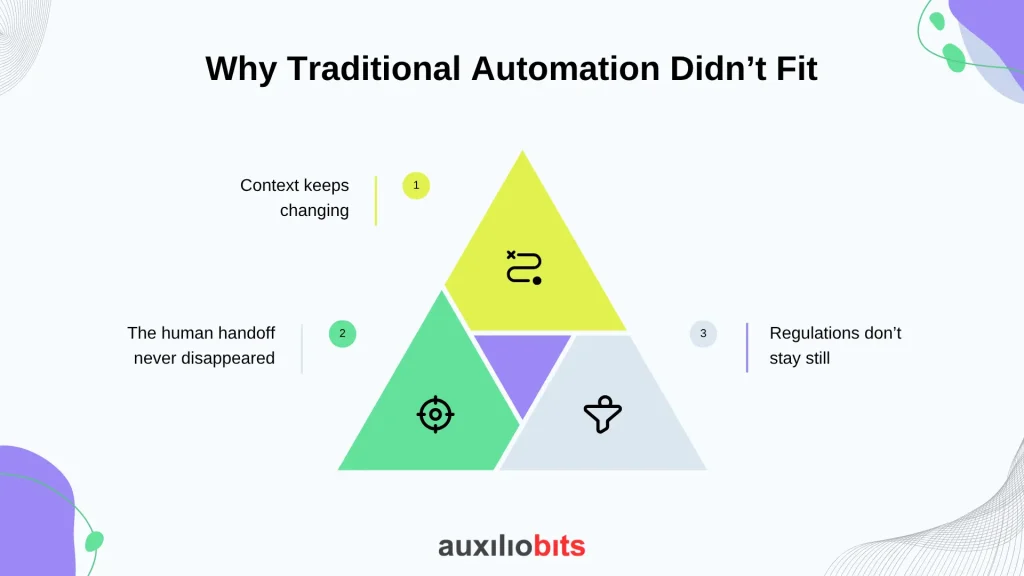
- Context keeps changing: A concrete curing permit in Texas means one thing; in Singapore, it means something else entirely. Rule-based bots don’t understand context—they execute, they don’t reason.
- The human handoff never disappeared: When something didn’t fit a rule, bots stopped and sent it to a human. That “human in the loop” turned into “human on every loop.”
- Regulations don’t stay still: Every few months, new environmental or safety standards come out. Updating templates and logic flows each time costs more than it saves.
CrewAI works differently because it doesn’t rely on static rules. It uses a small ecosystem of agents that can interpret meaning, recognize when something is unclear, and coordinate with one another—more like people than programs.
What CrewAI Really Means Here
Picture a construction project like a living system. Instead of one monolithic compliance tool, imagine a team of specialized digital crew members:
- A Permit Agent that monitors every active permit, checks expiration timelines, and cross-verifies local regulation updates.
- An Inspection Agent that reviews reports, highlights missing certifications, and even nudges inspectors to re-upload clean versions.
- A Safety Agent that reads logs, monitors incident data, and flags recurring risks before they become citations.
- A Documentation Agent that handles version control, aligns everything to ISO, OSHA, or local standards, and keeps an audit trail that can actually survive scrutiny.
The crucial part? These agents talk to each other. The Permit Agent might ask, “Has the subcontractor’s insurance been validated for this activity?” and get an actual verified answer from the Documentation Agent. That’s coordination, not just automation.
CrewAI isn’t a single bot that pushes buttons. It’s a digital crew that reasons through compliance steps the same way a field team does—only faster, more consistently, and without coffee breaks.
Fragmented Accountability: The Real Problem
Most compliance failures aren’t about negligence. They happen because accountability gets scattered. Permits might sit in the engineering folder. Safety records live on someone’s laptop. Insurance certificates? Procurement’s responsibility. Everyone assumes someone else is watching.
CrewAI changes that by attaching persistent memory and contextual reasoning to each compliance layer. When a document gets verified by one agent, that validation doesn’t vanish—it’s visible everywhere.
So the next time a safety officer uploads a checklist, the system already knows whether that worker’s induction training was current, whether the permit covered that task, and who approved it last time.
That’s not about replacing humans. It’s about removing the “Did anyone check this yet?” conversation that eats hours every week.
How CrewAI Handles Real-World Complexity
Take a practical example. A subcontractor is about to start electrical installation on-site. Before they begin, they need to ensure:
- Safety induction completed
- Equipment inspections done and logged.
- High-voltage work permits approved
- Site conditions are compliant with local safety norms
Normally, this means three emails, five attachments, and someone physically confirming a checklist. With CrewAI, the process reshapes itself:
- The Safety Agent validates worker certifications.
- The Inspection Agent checks tool compliance records.
- The Permit Agent ensures regulatory approval for that activity.
- A Supervisor Agent confirms all preconditions and sends a single green light notification to site leads.
No human coordinator needed, no frantic phone calls at 7 a.m. when inspectors show up. CrewAI anticipates these linkages, not just reacts to them.
The Integration Glue
Here’s where many companies misunderstand the point. CrewAI doesn’t replace your existing tools. It connects them.
Whether you’re using Procore, Autodesk, or Bentley systems, CrewAI reads from their APIs, interprets context, and acts when something’s missing.
If an inspection report is uploaded but lacks a digital signature, it doesn’t just flag an error. It says, “Inspection report for Tower B (dated 5 Nov) is missing certification. Should I request a digital sign-off from the Safety Officer?”
That’s how humans communicate. That’s how CrewAI earns trust—by behaving like a competent project assistant, not a rigid rule enforcer.
Where CrewAI Still Struggles
No system, however intelligent, eliminates ambiguity. Compliance will always have gray areas.
- Subjective decisions—whether a deviation counts as major or minor still need a human call.
- Legal accountability—agents can prepare attestations, but signatures stay with humans.
- Cultural barriers—many site managers still prefer visual proof to algorithmic suggestions.
So, while CrewAI reduces manual work, it doesn’t erase the need for oversight. It simply moves the human focus higher up—from chasing files to analyzing trends.
A Field Example
A mid-sized EPC firm tried CrewAI for environmental compliance last year. Fifteen active projects, all juggling waste disposal and emissions documentation.
Before CrewAI, it took about ten days per project each month just to compile and validate reports. Once they deployed a few reasoning agents:
- A Reporting Agent summarized sensor data from IoT devices.
- A Regulation Agent updated emission thresholds based on new local laws.
- A Document Agent prepared filings and routed them for final sign-off.
Within four months:
- Reporting time dropped by two-thirds.
- Filing errors shrank by 70%.
- And, maybe the best part—zero audit penalties for the first time in years.
The compliance officers didn’t feel replaced. They described it as finally having a system that knew what they meant, not just what they typed.
Reasoning Beats Panic
Anyone who’s been through a pre-audit week knows that tension — endless calls, missing files, last-minute reconciliations. CrewAI dismantles that chaos by keeping continuous memory.
Each agent retains state awareness: what’s validated, what’s pending, who last confirmed it. Instead of restarting every time an audit approaches, teams begin from an updated, living record.
It’s not just operational relief—it’s mental relief. That nagging “Did we forget something?” The feeling disappears, replaced by quiet confidence.
An Overlooked Advantage: Predictive Risk Profiling
The more CrewAI runs, the smarter it gets at spotting patterns.
- Delays in inspection uploads might indicate understaffing.
- Frequent permit renewals for identical scopes may signal planning inefficiency.
- Repeated document corrections could reveal a training gap.
These insights show up automatically as dynamic risk profiles. That means compliance isn’t a rearview process anymore—it becomes predictive.
Suddenly, compliance officers aren’t just keeping the site safe; they’re helping improve productivity and planning quality.
Beyond Construction: The Broader Echo
While construction makes for a perfect testbed—high complexity, rotating crews, volatile regulation — the underlying principle isn’t industry-specific.
CrewAI-style orchestration could apply in mining, oil and gas, or even pharmaceutical manufacturing, where multi-tier approvals and shifting safety norms dominate daily work.
If it can survive construction’s chaos, it can adapt anywhere.
Questions a Serious Manager Should Ask First
Rolling out CrewAI without introspection is a mistake. The right preparation matters. Ask:
- Where does your compliance knowledge live — in systems or people’s heads?
- How often do rules change, and who updates them?
- Can your tools talk to each other through APIs?
- Who handles exceptions when agents get stuck?
- Do your teams trust AI-generated alerts, or do they ignore them?
These questions shape whether CrewAI becomes a partner or just another pilot project that fizzles out after six months.
Rethinking Compliance Work Itself
For years, compliance was treated as a cost center—something you had to do to avoid trouble. CrewAI reframes it as a continuous operational pulse.
Instead of asking “Are we compliant?”, project leads start asking “How compliant are we, right now?”
It’s a shift from documentation to awareness — from static to live compliance. And that shift might do more for productivity than any scheduling app or ERP upgrade ever coul