







Key Takeaways
- Start with one high-volume product line; don’t attempt an enterprise-wide rollout immediately.
- Budget for retraining pipelines—models are not static assets.
- Treat integration as a first-class problem, not an afterthought.
- Prepare your workforce for role transitions; human inspectors won’t vanish, but their jobs will shift.
- Evaluate vendors not just on accuracy metrics but on their ability to integrate with your MES/ERP stack.
Quality control has always been a sore spot in manufacturing. Everyone knows it’s essential, yet it often sits at the awkward intersection of cost, speed, and human judgment. You hire inspectors, train them well, give them checklists and magnifiers—and still, defects slip through. Or, on the flip side, overzealous inspection rejects excellent products, adding waste where none should exist.
That tension has given rise to one of the most practical applications of computer vision and agent-driven automation: autonomous quality control. Unlike broad, futuristic visions of “Industry 4.0,” this is something companies are quietly deploying right now. And, perhaps ironically, it isn’t the robots that are flashy—it’s the cameras, the models behind them, and the orchestration of digital agents that are doing the heavy lifting.
Also read: How a Manufacturing Enterprise Automated Vendor Onboarding & Approval Processes with RPA + AI
Why Human Inspection Falls Short
On paper, humans should be ideal inspectors. Our eyes are adaptive, and our brains excel at pattern recognition. But on the shop floor, reality intervenes:
- Fatigue dull accuracy. A worker examining 2,000 circuit boards per shift simply cannot maintain the same sharpness in hour one and hour eight.
- Subjectivity creeps in. What one inspector calls “minor cosmetic blemish,” another flags as “reject.”
- Scaling is nearly impossible. Add a new product line or ramp up production, and suddenly you need dozens more inspectors—hard to train, harder to retain.
This doesn’t make human inspectors obsolete. In fact, their judgment is still critical in edge cases where defects are rare, ambiguous, or context-sensitive. But for repetitive, high-volume tasks, the math is merciless: vision algorithms beat people, both in consistency and speed.
Computer Vision Agents: Not Just Cameras with AI
The phrase “computer vision” tends to conjure up images of cameras running defect detection algorithms. That’s only part of the story. In real-world plants, vision systems must do more than just detect scratches or misalignments. They need to act like agents—autonomous entities that perceive, decide, and trigger downstream workflows.
A typical computer vision agent in a manufacturing line:
- Captures images or video streams at critical checkpoints (post-assembly, pre-packaging, final dispatch).
- Processes inputs in real time using convolutional neural networks (CNNs) or transformer-based models trained on historical defect datasets.
- Classifies outcomes into pass/fail categories, often with confidence scores.
- Triggers automated actions—ejecting defective units, alerting a supervisor, or updating the manufacturing execution system (MES).
- Learns and adapts by feeding back misclassifications into retraining pipelines, often orchestrated in the cloud.
Notice the distinction: these are not passive systems. They don’t wait for human intervention to act. And that autonomy is where the real operational gains show up.
Where It Works Best
Not all inspection tasks are equal. Autonomous quality control shines in some contexts and stumbles in others. From factory visits and project reviews, here’s where it tends to excel:
- High-volume, repetitive production: Electronics assembly lines, automotive components, or packaging where visual features matter.
- Clear defect signatures: Surface scratches, solder joint irregularities, missing labels—anything with a strong visual cue.
- Structured environments: Lines where lighting, positioning, and object orientation are consistent.
And where does it falter? Anywhere noise dominates the signal:
- Complex, irregular products like hand-crafted furniture, where each unit has natural variation.
- Transparent or reflective surfaces, where glare confuses algorithms.
- Rare defect scenarios: If a defect appears once in 10,000 units, training data will be scarce, and models will be prone to false negatives.
In those cases, hybrid inspection models—computer vision agents as the first pass, humans as final arbiters—tend to be more realistic.
Case Reference: Automotive Electronics
Consider an automotive supplier producing ECU (electronic control unit) boards. A single faulty board can lead to warranty claims costing millions. Historically, inspectors with microscopes would check solder joints. Now, high-resolution vision agents inspect every joint in under a second, flagging microscopic voids or cold joints invisible to the naked eye.
- Throughout, the jump jumped from 300 boards/hour to nearly 2,000.
- Consistency improved: Reject rates are now tightly correlated across shifts, rather than swinging depending on who’s on duty.
- Engineers intervene only on edge cases, reviewing less than 2% of boards.
This isn’t hypothetical. Several Tier-1 automotive suppliers have openly reported such gains at conferences, though most stop short of naming vendors (for competitive reasons).
Nuances in Implementation
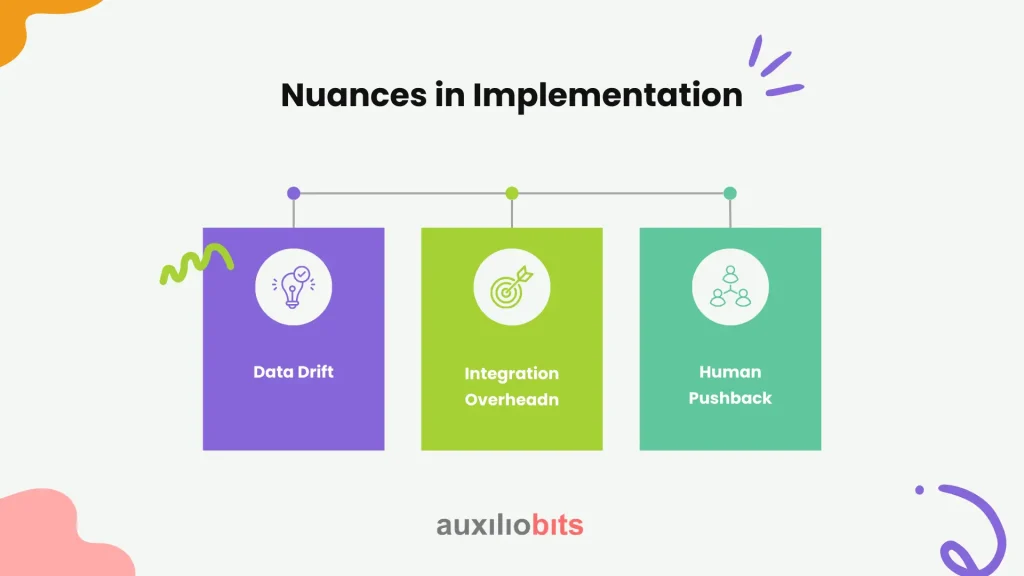
Anyone who’s been part of a rollout knows the hype can mislead. Installing cameras and slapping on a TensorFlow model isn’t the reality. Three things repeatedly come up in failed or delayed deployments:
1. Data Drift
Lighting changes, new suppliers for raw materials, or a subtle tweak in paint formulation can throw off a model trained on last year’s data. Agents need retraining pipelines, ideally automated, to stay accurate.
2. Integration Overhead
Spotting a defect is one thing; getting that signal to the right PLC (programmable logic controller) in milliseconds is another. If integration is clumsy, production halts instead of improving.
3. Human Pushback
Inspectors don’t always welcome cameras replacing parts of their job. Successful rollouts often involve repositioning human staff into roles that require judgment, not repetition—turning inspectors into supervisors of inspection.
The Business Equation
Manufacturers are not tech labs; they adopt systems when ROI is clear. With computer vision agents, ROI often comes from three overlapping sources:
- Reduced defect escapes → fewer warranty claims, fewer recalls.
- Higher throughput → lines run faster because inspections don’t bottleneck.
- Lower labor intensity → not necessarily layoffs, but less reliance on seasonal or temp inspection staff.
For a mid-size manufacturer, cutting inspection-related delays by even 10% can unlock millions annually. Of course, ROI varies by product margin, defect risk, and customer tolerance. In low-margin, high-volume consumer goods, the math often favors automation much faster than in low-volume, high-customization industries.
Why Agents, Not Just Models
An important point: why frame these as agents rather than “AI models”? Because in production, perception alone isn’t enough. These systems must integrate into broader digital ecosystems:
- An agent doesn’t just “see” a defect—it decides what to do about it.
- It communicates with MES, ERP, or warehouse systems, ensuring rejected goods are logged, not lost.
- It can negotiate priorities: when throughput is at risk, some lines are configured to allow marginal passes with downstream testing rather than hard stops.
This agentic framing also matters for scaling. As factories move toward autonomous lines, having siloed models becomes a liability. Coordinated agents—vision working with predictive maintenance, supply chain forecasting, and robotic handling—create synergy.
Yet, interestingly, the latter doesn’t always feel “better.” There’s a sterility to full automation that sometimes unnerves even seasoned managers.
There have been cases where operators deliberately slow adoption, preferring a hybrid setup not because it’s more efficient, but because it feels safer. Machines are relentless; humans add caution. That emotional layer—rarely discussed in technical whitepapers—often determines the pace of adoption more than ROI calculations.
What’s Next?
The technology stack itself is evolving quickly:
- Edge AI deployments reduce latency, eliminating the need to stream terabytes of video to the cloud.
- Synthetic data generation helps train models on rare defect types without waiting months for actual examples.
- Explainable vision models are emerging, making it easier to understand why a defect was flagged—a key issue in regulated industries like pharma.
Whether every manufacturer needs this tomorrow is debatable. But ignoring it altogether? That seems increasingly risky. Customers are starting to ask whether suppliers use automated inspection, especially in automotive and aerospace. The signal is clear: autonomous quality control is moving from “innovative” to “expected.”
Closing Thoughts
Autonomous quality control with computer vision agents isn’t a silver bullet, but it’s becoming hard to ignore. Plants that rely solely on human inspectors will continue to face fatigue-driven errors, bottlenecks, and escalating costs. Meanwhile, those that embed vision agents into their lines are discovering not just higher consistency, but also better data flows that feed into broader operational intelligence.
That said, adoption is rarely smooth. Models drift, integrations bite back, and workforce transitions require tact. But manufacturers that treat these challenges as part of the journey—not as reasons to stall—are already gaining a competitive edge.
The shift is subtle but profound: quality is no longer just about catching defects; it’s about building self-correcting systems that prevent them from slipping through in the first place. In that sense, computer vision agents are less about replacing people and more about raising the standard of what modern factories can realistically deliver.