

Key Takeaways
- Propagation, not approval is the real engineering change risk. Most failures happen after the ECO is approved, when dependent BOMs, routings, and documents drift out of sync.
- Engineering Change AI adds a reasoning layer above PLM and ERP systems. It predicts impact, detects hidden dependencies, and surfaces cross-functional blind spots that workflow tools alone cannot identify.
- BOM and routing misalignment is often subtle but expensive. Even small propagation gaps create rework, MRP instability, scrap, and audit exposure.
- AI works best as decision augmentation, not replacement. High-complexity changes benefit most, while human review remains critical for accountability and regulatory compliance.
- The real ROI is enterprise stability. Beyond cycle-time reduction, Engineering Change AI reduces planning noise, supplier confusion, and downstream operational disruption—creating a more predictable manufacturing environment.
If you’ve ever participated in a change control meeting that extended two hours beyond the scheduled time, you likely recognise the issue.
An engineering change sounds simple on paper. Update a drawing. Revise a component. Adjust a tolerance. But in a real manufacturing environment, that “small change” ripples through:
- The Bill of Materials (BOM)
- Routing steps in the ERP or MES
- Work instructions on the shop floor
- Supplier documentation
- Quality control plans
- Service manuals
And somewhere in that chain, someone misses an update. That’s not a software problem. It’s a propagation problem.
This is where Engineering Change AI stops being a buzzword and starts being practical infrastructure.
The issue isn’t generating changes. Engineers are skilled at that. The challenge is making sure every dependent artefact—BOMs, routings, documentation—reflects the new reality without weeks of manual coordination and risk.
Let’s talk about how propagation actually works, why it breaks, and what automation can (and can’t) realistically solve.
The Hidden Cost of Change Propagation
Most companies believe their change processes are “controlled.” They have an ECO or ECN workflow inside systems like SAP or Oracle. Approvals are tracked. Revisions are logged.
And yet:
- Production builds to an outdated routing.
- A supplier receives an obsolete drawing.
- A service manual references the wrong subassembly.
- MRP runs explode against a superseded component.
The systems exist. The synchronization does not.
Why?
Because traditional change management assumes human-driven propagation:
- Engineering updates the CAD.
- Someone updates the BOM.
- Another team reviews routing impact.
- Documentation revises instructions.
- Procurement checks supplier implications.
Each step depends on someone remembering what else the change might affect.
Memory does not scale.
Also read: Automating Bill of Lading and Shipping Documentation
Where Propagation Fails
Let’s ground this in reality.
An engineer replaces a machined bracket with a cast version to reduce cost. The CAD is updated. The top-level BOM revision changes.
But what about:
- Subassembly BOM references?
- Alternate BOMs for regional plants?
- Are the routing steps connected to the machining operations?
- Inspection plans referencing dimensional tolerances?
- Packaging documentation tied to weight changes?
If you’ve worked in manufacturing long enough, you know what usually happens.
Someone catches most of it. Not all.
The propagation gap isn’t dramatic. It’s subtle. It’s the 2% misalignment that causes:
- Rework
- Scrap
- Late shipments
- Audit findings
Engineering Change AI addresses that 2%.
BOM Propagation: More Than Just Line Items
cost roll-ups, alternates, and effectivity logic.
When a component changes, the impact could include:
- Parent assemblies across product families
- Phantom BOMs used in planning
- Regional variations
- Service or aftermarket configurations
Manual review works when product complexity is low. It collapses under variant-heavy portfolios.
Engineering change AI in BOM management does three important things:
1. Dependency Graph Analysis
AI models build relational maps of component usage across:
- Assemblies
- Plants
- Customers
- Revision histories
Instead of asking, “Where is this used?” you get a probabilistic impact model showing:
- Direct parents
- Indirect structural dependencies
- Historical change patterns tied to similar components
It doesn’t just search. It reasons.
2. Pattern Recognition in Historical Changes
Change patterns repeat. More than we admit.
For example:
- When tolerance tightens, inspection routing changes 78% of the time.
- When material changes, supplier updates are required in 62% of cases.
- When weight increases beyond threshold X, packaging specs must change.
Engineering Change AI learns these patterns from past ECO data. It flags likely downstream adjustments before humans even consider them.
3. Effectivity Conflict Detection
Effectivity dates and serial ranges are often the quiet killers of alignment.
AI can simulate overlapping effectivity logic across BOM structures and identify:
- Gaps in serial coverage
- Overlapping revisions
- Planning inconsistencies
That’s not something most teams manually verify. They assume ERP logic will handle it. It often doesn’t.
Routing Propagation: The Step Everyone Forgets
Routing is where engineering intent meets operational reality.
Change a part’s geometry, and suddenly:
- Machining cycle time shifts.
- A tool change becomes mandatory.
- An inspection step must be inserted.
- A manual assembly step disappears.
Yet routing updates are frequently treated as a secondary activity.
Why?
Because routings sit in operations. Engineering owns design. The bridge is usually a spreadsheet or an email thread.
Engineering Change AI helps close that gap by:
- Mapping design attributes to process steps.
- Detecting mismatches between new specifications and current routing logic.
- Suggesting impacted work centers based on feature changes.
For example:
If a component changes from aluminium to stainless steel:
It doesn’t blindly modify routing. It proposes structured updates with confidence scores.
And that matters. Because of fully autonomous routing edits? This approach is not recommended in environments that are subject to regulation.
Documentation: The Slowest Domino
Documentation is almost always the last thing updated.
Work instructions, quality plans, service manuals—these are narrative artifacts. They’re not clean database tables.
Propagation here is messy.
You’ll find:
- Embedded dimension references in PDFs.
- Copied text across multiple documents.
- Inconsistent terminology across regions.
Engineering change AI, especially when combined with large language models, can:
- Parse unstructured documents.
- Detect references to revised components.
- Highlight inconsistencies.
- Propose updated text blocks.
Is it perfect? No.
But it dramatically reduces the manual search-and-edit workload.
In regulated industries—medical devices, aerospace, automotive—the documentation burden is significant. Companies operating under standards like International Organization for Standardization frameworks or compliance regimes tied to U.S. Food and Drug Administration oversight cannot afford document misalignment.
Engineering change AI provides audit traceability by:
- The system links document updates to specific ECO triggers.
- Capturing rationale for proposed changes.
- Maintaining revision audit trails.
That’s where it becomes compliance infrastructure, not just automation.
A Practical Scenario: Mid-Sized Industrial Manufacturer
A mid-sized industrial equipment manufacturer—let’s call them “Company A”—struggled with recurring ECO delays.
Symptoms:
- 18–25 days average change cycle.
- Frequent shop floor clarification requests.
- MRP instability after design updates.
They were running on Siemens TeamCenter, integrated with ERP. The workflow existed. The propagation discipline did not.
When they implemented Engineering change AI:
- BOM dependency graphing reduced missed parent updates by 80%.
- Routing misalignment tickets dropped by nearly half.
- Documentation revision lag shrank from weeks to days.
What surprised thm most?
There was a decrease in meetings related to changes.
AI surfaced impact analysis automatically, so cross-functional reviews focused on decisions—not discovery.
That shift alone improved engineering morale.
Where Engineering Change AI Fails
It’s tempting to present this as magic. It isn’t.
Propagation AI struggles when:
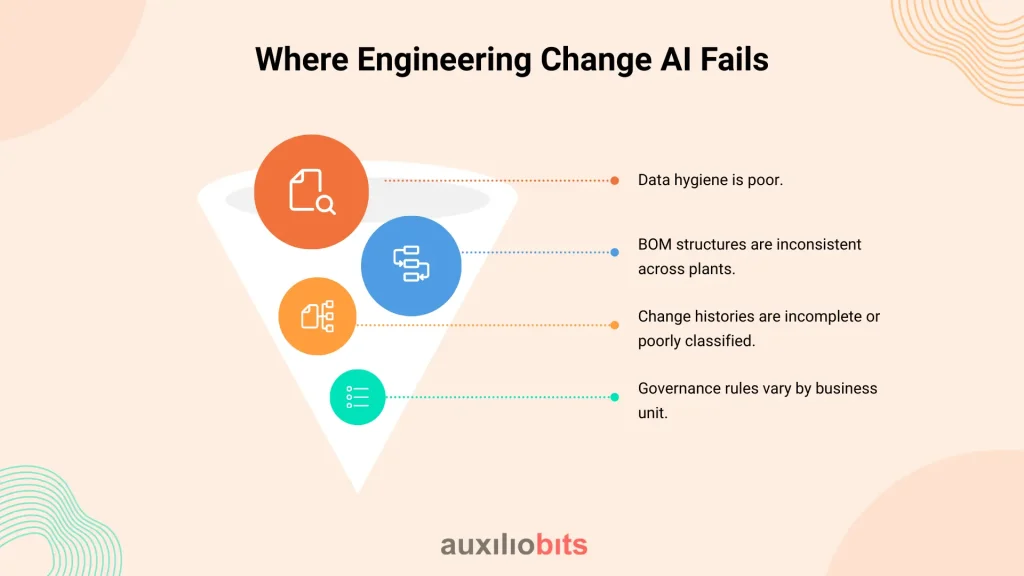
- Data hygiene is poor.
- BOM structures are inconsistent across plants.
- Change histories are incomplete or poorly classified.
- Governance rules vary by business unit.
Garbage in, intelligent garbage out.
Another nuance: not every change requires full automation.
For low-risk cosmetic updates, heavy AI analysis adds overhead. The value lies in high-complexity, high-impact changes. There’s also organizational resistance.
Engineers may distrust AI-suggested impacts. Operations teams may fear loss of control. IT may worry about integration risk.
Engineering change AI works best as decision augmentation, not decision replacement.
Why Traditional Workflow Tools Aren’t Enough
Workflow systems are transactional.
They answer:
- Who approves?
- When does it move?
- What revision number increments?
They do not answer:
- What else breaks?
- What patterns suggest hidden impact?
- Where are cross-functional blind spots?
That’s a reasoning layer problem.
Engineering change AI introduces:
- Predictive impact modeling
- Cross-domain dependency inference
- Historical pattern extrapolation
It sits above transactional systems.
Without that layer, organizations are relying on experience and checklists. Those work—until complexity scales.
The ROI Most Leaders Miss
Cost savings from automation are easy to calculate:
- Reduced engineering hours
- Faster cycle times
- Fewer errors
But the bigger impact is stability.
Every change destabilizes planning. MRP noise increases. Safety stock creeps upward. Expedites become normal.
Engineering change AI reduces:
- Unplanned production interruptions
- Downstream rework
- Supplier confusion
- Audit remediation efforts
It stabilizes the enterprise. And stability is rarely measured directly, yet it shows up everywhere—from margin to customer satisfaction.
Designing an Effective Engineering Change AI Layer
If you’re considering implementation, here’s what matters:
1. Start With Clean Structural Data
- Normalize BOM hierarchies.
- Standardize routing templates.
- Align naming conventions across plants.
Without structural consistency, AI impact modeling becomes unreliable.
2. Build Cross-System Connectors
Propagation rarely lives in one platform. Integration across:
- PLM
- ERP
- MES
- Document management systems
3. Train on Historical ECO Data
The more labeled change history you provide, the better the pattern recognition.
Don’t underestimate this. Five years of ECOs are far more valuable than a new algorithm.
4. Maintain Human Review
AI suggests. Humans approve. This preserves accountability and builds trust.
The Final Thoughts
Will Engineering change AI eliminate all propagation errors? No.
Will it replace engineering judgment? Absolutely not.
But in environments with:
- High product complexity
- Multi-plant operations
- Regulatory oversight
- Rapid design iteration
Manual propagation is increasingly fragile.
If your organization is scaling product variants, shortening design cycles, or integrating digital threads across lifecycle systems, propagation automation isn’t optional anymore.
It’s foundational.
And if you’ve ever spent a Friday evening reconciling a misaligned BOM and routing revision before a Monday production run—you already know why.
The technology is finally mature enough to support the nuance. The bigger question is whether organizations are ready to trust it.
In my experience, the ones that adopt it early don’t just move faster.
They sleep better.