


Key Takeaways
- AI Lead Qualification identifies genuine buying intent by analyzing behavioral patterns, company context, and historical CRM data rather than simple engagement metrics.
- Better marketing-to-sales handoffs improve conversion rates, as sales teams receive contextual lead insights instead of raw inquiries.
- AI lead scoring in manufacturing prioritizes engineering and product-level engagement signals, which are often stronger indicators of real purchase intent.
- Sales teams remain essential to the process, providing feedback that helps refine AI models and improve lead prioritization accuracy.
- Manufacturers adopting AI-driven lead scoring improve response speed and pipeline quality without increasing sales workload.
Manufacturing sales has never been simple. The deals are larger, the buying cycles stretch for months, sometimes years, and the number of stakeholders involved often grows as the opportunity progresses. In theory, marketing generates leads and sales closes them. In practice, the space between those two steps is where most revenue quietly disappears.
That space is lead qualification.
For years, manufacturing organizations relied on marketing automation platforms and rule-based scoring models to filter enquiries. A whitepaper download earns 10 points. A webinar attendance earns 20. A demo request jumps straight to “sales-ready”. It seemed structured, even scientific.
However, anyone with experience in a manufacturing sales organization understands the uncomfortable reality: those scores seldom accurately represent genuine buying intent.
A procurement manager researching a technology trend can look identical to a genuine buyer preparing a capital purchase. Marketing celebrates a high lead volume. Sales complains about poor quality. The handoff becomes friction instead of collaboration.
This is precisely where AI lead qualification is starting to reshape how manufacturing companies identify and route real opportunities. And interestingly, the most significant improvement is not just better prediction. It is better handoffs.
The Manufacturing Sales Qualification Problem
Before talking about algorithms, it helps to acknowledge how manufacturing sales actually work.
Unlike transactional B2B sales, manufacturing purchases typically involve:
- Multiple decision-makers across engineering, procurement, and operations
- Technical validation before commercial discussions
- Long research phases before engaging suppliers
- Channel partners and distributors influencing the decision
Because of this complexity, the traditional marketing-to-sales handoff model often breaks down. Marketing might generate thousands of leads through events, whitepapers, or trade publications. But sales teams operate with limited capacity. A regional sales engineer cannot realistically investigate every inquiry.
So organizations create filters. Marketing-qualified leads (MQLs), sales-qualified leads (SQLs), scoring thresholds.
The intention is good. The outcome is mixed.
Three patterns appear repeatedly in manufacturing companies:
First, many qualified leads are not actually ready to speak with sales.
They are researching specifications or exploring alternatives.
Second, genuinely promising opportunities sometimes get buried because they don’t meet arbitrary scoring rules.
Third, the transition from marketing to sales becomes slow and manual.
Someone reviews the lead. Someone else checks the company profile. Someone writes a handoff note. By the time sales engages, the buyer may already be speaking with a competitor.
Also read: Why Manufacturing Needs Decision Automation, Not Just Process Automation
Why Traditional Lead Scoring Struggles in Manufacturing
Rule-based scoring models worked reasonably well for high-volume B2B SaaS companies. They struggle in manufacturing environments for structural reasons.
Manufacturing buyers behave differently.
Consider a realistic example. A design engineer at an industrial equipment manufacturer spends two weeks researching robotic vision systems. They download technical documentation, view CAD integration guides, and read case studies.
Traditional scoring might treat this as moderate engagement. Now compare that with a university student downloading a general whitepaper on automation trends. That activity might generate a similar score.
From a sales perspective, these two contacts are completely different.
Rule-based scoring cannot reliably detect the difference because it relies on simple signals:
- Form submissions
- Page visits
- Email opens
These indicators are shallow. They rarely capture intent. That is precisely where AI lead scoring manufacturing systems begin to provide meaningful improvement.
What AI Lead Qualification Changes
There is a tendency to frame AI lead qualification as a magic prediction engine. That description misses the more practical value.
AI does not just score leads. It analyzes context. Instead of looking at isolated interactions, AI models evaluate patterns across multiple dimensions:
- Website behavior sequences
- Industry and company size alignment
- Content consumption patterns
- CRM engagement history
- Product configuration exploration
- Time gaps between interactions
When these signals combine, they reveal something much closer to buying intent.
For example, AI might recognize that:
- Engineering documentation downloads followed by pricing page visits often precede demo requests.
- Visitors from specific industry segments convert faster.
- Certain distributor referrals correlate strongly with closed deals.
These patterns emerge from historical sales data, not marketing assumptions. And once the model learns these relationships, it can prioritize leads in ways that rule-based systems simply cannot.
Why Better Handoffs Matter More Than Better Scores
This is where the real operational impact appears. The purpose of AI Lead Qualification is not just scoring accuracy. It is enabling smoother transitions between marketing and sales teams. Manufacturing companies frequently underestimate how much revenue is lost during this handoff stage.
Consider the traditional process. Marketing passes a lead with minimal context: “Downloaded whitepaper and attended webinar.”
Sales receives it and begins manual investigation.
- Who is this company?
- What product line might they need?
- Are they a current customer?
- Which region should handle the account?
The first interaction often becomes a discovery exercise rather than a relevant conversation.
AI-driven qualification changes this dynamic.
Instead of delivering a raw lead, the system can provide structured insight:
- Predicted product interest
- Industry-specific use case alignment
- Estimated deal size range
- Engagement signals indicating urgency’
Sales teams receive something far more useful than a score. They receive a contextual opportunity profile. And that dramatically improves the handoff.
A Realistic Example: Industrial Automation Supplier
One industrial automation company recently implemented AI-driven qualification after years of frustration with marketing-generated leads.
Their challenge was familiar. Marketing produced thousands of annual enquiries from trade shows and digital campaigns. Yet sales engineers consistently ignored most of them because past experiences suggested they were low value.
The result? Real opportunities were being missed. After introducing an AI lead scoring manufacturing model trained on historical CRM and ERP data, several patterns emerged.
Some surprising ones.
For instance:
- Visitors downloading integration documentation were far more likely to convert than those attending webinars.
- Companies with smaller engineering teams actually moved faster in purchase cycles.
- Repeated website visits from procurement roles were strong buying signals.
Once these signals were incorporated into the qualification model, the lead routing process changed.
Instead of sending everything to sales, the system created three categories:
- Immediate sales engagement
- Nurture with targeted technical content
- Low-priority or research-stage contacts
Sales engineers began receiving far fewer leads. But the ones they received were significantly better. Interestingly, the biggest improvement was not conversion rate. It was response speed. Sales responded faster because they trusted the leads. Trust is a strangely under-discussed element in marketing and sales collaboration. But it matters.
Signals That AI Systems Use for Manufacturing Lead Qualification
Manufacturing-specific AI qualification models rely on signals that traditional marketing automation often fails to capture effectively.
Some examples include:
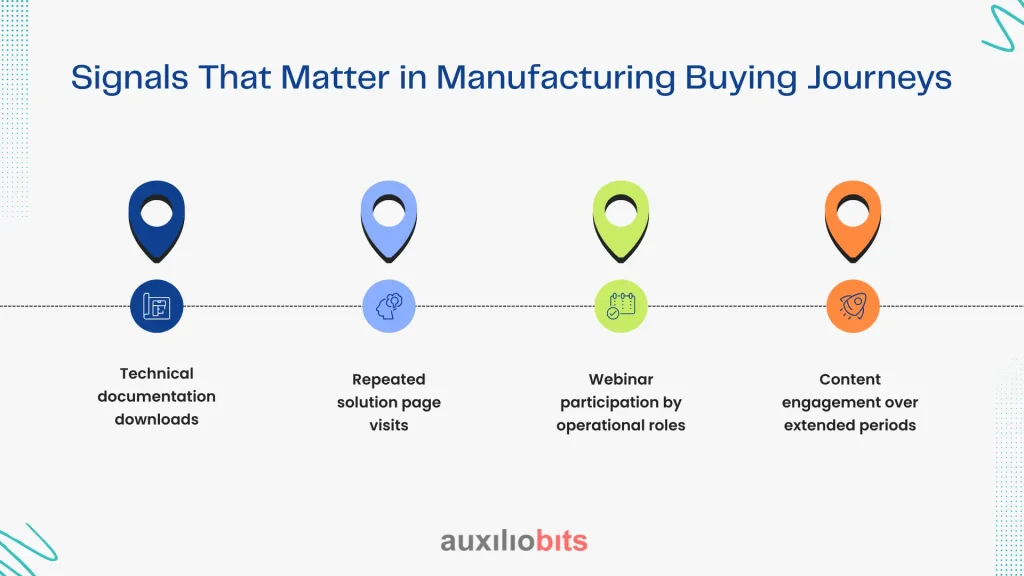
1. Behavioral Signals
- repeated visits to specification sheets
- CAD model downloads
- product configurator usage
- time spent on integration documentation
These actions usually indicate engineering involvement rather than casual browsing
2. Organizational Signals
- mpany size relative to target segments
- industry-specific purchasing cycles
- location proximity to distribution partners
A robotics manufacturer selling to automotive suppliers might prioritize entirely different signals than one targeting food processing plants.
3. Sales Interaction Signals
AI also learns from CRM history:
- prior quotes requested
- previous product inquiries
- distributor communications
- service ticket history
Often, a returning customer exploring an upgrade becomes the highest-value opportunity. Traditional lead scoring rarely captures this context.
Where AI Lead Qualification Still Fails
Despite the enthusiasm around AI-driven qualification, it is not perfect. And pretending otherwise creates unrealistic expectations.
Some common limitations appear repeatedly.
1. Limited historical data
Many manufacturing companies lack sufficient CRM history to train reliable models. Without closed-loop sales data, predictions remain shallow.
2. Poor data hygiene
Duplicate accounts, inconsistent industry tags, and incomplete records can distort AI analysis.
3. Unstructured buyer journeys
Manufacturing purchases sometimes begin offline through distributor relationships or industry referrals. AI systems relying heavily on digital signals may miss these opportunities entirely.
And occasionally, the system simply misinterprets intent. A curious engineer researching new technologies might trigger high scores despite having no purchasing authority. AI reduces these mistakes, but it does not eliminate them.
Practical Steps to Implement AI Lead Qualification
Manufacturing companies exploring AI Lead Qualification often start with technology selection.
That is usually the wrong starting point.
The more practical approach involves several operational steps.
1. Map the real sales journey
Document how opportunities actually emerge. Not the theoretical pipeline, but the messy reality. Where do enquiries originate? How long before they reach sales? Which signals correlate with deals?
2. Clean CRM and marketing data
Without reliable historical data, AI models cannot identify patterns. Many companies discover data issues during this stage.
3. Define clear handoff criteria
Rather than focusing purely on scoring thresholds, define what information sales teams need before engaging a lead.
For example:
- probable product line
- industry context
- company role in buying process
4. Introduce AI models gradually
Start with lead prioritization rather than full automation. Sales teams should validate the recommendations before relying on them completely.
5. Build feedback loops
Allow sales teams to flag incorrect classifications and contribute insight. The system improves when real-world experience feeds back into the model.
Why Manufacturing Organizations Are Prioritizing AI Lead Scoring Now
The timing of this shift is not accidental. Manufacturing companies face growing pressure to improve sales efficiency. Hiring more sales engineers is expensive. Trade shows produce unpredictable results. Marketing teams generate digital engagement, but converting that interest into revenue remains difficult.
AI-based qualification addresses a practical constraint: sales capacity.
When the right leads reach sales teams faster, several things happen simultaneously.
- Response times shrink
- Discovery conversations become more relevant
- Sales teams trust marketing pipelines more
It does not transform manufacturing sales overnight. But it improves the operational flow between marketing and sales in ways traditional automation never quite managed. And that operational flow is often where deals are won or lost.
The Ending Thoughts
sales processes.
In reality, the most meaningful improvements often happen quietly. Better prioritization. More contextual lead handoffs. Faster engagement with serious buyers.
Those changes do not appear dramatic in dashboards. But they compound over time. The companies that succeed with AI lead scoring manufacturing systems are rarely the ones chasing flashy AI capabilities. They are the ones fixing the overlooked operational gaps between marketing signals and sales conversations.
Lead qualification has always been about judgment. AI simply gives that judgment better information.