

Key Takeaways
- Installed base intelligence is the foundation for identifying cross-sell and upsell opportunities in manufacturing.
- Cross-Sell AI enables continuous monitoring of equipment lifecycles, usage patterns, and service signals to surface revenue opportunities.
- AI agents help sales teams prioritize high-value opportunities, reducing reliance on manual account research.
- Service and maintenance data are critical inputs for predicting upgrades, parts demand, and complementary product sales.
- Manufacturers that unify installed base data gain a long-term competitive advantage in recurring revenue and customer retention.
Manufacturers don’t usually think of themselves as “upselling businesses.” That mindset tends to live in SaaS companies and subscription platforms. Yet, quietly, manufacturing firms sit on one of the richest upsell opportunities in the entire B2B economy: the installed base.
Every machine sold creates a long tail of revenue potential—replacement parts, upgrades, maintenance packages, complementary equipment, software add-ons, retrofits, and consumables. In theory, sales teams should already be capturing these opportunities.
In practice, most companies barely scratch the surface.
The problem isn’t lack of intent. It’s lack of visibility. Sales teams rarely have a reliable view of what customers actually own, what condition it’s in, or what the logical next purchase should be. Data lives in fragmented systems: ERP holds transaction history, service teams manage maintenance logs elsewhere, and CRM often contains partial customer notes.
This is where cross-sell AI and autonomous agents are beginning to change the equation.
When AI agents learn from existing data, they can keep looking at equipment, service records, usage trends, and lifecycle information to find money-making chances that human teams would likely overlook.
The result is something manufacturing companies have been chasing for years: systematic cross-sell and upsell at scale.
The Installed Base Problem Most Manufacturers Ignore
Ask a manufacturing sales leader a simple question: What does your average customer own right now?
The answer is usually vague. Someone might say, “They bought three machines five years ago.” Another person will mention a service contract. But a precise, structured record of the installed base across customers? That’s surprisingly rare.
And yet the installed base should be the foundation of revenue growth. Consider a typical industrial equipment manufacturer. Over a 10–15 year lifecycle, the original equipment sale might represent only 30–40% of total lifetime revenue. The rest comes from:
- Spare parts
- Maintenance services
- Performance upgrades
- Software modules
- Replacement units
- Complementary equipment
However, the company risks missing these opportunities if it fails to maintain an accurate record of the installed base. Sales teams end up operating on memory, spreadsheets, or tribal knowledge. That’s not scalable.
Also read: Automating Service Request Management in Manufacturing
Why Traditional Cross-Selling Fails in Manufacturing
Most manufacturers do attempt cross-selling. The typical approach looks something like this:
- Sales reps review CRM records before customer meetings
- Service teams manually flag upgrade opportunities
- Marketing sends periodic product announcements
- Account managers rely on experience to suggest add-ons
None of these methods are inherently bad. The issue is coverage.
Even the best sales team can only monitor a limited number of accounts. When a company manages thousands of customers and tens of thousands of installed machines, manual tracking breaks down.
A few common patterns show up repeatedly:
- Service teams see opportunities but never communicate them
- Sales reps forget which customers have aging equipment
- Upgrade recommendations happen years too late
- Complementary products are sold randomly rather than strategically
Installed Base Intelligence: The Missing Layer
ore talking about AI agents, it’s worth understanding the concept of installed base intelligence.
Installed base intelligence means having a continuously updated understanding of:
- Which products a customer owns
- When they were purchased
- Current lifecycle stage
- Maintenance history
- Usage patterns
- Compatible upgrades
- Associated consumables
Many manufacturers technically store this information somewhere, but it’s rarely unified.
Installed base intelligence requires connecting data from multiple sources:
- ERP transaction history
- Service management platforms
- IoT telemetry from machines
- CRM customer records
- Warranty and maintenance databases
Once we unify those signals, intriguing patterns start to emerge.
Machines approaching replacement cycles. Customers consistently buy consumables late. Facilities are running equipment beyond recommended limits.
These patterns form the raw material that cross-sell AI manufacturing solutions analyze.
Where AI Agents Fit into the Picture
Traditional analytics tools can generate reports about installed equipment. But reports don’t drive action.
AI agents go a step further. Instead of simply analyzing data, agents actively monitor accounts, detect opportunities, and trigger actions across sales and service teams.
Think of them less as dashboards and more as revenue scouts operating inside your systems.
Their responsibilities typically include:
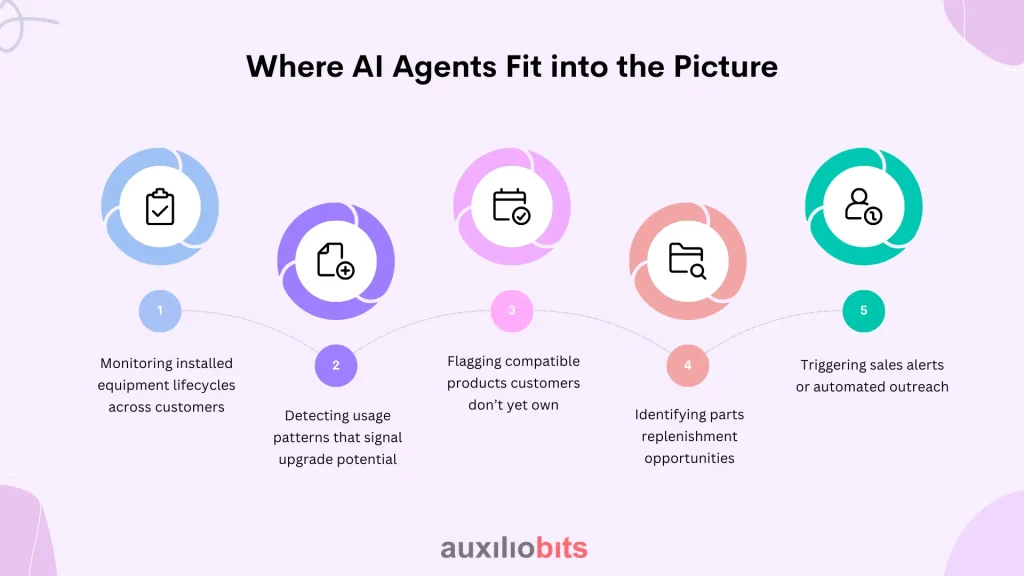
- Monitoring installed equipment lifecycles across customers
- Detecting usage patterns that signal upgrade potential
- Flagging compatible products customers don’t yet own
- Identifying parts replenishment opportunities
- Triggering sales alerts or automated outreach
A successful cross-sell AI system doesn’t just recommend opportunities—it prioritizes them.
Not every cross-sell suggestion matters equally. Some opportunities are worth $200; others represent six-figure upgrades. Agents can rank these based on probability, urgency, and expected revenue.
Where Cross-Sell AI Works
There’s a temptation to treat AI-driven cross-selling as a silver bullet. It isn’t. Installed base intelligence works best under certain conditions.
1. Environments where it thrives
Manufacturers with these characteristics tend to see the biggest gains:
- Complex equipment with long lifecycles
- Recurring spare parts demand
- Multiple compatible add-on products
- Field service teams collecting maintenance data
- Installed assets numbering in the thousands
Industries like heavy equipment, industrial automation, medical devices, and packaging machinery are especially strong candidates.
2. Situations where it struggles
Cross-Sell AI Manufacturing systems are less effective when:
- Product lifecycles are extremely short
- Installed base records are incomplete
- Spare parts ecosystems are fragmented
- Data quality is inconsistent
The Subtle Role of Service Teams
Here’s an interesting nuance: service teams often hold the most valuable installed base insights, yet they’re rarely integrated into cross-sell workflows.
Technicians visiting customer sites notice things that never appear in CRM systems:
- Equipment running beyond normal load
- Temporary workarounds customers have implemented
- Aging components that should be replaced
- Customers experimenting with third-party parts
AI agents can amplify these insights if service data is captured digitally.
For instance:
- A technician logs a note about unusual vibration in a compressor.
- The AI system correlates this with the equipment’s age and maintenance records.
- The system recommends an upgrade package before a failure occurs.
This kind of proactive upselling feels helpful rather than pushy. Customers appreciate it because it prevents downtime.
Cross-Sell AI Manufacturing and Sales Enablement
One misconception about AI agents is that they replace sales teams. In reality, they tend to make sales teams more effective.
Instead of manually researching accounts, reps receive prioritized opportunity signals.
For example, a weekly sales dashboard might highlight:
- Customers nearing upgrade cycle
- Facilities likely to purchase complementary products
- Accounts with unusually high parts consumption
- Installed equipment nearing warranty expiration
This changes the nature of sales conversations. Reps shift from generic check-ins to data-informed recommendations. Sometimes that subtle shift is enough to double cross-sell conversion rates.
The Automation Layer Most Companies Forget
Another overlooked aspect of Cross-Sell AI is workflow automation. Identifying opportunities is only half the battle. Acting on them consistently is harder.
Modern AI agent systems often automate parts of the response process:
- Creating CRM tasks for account managers
- Generating upgrade proposals automatically
- Triggering email outreach sequences
- Notifying service teams before scheduled maintenance
Some organizations even allow agents to initiate parts replenishment orders automatically when predictive models indicate depletion. Not every company is comfortable with that level of autonomy yet—but it’s coming.
Installed Base Intelligence as a Strategic Asset
There’s a broader strategic implication here. When manufacturers develop strong installed base intelligence, they gain a long-term competitive advantage.
Why? Competitors rarely have visibility into the installed equipment environment.
Once a manufacturer understands:
- Which machines are running where
- How customers use them
- Which upgrades deliver the most value
…it becomes extremely difficult for rivals to displace them. This is one reason large industrial companies invest heavily in digital service platforms. The data becomes the moat.
A Quick Reality Check
Despite the promise, many manufacturers are still early in this journey. Installed base data is messy. Service logs are inconsistent. Customer records aren’t always unified.
Deploying cross-sell AI manufacturing solutions often exposes these weaknesses. That can feel frustrating at first. But in a strange way, the cleanup process is valuable. Companies finally gain a structured understanding of their equipment footprint. And once that foundation exists, AI agents can start generating meaningful recommendations.
Practical Starting Points for Manufacturers
Organizations considering Cross-Sell AI usually begin with a few manageable steps. Rather than trying to build a perfect data model, they start small.
Common entry points include:
- Spare parts prediction – Identifying customers likely to reorder components soon
- Lifecycle upgrade alerts – Notifying sales teams when equipment approaches upgrade thresholds
- Service-driven upsell triggers – Converting maintenance events into sales opportunities
- Complementary product suggestions – Recommending compatible equipment
These early use cases often produce quick wins, which helps build confidence in the broader strategy.
The Quiet Revenue Opportunity
Cross-selling in manufacturing often receives less attention than digital transformation initiatives or factory automation.
Yet, for many companies, it represents one of the largest untapped revenue streams. Installed equipment already exists. Customers already trust the manufacturer. The next purchase is often predictable.
The missing ingredient has simply been systematic visibility. AI agents, powered by installed base intelligence, finally provide that.
Not perfectly. Not instantly. But steadily enough to change how manufacturers think about growth. And once organizations experience consistent, data-driven upsell opportunities appearing in their pipelines… going back to manual guesswork feels almost impossible.