





Key Takeaways
- Agent-driven RFP intelligence is not about writing faster—it’s about deciding earlier. The real value shows up when risks, misalignments, and non-viable bids are identified before teams commit weeks of effort. Speed is a side effect, not the objective.
- RFPs reward systems that understand nuance, not just structure. Clause-level interpretation, implicit expectations, and buyer-specific language are where traditional automation fails—and where agentic systems, paired with human review, outperform.
- The strongest agentic setups mirror how experienced proposal teams already think. Specialized agents for ingestion, classification, risk, and drafting work because they reflect real-world division of labor—just without fatigue, memory gaps, or coordination overhead.
- Proposal quality improves when humans stop doing low-value scanning. When agents handle extraction, comparison, and reuse intelligently, SMEs and proposal leaders can focus on persuasion, positioning, and deal strategy instead of policing documents.
- “End-to-end automation” is the wrong goal for RFPs. The winning model is controlled autonomy: agents surface insight, humans apply judgement. Organizations that respect this boundary see better win rates—and fewer post-award surprises.
Anyone who has spent time inside a procurement or pre-sales team knows the quiet dread that accompanies a new RFP landing in the inbox. Hundreds of pages. Contradictory clauses. Commercial terms buried in appendices. Technical requirements written by the committee. And a deadline that assumes you have nothing else to do.
Most organizations still approach RFPs as a brute-force exercise: throw people at the problem, divide sections, stitch responses together at the last minute, and hope legal catches the worst risks. It works often enough to survive—but it’s expensive, slow, and wildly inconsistent.
Agent-driven RFP analysis and proposal generation changes that dynamic, not by “automating writing”, but by restructuring how intelligence, judgement, and effort are applied across the lifecycle of a response. When done well, it feels less like software replacing humans and more like a very competent junior team that never gets worn out, never forgets precedent, and actually reads every clause.
Also read: How Procurement Automation Works: Vendor Onboarding, Approval Flows, and Strategy Digitization?
Why RFPs Are a Particularly Good Fit for Agentic Systems
RFPs sit at an awkward intersection of structure and ambiguity. On one hand, they are highly repetitive:
- Standard qualification questions
- Compliance matrices
- Legal and commercial boilerplate
- Technical capability descriptions
On the other hand, every RFP contains potential pitfalls:
- Subtle changes to indemnity language
- Non-standard SLAs hidden in “nice-to-have” sections
- Evaluation criteria that don’t align with stated priorities
This combination—high repetition plus high consequence—is exactly where agent-based systems outperform both manual effort and traditional rule-based automation.
Rules struggle with nuance. Humans struggle with scale and consistency. Agents, when properly designed, handle the boring parts relentlessly and surface the parts that require judgement.
That’s the difference between “AI writing proposals” and agent-driven RFP intelligence.
What “Agent-Driven” Means in This Context
There’s a lot of loose language around AI in procurement. To be precise, agent-driven RFP workflows involve multiple specialized agents, each with a narrow mandate, working together across stages of analysis and response creation.
Not one big model dumping text into a Word file.
Think more like this:
- One agent specializes in document ingestion and normalization
- Another focuses on requirement extraction and classification
- A separate agent handles risk identification
- Yet another assembles draft responses based on institutional memory
- Humans sit on top, reviewing, steering, and occasionally overruling
Stage 1: Ingesting and Understanding the RFP
Most RFP pain begins here. PDFs scanned from PDFs. Excel sheets embedded inside Word documents. Attachments referenced but not included. And every buyer has their own structure.
An ingestion agent’s job isn’t just to read—it’s to reconstruct intent.
This includes:
- Extracting sections and subsections regardless of formatting
- Identifying mandatory vs optional requirements (often not explicitly labeled)
- Mapping questions to evaluation criteria when buyers don’t do it themselves
- Flagging inconsistencies across documents (yes, they happen more than people admit)
Stage 2: Requirement Decomposition and Classification
Once the RFP is structurally understood, the real work begins: breaking requirements down into actionable units.
This is where agentic approaches shine.
A well-designed requirement agent will:
- Separate functional, technical, commercial, and legal requirements
- Identify implicit expectations (“Describe your approach to…” is rarely optional.)
- Detect “experience qualifiers” that disqualify vendors quietly
- Classify requirements by response source: standard library, custom input, SME validation
This isn’t trivial NLP tagging. It requires contextual awareness. For example, “Describe your data retention policy” means something very different in healthcare procurement than it does in retail.
Where agents struggle: domain-specific jargon that hasn’t been seen before. This is why feedback loops matter. The agent learns from corrections, but only if teams bother to correct it instead of working around it.
Stage 3: Risk and Feasibility Analysis
Most proposal teams focus on winning. Procurement leaders focus on not getting burned. These goals conflict more often than people admit.
Agent-driven risk analysis doesn’t replace legal or commercial review—but it changes the timing. Instead of finding problems two days before submission, risks surface early.
Examples of what risk agents flag well:
- Non-standard liability caps hidden in schedules
- Termination clauses triggered by vague performance language
- Payment terms that contradict master agreements
- Service levels that imply operational costs nobody budgeted for
Stage 4: Proposal Drafting That Respects Reality
Let’s address the uncomfortable truth: most proposal text is recycled. And that’s not inherently bad.
The problem isn’t reuse—it’s unthinking reuse.
Drafting agents should operate more like curators than authors. Their job is to:
- Retrieve relevant past responses based on requirement similarity
- Adapt tone and depth to the buyer’s stated priorities
- Maintain consistency across sections written by different contributors
- Flag where human input is genuinely required
Good agents don’t try to sound clever. They aim for compliance, clarity, and alignment.
Where they fail:
- Over-generalizing when specificity is expected
- Using outdated positioning language that no longer reflects offerings
- Missing subtle cultural cues (public sector vs private enterprise tone, for instance)
That’s why experienced proposal managers still matter. Agents accelerate; they don’t replace judgement.
Where Agent-Driven RFP Systems Break Down
It’s worth being candid about limitations. Anyone claiming “end-to-end automation” is either overselling or hasn’t dealt with real procurement.
Common failure points:
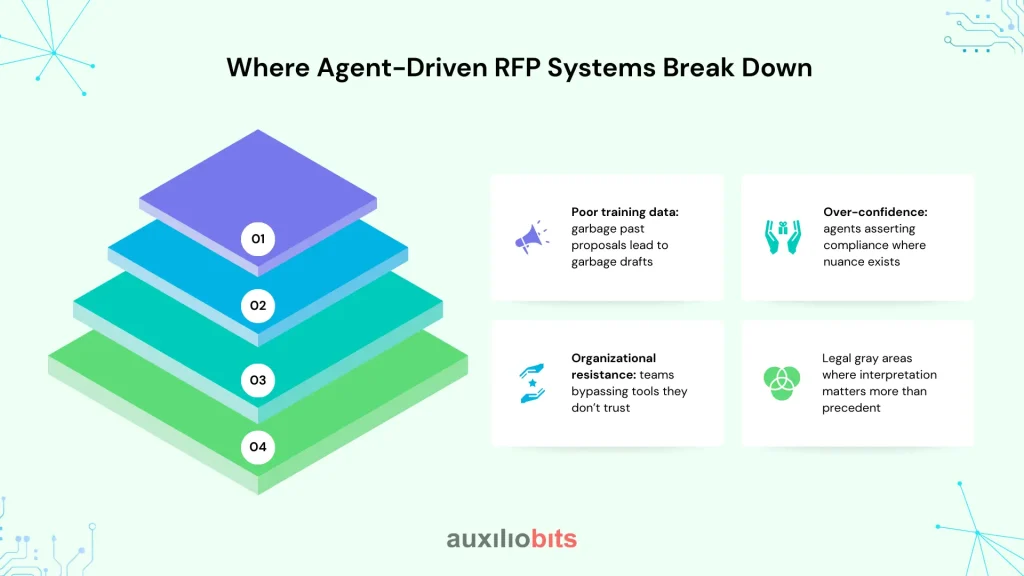
- Poor training data: garbage past proposals lead to garbage drafts
- Over-confidence: agents asserting compliance where nuance exists
- Organizational resistance: teams bypassing tools they don’t trust
- Legal gray areas where interpretation matters more than precedent
There’s also a softer issue: politics. Some buyers expect bespoke storytelling, even when they claim to want standardized responses. Agents don’t read ego. Humans still have to.
If your organization is exploring agent-driven proposal generation purely to “write faster”, you’ll be disappointed. Even if proposals are generated faster, they remain poor quality.
But if the goal is to think better at scale, reduce cognitive load, surface risk earlier, and let humans focus on persuasion rather than paperwork—then this approach earns its place.
RFPs aren’t going away. Buyers aren’t simplifying them. And hiring more people isn’t always the answer.
Agents won’t win deals on their own. But they change who spends time on what. And in procurement, that shift quietly makes all the difference.