





Manufacturing supply chains have become significantly more complex over the past decade. Global supplier networks, fluctuating demand patterns, geopolitical disruptions, and increasing customer expectations have forced organizations to rethink how their supply chains operate. For many enterprises, the traditional model of supply chain management—built around manual coordination, spreadsheets, and reactive decision-making is no longer sustainable. Operations leaders are now under pressure to build supply chains that are not only efficient but also resilient, responsive, and intelligent.
Today, most manufacturing organisations have already digitised their supply chains. Enterprise systems such as ERP platforms, warehouse management systems, transportation management systems, and procurement platforms store large amounts of operational data. However, despite this digitization, many operational activities still depend heavily on human intervention. Supply chain teams manually monitor dashboards, track shipments through emails, reconcile inventory data, approve logistics documentation, and resolve disruptions when they occur.
Many organizations assume that implementing dashboards and analytics tools automatically creates supply chain visibility. While dashboards provide data, they still require human teams to interpret the information and take action. When supply chain managers must constantly monitor multiple dashboards to identify issues, the process remains reactive rather than proactive. In fact, this gap between seeing a problem and acting on it is one of the biggest challenges in modern supply chain operations. This topic is explored in more detail in our blog, “Supply Chain Visibility: Why Dashboards Are Not Enough.”
This reliance on human coordination creates operational bottlenecks. When disruptions happen—such as delayed shipments, supplier shortages, inaccurate inventory records, or documentation errors—teams must quickly investigate the problem and determine the next course of action. This reactive approach slows down operations, increases costs, and reduces the overall agility of the supply chain.
This is where supply chain automation manufacturing strategies are transforming the future of operations. Instead of relying on people to constantly monitor systems and respond to events, automation technologies can continuously observe supply chain activities and initiate actions when predefined conditions are met. Intelligent workflows can now automatically handle tasks such as shipment tracking, inventory monitoring, procurement triggers, and documentation processing.

At the same time, advances in logistics automation AI are introducing a new layer of intelligence into supply chain operations. Artificial intelligence systems can analyze vast amounts of operational data to identify patterns, detect anomalies, and predict disruptions before they impact business operations. These capabilities allow organizations to move beyond basic automation toward more proactive and adaptive supply chain management.
For COOs, supply chain heads, and operations leaders, the strategic goal is evolving from simple operational visibility toward full supply chain autonomy. Visibility alone provides information about what is happening across the supply chain, but it does not resolve operational challenges. While control mechanisms enable organisations to automate certain processes, they remain reliant on predefined rules. True autonomy introduces intelligent systems that can monitor, analyze, and respond to supply chain events dynamically.
The convergence of supply chain automation, manufacturing technologies, and logistics automation AI is enabling the emergence of autonomous supply chains. These systems use automation, data intelligence, and AI-driven decision-making to manage supply chain operations with little human help. As a result, organizations can improve operational efficiency, reduce disruption risks, and build supply chains that continuously adapt to changing market conditions.
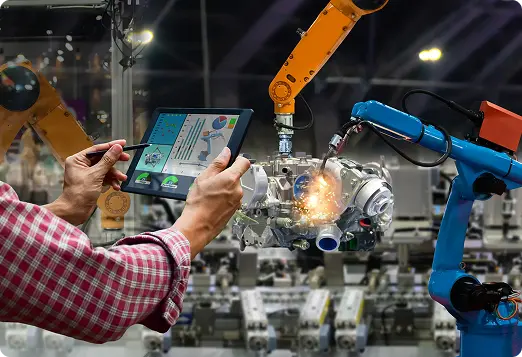
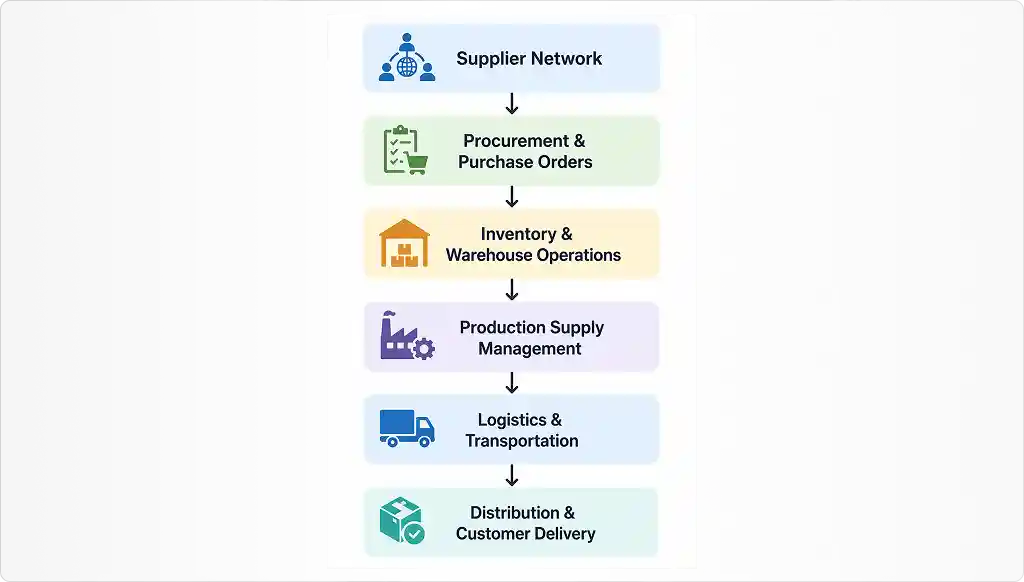
A large portion of supply chain work involves routine coordination tasks that add little strategic value.
Typical daily operational activities include:
These tasks consume valuable time for supply chain professionals. Instead of focusing on strategic decisions, operations teams often spend most of their time reacting to operational issues.
Another major challenge in manufacturing supply chains is data fragmentation. Operational information is typically spread across several enterprise systems.
Because these systems operate independently, supply chain managers must often gather information manually to understand what is happening across the network.
Modern logistics automation AI platforms solve this challenge by aggregating data from multiple systems and providing a unified operational view.
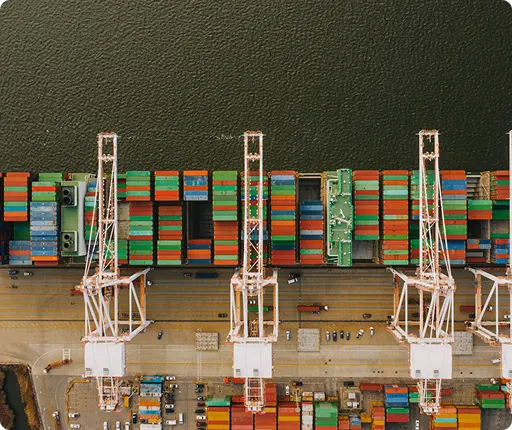
Supply chains are becoming more complex, volatile, and globalized. Manual coordination models can no longer keep up with this scale.
Organizations are therefore investing in supply chain automation manufacturing technologies that allow systems to coordinate workflows automatically.
When combined with logistics automation AI, these platforms can:
This shift is transforming supply chain operations from reactive management toward intelligent, data-driven orchestration.
Manufacturing supply chains do not become autonomous overnight. Organizations typically progress through multiple maturity stages before reaching fully automated operations. Most enterprises today operate somewhere between basic visibility and partial operationality control. While dashboards and analytics tools provide insight into supply chain activity, many operational decisions still require manual intervention from supply chain teams.
A major challenge at this stage is how organizations respond to disruptions and operational exceptions. Supply chain teams often spend significant time identifying issues, analyzing root causes, and coordinating responses across multiple systems and partners. Managing these exceptions manually slows down operations and increases the risk of delays. As automation technologies evolve, many enterprises are now exploring AI-driven exception handling, where intelligent agents can detect anomalies and initiate corrective actions automatically. This concept is explored further in supply chain exception management using autonomous agents.
Organisations must evolve through three distinct stages to transition toward supply chain automation manufacturing.

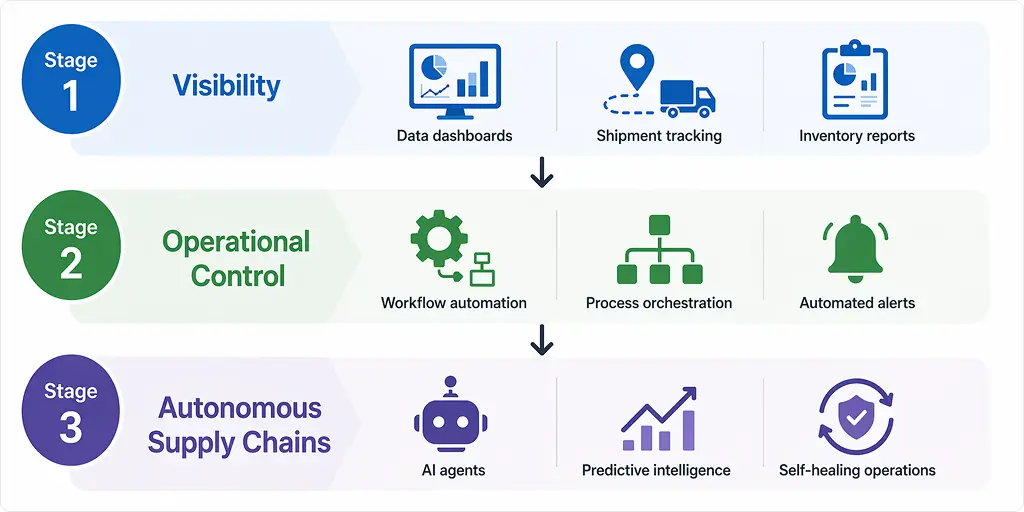
The first step toward modern supply chain management is achieving operational visibility. Visibility means organizations can monitor what is happening across their supply chain network in near real time.
This typically includes access to:
Visibility allows operations teams to detect issues more quickly than traditional manual monitoring methods.
Example of Visibility in Action: A manufacturing company may use dashboards to monitor incoming shipments from suppliers. If a shipment is delayed, logistics teams can immediately see the delay and investigate.
However, visibility alone does not solve operational challenges. Even when issues are detected quickly, humans still need to decide how to respond.
Once visibility is established, the next step is to introduce automation that enables systems to act on operational events.
At this stage, organizations begin implementing supply chain automation manufacturing workflows that reduce reliance on manual intervention.
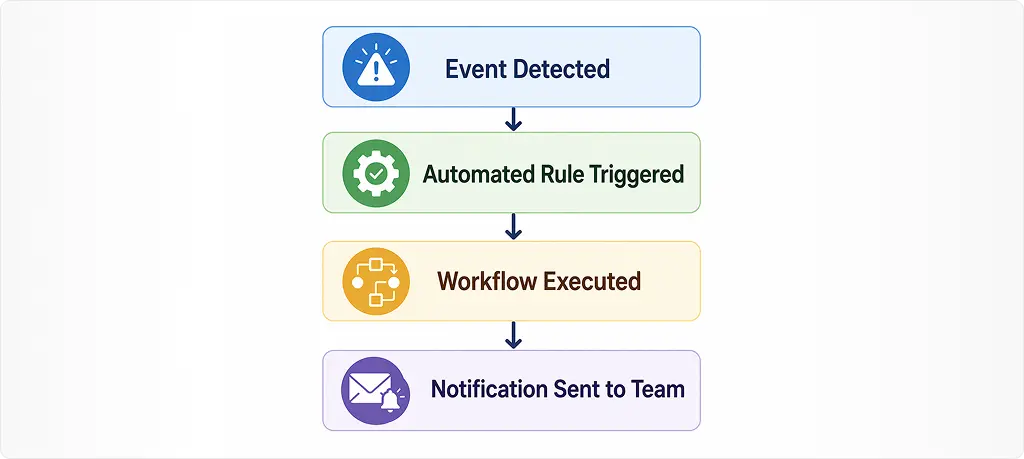
Automation allows systems to trigger actions automatically when specific conditions occur.
Examples include:
These capabilities significantly reduce manual monitoring requirements.
The most advanced stage of supply chain maturity is full autonomy.
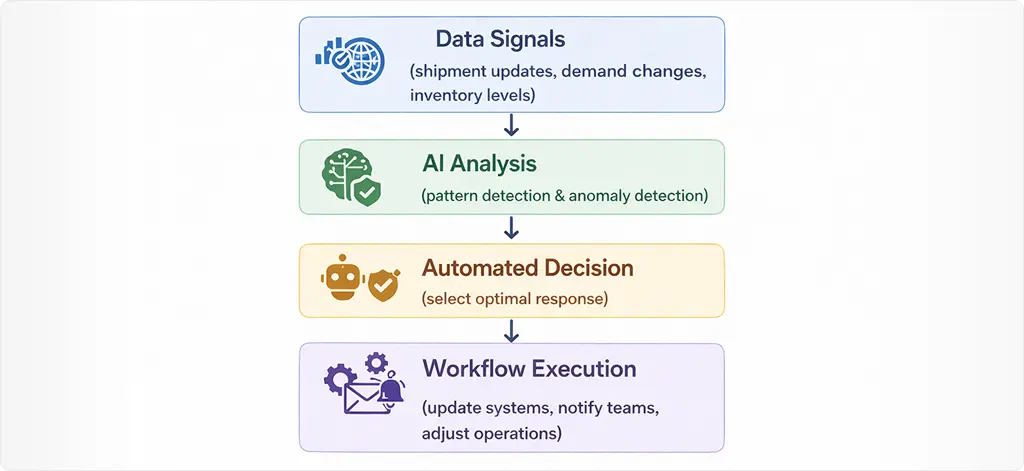
In autonomous supply chains, systems are not only capable of executing predefined workflows—they can also analyze operational patterns, predict disruptions, and coordinate responses automatically.
Logistics automation AI and AI-driven operational agents enable this level of intelligence.
AI systems continuously analyze supply chain signals such as:
When anomalies appear, AI agents can initiate corrective actions without waiting for human instructions.
These results explain why many manufacturing leaders are prioritizing investments in logistics automation AI and autonomous supply chain technologies. That said, feel free to talk to a supply chain automation expert now. and get your doubts clear.
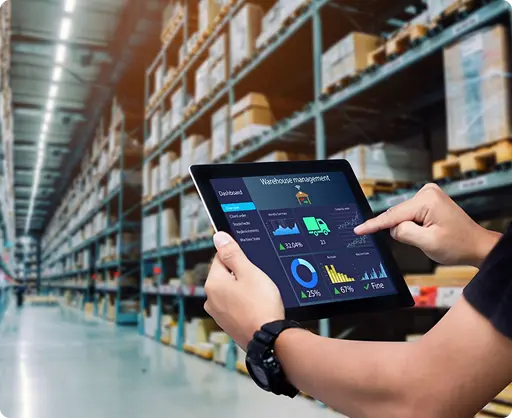
For COOs and supply chain leaders, the objective is not simply to automate individual processes. The real goal is to create an intelligent operational network where systems coordinate activities across the entire supply chain.
In many manufacturing enterprises, supply chain operations run across multiple enterprise platforms, such as different ERP systems, procurement tools, logistics platforms, and warehouse systems. While these systems store valuable operational data, coordinating processes across them often becomes complex. Manual handoffs, disconnected workflows, and inconsistent data synchronization frequently slow down decision-making and operational responsiveness.
Managing automation across such environments requires a strategy that can unify workflows without replacing existing systems. To understand this challenge deeply, feel free to explore our guide on multi-ERP supply chain automation.
Instead of reacting to disruptions after they occur, autonomous systems can anticipate operational challenges and respond proactively.
This shift represents the foundation for the next generation of supply chain operations.
A Supply Chain Control Tower is a centralized operational platform that provides real-time visibility, coordination, and decision support across the entire supply chain network.
For manufacturing enterprises managing complex global operations, a control tower acts as the command center of supply chain activity. It brings together operational data from different systems and provides a single view of inventory flows, shipments, supplier performance, and logistics operations.
Traditional supply chain management often involves monitoring separate systems independently. Procurement teams track supplier orders in ERP systems, logistics teams monitor shipments through carrier portals, and warehouse managers oversee inventory through warehouse management platforms.
A control tower eliminates this fragmentation by creating a single operational intelligence layer.
When combined with supply chain automation manufacturing, control towers change supply chain operations from just watching what happens to actively managing everything.
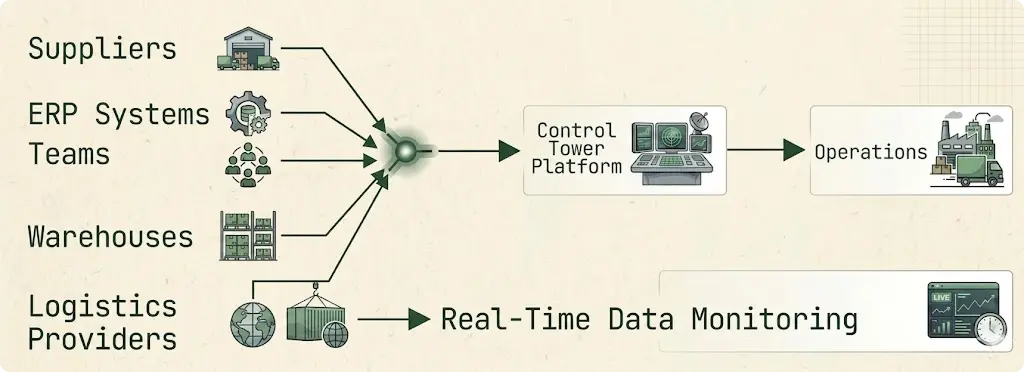
Manufacturing supply chains involve multiple stakeholders and operational processes, including suppliers, logistics providers, production facilities, and distribution networks.
Without centralized coordination, managing these moving parts becomes extremely difficult.
Control towers address several critical operational challenges:
In many organizations, supply chain teams can only see specific segments of operations. Procurement teams track supplier activity, logistics teams monitor transportation, and warehouse managers oversee inventory. A control tower connects these data sources into a single operational view.
When supply chain disruptions occur, teams often need time to gather information from different systems before deciding how to respond. Control towers reduce this delay by surfacing disruptions immediately.
Without centralized orchestration, teams rely on emails, spreadsheets, and phone calls to coordinate operational responses. Control towers replace fragmented workflows with automated coordination, which is supported by logistics automation AI.
A control tower functions effectively only when it integrates information from across the supply chain ecosystem.
The most common data sources include:

Traditional control towers primarily focused on monitoring and reporting operational data. While useful, these platforms still required humans to interpret information and decide how to respond.
The introduction of logistics automation AI is transforming control towers into intelligent operational systems.
AI capabilities within control towers include:
These capabilities allow organizations to move beyond passive monitoring toward active operational orchestration.
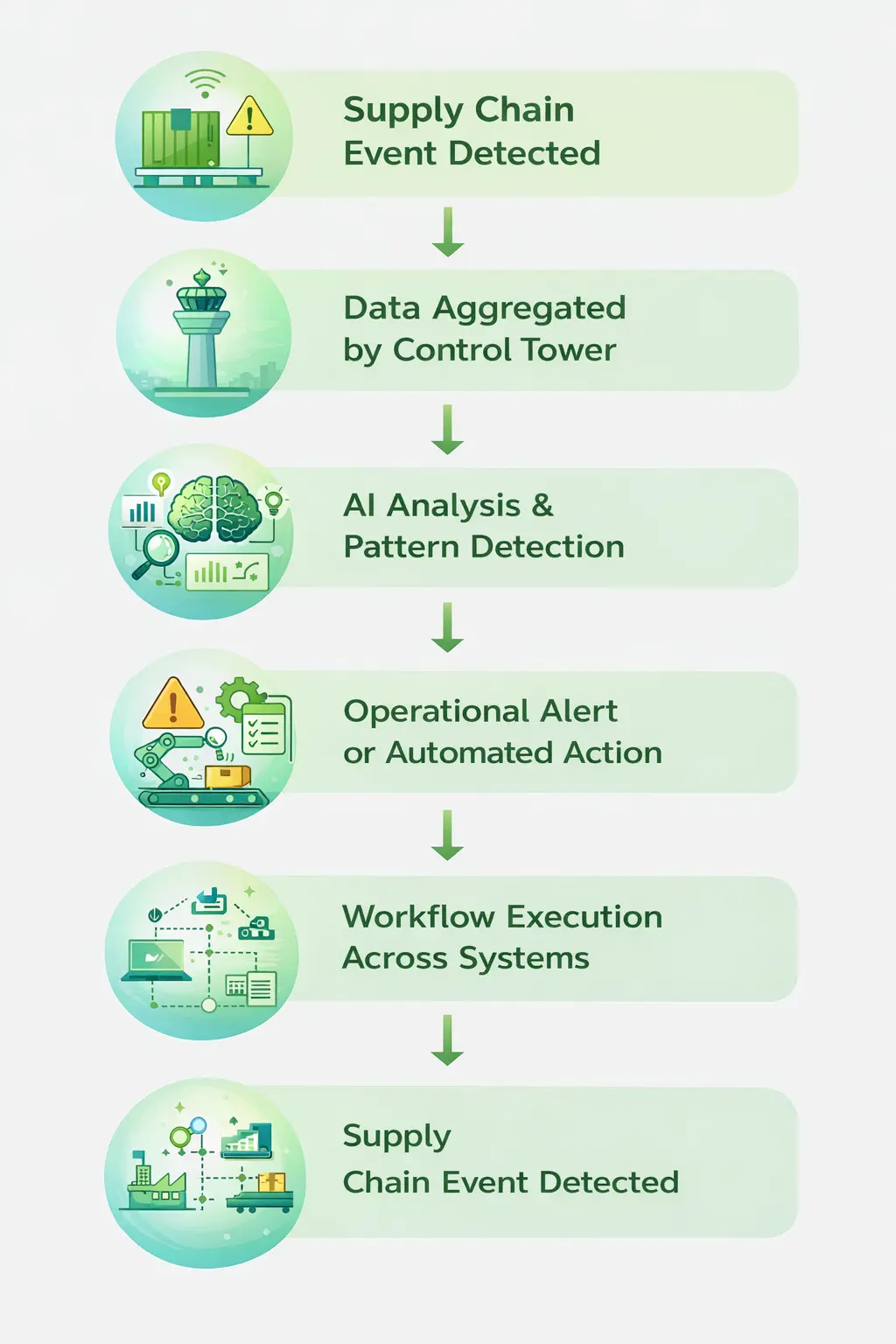
The next generation of control towers is evolving from simple monitoring platforms into intelligent orchestration systems.
By combining supply chain automation manufacturing with logistics automation AI, organizations can enable control towers to automatically coordinate responses to operational events. Modern control towers are also expanding their visibility beyond transportation and planning systems to include warehouse operations, inventory flows, and fulfillment activities—areas explored further in our blog “Warehouse Automation Beyond Robotics.”
For example:
This transformation enables control towers to act as the operational brain of autonomous supply chains.

Inventory management sits at the center of manufacturing supply chains. Every production schedule, procurement plan, and logistics operation depends on accurate inventory visibility and reliable demand forecasting.
However, managing inventory effectively is one of the most difficult challenges in supply chain operations.
Manufacturing organizations must balance several competing priorities:
Even small forecasting errors can cause large operational consequences. A shortage of a single component can halt an entire production line, while excess inventory ties up working capital and warehouse capacity. Traditional forecasting approaches often rely on historical reports and periodic planning cycles. As supply chains become more dynamic, many organizations are exploring AI-driven approaches that can continuously analyze demand signals, supplier performance, and inventory movements to predict shortages and trigger replenishment automatically. Our blog “Agentic AI for Inventory Forecasting and Replenishment” discusses this emerging approach in more detail.
This is why many organizations are investing in supply chain automation manufacturing capabilities to improve inventory intelligence and decision-making. When combined with logistics automation AI, modern supply chain platforms can analyse demand signals and inventory movement patterns to optimise stock levels across the entire supply chain network.
Many manufacturing companies struggle with inaccurate inventory data due to fragmented systems and manual reconciliation processes.
Common causes of inventory inaccuracies include:
These issues often lead to operational inefficiencies.
Below is a simplified overview of the impact of poor inventory visibility.

Demand forecasting is one of the most critical processes within manufacturing supply chains. Accurate forecasts allow organizations to plan procurement, production, and logistics activities more effectively.
Traditional forecasting methods often rely on historical sales data and manual adjustments from planning teams.
While this approach can provide baseline estimates, it often struggles to account for rapidly changing market conditions.
For example, demand patterns may shift due to:
This is where logistics automation AI introduces a significant advantage. AI-powered forecasting systems can analyze many data signals at the same time, including historical sales trends, supplier lead times, transportation delays, and market indicators.
By processing these variables continuously, AI models can generate more accurate demand predictions and recommend inventory adjustments automatically.

Automation plays an essential role in ensuring inventory intelligence translates into operational improvements.
Automated inventory workflows can trigger operational actions when certain conditions occur.
Examples include:
In many manufacturing environments, some components are far more critical than others. A shortage of a single specialized part—such as a semiconductor, precision component, or custom-engineered part—can halt entire production lines. Monitoring these critical components manually across multiple systems is extremely challenging for supply chain teams. Increasingly, organizations are exploring intelligent monitoring systems that continuously track high-risk inventory items and trigger early alerts before shortages occur. A deeper look at this approach can be found in our blog, “AI Agents for Critical Parts Inventory Monitoring.”
These capabilities reduce the manual workload and improve the supply chain’s responsiveness. When integrated with logistics automation AI, these automation workflows can also prioritise actions based on their operational impact. For example, shortages of critical production components may trigger immediate procurement workflows, while slower-moving inventory may trigger warehouse redistribution.
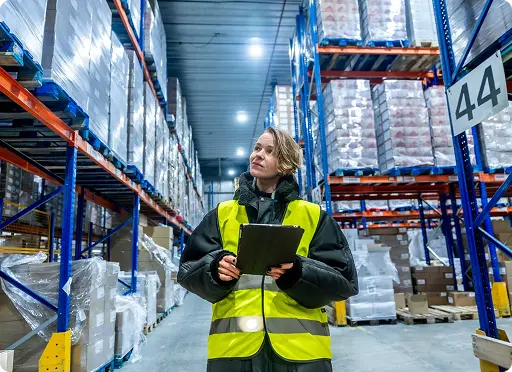
The combination of automation and AI-driven demand intelligence can significantly improve supply chain performance.
Manufacturing organizations adopting logistics automation AI for inventory optimization commonly report the following results:
Beyond cost savings, these improvements also increase operational resilience by ensuring production facilities receive the materials they need on time.
As supply chains become more complex and globally interconnected, the ability to predict demand and optimize inventory intelligently becomes a major competitive advantage.
For supply chain leaders, intelligent inventory systems are no longer optional—they are becoming a foundational component of modern supply chain automation manufacturing strategies.
Logistics is one of the most operationally intensive components of manufacturing supply chains. Every day, thousands of shipments move between suppliers, production facilities, warehouses, and distribution centers. Despite advances in transportation management systems and digital tracking tools, many logistics processes still depend heavily on manual coordination. This challenge is also examined in our blog “Logistics Automation in Manufacturing: From Planning to Execution”, where we look at how manufacturers manage logistics planning, shipment coordination, and execution activities across complex supply chain networks.

Operations teams often perform repetitive tasks such as:
These manual processes create delays, increase operational workload, and introduce opportunities for human error.
To address these challenges, organizations are increasingly adopting supply chain automation manufacturing strategies that automate logistics coordination and shipment monitoring.
When combined with logistics automation AI, these systems enable real-time tracking, automated document processing, and a faster response to disruptions.
Logistics operations involve multiple interconnected processes that ensure materials and products move efficiently across the supply chain network.
The table below highlights the primary logistics functions and the operational challenges commonly associated with each stage.
Shipment visibility is one of the most critical capabilities in logistics operations. Manufacturing organizations must monitor shipments closely to ensure production schedules and delivery commitments remain on track.
However, traditional shipment tracking often requires logistics teams to verify multiple carrier systems manually. In addition to tracking shipment status, logistics teams must also manage several shipping documents such as bills of lading, shipping manifests, freight invoices, and delivery confirmations. These documents must be validated, shared with carriers and warehouses, and recorded in enterprise systems to ensure accurate logistics execution.
Handling these documentation processes manually can slow down shipment processing and increase the risk of data errors. A detailed look at how these documentation workflows can be automated is covered in our blog “Automating Bill of Lading and Shipping Documentation.” That said, automation platforms can centralize shipment monitoring by integrating with carrier APIs and transportation management systems.
Key automation capabilities include:
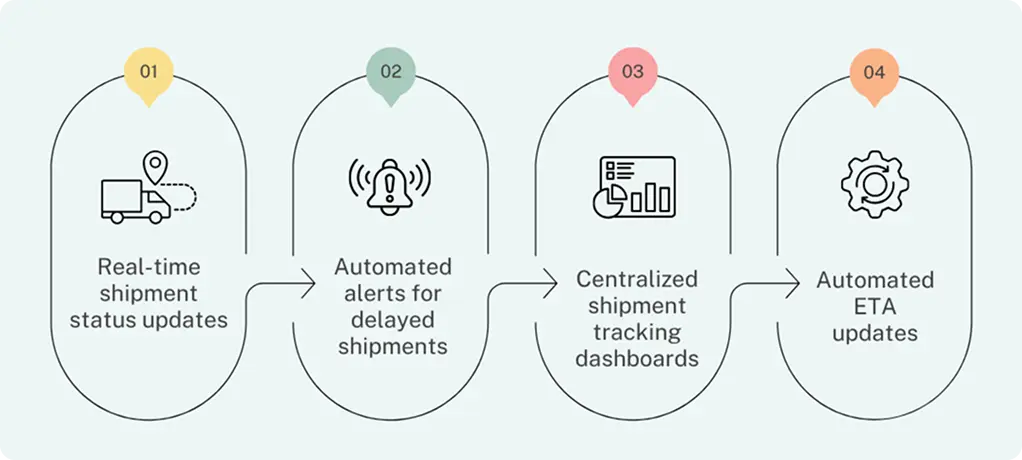
These capabilities significantly reduce the time logistics teams spend monitoring shipments.
By integrating these systems with logistics automation AI, organizations can also detect potential disruptions earlier and respond proactively.
Logistics documentation remains one of the most manual areas of supply chain operations.
Every shipment typically requires multiple documents, including:
Processing these documents manually can be time-consuming and error-prone.
Errors in logistics documentation may result in:
Automation technologies help address these challenges by extracting and validating information from logistics documents automatically.
Document automation platforms can:
These capabilities improve operational efficiency while reducing compliance risks.
When integrated with supply chain automation manufacturing, documentation workflows can operate with minimal manual intervention.
Many manufacturing organizations implement automation workflows to streamline logistics coordination.
Below are examples of common automated logistics processes.
The adoption of automation and AI-driven logistics platforms delivers measurable operational benefits for manufacturing organizations.
Industry research shows several common improvements
These improvements demonstrate why logistics automation is becoming a critical component of modern supply chain strategies.
For organizations operating global manufacturing networks, even small improvements in logistics efficiency can translate into significant cost savings and improved customer satisfaction.
Common supply chain exceptions include:
In traditional supply chain operations, resolving these issues requires manual intervention. Operations teams must detect the problem, investigate the cause, coordinate with relevant partners, and determine the appropriate response.
This reactive process can take hours or even days, especially when multiple systems scatter information.
This is why modern organizations are implementing supply chain automation manufacturing solutions designed to detect and resolve exceptions faster.
When combined with logistics automation AI, these systems can automatically identify operational disruptions and initiate corrective actions with minimal human involvement.
An exception in supply chain operations occurs whenever an event deviates from the expected workflow.
Examples include:
These exceptions often create ripple effects across the supply chain.
For example, a delayed shipment of raw materials may disrupt production schedules, which can then delay finished product deliveries to customers.
Without automated exception management, operations teams must manually track and resolve each issue. As supply chains become more complex, many organizations are moving toward self-healing supply chain models, where systems can automatically detect disruptions and initiate corrective actions. Our blog “The Road to Self-Healing Supply Chains” discusses the broader journey toward building these intelligent and resilient supply networks.
Each of these issues requires quick identification and coordinated response to minimize operational impact.
Historically, supply chain exception management has been a manual and reactive process.
The typical workflow looks like this:
A team member identifies a problem through dashboards, reports, or supplier communication.
Operations teams gather information from multiple systems to determine the root cause.
Teams communicate with suppliers, logistics providers, and internal departments.
The issue is addressed through manual adjustments to shipments, inventory, or procurement plans.

The introduction of logistics automation AI enables organizations to move beyond reactive exception management.
AI-driven systems continuously monitor supply chain data and identify anomalies in real time.
Examples of monitored signals include:
When irregular patterns appear, AI agents can immediately flag the issue and recommend corrective actions.
For example:
If a shipment delay is detected, the system may notify logistics teams and recommend alternative routes.
If supplier delays occur, the system may trigger procurement workflows with backup suppliers.
If inventory shortages are predicted, automated replenishment orders can be initiated.
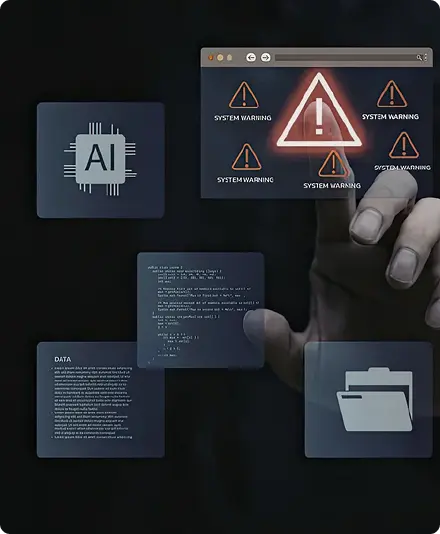
Machine learning models can detect abnormal patterns in shipment timelines, supplier performance, or inventory movement.
AI systems can forecast potential disruptions by analyzing historical data and real-time signals.
When an anomaly occurs, automated notifications inform operations teams immediately.
Beyond detection, AI-driven systems can also automate the resolution of certain operational exceptions.
Examples of automated responses include:
These automated workflows significantly reduce the burden on supply chain teams.
Instead of manually resolving every operational issue, teams can focus on high-impact decisions that require human expertise.
As supply chains become more automated, operational management increasingly shifts toward an exception-driven model.
In this model, routine activities are handled automatically through automation workflows. Human intervention is required only when unusual situations occur.
This approach allows supply chain teams to focus on:

Instead of spending their time monitoring dashboards and resolving minor operational issues.
By integrating logistics automation AI with intelligent automation platforms, organisations can create supply chain systems that can identify and resolve disruptions before they escalate.
This capability is a critical step toward building resilient and autonomous supply chains.
For COOs, supply chain heads, and operations leaders, adopting new technologies must translate into measurable business value. While automation and artificial intelligence introduce powerful capabilities, their success is ultimately evaluated through operational performance metrics.
Organizations implementing supply chain automation manufacturing initiatives typically begin by identifying key performance indicators (KPIs) that reflect supply chain efficiency, reliability, and responsiveness. These metrics allow leadership teams to measure how automation and AI-driven decision-making improve day-to-day operations.
When combined with logistics automation ai, autonomous supply chain systems can deliver improvements across several core operational dimensions, including inventory management, logistics performance, disruption response, and overall operational productivity.
Understanding how these improvements translate into tangible business outcomes is critical for evaluating the return on investment from supply chain automation initiatives.
Manufacturing organizations track several metrics to measure supply chain performance. These KPIs provide insight into how efficiently materials move through the supply chain and how reliably products reach customers.
The following table highlights some of the most important metrics used to evaluate supply chain performance.
Organizations implementing supply chain automation manufacturing technologies often see measurable improvements across these metrics. When automation initiatives evolve toward hyperautomation, where AI agents, RPA workflows, analytics platforms, and orchestration layers work together, supply chains begin to operate with far greater speed and intelligence.
For example, automated inventory monitoring can reduce stockout rates, AI-driven logistics coordination can improve on-time delivery performance, and automated order processing can significantly reduce fulfillment cycle times. These kinds of improvements illustrate why many enterprises are now focusing on hyperautomation as the next stage of supply chain transformation. Our blog, “Supply Chain KPIs That Improve with Hyperautomation,” examines how these performance metrics typically evolve as organisations introduce hyperautomation capabilities into their supply chain operations.
Inventory management is one of the areas where automation and AI deliver immediate value.
Traditional inventory planning often relies on static reorder thresholds and manual demand forecasting. These approaches can struggle to adapt quickly to changing demand patterns.
AI-powered inventory intelligence platforms analyze demand signals continuously and adjust inventory strategies dynamically.
Common improvements observed in organizations that adopt logistics automation AI include the following:

Transportation and logistics operations represent a significant portion of total supply chain costs. Inefficient logistics coordination can lead to shipment delays, increased freight expenses, and poor customer service performance.
By implementing supply chain automation manufacturing platforms, organizations can automate many routine logistics coordination tasks such as shipment tracking, carrier communication, and documentation processing.
When enhanced with logistics automation AI, these systems can also optimize transportation decisions and predict potential disruptions.
The resulting operational improvements are often substantial.
Automation significantly reduces the manual workload associated with supply chain operations.
Intelligent systems can now handle activities that previously required human intervention—such as shipment monitoring, inventory reconciliation, and documentation validation—automatically.
As a result, operations teams can shift their focus to higher-value activities such as supply chain optimization and strategic planning.
Organizations implementing supply chain automation manufacturing platforms often report the following productivity improvements.
One of the most valuable benefits of autonomous supply chains is improved resilience. Modern supply chains face increasing disruption risks due to global supplier networks, transportation bottlenecks, and geopolitical uncertainties.
AI-powered monitoring systems continuously analyze operational signals and detect disruptions early.
This allows organizations to respond more quickly when problems occur.
By integrating logistics automation AI into supply chain management platforms, companies can improve their ability to detect and resolve disruptions before they escalate.
Common resilience improvements include:
For manufacturing organizations operating complex supply networks, improved resilience can protect revenue and maintain customer satisfaction during challenging conditions.
Organizations often see automation projects deliver returns within the first 12 to 24 months of deployment.
In addition to direct financial benefits, autonomous supply chains also provide strategic advantages such as improved scalability and operational agility.
As global supply chains continue to grow more complex, traditional manual coordination models become increasingly difficult to manage.
Organizations that successfully implement supply chain automation manufacturing capabilities gain the ability to operate supply chains that are faster, more resilient, and more adaptable to changing market conditions.
At the same time, logistics automation AI provides the intelligence needed to anticipate disruptions, optimize operational decisions, and continuously improve supply chain performance.
One of the key advantages of these intelligent systems is their ability to provide near-real-time visibility and control across supply chain operations—from inventory monitoring to shipment tracking and disruption response. Our blog “How Manufacturing Firms Achieve Near-Real-Time Supply Chain Control” explores this shift toward real-time operational coordination. For COOs and supply chain leaders, autonomous supply chains represent more than a technology initiative—they represent a transformation in how supply chain operations are designed and managed.
Organizations investing in automation and AI-driven supply chain capabilities today position themselves to compete more effectively in an increasingly complex and dynamic global marketplace.
Manufacturing supply chains are entering a new era defined by intelligence, automation, and operational agility. For decades, organizations have focused on digitizing supply chain processes by implementing ERP systems, warehouse platforms, and transportation management tools. While these systems improved visibility and data availability, they did not eliminate the need for manual coordination.
Today, the next phase of supply chain transformation is centered on autonomy.
By adopting supply chain automation manufacturing strategies, organizations can move beyond fragmented workflows and manual monitoring toward integrated, automated supply chain ecosystems. These systems coordinate procurement, inventory management, logistics, and operational decision-making across multiple platforms.
At the same time, advances in logistics automation AI are introducing a new layer of intelligence that allows supply chains to analyze operational signals, detect anomalies, and respond to disruptions in real time.
Instead of waiting for problems to escalate, autonomous supply chains can proactively:
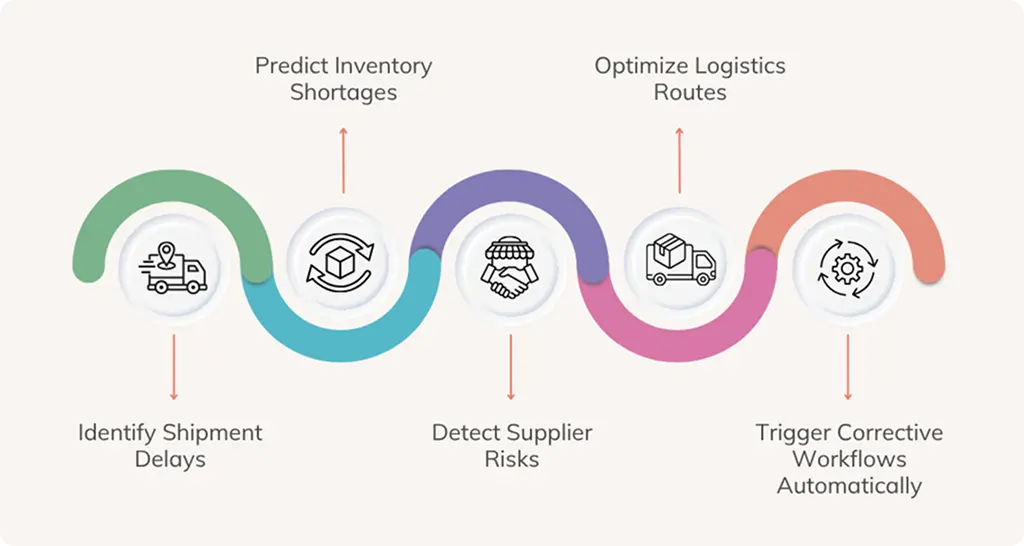
This transformation allows operations teams to shift their focus from routine coordination tasks toward higher-value activities such as supply chain strategy, network optimization, and supplier collaboration.
For COOs and supply chain leaders, the strategic objective is no longer simply improving visibility. The real goal is to build resilient, adaptive, and intelligent supply chains capable of responding to market changes instantly.
Organizations that successfully implement supply chain automation in manufacturing, along with logistics automation and AI, will gain significant advantages in operational efficiency, cost control, and service reliability.
In an increasingly complex global marketplace, autonomous supply chains are quickly becoming a key competitive differentiator.
If your organization is exploring ways to improve supply chain efficiency, reduce operational disruptions, and build more resilient logistics networks, intelligent automation can play a critical role. Talk to a supply chain automation expert now.
Furthermore, discover how modern supply chain automation and manufacturing solutions, combined with logistics automation and AI, can transform your supply chain operations into a more intelligent, responsive, and autonomous system. In rapidly changing markets, these technologies also enable organizations to adapt their production and logistics strategies dynamically—an approach discussed in our blog, “AI-Driven Capacity Planning in Volatile Markets.”
Volatile market conditions—such as sudden demand fluctuations, supplier disruptions, or geopolitical shifts—often make traditional capacity planning models unreliable. AI-driven planning systems can continuously analyze demand signals, production capacity, supplier availability, and logistics constraints to help manufacturers adjust production schedules and resource allocation in near real time. By combining predictive analytics with automated operational workflows, organizations can better balance supply and demand while minimizing operational risk.
As more enterprises adopt these intelligent capabilities, supply chains begin to operate with greater agility, allowing leaders to make faster decisions and maintain stability even in uncertain market conditions.
In manufacturing, supply chain automation means using technology to automate tasks like coordinating purchases, keeping track of inventory, tracking shipments, and writing logistics documents.
Through supply chain automation manufacturing, organizations can reduce manual work, improve operational accuracy, and enable systems to coordinate supply chain activities automatically.
Automation platforms typically integrate with ERP systems, warehouse platforms, and transportation systems to streamline supply chain workflows.
Artificial intelligence enhances logistics automation by analyzing operational data and identifying patterns that help optimize supply chain decisions.
With logistics automation AI, organizations can:
These capabilities allow logistics operations to become more proactive and responsive.
A supply chain control tower is a centralized operational platform that provides end-to-end visibility and coordination across the supply chain.
Control towers collect data from multiple systems, including ERP platforms, warehouse systems, and transportation systems, to provide a unified view of supply chain activity.
When integrated with supply chain automation manufacturing and logistics automation AI, control towers can also automate workflows and assist in responding to operational disruptions.
Autonomous supply chains provide several operational advantages for manufacturing organizations.
Common benefits include:
By combining supply chain automation manufacturing with logistics automation AI, organizations can create supply chain systems that continuously monitor and optimize operations.
Most organizations begin their automation journey by identifying high-impact operational processes that involve significant manual work.
Common starting points include:
From there, organizations can gradually expand automation initiatives and introduce logistics automation AI capabilities to support predictive decision-making and intelligent orchestration.

Follow Us