





Manufacturing procurement has always been a high-stakes function—but today, it’s under more pressure than ever. Volatile supply chains, rising input costs, fragmented supplier ecosystems, and increasing compliance requirements are forcing procurement and finance leaders to rethink how sourcing and purchasing actually work.
Despite heavy investments in ERP systems, most manufacturing organizations still operate with manual-heavy, fragmented procurement workflows. Supplier onboarding happens over emails. Risk checks are reactive. Purchase orders move across disconnected systems. Invoices require human validation. And Accounts Payable (AP) teams spend more time chasing discrepancies than enabling financial control.
This is where procurement automation in manufacturing moves from being a cost-saving initiative to a strategic necessity. The shift is no longer just about digitizing processes—it’s about making them intelligent, autonomous, and decision-driven. For a step-by-step guide on how to implement direct sourcing automation in manufacturing, read our blog: Automating Direct Sourcing in Manufacturing: Where to Start
Traditional automation approaches, such as RPA, streamlined repetitive tasks but were limited to rule-based execution. They couldn’t handle variability in supplier data, unstructured invoices, dynamic pricing contracts, or real-time risk signals.
Today, with the rise of Agentic AI and intelligent automation, procurement is evolving into a self-orchestrating function—one that can:
Many procurement leaders still cling to outdated assumptions about automation. Read our blog: Procurement Automation Myths Manufacturing Leaders Should Stop Believing, to discover what misconceptions may be slowing your digital transformation. Manufacturing relies heavily on procurement to ensure production continuity, inventory planning, and financial performance.

Even with advanced ERP systems in place, core procurement challenges persist:

This pillar page takes a deep dive into how intelligent sourcing and procurement automation can transform manufacturing operations—moving from reactive, manual processes to autonomous, insight-driven procurement ecosystems.
We will explore:
And more importantly, we will break down the transformation across key areas:
For CPOs, CFOs, and procurement leaders, the mandate is changing. It’s no longer just about cost negotiation or vendor management—it’s about building a digitally fluent procurement function that can:
The organizations that succeed will not just automate procurement—they will re-architect it using intelligence, autonomy, and continuous learning. A key part of this transformation is the ability to detect anomalies before they impact financials or operations. Agentic automation can identify unusual spending patterns, invoice mismatches, or contract deviations before posting, enabling procurement teams to take corrective action proactively rather than reacting after the fact.
For a deeper look at how this works in practice, see our blog: How Agentic Automation Detects Procurement Anomalies Before Posting‘, which highlights strategies for real-time anomaly detection and smarter, risk-aware procurement decisions.

Manufacturing procurement operates at the intersection of supply chain continuity, cost control, and financial accuracy. Every sourcing decision, purchase order, and invoice directly impacts production timelines and working capital.
However, most manufacturing organisations still experience a fragmented Source-to-Pay (S2P) lifecycle. Sourcing teams work in isolation; procurement workflows depend on manual approvals, supplier data is inconsistent, and Accounts Payable (AP) teams struggle with high invoice volumes.
Even with ERP systems in place, the reality is:
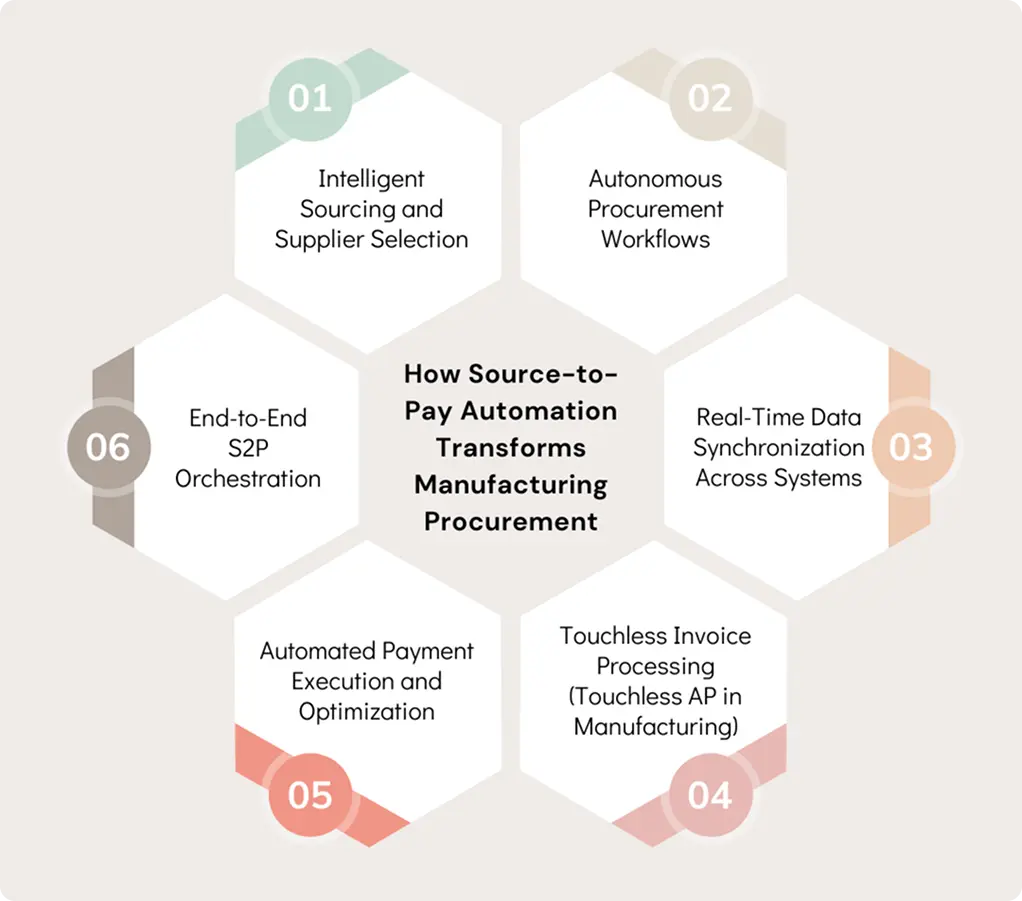

In manufacturing, suppliers are not just vendors—they are critical extensions of your production ecosystem. A delayed shipment, a quality issue, or a compliance failure from a single supplier can disrupt entire production lines, impact customer commitments, and increase operational expenses.
Despite these challenges, many organizations still manage suppliers reactively.
Several systems spread supplier data assessments periodically rather than continuously and base decisions on incomplete or outdated information. This fragmented approach makes it difficult to spot early warning signs, ensure compliance, or maintain consistent supplier performance.
This is where agentic AI can make a significant difference. By automating the process of bringing on new suppliers, keeping an eye on supplier risks, and using real-time data in decision-making, procurement teams can take action before problems arise instead of just responding to them. Supplier profiles are kept up to date automatically, risks are flagged as they emerge, and only verified, compliant suppliers are added to the ecosystem—reducing delays, mitigating operational risks, and strengthening supply chain reliability.
For a detailed look at how the system works in practice, read our blog: Agentic AI for Supplier Onboarding and Risk Monitoring, which shows how real-time monitoring and intelligent onboarding improve supplier performance and protect manufacturing operations.

Instead of relying on spreadsheets or periodic reviews, intelligent systems create real-time, continuously updated supplier profiles that procurement teams can act on. By leveraging AI agents, organizations can monitor supplier performance continuously and proactively improve it, identifying bottlenecks, predicting risks, and ensuring suppliers consistently meet quality and delivery expectations.
For a more profound look at how AI agents enhance supplier performance management, refer to our blog: How AI Agents Improve Supplier Performance Management. It provides practical examples of how real-time insights translate into stronger supplier relationships and reduced operational risk.

With intelligent automation, organizations can create a centralized supplier intelligence layer that brings together all relevant data.
This layer includes:
This unified view ensures that procurement and finance teams operate with accurate, consistent, and actionable information. By leveraging intelligent sourcing strategies, organizations can move beyond tactical, reactive procurement to strategic, data-driven sourcing decisions that optimize supplier selection, risk mitigation, and overall supply chain performance.
For a deeper dive into this transformation, read our blog: From Tactical Procurement to Intelligent Sourcing, which explores how companies can unify supplier intelligence and elevate procurement from a transactional function to a strategic advantage.
One of the most powerful capabilities of supplier intelligence is continuous risk monitoring.
Instead of periodic reviews, systems can:
Such functionality allows organizations to detect risks early, before they impact production or financial performance.

Supplier onboarding is often a slow and manual process, involving document collection, validation, and compliance checks.
With automation:
This ensures that only compliant and reliable suppliers are onboarded, reducing downstream risks.
Beyond monitoring, intelligent systems can predict potential supplier risks using historical and real-time data.
They can:
This shifts procurement from a reactive function to a predictive one, enabling faster and more informed decisions.

Supplier intelligence is not just about risk mitigation—it is also about performance improvement.
With continuous insights, organizations can:
This approach leads to a more resilient and high-performing supplier ecosystem.
For CPOs, CFOs, and procurement leaders, the impact is significant:

Supplier intelligence and risk automation enable manufacturing organizations to move from managing suppliers to truly understanding and optimizing them.
Instead of reacting to disruptions, procurement teams can anticipate, adapt, and act—ensuring that supplier ecosystems are not just efficient but also resilient, compliant, and future-ready.
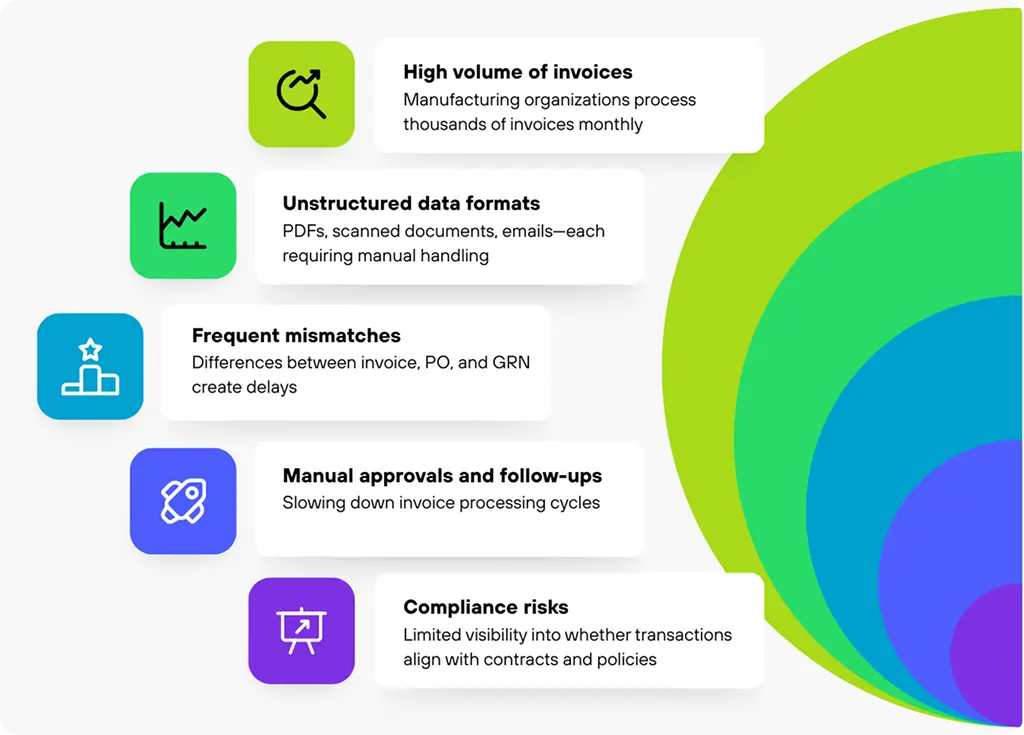
In manufacturing, Accounts Payable (AP) sits at the center of financial operations—processing high volumes of supplier invoices, validating transactions, and ensuring payments are accurate and compliant. However, despite digital systems, AP processes in most organizations remain manual, error-prone, and time-consuming.
Invoices arrive in multiple formats, data extraction requires human effort, mismatches are frequent, and compliance checks are often reactive. Such an approach slows down processing and creates risks related to financial inaccuracies, duplicate payments, and regulatory non-compliance.
Touchless AP in manufacturing changes the accounts payable process into a fully automated and smart system, where invoices are handled with very little human involvement and each transaction is checked instantly.
For organizations looking to understand how this transformation works end-to-end, our blog: Invoice Processing in Manufacturing: From RPA to Touchless AP explores the journey from traditional RPA to fully touchless, intelligent invoice processing, highlighting real-world strategies and benefits.
Touchless AP refers to the ability to process invoices end-to-end without manual intervention, except in exceptional cases.
This includes:
The goal is simple: Minimize human touchpoints while maximizing speed, accuracy, and compliance. In high-volume manufacturing environments, touchless GRN matching becomes especially critical. By automatically reconciling goods receipts with invoices and POs in real time, organizations can prevent errors, reduce delays, and improve financial accuracy. For a deeper look at how this works in practice, read our blog: Touchless Goods Receipt Matching in High-Volume Manufacturing, which highlights strategies for automating GRN matching and achieving end-to-end touchless AP.
The first step toward touchless AP is eliminating manual data entry.
With intelligent automation:
This process removes the need for manual data entry and significantly reduces errors.
One of the most critical steps in AP is validating invoices against procurement data.
With automation:
Instead of manually checking each invoice, the system performs real-time validation, ensuring accuracy and consistency.



Touchless AP and compliance automation transform Accounts Payable from a back-office function into a strategic enabler of financial control.
By eliminating manual effort, embedding compliance, and enabling real-time validation, organizations can ensure that every transaction is accurate, compliant, and optimized for financial performance.
In manufacturing, procurement spend is one of the largest and most complex cost centers. From raw materials and components to indirect purchases and services, organizations deal with thousands of transactions across multiple suppliers, categories, and geographies.
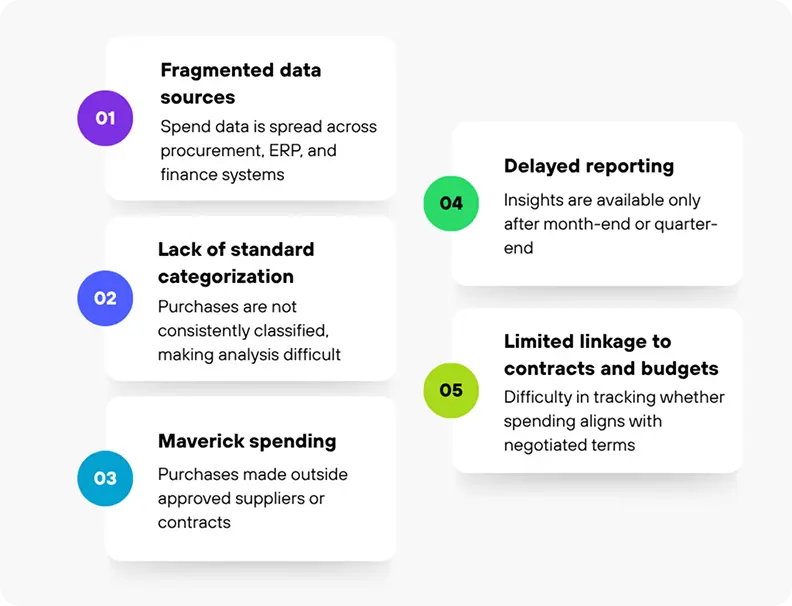
Yet, despite this scale, most organizations lack real-time visibility into where money is being spent, how it is being spent, and whether it aligns with contracts and budgets.
Data is often scattered across ERP systems, procurement tools, and finance platforms. Reporting is delayed, categorization is inconsistent, and decision-making is based on historical data rather than real-time insights.
Spend visibility and control automation transforms the process by enabling organizations to track, analyze, and optimize procurement spend in real time—ensuring financial discipline, compliance, and strategic cost management.
Traditional reporting provides historical insights, but modern procurement requires real-time visibility.
With automated analytics:
For CPOs, CFOs, and procurement leaders, the impact is significant:
Procurement teams often juggle two distinct sourcing approaches: direct sourcing, which focuses on raw materials and production-critical components, and strategic sourcing, which is broader, supplier-focused, and long-term. Traditional methods rely heavily on manual workflows, emails, and spreadsheets, which introduces delays and errors.
Automation in direct sourcing optimizes operational efficiency by:
Automation in strategic sourcing goes beyond transactional efficiency to deliver actionable intelligence:
By using automation for both types of sourcing, procurement teams move from reacting to situations and doing things by hand to using data to make informed decisions—this speeds up the procurement process, lowers the chances of running out of stock, and strengthens the entire supply chain.
Supplier risk is a critical concern for manufacturing procurement, where a single disruption can halt production lines. Managing supplier master data manually introduces risks such as duplicate records, outdated certifications, or untracked financial instability.
Automation benefits in supplier risk management include:
This approach reduces operational and reputational risk and empowers procurement teams with reliable, up-to-date supplier data for faster and safer decision-making. Leveraging AI agents for master data management ensures that supplier records remain accurate, complete, and actionable, creating a strong foundation for both risk management and strategic procurement initiatives.
For a practical guide on implementing this approach, read our blog: Supplier Master Data Management Using AI Agents, which highlights how AI-driven master data management can enhance supplier risk monitoring and drive procurement efficiency.

Manual processing of invoices, purchase orders (POs), and goods receipt notes (GRNs) is prone to delays, errors, and reconciliation issues. Automation transforms these traditionally fragmented workflows into a seamless, end-to-end cycle.
Key automation outcomes include:
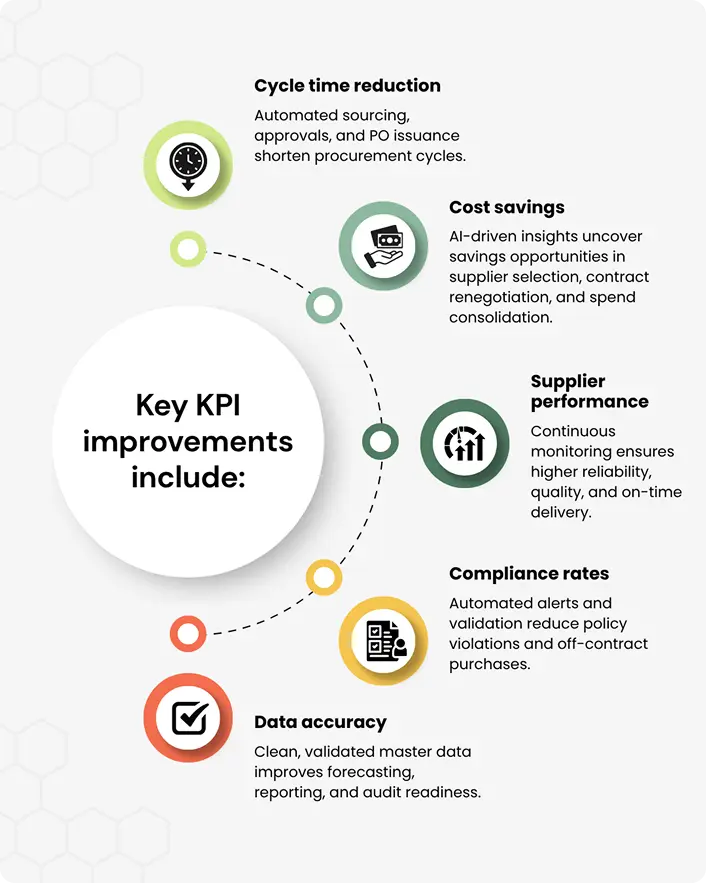
By using Agentic AI in procurement processes, organisations work more efficiently and gain valuable insights that help them save money, reduce risks, and strengthen their supply chain. For a deeper dive into which procurement KPIs see the most impact when Agentic AI is introduced—and how to measure them effectively—read our blog: Procurement KPIs That Improve When You Introduce Agentic AI.
The future of procurement in manufacturing and large enterprises is no longer just about cost savings—it’s about intelligent, proactive decision-making, risk mitigation, and operational agility. By integrating automation across direct and strategic sourcing, supplier management, invoice processing, and contract compliance, organizations can eliminate inefficiencies, reduce errors, and free their teams to focus on strategic initiatives.
Agentic AI takes this transformation a step further, delivering predictive insights, continuous monitoring, and intelligent recommendations that traditional automation cannot achieve. Procurement teams move from just reacting to situations to becoming important business partners that use data to make better decisions, leading to better spending visibility and managing supplier risks.
Enterprises that embrace these technologies today will not only gain faster procurement cycles and higher compliance but also strengthen their competitive advantage in an increasingly dynamic market.
The path is clear: automation plus Agentic AI equals smarter procurement, stronger supply chains, and measurable business impact.

Follow Us