





Key Takeaways
- Manufacturing automation succeeds when it focuses on end-to-end processes, not isolated tasks.
- Platform-agnostic automation allows manufacturers to integrate automation with existing ERP, MES, and legacy systems.
- Agentic Process Automation enables AI agents to coordinate workflows and respond dynamically to operational changes.
- A CoE-driven automation strategy helps manufacturers scale automation across departments without fragmentation.
- Choosing the right manufacturing automation partner ensures automation delivers measurable operational impact, not just technical improvements.
Manufacturing leaders rarely wake up thinking about automation frameworks. They think about late shipments, inventory mismatches, procurement bottlenecks, quality exceptions, and finance teams chasing invoices that should have been settled weeks ago.
Automation discussions usually start somewhere else—often with a platform pitch.
A vendor arrives with a demo. A bot fills forms quickly. A dashboard looks impressive. A proof of concept works in a controlled environment.
And yet, a few months later, the plant operations team still sends emails to procurement. Finance still reconciles spreadsheets manually. Customer service still chases shipment confirmations across three systems.
That gap between automation promise and operational reality is precisely where the Auxiliobits agentic process automation model tends to resonate with manufacturing enterprises.
It doesn’t start with platforms. It starts with processes that already exist—and the messy operational realities around them.
This is one reason why discussions about auxiliobits for manufacturing tend to sound different from those about conventional automation vendors.
Manufacturing Automation Is Rarely a Technology Problem
Most manufacturing companies already have technology. ERP platforms are in place. MES systems run production. Supplier portals exist. CRM tools track orders. Finance uses accounting platforms. On paper, the enterprise stack looks mature.
The real issue sits between those systems.
Manual coordination still dominates critical workflows:
- Vendor onboarding handled through email attachments
- Order confirmations arriving via PDFs or spreadsheets
- Finance teams reconciling data between ERP and logistics systems
- Quality teams documenting incidents in shared drives
- Customer service manually verifying shipment status
This isn’t digitization failure. The systems exist. The problem is orchestration. Processes stretch across departments, tools, and human decisions. Traditional RPA helped for a while—automating repetitive tasks. But manufacturing workflows rarely stay static long enough for rigid bots to keep up.
That’s where agentic process automation starts to look more practical.
Also read our ebook: Auxiliobits Consulting Services Strategic Consulting for the Agentic, AI-Powered Enterprise
The Shift from Task Automation to Process Autonomy
Instead of asking, “Which task can we automate?”
The more useful question becomes, “Which business process should run autonomously?”
This model particularly suits manufacturing processes due to their involvement in continuous decision loops.
Consider a typical order-to-cash cycle in manufacturing:
- Order received through CRM
- Availability validated in ERP
- Credit checks performed by finance
- Production scheduling updated in MES
- Shipment coordination with logistics
- Invoice generation and payment tracking
Each step triggers the next. Exceptions appear frequently.
- Customer changes order quantity
- Supplier shipment delays production
- Credit thresholds require review
- Logistics partners update delivery timelin
A static automation script struggles with this level of variability. An AI-driven agent, on the other hand, can monitor the workflow, interpret conditions, and trigger the next action dynamically. That’s the architectural foundation behind the Auxiliobits APA approach.
Why Platform-Agnostic Automation Matters in Manufacturing
Manufacturing environments are rarely standardized.
Two plants under the same company may run entirely different technology stacks.
- One facility runs SAP
- Another relies on Oracle ERP
- MES varies by plant
- Procurement tools differ across regions
- Legacy systems still handle niche functions
A platform-first automation strategy creates friction immediately. Teams spend months debating tooling decisions instead of fixing operational bottlenecks. Auxiliobits intentionally avoids that trap by adopting a platform-agnostic approach.
Automation is designed around processes, not software brands.
That means solutions may combine:
- RPA platforms like UiPath or Power Automate
- AI models for document understanding
- API orchestration across ERP and MES systems
- AI agents managing workflow coordination
- Process mining tools identifying inefficiencies
The technology stack adapts to the enterprise environment.
Not the other way around. For manufacturing organizations that have spent decades building their digital ecosystem, that flexibility is more valuable than it sounds at first.
Department-Wise Value: Automation That Mirrors Real Workflows
Manufacturing processes cut across departments constantly. Automating a single task inside one team rarely solves the bigger operational issue. The Auxiliobits model addresses automation department by department while connecting those workflows through AI agents.
1. Procurement
Procurement teams deal with supplier onboarding, vendor documentation, compliance checks, and purchase order management.
Manual effort often concentrates around:
- Vendor data entry into ERP systems
- Contract verification
- Compliance validation
- Purchase order approvals
Automation here usually includes:
- AI document extraction for vendor forms
- Automated supplier onboarding workflows
- Approval routing through AI agents
- ERP entry handled by RPA bots
What changes isn’t just speed—it’s consistency. Procurement processes stop depending on who happens to be available that day.
2. Finance and Accounting
Manufacturing finance teams spend significant time on operational work:
- Invoice validation
- Payment matching
- Credit checks
- Accounts receivable follow-ups
Agentic automation helps finance operate more proactively.
Examples include:
- AI agents monitoring overdue invoices and triggering reminder workflows
- Automated reconciliation between ERP and bank systems
- Intelligent invoice matching across procurement and logistics records
Finance leaders often discover something surprising after implementation: It isn’t just about faster transactions. It’s about reducing revenue leakage caused by overlooked discrepancies.
3. Supply Chain Operations
Supply chains introduce constant variability. Production schedules shift. Supplier delays ripple through the system. Inventory levels fluctuate. Agentic automation improves visibility and response time.
A typical automation framework might:
- Monitor supplier updates automatically
- Flag potential production delays
- Adjust scheduling workflows dynamically
- Notify procurement teams before shortages occur
These aren’t rigid scripts. AI agents monitor conditions and respond accordingly. That distinction matters in manufacturing environments where unexpected changes are the norm rather than the exception.
4. Customer Service
Customer service in manufacturing often operates as an information bridge between departments.
Customers ask questions that require digging across systems:
- Shipment status
- Order modifications
- Delivery delays
- Invoice clarifications
CRM systems. Instead of escalating internally, support teams receive real-time answers.
It’s a subtle improvement, but it dramatically reduces response times and customer frustration.
Why CoE-Driven Execution Works Better in Manufacturing
Automation efforts often fail because they remain isolated projects. One team automates procurement. Another experiment with finance bots. Operations pilots a logistics dashboard. Six months later, none of these initiatives talk to each other.
The Auxiliobits delivery model relies heavily on Automation Centers of Excellence (CoE).
A CoE does more than govern automation standards.
It establishes:
- Process discovery frameworks
- Automation prioritization models
- Cross-department workflow orchestration
- Governance around AI agent deployment
Manufacturing companies with mature CoEs tend to scale automation faster—and more safely. Without that governance structure, automation becomes fragmented. Some organizations learn this the hard way after dozens of disconnected bot deployments.
Where Automation Projects Fail
Automation conversations usually highlight success stories. Failures are more instructive.
Common pitfalls include
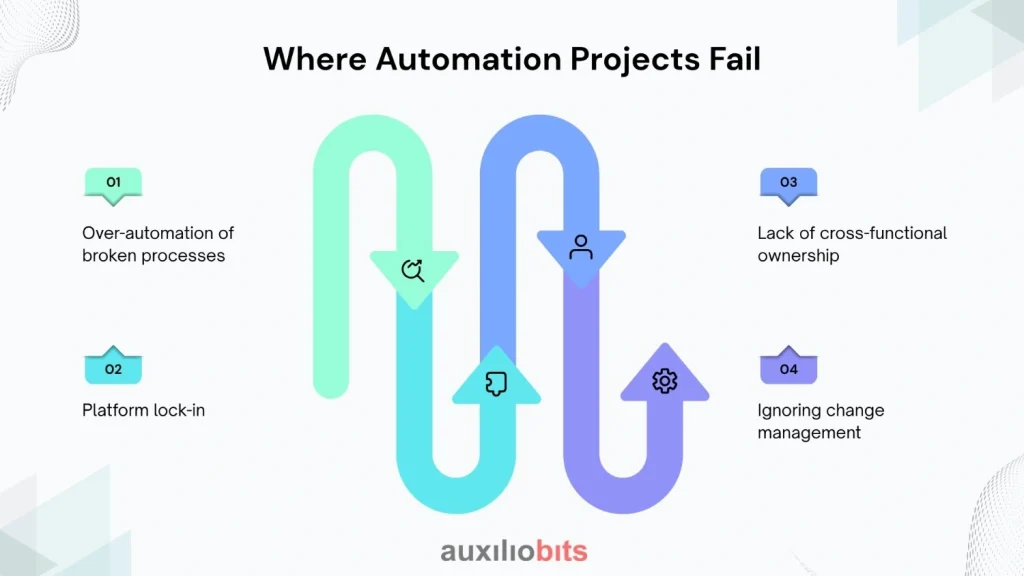
1. Over-automation of broken processes
Sometimes companies automate workflows that should have been redesigned entirely.
2. Platform lock-in
Selecting automation tools before understanding process requirements often creates long-term constraints.
3. Lack of cross-functional ownership
Manufacturing processes usually span multiple departments. Without shared accountability, automation initiatives stall.
4. Ignoring change management
Automation affects how people work. When teams perceive automation as imposed rather than collaboratively designed, the pace of adoption significantly slows.
The Auxiliobits approach intentionally addresses these risks through process discovery and CoE governance.
It sounds procedural, but it prevents expensive missteps.
The Question Manufacturing Leaders Eventually Ask
Automation projects typically start with a narrow objective. Reduce manual work. Speed up invoice processing. Improve procurement workflows.
But once automation begins working at scale, the question changes. Leaders start asking, ‘What if the entire operational workflow could run autonomously?’
Not fully automated in the robotic sense, but coordinated intelligently through AI agents. Procurement triggers production adjustments. Production changes trigger logistics updates. Finance receives accurate invoice triggers automatically. Customer service stays informed in real time.
This isn’t science fiction. It’s the natural evolution of process automation.
Why Auxiliobits Is Emerging as a Manufacturing Automation Partner
The reason conversations around manufacturing automation partner selection increasingly include Auxiliobits comes down to three practical factors.
1. Platform-Agnostic Execution
Automation adapts to existing enterprise technology rather than forcing system replacements.
2. Department-Level Process Understanding
Solutions address operational workflows—not isolated tasks.
3. CoE-Led Governance
Automation scales through structured execution rather than scattered pilot projects. That combination allows manufacturing organizations to move beyond tactical automation. They begin building something closer to autonomous enterprise operations.
And once companies see that shift in action, it becomes difficult to imagine returning to manual process coordination.
Not because automation is fashionable. Simply put, manufacturing has too many moving parts to operate in any other manner anymore.
Conclusion
Manufacturing companies don’t lack automation tools. What they often lack is an automation model that fits the way their operations truly run. Processes stretch across procurement, production, finance, and logistics. Systems vary from plant to plant. Exceptions appear daily. In that environment, rigid automation frameworks tend to break down quickly.
That’s why the Auxiliobits approach feels more practical. By not sticking to one specific platform, concentrating on the value for each department, and using a model driven by a Center of Excellence, automation becomes more like a core part of the business instead of just a bunch of separate
Manufacturers looking for a reliable manufacturing automation partner usually reach the same realization after a few automation attempts: tools alone don’t solve process complexity.
What matters is how automation is designed, governed, and integrated into the way the enterprise actually operates.
That’s precisely where the why Auxiliobits for manufacturing conversation tends to begin.