







Short Key Takeaways
- Automation amplifies data behaviour—good or bad. Without strong data governance, errors scale quietly.
- Trust comes from embedded controls, not after-the-fact validation or audit fixes.
- Data ownership matters more than tools—unclear accountability breaks governance faster than bad technology.
- Exceptions are where governance proves itself, not in straight-through processing.
- Data governance automation works best when it’s continuous, enforcing rules in real time rather than relying on periodic checks.
Most automation programs in manufacturing don’t fail loudly. They drift. A reconciliation bot runs for months, matching transactions across systems. No one complains. Then quarter-end hits, auditors ask for lineage, and suddenly no one can clearly explain why certain entries were posted the way they were. The numbers aren’t wildly off, but they’re not defensible either.
That’s usually the moment when “data governance” enters the conversation. Data governance often arrives late, is sometimes misinterpreted, and is often viewed as a compliance add-on.
It shouldn’t be. In manufacturing environments, where data moves across plants, ERPs, suppliers, and spreadsheets that somehow still survive every transformation program—data governance isn’t a control layer. It’s the thing that makes automation trustworthy in the first place.
Automation Doesn’t Clean Data—It Multiplies Its Behavior
There’s a persistent assumption that automation somehow “fixes” suboptimal processes. It doesn’t. It standardizes them. If your vendor master has duplicates, automation will process them faster. If plant-level data uses inconsistent units or naming conventions, your bots will reconcile inconsistencies at scale.
And here’s the uncomfortable part—automation often hides the problem temporarily.
Manual processes expose friction:
- Someone pauses when something looks off
- A finance analyst questions a mismatch
- A plant controller flags an anomaly
Automation removes those pauses. Which is great for efficiency—but not so great when the underlying data is unreliable. This is why data governance automation has to sit inside the process, not outside it. Otherwise, you’re just speeding up uncertainty.
Also read: Agent-Augmented Policy Making in Public Sector Governance
What Governance Looks Like When It Works
Not the policy documents. Not the frameworks sitting in SharePoint. We are talking about what shows up in day-to-day operations.
In a well-governed automation setup, you’ll notice small but telling things:
- A bot refuses to process an invoice because the vendor record is incomplete—and it tells you exactly what’s missing
- Currency mismatches are caught before posting, not during reconciliation
- Every automated decision leaves behind a breadcrumb trail that someone can follow without needing three teams involved
While this process may not be glamorous, it is essential for cultivating what many automation programs struggle to achieve: trust in the final output.
Manufacturing Makes Governance Messy
You can design clean governance models on paper. Manufacturing will break them.
1. Plants Don’t Operate Identically—Even When They’re Supposed To
Global templates exist. Local workarounds exist more.
One plant might:
- Maintain supplier data rigorously
Another:
- Keeps a parallel Excel tracker “just in case”
Now layer automation across both. The bot doesn’t know which one reflects reality—it just processes inputs.
2. Legacy Systems Aren’t Going Anywhere
Every manufacturing organization has that one system:
- No API
- Poor documentation
- Critical to operations
You don’t replace it—you work around it.
Which means governance has to account for:
- Partial data visibility
- Inconsistent formats
- Delayed updates
That’s not a theoretical problem. It shows up in things like inventory mismatches or delayed financial postings.
3. Ownership Is… Blurry
Ask three people who own supplier master data, and you’ll get four answers.
- Procurement says they create it
- Finance says they validate it
- IT says they maintain the system
- Plants quietly override things when needed
Automation cuts across all of these operations. And when something goes wrong, governance breaks down not because of missing rules, but because no one is clearly accountable.
Where Data Governance Quietly Fails
It’s usually a gradual process. More like erosion.
Controls Exist—But Not Where They’re Needed
You’ll often see:
- Strong audit controls
- Well-defined approval workflows
But inside the automation itself? Minimal validation. Why? Because controls are treated as external requirements, not design principles.
Exceptions Are Treated as “Someone Else’s Problem”
A bot hits an issue and routes it to a human queue.
Sounds fine—until you look closer:
- No context
- No suggested resolution
- No prioritization
So now a human has to:
- Investigate
- Understand
- Fix
At that point, you haven’t reduced effort—you’ve just shifted it.
Building Trust: What Actually Moves the Needle
Not theory. Not frameworks. Just things that tend to work in real programs.
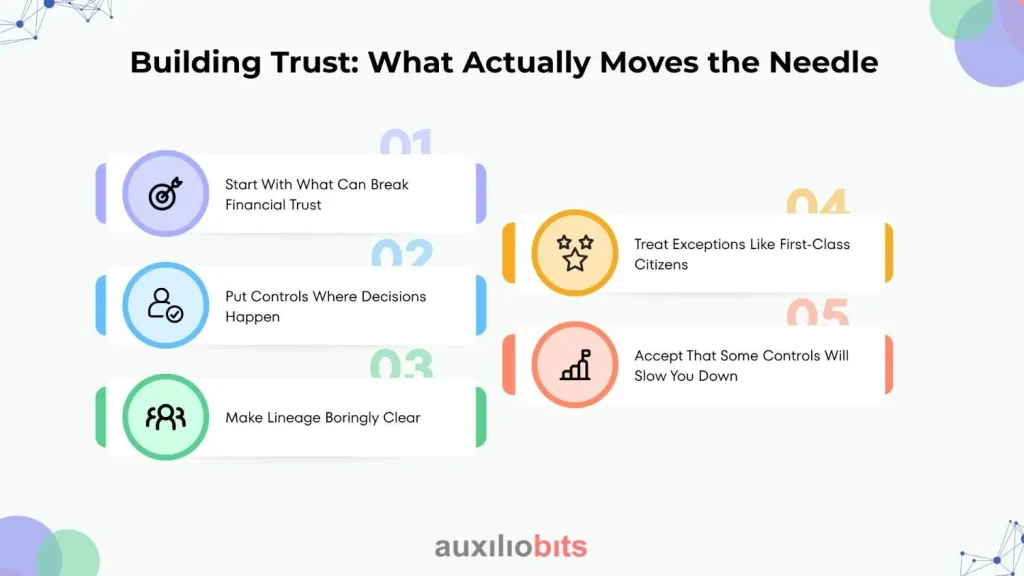
1. Start With What Can Break Financial Trust
Don’t try to govern everything.
Focus on:
- Posting logic
- Currency conversions
- Vendor master data
- Inventory valuation inputs
If these go wrong, downstream impact is immediate and visible.
2. Put Controls Where Decisions Happen
This sounds obvious, but it’s often missed.
Instead of:
- Running validation reports after processing
Do this:
- Validate before posting
- Block incorrect entries early
- Force correction at the source
It’s slightly more painful upfront. Much less painful later.
3. Make Lineage Boringly Clear
If someone asks, “Why did this happen?”—you should have a straightforward answer.
Not:
- “We need to check with IT”
- “Let’s pull logs”
But:
- Source → Transformation → Outcome
If it takes more than a few minutes to trace, governance isn’t working.
4. Treat Exceptions Like First-Class Citizens
Most programs optimize for the 80% straight-through flow. The remaining 20%? That’s where governance proves its value.
Better approaches:
- Classify exceptions (not all are equal)
- Attach context automatically
- Suggest likely resolutions
Otherwise, you’re just creating smarter bottlenecks.
5. Accept That Some Controls Will Slow You Down
This is where teams push back. “Yes, but it reduces processing speed.” Sometimes, it should. A control that prevents incorrect financial postings is worth more than a few seconds saved in automation.
Not every step needs friction—but some absolutely do.
Where Data Governance Automation Helps
There’s a lot of noise around this term, so it’s worth grounding it. Data governance automation isn’t about replacing governance teams. It’s about making governance continuous instead of periodic.
In practice, that means:
- Data validation happens during processing, not after
- Rules are enforced automatically, not manually checked
- Lineage is captured as a byproduct, not reconstructed later
- Exceptions come with context, not just alerts
But this detail gets overlooked—it only works if the underlying rules are well thought out. Bad rules, automated, just create faster confusion.
The Trade-Offs No One Resolves Cleanly
You’ll run into these whether you plan for them or not.
1. Speed vs. Control
More controls = slower processing.
Fewer controls = higher risk.
There’s no perfect balance. It depends on what your organization is willing to tolerate.
2. Global Consistency vs. Local Reality
Central teams want standardization. Plants need flexibility.
Push too firmly either way, and something breaks—either governance or operations.
3. Automation vs. Judgment
Not everything should be automated. High-risk decisions still need human oversight—but ideally with better data, not more guesswork.
What Mature Programs Do
They don’t get everything right. But they approach things differently.
- Governance is part of design conversations, not post-implementation fixes
- Data ownership is defined—even if it’s occasionally debated
- Controls evolve based on actual issues, not theoretical risks
- There’s less obsession with perfection, more focus on reliability
And maybe the most telling sign—they don’t assume the system is correct just because it’s automated.
One Last Thought
If automation gives you faster answers, data governance determines whether those answers are worth trusting. In manufacturing, that distinction shows up in very real ways—financial accuracy, audit outcomes, and operational decisions.
You can run a highly automated operation and still spend weeks explaining numbers. Alternatively, you can incorporate governance into the system, thereby eliminating the need for such discussions.
Most teams learn this the hard way.