







Key Takeaways
- Most delays in material ledger closing comes from data readiness issues—not system limitations.
- Material ledger closing automation improves speed by shifting effort earlier in the cycle, not just compressing timelines.
- Pre-close validation delivers more impact than automating the closing run itself.
- Automation reduces dependency on manual expertise but doesn’t eliminate the need for financial judgment.
- Faster month-end closing is ultimately about trust in data, not just process efficiency.
Month-end in manufacturing finance has always had a certain rhythm—predictable, exhausting, and, frankly, a bit outdated. The closer you get to the final working day, the more everything starts to compress: inventory valuations, cost roll-ups, price differences, and reconciliations. And right in the middle of it sits material ledger closing—a process that is both critical and notoriously unforgiving.
If you’ve worked in an SAP-driven manufacturing environment, you already know the task isn’t just another checklist item. It’s the moment where actual costing meets reality. Where assumptions get corrected. This is the critical juncture where margins either maintain their stability or subtly decline.
And yet, for something so central to financial accuracy, the process itself is often held together with spreadsheets, manual validations, and a surprising amount of human memory.
That’s where material ledger closing automation starts to shift the conversation—not as a buzzword, but as a very practical lever for month-end acceleration.
Why Material Ledger Closing Becomes a Bottleneck
At a high level, material ledger closing is about determining actual costs of materials by considering all price differences accumulated during the period. Straightforward on paper. Messy in execution.
The friction typically shows up in places like:
- Incomplete goods movements or delayed postings
- Unsettled production orders
- Price differences sitting in limbo due to missing allocations
- Intercompany transfers that don’t quite reconcile
- Currency valuation inconsistencies in global operations
Individually, these aren’t catastrophic. Together, they create a dependency web that slows everything down. And here’s the uncomfortable truth: most delays are due to reasons apart from the system’s inability to process the data. They happen because finance teams don’t fully trust the data yet.
So they wait. They validate. They re-check. Then someone finds a discrepancy at 8:30 PM on day three of closing, and the whole sequence restarts.
The Illusion of Control in Manual Closing
There’s a long-standing belief that manual intervention equals control. It doesn’t. It just feels that way.
In material ledger closing, manual checks often introduce:
- Timing mismatches (you validated data that changed 30 minutes later)
- Inconsistent logic across plants or regions
- Over-reliance on “that one expert” who knows how to fix edge cases
- Silent errors—especially in spreadsheet-based reconciliations
Ironically, manual control becomes less sustainable as operations grow more complex, involving multiple plants, currencies, and a high volume of SKUs. Yet many organizations still operate this way because… well, it’s how it’s always been done.
Where Automation Actually Fits
Let’s clear something up: material ledger closing automation doesn’t replace SAP logic. It doesn’t rewrite costing algorithms or bypass standard processes.
What it does is eliminate the friction around those processes. Think of it as automation layered on top of existing systems—focusing on execution, validation, and orchestration.
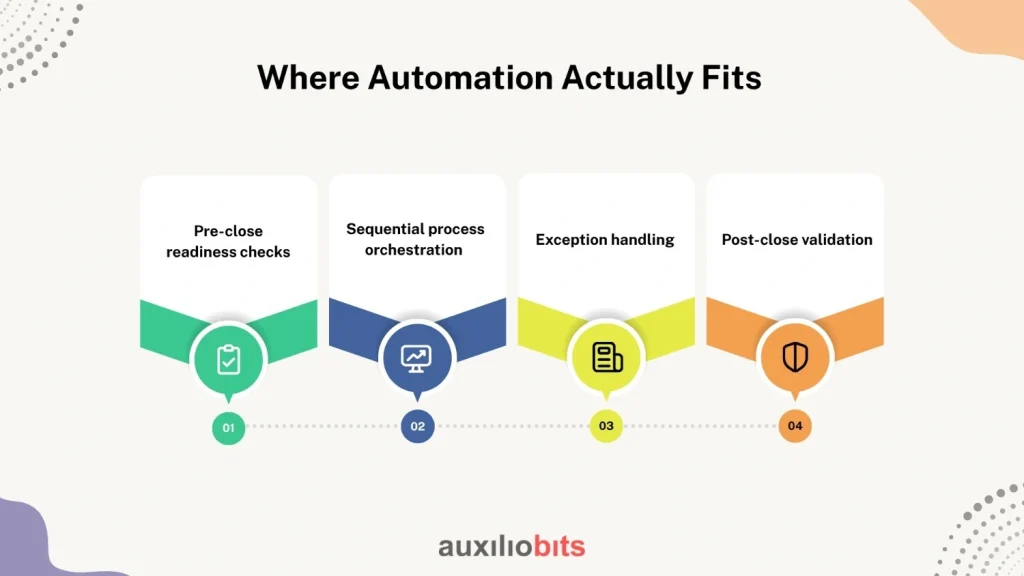
Areas where automation makes a real difference:
1. Pre-close readiness checks
- Identify missing goods movements
- Flag incomplete production orders
- Detect abnormal price variances before closing begins
2. Sequential process orchestration
- Trigger closing steps in the correct order across plants
- Handle dependencies automatically (instead of relying on emails or trackers)
3. Exception handling
- Surface only the records that actually need human attention
- Provide context (why this failed, what changed, what’s impacted)
4. Post-close validation
- Reconcile results against expected thresholds
- Highlight anomalies instead of forcing teams to search for them
Where does automation struggle? Edge-case judgment. There are still scenarios where finance expertise is needed—especially when business context matters more than system logic. But those cases are fewer than most teams assume.
Month-End Acceleration: What Changes
When organizations discuss faster closing, they often mean shaving off a day or two. That’s part of it, but not the whole story.
What changes with material ledger closing automation is the shape of the close cycle.
Instead of a linear, high-pressure sequence, you get something closer to a continuous readiness model.
Before automation:
- Day 1–2: Data cleanup
- Day 3–4: Closing execution
- Day 5: Reconciliation and corrections
After automation:
- Continuous: Data monitored and corrected throughout the month
- Day 1–2: Mostly execution
- Day 3: Exception resolution and validation
It’s subtle but powerful. You’re not compressing work into fewer days—you’re redistributing it. And that changes behavior across the organization.
A Practical Scenario: Where Things Usually Break
Consider a mid-sized manufacturing company with:
- 6 production plants
- Multiple currencies
- High intercompany material movement
During month-end, one plant delays goods issue postings by a day. Another completes production orders late. Price differences accumulate unevenly.
By the time finance runs Material Ledger Closing:
- Allocations fail in two plants
- Actual cost calculations produce unexpected variances
- Reconciliation reports don’t align with prior expectations
So the team pauses. They investigate and correct upstream data. In addition to this, they also rerun the process. Now multiply that by three or four iterations. This isn’t an edge case—it’s fairly typical.
With automation in place:
- The system flags delayed postings before closing begins
- Incomplete orders are highlighted daily
- Price variance thresholds trigger alerts mid-cycle
By the time closing starts, we have already resolved most issues. Not all—but enough to prevent cascading failures.
What Good Automation Looks Like
There’s a tendency to equate automation with RPA scripts clicking through SAP screens. That’s the entry point, not the destination.
Effective material ledger closing automation usually combines:
- Rule-based validation engines: Checking for completeness, consistency, and thresholds
- Workflow orchestration layers: Managing dependencies across plants and processes
- Context-aware alerts: Not just “something failed”, but why it failed
- Integration with existing ERP logic: Respecting SAP processes rather than bypassing them
And occasionally—this area is where things get intriguing—AI-driven anomaly detection. Not perfect. Sometimes overly sensitive. But useful when tuned correctly.
Also read: Quote-to-Order Automation in Complex Manufacturing
Common Pitfalls
It’s tempting to assume automation will clean everything up instantly. It won’t.
Some recurring issues:
- Automating broken processes: If your closing logic is inconsistent, automation will just execute inconsistency faster
- Overengineering workflows: Too many rules, too many exceptions—teams end up managing the automation instead of benefiting from it
- Ignoring user adoption: Finance teams need to trust the system. If they don’t, they’ll keep manual backups “just in case”
- Lack of ownership: Who owns the automation layer? IT? Finance? Both? This ambiguity causes more friction than people expect
The Shift: From Reactive to Predictive Closing
This phase is where things start to feel different. Traditional material ledger closing is reactive. You run the process, see what breaks, then fix it.
Automation introduces a more predictive approach:
- Issues identified mid-cycle
- Variances tracked as they develop
- Dependencies managed proactively
It doesn’t eliminate surprises entirely—manufacturing environments are too dynamic for that—but it reduces the frequency and impact. And perhaps more importantly, it changes how finance teams spend their time.
Less chasing data. More interpreting it.
Some Observations From the Field
A few patterns that show up consistently across implementations:
- Plants with higher automation maturity close faster—not just because of tools, but because processes are cleaner.
- Finance teams initially resist automation, then become its biggest advocates once late-night fire drills disappear.
- The biggest gains often come from pre-close validation, not the closing execution itself.
And one slightly controversial take: You don’t need full automation to see value. Even partial automation—focused on validation and orchestration—can cut closing time significantly.
What to Prioritize First?
If you’re considering automation for material ledger closing, starting points matter.
Not everything needs to be automated on day one. Focus areas that typically deliver the most impact:
Data readiness checks
- Missing postings
- Incomplete orders
- Abnormal variances
Dependency mapping
- Which processes block others
- Where delays usually occur
Exception visibility
- What actually requires human intervention
- What doesn’t
From there, you can expand into orchestration and advanced analytics. Trying to automate everything at once? That usually ends in frustration.
A Final Thought
Material ledger closing isn’t going away. If anything, it’s becoming more important as organizations push for more accurate, real-time cost insights.
But the way it’s executed is overdue for change. Not because automation is trendy—but because the current approach doesn’t scale.
Month-end acceleration isn’t really about speed. It’s about confidence. The ability to close faster because you trust the process, not in spite of it.
And that’s where material ledger closing automation earns its place—not as a technical upgrade, but as a shift in how manufacturing finance actually operates under pressure.