






Key Takeaways
- Most compliance systems fail not due to lack of detection, but because alerts rarely lead to timely action
- AI agents shift compliance from passive monitoring to real-time decision-making and intervention
- Alerts become effective only when they clearly explain what happened, why it matters, and what to do next
- Controlled automation (not full autonomy) is the practical way to enable safe corrective actions
- Real-time compliance works best when tightly integrated with workflows and focused on meaningful, actionable signals
Most compliance setups don’t break because of missing controls. The violation of those controls leads to their breakdown. That sounds obvious, but it’s surprisingly common.
You’ll see organizations invest heavily in compliance monitoring automation—dashboards, rule engines, audit logs, and even some level of machine learning. Everything looks solid on paper. But then you ask a simple question: “What happens when something goes wrong?”
And the answer is usually… “An alert is generated.”
That’s the problem. An alert, by itself, is not control. It’s a notification. And often, it’s just noise.
The Quiet Failure of Alerts
There’s this assumption that if you surface issues fast enough, people will act on them.
That assumption doesn’t hold up.
In one manufacturing company, their compliance tool generated around 1,200 alerts a week related to procurement deviations—duplicate invoices, skipped approvals, and vendor mismatches. Sounds like strong oversight, right?
Except:
- Less than 15% of alerts were actually reviewed
- Fewer than 5% led to corrective action
- Some alerts stayed unresolved for weeks
No one ignored them on purpose. They just got buried. Different teams, unclear ownership, no prioritization. At a certain point, people stop reacting.
You could argue that the system was “working” because it detected issues. But detection without response is just delayed reporting.
That’s where Real-Time Compliance starts to mean something different. Not faster alerts—faster decisions.
Also read: Quote-to-Order Automation in Complex Manufacturing
AI Agents Change the Timing, Not Just the Technology
There’s a tendency to frame AI agents as some kind of upgrade to rule engines. That’s not quite right.
The real difference is timing.
Traditional monitoring:
- Detect → Log → Alert → Wait
AI-driven monitoring:
- Detect → Interpret → Decide → Act (or escalate)
That compression of steps is where the value comes from.
But—and this is important—it only works if the system is allowed to do something beyond notifying.
Otherwise, you’ve just built a smarter way to create alerts people still won’t read.
What Makes an Alert Worth Acting On?
Alerts often fail to be effective because they lack necessary context. Examples of this insufficient detail include messages like:
- Threshold exceeded.
- Policy violation detected.
- Unusual activity flagged.
These aren’t wrong—they’re just incomplete. They don’t tell the person receiving them what actually matters.
A useful alert answers three questions immediately:
- What exactly happened?
- Why does it matter right now?
- What should be done next?
If any of them are missing, the alert gets deprioritized. Not consciously—but it happens.
AI agents assist by consolidating signals that typically scatter across systems.
Instead of flagging a single event, they correlate:
- Transaction patterns
- User behavior
- Historical deviations
- Process context
So the alert starts to look more like:
- Payment initiated outside approval workflow
- Same vendor triggered similar exception last quarter
- Amount is within limit, but sequence is abnormal
- Suggested action: hold transaction and request secondary approval
Now it’s not just a warning—it’s a decision prompt. And people tend to respond to those.
The Part Most Teams Avoid: Taking Action Automatically
This phase is where things become uncomfortable. Generating better alerts is widely accepted. Letting systems take corrective action? Not so much.
There’s always hesitation:
- What if it blocks the wrong transaction?
- What if the model misinterprets something?
- We can’t afford disruption.
All valid concerns. But here’s the flip side—manual intervention isn’t exactly risk-free either. It’s just slower and often inconsistent.
The more practical approach isn’t full automation. It’s controlled intervention.
What Corrective Actions Look Like in Practice
There’s a spectrum here, and not everything should sit at the far end.
Some actions are low-risk and should almost always be automated:
- Temporarily pausing a transaction pending review
- Flagging and rerouting approval workflows
- Locking incomplete records from progressing further
Others need human involvement but can still be accelerated:
- Pre-filling remediation steps
- Assigning ownership automatically
- Providing context so the reviewer doesn’t start from scratch
And then there are actions you should be careful with:
- Reversing financial transactions
- Disabling user access
- Making policy-level changes
Those can be automated, but only under very tight conditions. Otherwise, you end up solving one compliance issue by creating another.
A Small Example
Take vendor onboarding in a typical enterprise setup. Even with ERP systems in place, there are still manual gaps—documents uploaded late, approvals bypassed, and data entered inconsistently.
Without real-time monitoring:
- The vendor gets approved
- Transactions begin
- Issues are discovered during audit
With AI-driven compliance monitoring:
- Missing documentation is detected at submission
- The onboarding process is paused automatically
- The requester is notified with specific requirements
- Escalation kicks in only if delays exceed a threshold
Nothing dramatic. No “AI magic”. Just timely intervention. And yet, this alone can eliminate a large percentage of downstream compliance issues.
Why Some Implementations Still Don’t Work
Even with AI agents in place, things can go sideways.
A few patterns show up repeatedly:
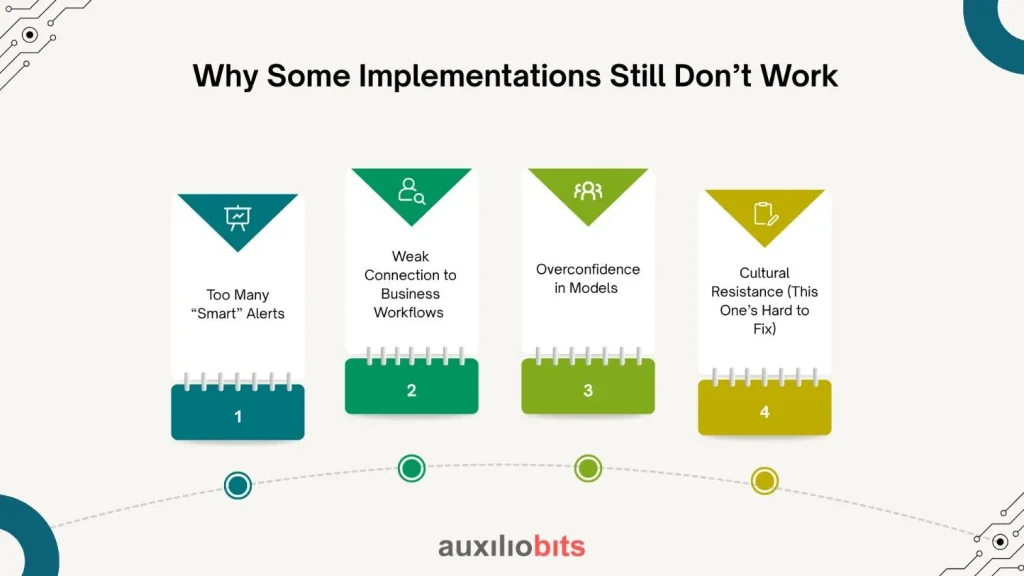
1. Too Many “Smart” Alerts
Ironically, adding intelligence can sometimes increase complexity. If every alert becomes multi-layered and verbose, users still tune out.
2. Weak Connection to Business Workflows
If alerts live in a separate system and actions happen elsewhere, response times don’t really improve.
3. Overconfidence in Models
AI isn’t infallible. If teams stop questioning decisions entirely, small errors can scale quickly.
4. Cultural Resistance (This One’s Hard to Fix)
Some teams are just used to retrospective compliance. Moving to real-time intervention feels intrusive.
And honestly, sometimes it is. Not everyone likes being stopped mid-process because a system flagged something.
Where Real-Time Compliance Pays Off
Not everywhere.
In low-volume or low-risk processes, the overhead might not be worth it. A periodic audit works just fine.
But in environments where:
- Transactions happen continuously
- Multiple systems interact
- Regulatory exposure is high
- Delays amplify risk
…real-time monitoring starts to make a noticeable difference.
Finance is the obvious candidate. Manufacturing procurement, healthcare claims processing, and even sales discount approvals all benefit from catching issues before they propagate.
The Subtle Shift Most People Miss
This isn’t just about technology. It changes how teams behave.
When people know that:
- deviations are detected immediately
- actions are triggered instantly
- and there’s a clear trail of accountability
…they adjust.
Not always consciously, but it happens.
Compliance stops being something that’s checked later and starts becoming something that shapes how work gets done.
An Observation
Many organizations say they want Real-Time Compliance. What they actually want is faster visibility, not real-time enforcement. Because enforcement introduces friction. It interrupts workflows. It forces decisions earlier than people are used to making them.
AI agents don’t just improve monitoring—they make inaction harder.
And that’s where the real resistance shows up.
So What Works?
If you strip away the buzzwords, the setups that work tend to follow a few principles:
- Keep alerts limited, but meaningful
- Tie every alert to a clear next step
- Automate low-risk actions without hesitation
- Introduce autonomy gradually, not all at once
- Continuously adjust based on how users respond (not just system accuracy)
It’s less about building a perfect system and more about building one people don’t ignore.
One Last Thought
You can have perfect detection logic, well-trained models, and even beautifully designed dashboards.
If alerts don’t lead to action, none of it matters. That’s the uncomfortable truth behind most compliance monitoring automation efforts.
AI agents help—but only when they’re allowed to close the loop.
Not just highlight the problem. Actually do something about it.