





Agentic AI in manufacturing fundamentally transforms the execution, coordination, and optimisation of industrial operations. It introduces intelligent software agents that do not merely assist human workers or automate isolated tasks but instead assume operational responsibility for executing workflows, making decisions, and coordinating enterprise systems autonomously. This shift represents a defining stage in the manufacturing automation evolution, where automation progresses from task execution to autonomous operational management.
Unlike previous methods, hyperautomation in manufacturing creates a framework that allows intelligent agents to work across ERP, MES, supply chain, and financial systems with complete understanding of the operations. Gartner defines hyperautomation as a strategic approach that combines RPA, AI, machine learning, and other advanced technologies to scale automation beyond task-level scripts and enable end-to-end operational orchestration. This layered architecture provides the foundation upon which agentic systems assume autonomous execution responsibility.
Within this environment, autonomous manufacturing systems continuously monitor operational conditions, interpret enterprise signals, and execute workflows independently. Software systems no longer function as passive tools awaiting human instruction; instead, they act as active operational participants responsible for maintaining continuity, coordinating processes, and ensuring consistent execution across industrial operations.
In this new paradigm, manufacturing execution is no longer dependent on continuous human coordination. Intelligent agents monitor enterprise environments, evaluate operational conditions, and execute workflows independently. Operational execution becomes continuous rather than intermittent, adaptive rather than static, and intelligence-driven rather than workforce-dependent. The result is a manufacturing model defined by intelligent coordination, continuous execution, and autonomous operational management.
This transformation represents a structural change in industrial operating models. Instead of humans serving as the primary coordinators of enterprise systems, intelligent agents assume responsibility for maintaining operational continuity. Manufacturing environments evolve from human-coordinated ecosystems into autonomous operational systems capable of managing themselves.
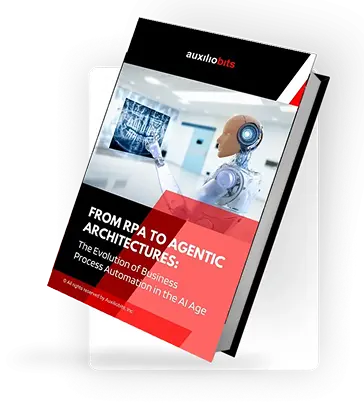
Organizations looking to understand this shift in greater depth—from traditional automation models to autonomous agent-driven architectures—can explore our ebook, From RPA to Agentic Architectures, which explains how enterprises are transitioning toward intelligent, self-operating systems.
This strategic shift is also influencing executive priorities across the manufacturing sector. Manufacturing leaders are redefining their automation strategies to move beyond task-level efficiency and toward full operational autonomy, as explored in why manufacturing CXOs are moving from automation to agentic AI.
Discover how your manufacturing operations can transition from automation to true operational autonomy. Connect with our experts to explore how Agentic AI can be deployed across your ERP, MES, and supply chain environments—and start building a manufacturing system that runs intelligently, continuously, and independently.

enabling organizations to track manufacturing activities, monitor production performance, and coordinate shop floor execution. Warehouse Management Systems (WMS) improved inventory tracking, fulfillment accuracy, and logistics coordination.
Automation technologies further enhanced operational efficiency. Robotic Process Automation (RPA) enabled repetitive digital tasks to execute automatically, reducing manual effort and improving accuracy. Artificial intelligence brought with it the ability to make predictions, like demand forecasting, predictive maintenance, and anomaly detection. This capability helped businesses get ready for changes in their operations, such as adapting to market fluctuations and optimising resource allocation. However, despite these advancements, many organizations discovered structural limitations in these approaches, which explains why many automation programs fail to achieve true operational independence.
To understand how enterprises are moving beyond traditional RPA toward intelligent, autonomous operations, explore our webinar “Revolutionizing Enterprise Automation: From RPA to Agentic AI“.
These technologies delivered meaningful improvements in efficiency and visibility. However, they did not fundamentally eliminate human responsibility for operational coordination. Enterprise systems provided information. Automation executed predefined tasks. Artificial intelligence generated insights. But humans remained responsible for interpreting operational conditions, making decisions, and initiating workflows.
Digitization improved operational awareness, but it did not create operational autonomy.
Agentic AI refers to autonomous software agents that can monitor operations, make decisions, and execute workflows independently across manufacturing systems without requiring constant human intervention.
Despite advances in enterprise technology, humans continue to function as the operational glue connecting enterprise systems and ensuring workflow continuity. Operational execution remains dependent on human interpretation, decision-making, and coordination.
When production schedules require adjustment, humans analyze operational data and modify plans. Humans assess procurement needs and plan supplier actions in the event of inventory shortages. When financial discrepancies arise, humans reconcile transactions and initiate corrective workflows. Humans decipher signals and plan operational reactions when supply chain disruptions occur.
This human coordination layer introduces structural limitations.
Operational execution becomes dependent on workforce availability, expertise, and responsiveness. Decision-making latency increases because workflows must wait for human evaluation and action. Operational risk increases because human error, fatigue, and inconsistency affect execution reliability. Scalability becomes constrained because increasing operational capacity requires proportional workforce expansion.
Even in highly digitized manufacturing environments, humans remain responsible for maintaining operational continuity. This dependency represents a fundamental architectural limitation of traditional manufacturing operating models and marks the transition from digital factories to cognitive factories, where operational coordination shifts from human-driven execution to intelligent, autonomous systems.
Agentic process automation eliminates this structural dependency by using smart software agents that can manage operational workflows on their own. These agents function as autonomous operational entities that continuously monitor enterprise environments, evaluate operational conditions, determine appropriate actions, and execute workflows without requiring human instruction.
Agentic systems coordinate workflows across ERP platforms, MES environments, supply chain systems, procurement platforms, and financial systems. They interpret operational signals, initiate workflows, and maintain operational continuity autonomously. Instead of waiting for human intervention, intelligent agents proactively manage operational execution.
This enables manufacturing environments to operate continuously rather than intermittently. Operational disruptions are detected and addressed immediately. Workflow execution becomes instantaneous. Operational capacity scales independently of workforce size. The measurable operational, financial, and scalability advantages of this model form the business case for agentic AI in manufacturing enterprises, where autonomy becomes a strategic growth enabler rather than just a technology upgrade.
Agentic Process Automation transforms software from passive tools into active operational participants responsible for executing and coordinating enterprise workflows.
Hyperautomation provides the technological infrastructure required to enable agentic manufacturing. Hyperautomation combines automation tools, artificial intelligence, coordination systems, and process knowledge into a single system that can run on its own.
Within this architecture, automation platforms provide workflow execution capability. Artificial intelligence provides decision intelligence. Integration frameworks enable communication across enterprise systems. Orchestration platforms coordinate workflow execution across multiple systems. Process intelligence provides operational visibility and context.
Agentic AI operates as the intelligence and coordination layer within this architecture. Intelligent agents interpret operational conditions, determine appropriate actions, and orchestrate workflow execution across enterprise systems.
Hyperautomation enables execution. Agentic AI enables autonomy. This architectural shift demonstrates that hyperautomation is not solely an efficiency initiative but a strategic operational capability, as explored in hyperautomation in manufacturing beyond cost reduction, where the focus expands from automation savings to enabling autonomous, self-managing manufacturing operations.
Together, these technologies create manufacturing environments that can operate independently without the need for continuous human coordination.

Agentic AI establishes the foundation for autonomous manufacturing environments. Autonomous manufacturing systems operate continuously, without waiting for human instruction or manual workflow initiation. Intelligent agents monitor operational conditions, evaluate requirements, and execute workflows in real time.
Production coordination becomes adaptive, adjusting dynamically to operational conditions. Procurement execution becomes proactive, initiating actions before shortages disrupt operations. Without sporadic human intervention, financial reconciliation becomes continuous while maintaining accuracy. Supply chain coordination becomes autonomous, responding instantly to disruptions and changes.
In manufacturing, people used to have to fix problems, but now they can do it on their own. This operational shift reflects how organizations are transitioning toward fully autonomous execution models, a transition examined in how manufacturing leaders are building autonomous operations.
This transformation represents the emergence of software-defined manufacturing operations, where intelligent software systems define operational capability rather than workforce capacity.
The emergence of agentic AI manufacturing reflects a broader shift in enterprise operating models. Traditional manufacturing environments scale operational capacity by increasing workforce size. Expanding production, managing larger supply chains, and increasing throughput require hiring additional personnel to coordinate and execute workflows.
Agentic manufacturing introduces a fundamentally different scalability model.
Operational capacity scales with computational capability rather than workforce size. Intelligent agents operate continuously without fatigue, enabling manufacturing. This approach allows organisations to manage increasing operational complexity without needing to proportionally expand their workforce. Workflow execution becomes independent of human availability, enabling continuous operational continuity. This new scalability model demonstrates how agentic AI helps manufacturing firms scale without adding headcount, enabling organizations to expand operations without increasing workforce dependency.
This shift improves operational scalability, resilience, and efficiency, demonstrating manufacturing AI investments where CXOs actually see ROI through measurable gains in speed, continuity, and operational independence.
Manufacturing organizations can expand operational capacity without increasing operational complexity or workforce dependency. Operational resilience improves because intelligent agents maintain continuity regardless of workforce availability. Operational speed improves because workflows execute instantly. Operational consistency improves because agents execute workflows deterministically according to defined objectives and operational context.

The emergence of agentic AI in manufacturing did not occur in isolation. It represents the culmination of a multi-stage technological evolution that has progressively expanded the scope of automation, intelligence, and operational autonomy within industrial environments.
Understanding this evolution is important when determining why agentic systems represent a structural shift rather than an incremental improvement and why organizations are now focused on designing an agentic automation roadmap for manufacturing to transition from task-level automation to autonomous operational execution.
Manufacturing automation has progressed through three primary phases:
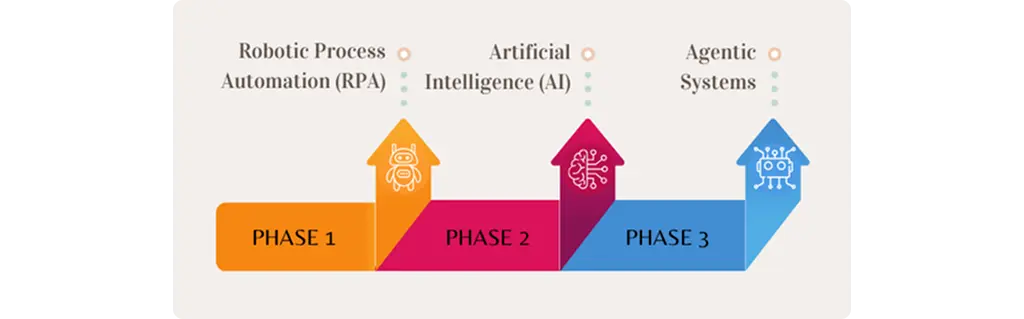
Each stage introduced new capabilities while exposing structural limitations that ultimately necessitated the next phase.
Robotic Process Automation marked the first major step toward reducing manual digital effort in manufacturing enterprises.
RPA systems were designed to replicate repetitive, rule-based human actions within enterprise software environments. These systems interacted with ERP platforms, supply chain systems, and financial applications to automate structured workflows such as:
RPA improved efficiency by reducing manual workload and minimizing human error in repetitive tasks. It delivered cost savings and improved processing speed, particularly in back-office operations.
However, RPA operated within rigid constraints.
RPA systems:

When operational complexity increased or workflows deviated from predefined patterns, human intervention remained necessary.
RPA automated tasks. It did not automate operational responsibility. This evolution reflects the reality that RPA is not dead—but it’s no longer enough, as manufacturing environments demand intelligence, adaptability, and autonomous coordination beyond rule-based automation.
AI models analyzed historical and real-time data to generate insights, identify patterns, and predict future conditions. This enhanced decision quality and improved operational planning accuracy.
However, AI systems typically functioned as advisory tools.
AI systems:

But they do not independently execute enterprise workflows.
Human operators remained responsible for interpreting AI insights and initiating corresponding actions. AI improved decision intelligence but did not eliminate the human coordination layer.
AI provided awareness. It did not provide autonomous execution. This distinction is critical. Intelligence alone does not create autonomy. Agentic systems orchestrate RPA and AI within a unified operational framework.
If you’re ready to move beyond isolated RPA bots and predictive dashboards toward coordinated, autonomous execution, let’s map the transition together. Let’s design your agentic manufacturing future. Get in touch with our team and explore what autonomous operations could look like inside your plant.
Despite advancements in RPA and AI, manufacturing environments remained fundamentally human-coordinated.
The operational model still required:
Enterprise systems became smarter and more efficient, but operational continuity remained dependent on human orchestration.
This gap between insight and execution exposed the limitations of traditional automation approaches. Manufacturing environments required systems capable not only of understanding operational conditions but also of acting upon them autonomously.
This requirement led to the emergence of agentic systems.

Instead of needing people to connect different systems, agentic systems manage ERP platforms, MES environments, procurement systems, financial systems, and logistics platforms on their own.
Execution becomes continuous. Decisions become instantaneous. Exception handling becomes dynamic.
Manufacturing environments transition from static automation frameworks to adaptive autonomous ecosystems.
Agentic systems do not replace RPA or AI. They orchestrate and elevate them. RPA becomes the execution mechanism. AI becomes the intelligence engine. Agentic systems becomes the operational coordinator.
This layered evolution enables autonomous manufacturing.
Autonomous manufacturing represents the operational state in which manufacturing environments can execute, coordinate, and optimize production and enterprise workflows continuously without requiring human initiation or manual coordination. It is the real-world application of agentic AI in factories, where smart software agents take charge of running processes based on set goals, limits, and performance standards.
This transformation shifts manufacturing from human-dependent operational coordination to intelligence-driven operational execution.
In traditional manufacturing environments, enterprise systems provide visibility, automation tools execute predefined tasks, and artificial intelligence generates insights. However, humans remain responsible for interpreting information, initiating workflows, coordinating across systems, and resolving operational exceptions. Autonomous manufacturing removes this dependency by introducing intelligent agents capable of independently managing operational workflows end-to-end.
These systems do not wait for instructions. They continuously monitor enterprise environments, interpret operational conditions, and execute workflows autonomously to maintain operational continuity and performance. This change shows a larger shift mentioned in Manufacturing 2026: What will be automated? What will be agent-led, where more responsibility for operations is moving from humans to agents that work on their own.
Autonomous manufacturing environments function through continuous operational awareness, intelligent decision-making, and autonomous workflow execution. Agentic systems operate as persistent operational entities that continuously interact with enterprise platforms, production environments, and supply chain systems.
Operating at this level of autonomy requires more than technology deployment; it demands structured ownership, governance, and architectural consistency across the enterprise—principles central to building a manufacturing automation CoE for the agentic era, where autonomous systems are managed as a long-term operational capability rather than isolated automation initiatives.
Organizations exploring this shift can also refer to our detailed guide on intelligent automation in manufacturing to understand how automation frameworks evolve into enterprise-wide operational capabilities.
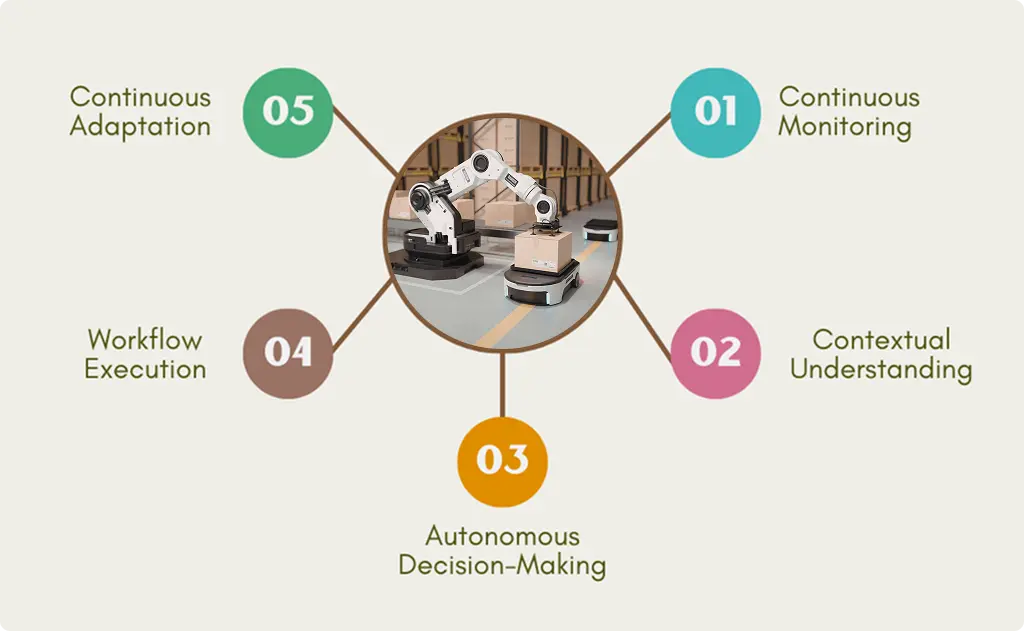
Intelligent agents continuously observe enterprise environments, including:
This continuous monitoring ensures complete operational awareness.
Unlike human operators who review systems periodically, agentic systems maintain uninterrupted situational awareness
Based on operational context and defined objectives, agentic systems determine appropriate actions.
These actions may include:
Decisions are made instantly, eliminating delays associated with human analysis and approval cycles.
After determining appropriate actions, agentic systems execute workflows directly across enterprise systems.
This may involve:
Execution occurs automatically without requiring manual intervention.
Manufacturing environments are dynamic. Autonomous systems continuously adapt to changing conditions.
When operational variables change, agentic systems immediately reassess conditions and adjust workflows accordingly. This ensures operational continuity and performance optimization.
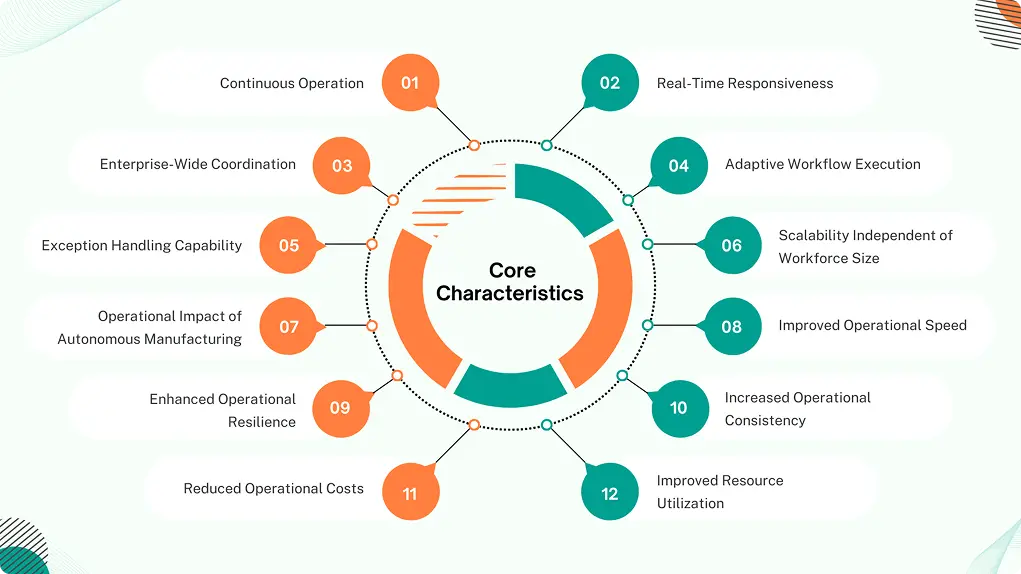

Agentic systems operate continuously without interruption. They monitor, analyze, and execute workflows 24 hours a day, ensuring uninterrupted operational coordination. This eliminates operational delays caused by workforce availability limitations.

Autonomous systems respond instantly to operational changes. When disruptions occur, intelligent agents immediately initiate corrective workflows, minimizing operational impact. This improves resilience and operational stability.

Autonomous manufacturing environments coordinate workflows across enterprise systems. Instead of isolated automation implementations, agentic systems orchestrate workflows across ERP, MES, supply chain, and financial systems. This enables unified operational execution.

Traditional automation executes fixed workflows. Autonomous systems dynamically adjust workflows based on operational context. This enables manufacturing environments to operate effectively in unpredictable conditions.

Exception handling is one of the most significant advantages of autonomous manufacturing. Traditional automation systems fail when encountering unexpected conditions. Autonomous systems evaluate exceptions and execute corrective workflows automatically. This ensures operational continuity.

Autonomous manufacturing environments scale operational capacity without requiring proportional workforce expansion. Intelligent agents operate continuously without fatigue, enabling organizations to expand operational throughput efficiently.

Autonomous manufacturing transforms operational performance across multiple dimensions.
Decisions and workflows execute instantly, eliminating delays associated with human coordination.

Agentic systems maintain operational continuity even during disruptions.

Workflows execute deterministically according to defined objectives, reducing variability and human error.

Reduced dependency on manual coordination lowers operational costs.

Autonomous coordination ensures optimal utilization of production resources.
Agentic AI delivers the greatest value in areas where manufacturing operations require continuous coordination, rapid decision-making, cross-system execution, and dynamic adaptation to changing conditions. Unlike traditional automation, which optimizes isolated tasks, agentic systems generate enterprise-wide impact by assuming responsibility for operational workflows across production, supply chain, quality, maintenance, and financial systems.
The value of agentic manufacturing emerges not from isolated efficiency gains but from systemic operational transformation, a shift that underscores automation as a strategic weapon in manufacturing M&A, where operational autonomy directly influences deal multiples and long-term scalability.
Below are the primary domains where agentic AI produces measurable and strategic impact
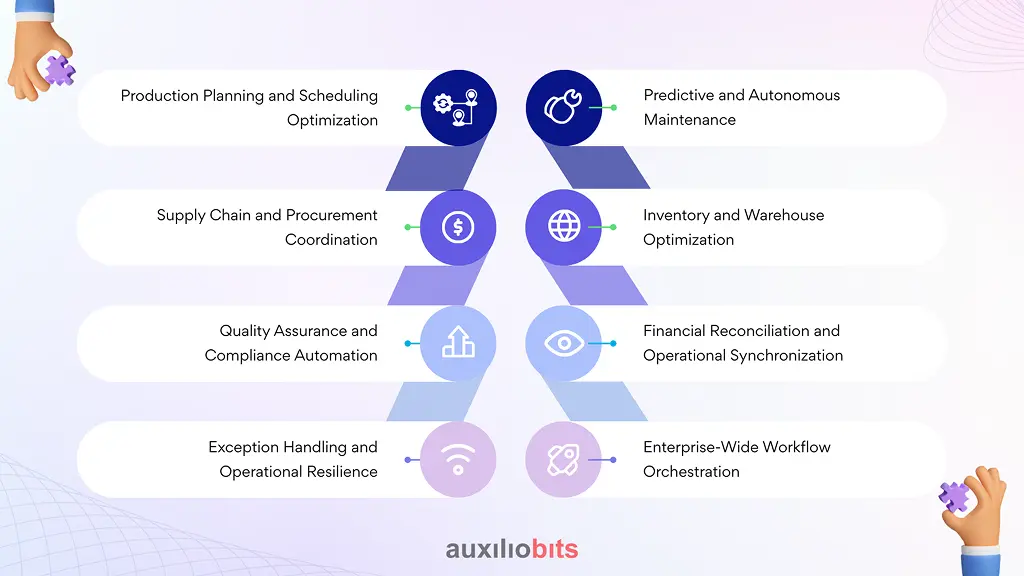
Production planning in traditional environments requires continuous human coordination. Planners analyze demand forecasts, inventory levels, production capacity, labor availability, and supply constraints before adjusting schedules. These processes introduce latency and limit responsiveness.
Agentic AI transforms production planning into a continuous optimization process.
Intelligent agents:
When disruptions occur—such as equipment downtime or supply delays—agent systems immediately recalibrate production schedules to minimize impact.
This enables adaptive production environments that continuously optimize throughput, reduce idle time, and improve on-time delivery performance.
Unplanned downtime represents one of the most significant cost drivers in manufacturing. While predictive maintenance models can forecast equipment failure, traditional systems still rely on human intervention to initiate maintenance workflows.
Agentic AI closes this execution gap.
Agentic systems:
Instead of merely predicting failure, agentic systems act autonomously to prevent it.
This reduces downtime, extends equipment lifespan, and ensures maintenance coordination aligns with production objectives.
Manufacturing operations are deeply dependent on supply chain reliability. Traditional procurement workflows require human intervention when shortages, delays, or disruptions occur.
Agentic AI enables proactive and autonomous supply chain coordination.
Intelligent agents:
This ensures continuous material availability and reduces the risk of production stoppages due to supply chain disruptions.

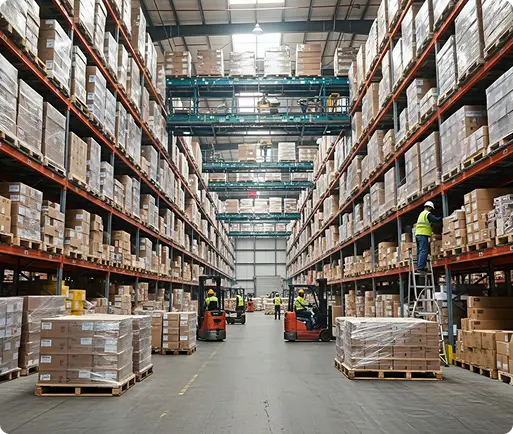
Inventory management in dynamic manufacturing environments requires constant balancing between overstocking and stockouts. Human-managed environments often struggle with synchronization across ERP, warehouse, and production systems.
Agentic systems coordinate inventory management across enterprise platforms.
They:
This improves working capital efficiency while maintaining production continuity.
Quality assurance processes traditionally require human oversight for anomaly detection, compliance tracking, and corrective action management.
Agentic AI enhances quality management by introducing autonomous anomaly detection and corrective execution.
Agentic systems:
Rather than waiting for quality failures to be discovered manually, agentic systems act immediately to contain and resolve issues.
This reduces defect rates, improves product consistency, and strengthens regulatory compliance.
Manufacturing finance teams often manage reconciliation processes across procurement, production, inventory, and accounting systems. These processes are time-consuming and prone to discrepancies.
Agentic AI enables continuous financial reconciliation.
Intelligent agents:
This reduces financial risk, improves reporting accuracy, and eliminates reconciliation bottlenecks.
Traditional automation systems are highly efficient under predictable conditions but fail when encountering unexpected scenarios. Manufacturing environments, however, are inherently dynamic and unpredictable.
Agentic systems excel in exception handling.
They:
This ensures operational continuity even during supply disruptions, production delays, or transactional inconsistencies.
Resilience becomes embedded into the operational architecture.

One of the most significant value drivers of agentic AI is its ability to coordinate workflows across traditionally siloed systems.
In conventional environments:
Coordination between these systems relies on human oversight. Agentic AI eliminates these silos by continuously orchestrating workflows across systems.
This unified coordination enables enterprise-wide optimization rather than isolated process improvements.
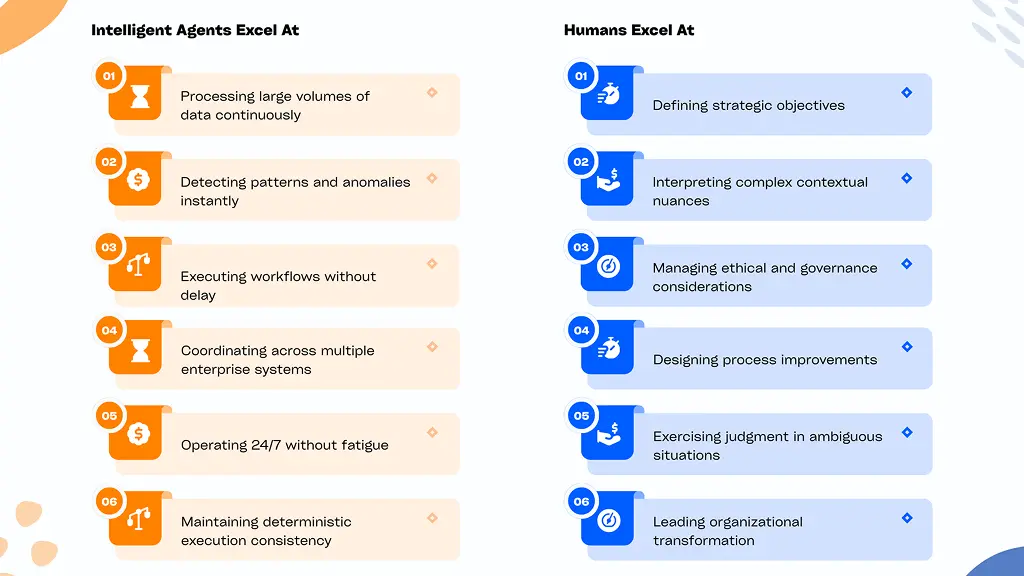
The rise of agentic AI in manufacturing does not eliminate the role of humans. Instead, it redefines it. Autonomous manufacturing environments function most effectively when intelligent agents and human professionals operate in a coordinated, complementary model. This hybrid workforce structure combines machine-driven execution with human strategic oversight, creating operational systems that are both highly efficient and intelligently governed.
Agentic systems assume responsibility for continuous monitoring, workflow coordination, and execution. Humans focus on strategic decision-making, innovation, governance, and performance optimization. This evolution represents the future of manufacturing work, humans + agents, where operational execution is autonomous while human expertise directs strategy, innovation, and enterprise priorities.
This shift represents a transition from human-coordinated operations to human-directed autonomy.

Manufacturing organizations typically operate complex technology environments composed of multiple enterprise platforms, each responsible for specific operational functions. While these systems provide visibility and transaction processing capabilities, coordination between them often depends on human intervention.
Auxiliobits introduces an agentic intelligence layer that operates above these systems.
This intelligence layer:
This enables enterprise systems to function as a unified operational ecosystem rather than isolated technology silos.
Instead of humans coordinating systems, intelligent agents assume this responsibility.
Auxiliobits focuses on identifying operational workflows that require human coordination and transforming them into autonomous workflows managed by agentic systems.
These workflows often include:
In traditional environments, these workflows depend on human monitoring, analysis, and execution.
Auxiliobits enables intelligent agents to manage these workflows continuously and autonomously. This eliminates delays, reduces operational risk, and improves execution consistency.
Auxiliobits designs agentic automation architectures that integrate seamlessly with existing enterprise infrastructure.
This includes integration with:
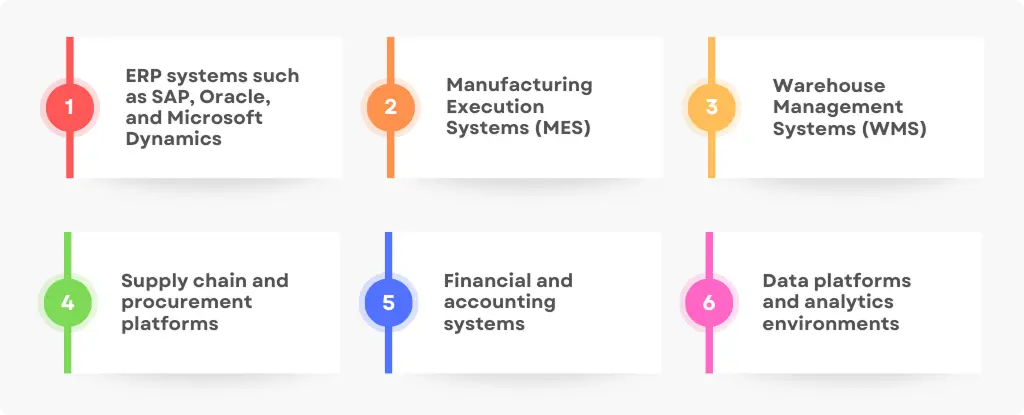
This integration enables intelligent agents to operate across enterprise environments without requiring disruptive system replacement.
Organizations retain their existing technology investments while gaining autonomous operational capability.
Your existing systems are not the limitation. The orchestration layer is. If you’re looking to activate autonomous intelligence across SAP, MES, WMS, and supply chain platforms—without ripping and replacing your core infrastructure, let’s design the right integration architecture.
Unlock agentic intelligence on top of your current manufacturing stack. Get in touch with our team to explore how seamless integration can turn your existing systems into an autonomous execution engine.
Auxiliobits delivers agentic automation through a hyperautomation framework that combines multiple enabling technologies.
This includes:
Within this architecture, agentic systems function as the operational intelligence layer that directs execution across automation and enterprise platforms. This enables end-to-end autonomous workflow execution.

Auxiliobits enables manufacturing organizations to achieve measurable improvements across operational and strategic dimensions.
These outcomes include:
By eliminating human coordination bottlenecks, organizations can operate faster, more efficiently, and more reliably. Operational environments become adaptive, scalable, and continuously optimized.
Agentic process automation represents the next stage in manufacturing evolution. Organizations that successfully implement agentic operational architectures gain structural advantages in scalability, resilience, efficiency, and operational performance.
Auxiliobits makes this change possible by providing automation systems that combine intelligence, automation, and coordination into a single operational setup.
This establishes the technological and operational foundation for autonomous manufacturing environments capable of operating continuously, adapting dynamically, and scaling efficiently.
Agentic process automation is not simply an automation initiative. It is the foundation of intelligence-driven manufacturing operations. To begin your transition toward autonomous manufacturing, book a CXO strategy session.

Follow Us