






Key Takeaways
- Revenue leakage in manufacturing often originates from pricing errors, uncontrolled discounting, and unresolved invoice disputes.
- Manual pricing and discount approvals create inconsistencies that quietly erode margins over time.
- Automated validation and approval workflows help enforce pricing policies without slowing down sales teams.
- Intelligent dispute management significantly reduces resolution time and improves cash flow visibility.
- Automation doesn’t just recover lost revenue—it strengthens overall revenue integrity across the order-to-cash cycle.
Manufacturers tend to think about revenue in terms of production capacity, sales volume, and margins. Those are the obvious levers. Yet in many organizations, a surprising amount of money quietly slips away after the deal is already signed.
Not because the product was wrong.
Not because the customer didn’t pay.
But because the operational mechanics of revenue—pricing accuracy, discount governance, and dispute resolution—aren’t as controlled as leadership assumes.
The result is revenue leakage. And in manufacturing environments, it’s often embedded deep inside routine workflows.
Ask a finance leader where revenue leakage originates, and you’ll usually hear about credit issues or collections delays. That’s part of the story. But the bigger problem typically lives upstream, where pricing agreements get interpreted manually, discounts are negotiated through emails, and invoice disputes drag across departments.
None of these issues looks dramatic on a balance sheet. However, when combined, these factors gradually erode profitability.
In discussions around revenue leakage in manufacturing, three operational areas repeatedly show up as root causes:
- Pricing inconsistencies
- Discounting outside governance frameworks
- Invoice disputes that delay or reduce payment
Automation doesn’t eliminate these problems overnight—but it does change how companies detect, prevent, and resolve them. And the difference can be significant.
The Nature of Revenue Leakage
Revenue leakage usually consists of multiple small errors. It’s usually a pattern of small misalignments across the order-to-cash lifecycle.
For example: A manufacturer agrees to a volume-based pricing contract with a distributor. The ERP system contains the standard price list, but the volume rebate logic sits in a spreadsheet maintained by the sales operations team.
Six months later:
- Sales teams apply outdated pricing tiers
- Finance calculates rebates manually
- Customers notice discrepancies and submit disputes
Individually, each issue might represent a few thousand dollars. Across hundreds of transactions, however, the impact compounds quickly.
One global industrial supplier we collaborated with estimated that operational leakage resulted in a loss of 1–3% of their annual revenue. That’s not unusual.
In large manufacturing organizations, revenue leakage tends to accumulate in places where:
- Data moves between systems manually
- Pricing logic exists outside ERP controls
- Exception handling relies on email threads
These are precisely the conditions where automation begins to matter. But before discussing solutions, it’s worth understanding where the leakage actually originates.
Also read: Building Autonomous AI Agents for Manufacturing Control Systems
Pricing Complexity: The Quiet Catalyst
Manufacturing pricing structures are rarely simple.
Even mid-sized companies manage a combination of:
- Contract pricing for large distributors
- Regional price lists
- Volume-based discounts
- Promotional campaigns
- Customer-specific negotiated rates
In theory, ERP systems manage this complexity. In practice, reality looks messier. Sales teams often need flexibility to close deals quickly. Pricing exceptions happen. Temporary discounts are approved verbally. New SKUs launch before pricing tables are fully configured.
And then something subtle happens. The “temporary” exception becomes a recurring practice.
Where Pricing Leakage Appears
A few typical scenarios:
- Sales teams manually override system pricing to match prior agreements
- Legacy contracts still influence order pricing years later
- Promotional discounts applied beyond the intended timeframe
- Incorrect unit-of-measure conversions affecting price calculations
- Pricing tiers misaligned with updated cost structures
None of these issues indicate malicious intent. Most arise from operational friction. Sales teams prioritize speed. Finance prioritizes control. Systems struggle to keep up with both.
This is one reason revenue leakage manufacturing discussions often shift toward pricing governance. Not stricter policies—those already exist—but better operational enforcement.
Automation can help by:
- Detecting pricing anomalies before invoices are generated
- Automatically validating order prices against contract terms
- Escalating unauthorized overrides in real time
Discounts: Where Policy Meets Reality
Discounting is unavoidable in manufacturing. Competitive markets demand flexibility. The challenge isn’t the existence of discounts. The issue is the lack of structured visibility into how these are applied.
Discount decisions often occur through fragmented communication channels:
- Email approvals
- Messaging apps
- Verbal conversations between sales managers and finance
By the time an order reaches the ERP system, the logic behind the discount may already be lost. That creates risk.
Discount Leakage Patterns
Manufacturers frequently encounter situations like these:
- Stacked discounts applied unintentionally across multiple promotions
- Legacy discount structures remaining active after contract renewal
- Sales reps applying discretionary discounts beyond approved limits
- Incorrect margin calculations due to outdated cost inputs
Some of these issues stem from system limitations. Others stem from human behavior.Salespeople operate under revenue targets. When deals stall, discounting becomes the fastest tool available.
And to be fair, sometimes it works. But without guardrails, discounting can erode margins faster than leadership realizes.
Automation changes this dynamic in subtle ways.
Instead of blocking sales activity outright, automated workflows can:
- Check discount thresholds against predefined rules
- Route exceptions for rapid digital approval
- Maintain a full audit trail of pricing decisions
- Provide real-time margin visibility before orders are confirmed
Sales teams retain flexibility—but the organization gains transparency.
In one heavy equipment manufacturer, automated discount approval workflows reduced unauthorized discounts by nearly 40% within six months.
Sales teams didn’t complain much. Faster approvals helped them close deals sooner.
Invoice Disputes: The Hidden Cost Multiplier
If pricing and discount errors are the source of revenue leakage, disputes are where the damage multiplies.
Disputes usually take time to resolve. They involve multiple departments:
- Customer service
- Sales
- Finance
- Sometimes logistics teams
A typical dispute cycle might look like this: Customer identifies a pricing discrepancy
- Customer identifies a pricing discrepancy
- Email sent to the account manager
- Finance reviews invoice data
- Sales checks the original quote
- Customer service retrieves shipment records
At this point, several days—or weeks—may have passed. Meanwhile, the invoice remains unpaid. This affects more than revenue recognition. It impacts cash flow, customer relationships, and operational overhead.
Common Dispute Triggers
Manufacturing companies often see disputes originating from:
- Pricing mismatches between quote and invoice
- Incorrect discount application
- Freight charges not clearly communicated
- Partial shipments causing invoice confusion
- Rebate calculations disputed by distributors
Not all disputes result in lost revenue. But they consume time. A finance director once described disputes as “operational quicksand”. Teams keep stepping into them, but nobody owns the terrain.
Automation doesn’t eliminate disputes entirely. However, it can dramatically shorten resolution cycles.
Automated dispute management platforms can:
- Capture disputes directly from customer portals
- Categorize issues automatically
- Retrieve supporting documents instantly
- Assign cases to the correct department
More importantly, they provide visibility into dispute patterns. When organizations analyze dispute data at scale, they often discover that a handful of recurring issues cause the majority of cases.
And once identified, those root causes can often be automated away.
Why Revenue Leakage Persists in Manufacturing
At this point, the natural question emerges: if these issues are so common, why haven’t they already been solved?
Manufacturing organisations prioritise production and supply chain optimisation, which contributes to the persistence of these issues. Revenue operations historically received less attention.
Another reason is system architecture.
Manufacturers typically run complex ERP landscapes with multiple integrations:
- CRM systems managing customer agreements
- ERP systems processing orders and invoices
- Pricing tools or spreadsheets used by sales operations
- Document repositories containing contracts
Every system contains a fragment of the truth. Automation becomes valuable precisely because it can orchestrate processes across these systems without requiring full system replacements.
And that matters.
Most manufacturers aren’t looking to overhaul their ERP environment every five years. They want operational improvements without major disruptions.
That’s where modern automation strategies—especially agent-driven process automation—fit naturally.
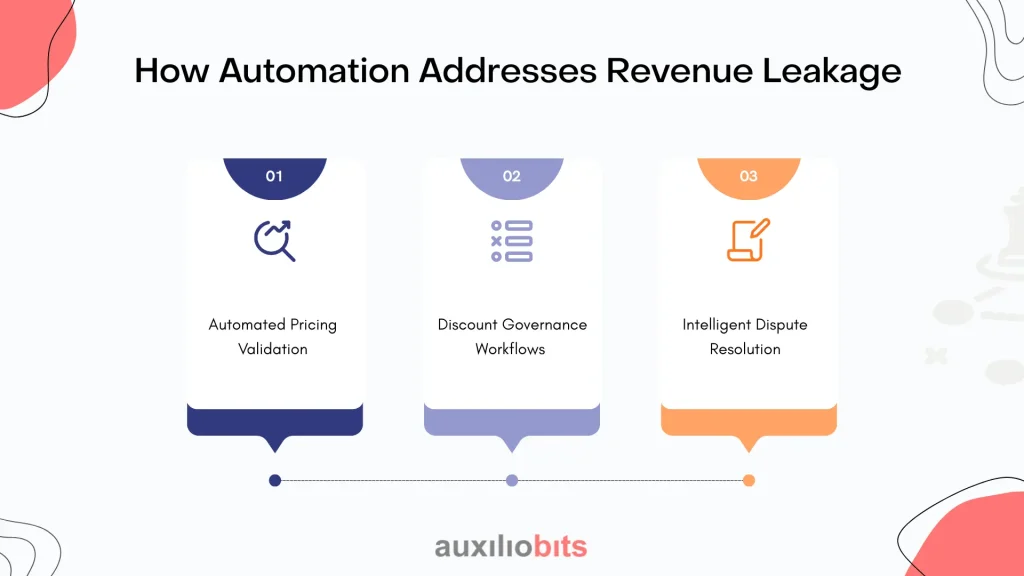
How Automation Addresses Revenue Leakage
Automation works best when applied to decision points, not just repetitive tasks.
Revenue leakage tends to occur at those decision points:
- Should this discount be approved?
- Does this price match the contract terms?
- Is this dispute valid?
Automated workflows can support these decisions through a combination of rule enforcement, data retrieval, and intelligent escalation.
Some practical implementations include:
1. Automated Pricing Validation
Before orders enter fulfillment pipelines, automation tools can:
- Compare order prices against contract pricing tables
- Detect unusual pricing deviations
- Flag transactions for review before invoices are issued
Preventing errors early is far easier than correcting them later.
2. Discount Governance Workflows
Rather than relying on manual approvals:
- discount requests routed automatically based on thresholds
- approvals logged digitally with full traceability
- real-time margin calculations visible during negotiation
Sales teams move faster, and finance retains oversight.
3. Intelligent Dispute Resolution
Automation can accelerate dispute handling by:
- Gathering shipment, pricing, and contract data automatically
- Assigning cases to appropriate teams
- Identifying patterns across disputes
This process reduces investigation time dramatically.
The Cultural Shift Automation Introduces
There’s a subtle organizational shift that occurs when revenue processes become automated.
Conversations change. Instead of debating whether a pricing error occurred, teams start asking why the system allowed it.
That shift matters. Automation introduces operational accountability without relying on constant manual oversight. Sales teams gain clarity around discount boundaries. Finance teams see pricing anomalies earlier. Customer service teams resolve disputes faster because information is readily available.
Does it eliminate every revenue leak? Of course not. But it turns revenue protection into a proactive process rather than a reactive investigation.
A Practical Perspective on Implementation
Organizations sometimes hesitate to pursue automation initiatives around revenue operations because they assume the scope will be large.
It doesn’t have to be.
Many successful initiatives start with one focused objective:
- Pricing validation before invoice generation
- Automated discount approval workflows
- Dispute categorization and case routing
These are manageable starting points. From there, companies expand gradually. Interestingly, the biggest benefits often appear not in recovered revenue—but in operational clarity.
Once pricing logic, discount governance, and dispute workflows become transparent, revenue leakage becomes easier to diagnose.
And easier to fix.
The Real Value: Revenue Integrity
Manufacturers spend enormous effort improving production efficiency and supply chain resilience. Those investments are visible and measurable.
Revenue integrity deserves similar attention. Because when pricing structures grow complex, discounting becomes competitive, and disputes accumulate, even strong sales performance can mask operational inefficiencies.
That’s the uncomfortable reality behind revenue leakage manufacturing.
Automation doesn’t just reduce manual effort—it protects the financial outcomes those sales efforts were meant to achieve in the first place.
And for manufacturers operating on tight margins, that protection is often worth far more than the automation investment itself.