






Key Takeaways
- Customer Segmentation AI helps manufacturers analyze real customer behavior instead of relying only on static attributes like industry or company size.
- Agentic AI systems continuously monitor behavioral, transactional, and lifecycle signals, allowing segmentation models to evolve dynamically.
- Behavioral segmentation often reveals early buying intent and expansion opportunities before revenue changes become visible.
- In customer segmentation manufacturing environments, transactional patterns such as order frequency, pricing sensitivity, and product mix provide deeper customer insight.
- When integrated into sales and marketing systems, AI-driven segmentation improves account prioritization, churn prevention, and cross-sell discovery.
Manufacturing companies have never lacked customer data. In fact, the opposite is usually true. ERP systems capture order histories. CRM platforms track interactions. Service platforms record warranty claims and support tickets. Marketing tools track campaign responses and digital engagement.
Yet when most manufacturing sales or marketing leaders are asked a simple question — “Who are your most valuable customers and why?” — their answers are rarely clear.
Traditional segmentation models tend to rely on static attributes: industry, company size, geography, or revenue potential. While these factors are helpful, they only provide a limited understanding of customer behaviour. Two customers in the same industry with similar order volumes can have entirely different purchasing patterns, loyalty levels, and expansion potential.
This is where customer segmentation AI begins to reshape the conversation. More specifically, AI systems that constantly analyse, think, and adjust are creating a much more flexible way to group customers in manufacturing settings.
Instead of assigning customers to fixed categories once a year, agentic systems continuously interpret behavioral signals, transactional data, and lifecycle patterns to identify evolving customer groups. And occasionally the insights they surface are not what teams expect.
Why Traditional Customer Segmentation Often Falls Short in Manufacturing
Manufacturing organizations historically built segmentation models around structural attributes:
- Industry vertical
- Geographic location
- Annual revenue
- Order volume
- Strategic account status
These models work reasonably well for high-level account planning. But they rarely capture the nuances that actually drive revenue outcomes.
Consider two industrial distributors buying the same components:
| Attribute | Distributor A | Distributor B |
| Annual spend | $3M | $3M |
| Industry | Automotive | Automotive |
| Geography | North America | North America |
| Contract type | Standard | Standard |
On paper, they look identical.
But behavioral data might reveal something entirely different:
- Distributor A places small weekly orders, rarely negotiates pricing, and consistently pays early.
- Distributor B places large irregular orders, frequently requests discounts, and delays payments.
From a profitability standpoint, these accounts are not equivalent at all. Traditional segmentation misses these distinctions. This is precisely the kind of pattern customer segmentation AI identifies automatically—not through static labels, but by continuously analyzing real activity.
What Makes Agentic AI Different from Traditional Segmentation Models
Many companies already use analytics tools or machine learning to cluster customers. Agentic systems go a step further.
Instead of running periodic segmentation analyses, AI agents continuously monitor operational signals, adjust segmentation logic, and trigger actions across business systems.
An agentic segmentation system typically performs several tasks simultaneously:
- Observes customer interactions across CRM, ERP, service platforms, and marketing tools
- Detects patterns in purchasing behavior and engagement
- Updates segmentation categories dynamically
- Communicates insights to sales or marketing systems
- Triggers recommended actions
This autonomous cycle is the reason agentic architectures are gaining attention in customer segmentation and manufacturing operations. Manufacturing sales cycles are long, customer relationships evolve slowly, and small changes in buying behavior can signal major shifts months in advance. Human analysts often miss these patterns. AI agents can.
Behavioral Segmentation: Understanding How Customers Actually Engage
Behavioral segmentation examines how customers interact with a company, rather than who they are. Manufacturers often overlook behavioral signals because they are scattered across multiple systems. Yet these signals often reveal the strongest predictors of future revenue.
Examples include:
- Frequency of product inquiries
- Website interactions with technical documentation
- Response patterns to marketing campaigns
- Engagement with service or support teams
- Quote request frequency
Agentic AI agents continuously monitor these signals and cluster customers based on engagement patterns. Some common behavioral segments that emerge include:
1. Highly Engaged Technical Buyers
Customers who regularly download product documentation, request specifications, and interact with technical support teams. These buyers often influence engineering decisions within their organizations. They may not control purchasing budgets directly, but their recommendations frequently determine vendor selection.
2. Transactional Buyers
Customers focused primarily on price and delivery speed. They tend to respond strongly to promotions and discounts but show limited long-term loyalty.
3. Passive Accounts
Accounts with existing contracts but declining engagement — fewer inquiries, less portal activity, minimal communication. These are often early warning signs of churn.
4. Expansion Candidates
Customers whose engagement signals indicate growing internal demand even before purchase volumes increase. One industrial equipment manufacturer discovered that customers frequently downloading maintenance guides were often preparing for additional equipment purchases within six months. That insight alone reshaped their sales outreach strategy. This is where customer segmentation AI begins to feel less like analytics and more like a real-time intelligence system.
Transactional Segmentation: Reading the Signals in Purchase Behavior
While behavioral segmentation focuses on engagement patterns, transactional segmentation examines purchasing activity itself.
Manufacturing transactions contain a surprising amount of strategic information:
- Order frequency
- Product mix diversity
- Contract compliance
- Pricing sensitivity
- Average order value
- Delivery urgency
AI agents analyze these variables together to detect patterns that manual analysis rarely uncovers. For example, transactional segmentation may identify groups such as:
1. High-Volume Repeat Buyers
- Frequent purchases
- Predictable order patterns
- Low price negotiation
These customers often represent the most stable revenue streams.
2. Irregular Project Buyers
- Large orders tied to specific projects
- Long periods of inactivity between purchases
Traditional segmentation sometimes treats these accounts as inconsistent customers. If we understand project pipelines properly, these accounts often represent significant growth opportunities.
3. Price-Sensitive Opportunistic Buyers
- Frequent quote requests
- Low quote-to-order conversion
- Heavy negotiation behavior
Sales teams often spend disproportionate time on these accounts. Agentic AI systems can flag when transactional patterns change. A steady customer suddenly placing smaller orders may signal inventory constraints, competitor encroachment, or internal budget changes.
Sales teams rarely notice these signals early enough. AI agents do.
Lifecycle Segmentation: Understanding Where Customers Are in the Relationship
Customer relationships in manufacturing typically unfold across long time horizons. A single account might move through several lifecycle stages:
- Prospect
- New customer
- Growth-stage customer
- Mature strategic account
- At-risk account
Lifecycle segmentation has existed for years, but it has traditionally been manually maintained inside CRM systems. Which means it often becomes outdated quickly.
Agentic systems update lifecycle stages automatically by evaluating signals such as:
- Purchase frequency changes
- Product adoption patterns
- Contract renewal timelines
- Service usage
- Engagement levels
A customer might appear healthy based on recent revenue but still show signs of entering an at-risk lifecycle stage.
For instance:
- declining support engagement
- fewer product inquiries
- increasing payment delays
These subtle indicators often precede churn by months. Customer segmentation AI identifies these transitions earlier and recommends interventions — perhaps a proactive account review or targeted retention campaign.
Why Manufacturing Segmentation Requires More Context Than Other Industries
Customer segmentation in manufacturing differs from retail or SaaS environments in several ways.
First, purchasing decisions often involve multiple stakeholders — procurement teams, engineers, operations managers, and finance departments.
Second, demand patterns frequently align with production cycles or project timelines, not simple consumption patterns.
Third, product catalogs can be extremely complex. Customers may purchase hundreds of SKUs across multiple product categories.
These realities mean segmentation must consider not just customer behavior, but product usage context.There is no denying that agentic AI systems can correlate:
- product families purchased
- maintenance or service requests
- equipment cycles
- seasonal production changes
This is where manufacturing strategies for customer segmentation come from AI agents that can reason across multiple datasets simultaneously.
The Real Business Value of Agentic Customer Segmentation
Segmentation itself is not the goal. The real value lies in how organizations act on segmentation insights. When properly implemented, agentic segmentation systems influence several operational areas.
1. Sales Prioritization
AI agents identify which accounts show the strongest signals for expansion, allowing sales teams to focus on customers most likely to grow. Instead of chasing every opportunity, sales teams concentrate on behaviorally validated prospects.
2. Personalized Marketing
Marketing campaigns can be tailored to specific behavioral clusters.
For example:
- Technical education content for engineering-focused buyers
- Pricing promotions for transactional buyers
- product innovation updates for strategic partners
3. Churn Prevention
Lifecycle segmentation highlights accounts drifting toward inactivity. Sometimes the signals are small: a drop in portal logins, fewer quote requests, or delayed payments.
But catching these signals early often prevents revenue loss.
4. Cross-Sell and Upsell Opportunities
Agentic systems frequently detect product adjacency patterns. Customers purchasing a certain equipment line may typically adopt related components within 12–18 months.
Sales teams can proactively recommend these products before competitors do.
A Real-World Example: Industrial Components Manufacturer
One mid-sized industrial components manufacturer implemented an AI-driven segmentation model after struggling with inconsistent sales forecasting.
Their initial segmentation relied on revenue tiers and industry classification. Agentic analysis revealed something unexpected.
A cluster of customers with moderate annual spend but extremely high technical engagement turned out to be early adopters of new product lines. These accounts frequently tested prototype components and influenced product design decisions.
Previously, these customers were classified as mid-tier accounts.
After segmentation updates:
- they were assigned dedicated technical account managers
- invited to product roadmap discussions
- prioritized for early access programs
Within a year, several of these accounts became top revenue contributors. Interestingly, the sales team initially resisted the segmentation change. They believed their existing “strategic accounts” list was already accurate. It wasn’t.
Where Customer Segmentation AI Sometimes Fails
Despite the promise, AI-driven segmentation is not foolproof. Several common pitfalls appear in real deployments.
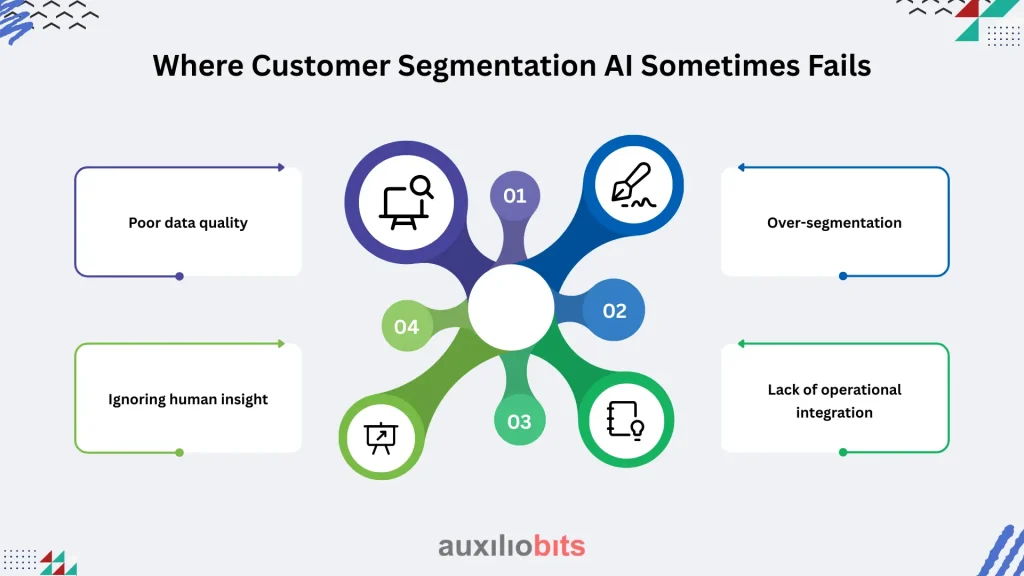
1. Poor data quality
If CRM or ERP systems contain inconsistent or incomplete records, segmentation results become unreliable.
2. Over-segmentation
Some organizations create dozens of micro-segments that become impossible for sales teams to operationalize.
3. Ignoring human insight
AI can identify patterns, but domain expertise still matters. A sudden drop in orders might reflect a known production shutdown rather than churn risk.
4. Lack of operational integration
Segmentation insights must feed directly into CRM workflows, marketing platforms, and sales dashboards. Otherwise they remain academic exercises.
Agentic AI systems perform best when they augment human judgment rather than replace it.
The Shift Happening in Manufacturing Revenue Operations
Many manufacturing companies still treat segmentation as a marketing exercise. But the organizations gaining the most value from customer segmentation AI treat it as an operational intelligence layer.
AI agents continuously interpret customer behavior and feed insights into:
- sales pipelines
- demand forecasts
- product development decisions
- service operations
The shift is subtle but significant. Segmentation is no longer just about grouping customers. It becomes a real-time system for understanding how relationships evolve.
And in complex manufacturing environments—where contracts last years and buying patterns shift slowly—that evolving understanding can make the difference between reactive account management and proactive growth.
Not every company is ready for agentic segmentation yet. Data silos, fragmented systems, and cultural resistance still slow adoption.
But once organizations see how behavioral, transactional, and lifecycle signals combine to reveal hidden patterns in customer relationships, it becomes difficult to go back to static segmentation models.
Because the truth is, customers were never static to begin with.