







Key Takeaways
- Quote-to-Order Automation reduces delays caused by manual configuration, pricing validation, and approval workflows.
- Configuration rules prevent invalid product combinations, reducing unnecessary engineering reviews.
- Automated pricing protects margins by enforcing discount thresholds and dynamic cost calculations.
- Structured approval routing speeds up deals by eliminating email-based decision loops.
- Manufacturers gain faster sales cycles and cleaner ERP orders when quote-to-order processes are automated.
Manufacturers usually manage demand generation well. The real friction tends to appear later—after the sales conversation begins but before revenue actually materializes. In complex manufacturing environments, turning a quote into an executable order can feel surprisingly manual. Configuration decisions, pricing validations, engineering approvals, and contract checks all intersect in ways that make the quote-to-order process slower than most organizations expect.
This is exactly where quote-to-order automation becomes more than a productivity tool. It becomes operational infrastructure.
In industries such as industrial machinery, heavy equipment, automotive components, or specialized electronics, the quote itself is not just a price estimate—it’s a structured representation of product configuration, technical feasibility, compliance constraints, and commercial terms. And when that structure depends on spreadsheets, emails, or disconnected systems, delays are inevitable.
Automation, when done properly, doesn’t simply generate quotes faster. It stabilizes configuration logic, enforces pricing discipline, and removes the hidden approval bottlenecks that stall revenue.
Why Quote-to-Order Is Harder Than It Looks in Manufacturing
On paper, the quote-to-order flow appears straightforward: configure the product, calculate pricing, send the quote, receive approval, and convert to order. In practice, every step hides operational complexity.
Sales teams often deal with configurable products—machines with optional modules, region-specific compliance requirements, custom materials, and integration considerations. A quote might involve dozens of variables.
For example: A manufacturer selling industrial compressors might allow variations across:
- Motor capacity
- Cooling configuration
- Control panel type
- Environmental certifications
- Installation accessories
- Maintenance packages
Each combination changes cost, margin, and delivery feasibility. Sales teams therefore rely on engineering inputs constantly. Pricing teams validate margins. Finance reviews discount thresholds. Legal sometimes checks contract terms.
Without quote-to-order automation, the process becomes a fragmented workflow.
Typical reality inside manufacturing sales teams:
- Sales builds configuration in spreadsheets
- Pricing models live in separate cost sheets
- Engineers review feasibility through email
- Managers approve discounts through messaging tools
- ERP order entry happens later, often manually
The result? A process that can take days—or weeks—before an order becomes official. And by then, competitors may already be responding.
Also read: How AI Agents Deliver a 360° Customer View in Manufacturing
Configuration Complexity: The First Bottleneck
SKUs. Instead, they sell product families with configurable attributes. Every variation must remain technically feasible and manufacturable.
Without automation, configuration depends heavily on human knowledge. Experienced sales engineers often know which combinations work and which do not. But this knowledge rarely exists in structured systems.
This creates predictable risks:
- Invalid configurations reaching engineering review
- Manufacturing constraints discovered late
- Incorrect component selection
- Cost miscalculations
Many organizations assume configuration errors are rare. They aren’t. They’re just hidden until production planning begins. Quote-to-order automation addresses this by embedding product configuration logic directly into the quoting process.
Instead of relying on tribal knowledge, automated configuration models enforce rules such as:
- Compatibility between modules
- Mandatory components for certain configurations
- Geographic compliance requirements
- Capacity thresholds
The effect is subtle but powerful: sales teams build quotes that are technically valid from the start. No engineering back-and-forth. Or at least far less of it.
Pricing Logic Is Often More Fragile Than Companies Admit
Pricing in complex manufacturing is rarely static.
Base product pricing might be defined centrally, but the final quote usually incorporates multiple dynamic elements:
- Volume discounts
- Channel partner pricing tiers
- Regional adjustments
- Material cost fluctuations
- Custom engineering charges
- Installation or service bundles
When these elements live across spreadsheets, ERP tables, and internal documentation, pricing consistency becomes difficult. And inconsistencies happen more often than leaders realize.
Some quotes underprice products because margin checks were skipped. Others lose deals because sales teams overprice due to uncertainty.
Automation changes this dynamic by centralizing pricing logic and embedding it into the quote generation workflow.
With Quote-to-order automation, pricing calculations can automatically:
- Apply margin thresholds
- Validate discount levels
- Adjust prices based on configuration complexity
- Include engineering or customization costs
- Generate structured quote documentation
This eliminates a common operational pattern: sales teams asking finance teams to “quickly validate this quote.” The system handles it.
Approval Workflows: The Silent Source of Delays
Configuration and pricing receive most of the attention, but approval workflows often slow down deals just as much. In many manufacturing organizations, approvals are loosely structured.
Examples include:
- Discount approval from sales managers
- Margin approval from finance
- Engineering approval for customization
- Contract review from legal
These approvals typically move through email chains or chat messages. Sometimes they are forgotten entirely. Occasionally approvals are granted verbally and never documented. This creates operational ambiguity, especially when orders reach ERP systems or production planning. Automation introduces structure into approval processes without adding friction. A well-designed Quote-to-order automation workflow automatically routes quotes based on predefined thresholds:
For example:
If discount > 15% → Sales Director approval required
If margin < 20% → Finance review required
If configuration includes custom components → Engineering validation triggered
Instead of manually chasing approvals, the system handles routing. Notifications go to the right stakeholders. Approvals are logged. And most importantly, the quote progresses automatically once approvals are granted.
Real-World Scenario: Industrial Equipment Manufacturer
Consider a mid-sized manufacturer of material handling equipment.
Their quoting process previously looked like this:
- Sales engineer builds configuration in Excel
- Cost sheet calculates estimated pricing
- Engineering reviews feasibility through email
- Finance validates margins
- Sales manager approves discounts
- Final quote generated manually
- Order entered into ERP by operations team
Average turnaround time: 5–7 business days Deal velocity was heavily dependent on internal response times. After implementing Quote-to-order automation, several changes occurred:
Configuration logic moved into a structured model. Pricing calculations became automated. Approval workflows were triggered automatically based on margin thresholds.
New workflow:
- Sales selects configuration options in system
- Pricing automatically calculated
- Engineering validation triggered only if configuration is non-standard
- Approval workflows routed digitally
- Quote generated instantly once approved
- Order automatically created in ERP
Average turnaround time dropped to under 24 hours. More importantly, configuration errors declined significantly. This is the kind of operational improvement that rarely appears in marketing brochures—but sales teams notice it immediately.
Where Quote-to-Order Automation Often Fails
Automation initiatives don’t always succeed. Some organizations invest heavily in CPQ tools but still struggle with slow quote cycles.
Why? Because the problem wasn’t the software. It was the underlying process.
Common pitfalls include:
1. Overly Complex Configuration Models
Some companies attempt to model every possible configuration rule immediately. This often leads to systems that are difficult to maintain. A better approach is incremental modelling—starting with the most common product variations.
2. Poor Pricing Governance
Automation works only when pricing logic is well defined. If pricing rules remain unclear or inconsistent, automation simply replicates the confusion faster.
3. Approval Overload
Some companies translate every manual approval into automated workflow steps. The result is excessive approval chains that slow things down even more. Automation should remove approvals where possible, not just digitize them.
4. Misalignment Between Sales and Engineering
Configuration logic requires deep collaboration between product engineering and commercial teams. If engineering knowledge remains undocumented, automation systems struggle to enforce configuration validity.
What Effective Quote-to-Order Automation Looks Like
In practice, mature automation environments share a few common characteristics.
They don’t necessarily rely on one platform. Instead, they orchestrate multiple systems around a structured workflow.
Key capabilities typically include:
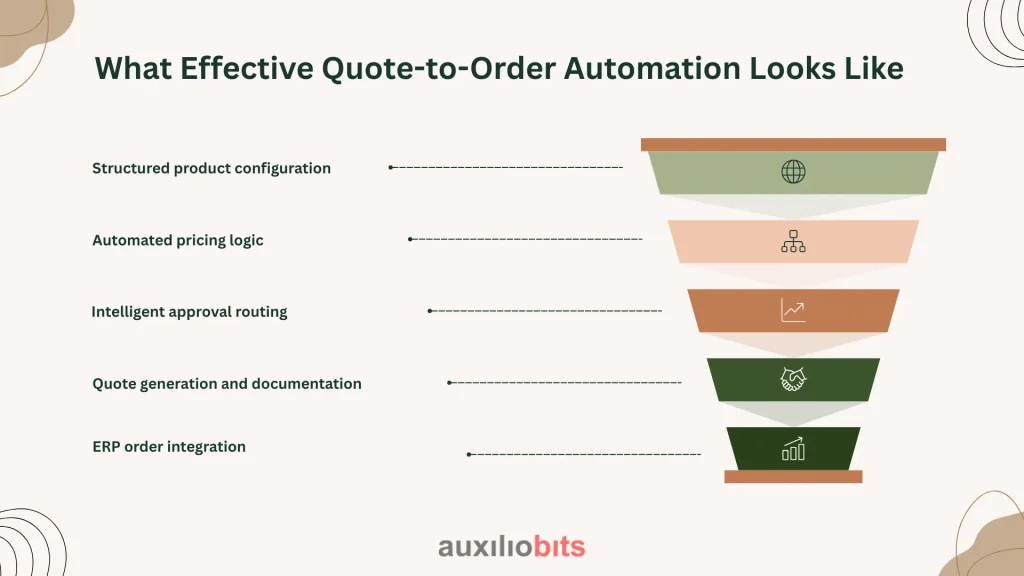
1. Structured product configuration
- Rule-based configuration models
- Dependency management across components
- Predefined product bundles
2. Automated pricing logic
- Margin validation rules
- Dynamic pricing adjustments
- Integrated cost models
3. Intelligent approval routing
- Discount thresholds
- Margin triggers
- Custom configuration approvals
4. Quote generation and documentation
- Standardized templates
- Contract clause automation
- Version control
5. ERP order integration
- Automated order creation
- Configuration data transfer
- Manufacturing readiness checks
When these elements function together, the quote-to-order cycle becomes predictable rather than reactive.
The Strategic Impact: Faster Revenue, Fewer Errors
It’s tempting to view quote-to-order automation primarily as a sales productivity tool. But the impact extends much further. Manufacturers that automate the quote-to-order process typically see improvements across multiple operational dimensions.
1. Revenue velocity increases
Deals move faster through the pipeline.
2. Pricing discipline improves
Margin leakage becomes easier to control.
3. Engineering workload decreases
Fewer invalid configurations require review.
4. Operational planning improves
Orders entering ERP systems contain cleaner configuration data. Interestingly, one of the most overlooked benefits is internal trust. When configuration rules and pricing logic are embedded into systems, sales, engineering, and finance operate from the same assumptions.
Why Automation Should Focus on the Process, Not the Platform
One misconception about Quote-to-Order Automation is that it requires a complete technology overhaul.
That’s usually false. Most manufacturers already operate ERP systems capable of handling orders. The real issue lies in the manual work surrounding those systems.
Sales teams generate quotes outside the ERP. Approvals happen through email. Configuration logic exists in documentation. Automation should focus on orchestrating these steps—not replacing the ERP. This approach also aligns with a broader automation philosophy: eliminate manual coordination without disrupting core business systems.
For many organizations, that distinction matters. Replacing enterprise systems is expensive. Automating workflows around them is far more practical.
The Next Phase: Intelligent Quoting Systems
Automation itself is evolving.
The next generation of quote-to-order systems incorporates AI-driven capabilities such as:
- Suggesting optimal configurations based on historical deals
- Predicting win probability based on pricing adjustments
- Identifying risky discount levels
- Recommending alternative configurations when components are unavailable
These capabilities push the quoting process beyond automation toward decision support. Sales teams don’t just generate quotes faster—they make better quoting decisions. However, those advanced capabilities only function effectively when the foundational elements—configuration, pricing, and approvals—are already in place. Without that foundation, intelligence has nothing reliable to analyze.
The Last Thoughts
Manufacturing organizations rarely advertise their quoting capabilities as a differentiator. But customers notice responsiveness. If one supplier takes five days to produce a quote and another responds within hours—with accurate configuration and transparent pricing—the difference is obvious.
This is where Quote-to-order automation quietly becomes a competitive advantage. It shortens sales cycles. And prevents pricing mistakes.
And it turns what used to be a messy internal coordination exercise into a streamlined commercial operation. Most companies don’t realize how inefficient their quote-to-order process is until they finally automate it.
Once they do, the old workflow feels surprisingly fragile.