






Key Takeaways
- CSAT and resolution time remain the most reliable indicators of customer experience in manufacturing service operations.
- Agentic AI improves these metrics by reducing operational friction, not simply by enhancing customer interactions.
- Resolution time directly influences CSAT, with faster service recovery producing measurable satisfaction gains.
- Manufacturing CX KPIs should combine operational and customer indicators, including ticket inactivity, escalation frequency, and first-time fix rates.
- The real value of agentic automation lies in proactive service coordination, preventing delays before customers experience them.
Customer experience in manufacturing looks deceptively simple on dashboards.
Executives see charts: CSAT scores, service response metrics, ticket volumes. Everything appears measurable. Yet anyone who has worked inside service operations knows how misleading those numbers can be.
A manufacturer selling industrial equipment, for example, might receive only a few thousand service requests a year. That seems manageable—until you realize each request may involve:
- A dealer network
- Spare parts logistics
- Warranty validation
- Technician dispatch
- Engineering escalation
- Documentation review
A single issue can pass through six or seven internal systems before resolution. Customers don’t see any of that complexity. What they experience is straightforward:
How long did it take to fix my problem? Did the company resolve it the first time?
That’s why two metrics quietly dominate manufacturing service perception:
- CSAT (Customer Satisfaction Score)
- Resolution Time
Interestingly, both metrics are deeply operational. They depend less on customer communication and far more on how efficiently internal processes work.
This is where a new category of automation, Agentic AI, is beginning to shift how service operations run.
Why Traditional CX Metrics Often Fail Operations Teams
Many manufacturers track dozens of customer metrics:
- Net Promoter Score (NPS)
- Customer Effort Score (CES)
- Service response time
- Ticket backlog
- Technician utilization
All useful. Yet when service leaders look closely at complaints or escalations, the same pattern appears again and again.
Customers rarely complain about surveys or communication style. They complain about delays.
Examples from real service environments include:
- A warranty claim stuck in approval loops for four days
- A technician dispatched without the correct spare part
- A support ticket transferred between teams three times
- A service agent waiting for ERP data to verify entitlements
Poor customer-facing staff are not responsible for these issues. They’re caused by process friction inside enterprise systems, such as inefficient data retrieval and outdated workflows that hinder timely service delivery, which ultimately affects the overall customer experience and satisfaction levels. That’s why CX KPIs Manufacturing leaders truly care about often collapsing into operational metrics. If operations improve, the customer experience improves automatically.
Agentic AI addresses precisely that layer: the operational decision-making that slows service execution.
Also read: Automating Service Request Management in Manufacturing
Two KPIs That Reflect Customer Experience
After years of consulting across service organizations, one observation keeps surfacing. You can analyze dozens of metrics, but two will tell you most of what you need to know.
1. CSAT (Customer Satisfaction Score)
CSAT measures how customers feel about the service they received.
In manufacturing environments, CSAT often reflects factors like:
- Speed of issue resolution
- Accuracy of technician diagnosis
- Availability of spare parts
- Transparency during service updates
Interestingly, communication quality matters, but resolution quality matters more. A polite service team cannot compensate for slow problem-solving.
2. Resolution Time
Resolution time tracks the period between issue creation and final closure.
In manufacturing service operations, this timeline often includes:
- Issue validation
- Warranty eligibility checks
- Spare parts availability confirmation
- Technician scheduling
- Field repair execution
- Post-service documentation
Each step introduces potential delays.
When resolution time decreases, several positive effects appear simultaneously:
- Customers regain operational uptime faster
- Escalation rates drop
- Service teams handle more tickets
- CSAT scores rise
This is why manufacturing CX KPIs often revolve around operational throughput rather than marketing-style engagement metrics.
Where Agentic AI Changes the Equation
Traditional automation tools—RPA, workflow engines, simple AI models—improve parts of the service process.
Agentic AI goes further. Instead of executing isolated tasks, AI agents monitor processes, evaluate conditions, and take actions across systems.
Think of them less as bots and more as operational coordinators.In a manufacturing service environment, agentic systems can:
- Detect abnormal service delays
- Trigger data collection from multiple platforms
- Evaluate resolution pathways
- Initiate corrective workflows automatically
This issue is important because many service delays are not due to missing data. They occur because no one notices the problem quickly enough. An AI agent doesn’t wait for escalation. It detects patterns continuously.
How Agentic Systems Reduce Resolution Time
Resolution time improves when service processes become proactive instead of reactive. Agentic AI enables that shift in several ways.
1. Continuous Case Monitoring
Instead of relying on service managers to track ticket progress, AI agents watch service workflows in real time. When something unusual occurs—say, a ticket remains inactive for 12 hours—the agent triggers intervention.
Possible actions include:
- Escalating to engineering support
- Requesting missing data from CRM
- Checking inventory systems for alternative spare parts
Small interventions like these prevent cases from quietly aging
2. Intelligent Technician Dispatch
Technician scheduling is one of the biggest contributors to service delays.
AI agents can evaluate multiple variables simultaneously:
- Technician skill profiles
- Geographic proximity
- Spare parts availability
- Current service backlog
Rather than relying on static rules, agents can dynamically recommend dispatch decisions.
Even a 10–15% improvement in technician routing efficiency can reduce resolution times dramatically.
3. Automated Warranty Validation
Warranty validation often involves manual checks across CRM and ERP systems.
AI agents can validate:
- Customer purchase history
- Warranty terms
- Installed equipment configurations
This approach removes hours—or sometimes days—from the service approval process.
4. Cross-System Coordination
Manufacturing service environments rely on several platforms:
- CRM systems
- ERP platforms
- Field service management tools
- Dealer portals
Human agents spend large amounts of time switching between them. Agentic AI removes that friction by coordinating actions across systems automatically
The Direct Relationship Between Resolution Speed and CSAT
It might sound obvious that faster resolution improves customer satisfaction. But the relationship is stronger than many organizations realize. Studies across industrial service operations show something interesting:
When resolution time drops by 20–25%, CSAT often increases by 8–12 points.
Why? Faster resolution simultaneously enhances various facets of the service experience.
Customers experience:
- Less downtime
- Fewer status updates required
- Fewer escalations
- More confidence in the manufacturer’s service reliability
In manufacturing environments, uptime equals productivity. Every hour saved during service recovery has a tangible business impact. This is why manufacturing CX KPIs rarely operate independently. They are tightly linked. Resolution efficiency drives satisfaction.
Practical Examples from Manufacturing Service Environments
Consider a heavy equipment manufacturer supporting mining operations.
A machine breakdown ticket previously followed this process:
- Customer reports issue through dealer portal
- Support agent reviews equipment configuration
- Warranty validation performed manually
- Technician availability checked
- Spare parts inventory confirmed
- Service dispatch scheduled
Average resolution time: 72 hours.
After introducing agentic service coordination:
- I agents automatically verified warranty eligibility
- Spare part availability checked instantly across warehouses
- Technician schedules are optimized dynamically
Resolution time dropped to 44 hours. Customers noticed the difference immediately. The improvement in resolution time was not due to enhanced communication but rather the quicker return of equipment to operation.
Another example comes from a manufacturing company managing thousands of service tickets across global plants. Their biggest problem wasn’t technician availability—it was ticket stagnation. Many tickets sat idle between teams.
Agentic monitoring systems detected inactivity and triggered automatic follow-ups.
The result:
- 0% reduction in ticket aging
- CSAT improvement across service regions
These improvements didn’t require new customer-facing platforms. They came from fixing operational bottlenecks.
CX KPIs Manufacturing Leaders Should Monitor in an AI-Driven Service Model
When agentic automation becomes part of service operations, traditional CX dashboards need adjustment.
Manufacturing organizations should track a blend of operational and customer indicators.
Important metrics include:
- Average Resolution Time – the core service efficiency metric
- First-Time Fix Rate – fewer repeat visits improve customer trust
- CSAT by Resolution Speed – understanding how timing impacts perception
- Ticket Escalation Frequency – high rates indicate operational bottlenecks
- Service Process Cycle Time – total duration across all workflow stages
Another useful indicator is something many organizations overlook is Inactive Ticket Duration This measures how long tickets remain untouched between steps. In some service environments, inactive time accounts for 40–60% of total resolution time. Agentic AI targets exactly that inefficiency. Tracking it provides a clearer view of operational friction.
When AI Improves CX — and When It Doesn’t
Agentic AI improves CX KPIs when it is applied to operational coordination. But it doesn’t fix everything.
For example: AI cannot compensate for poor spare parts planning. It cannot repair weak technician training programs. If a technician misdiagnoses equipment repeatedly, automation simply accelerates the wrong actions.
Another limitation appears when organizations treat AI as a customer communication tool rather than an operational engine. Chatbots may answer questions faster, but if the underlying service workflow remains slow, CSAT rarely improves.
In other words, customer experience improvements come from operational intelligence, not just customer interaction automation.
That distinction matters.
Operational Changes Required to Sustain CX Improvements
Organizations adopting agentic service automation often discover something unexpected.
Technology is the easy part. Operational alignment is harder. To sustain improvements in manufacturing CX KPIs, service organizations must adjust several areas.
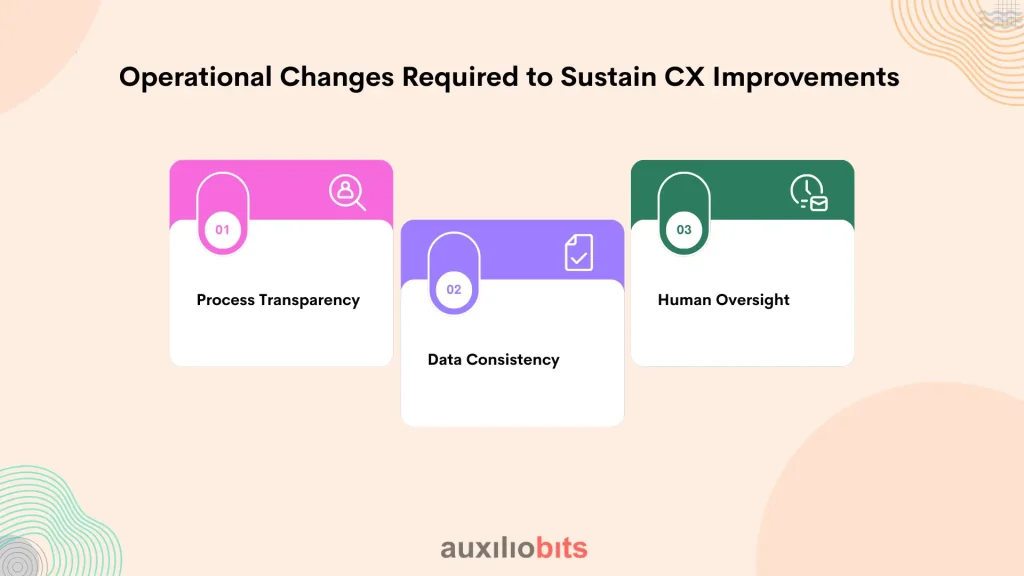
1. Process Transparency
AI agents require visibility into service workflows. Hidden manual steps—spreadsheets, email approvals, undocumented processes—limit automation effectiveness.
2. Data Consistency
Service data scattered across systems reduces decision accuracy. Standardizing asset records, warranty data, and service histories becomes essential.
3. Human Oversight
Agentic systems should not operate without supervision. Service leaders still need dashboards to review decisions and intervene when necessary. In practice, the most successful deployments treat AI agents as operational assistants, not autonomous replacements.
What Manufacturing CX KPIs Will Look Like in the Next Five Years
Manufacturing service operations are shifting toward predictive models. Instead of measuring how quickly problems are resolved, organizations will increasingly measure how many issues are prevented altogether.
Future CX metrics may include:
- Predicted failure detection rates
- Preventive maintenance success percentages
- Autonomous service workflow completion rates
Resolution time will still matter, but fewer problems will reach the reactive stage. CSAT will likely reflect this change. Customers rarely complain about problems that never occur.
The Ending Thoughts
Manufacturing service operations are complicated environments. Systems multiply, teams specialize, processes expand over time. Inefficiencies creep in quietly.
Customers rarely care about those internal complexities.
Customers only notice two things: the speed of issue resolution and the reliability of the experience. Improving those two outcomes has always been the goal of service leaders. agentic AI, which refers to artificial intelligence systems that can act autonomously to assist in decision-making, simply gives them a new operational tool to achieve it.