








Key Takeaways
- Dealer Data Automation improves more than efficiency—it ensures accuracy and reliability across distributor networks.
- Validation mechanisms prevent incorrect dealer submissions from corrupting CRM, ERP, and analytics systems.
- Data enrichment adds valuable context, transforming raw dealer inputs into actionable business intelligence.
- Dealer management automation creates a continuous data pipeline connecting partners, internal systems, and decision-makers.
- Enterprises that automate validation and enrichment gain better forecasting, stronger partner visibility, and more reliable analytics.
Manufacturers rely on dealer and distributor networks for revenue, market reach, and customer engagement. Yet the way many organizations collect and manage dealer data still resembles a patchwork system—emails, spreadsheets, CRM exports, partner portals, and sometimes even phone calls.
The irony is impossible to miss. Companies invest millions in ERP systems, CRM platforms, and analytics tools, but the foundational data flowing into those systems often remains inconsistent, incomplete, and delayed, leading to challenges in data reliability and decision-making processes.
This is where dealer data automation begins to matter—not just for efficiency, but for trust in the data itself. Automating the collection of dealer information is only half the solution. The real transformation happens when that information is validated, enriched, and standardized before it touches downstream systems.
Without that layer of intelligence, automation simply accelerates bad data.
The Hidden Complexity of Dealer and Distributor Data
Dealer networks look deceptively simple from a distance.
A manufacturer sells to distributors. Distributors sell to dealers. Dealers interact with customers.
But inside the operational layer, data flows in multiple directions:
- Dealer onboarding information
- Sales performance reports
- Inventory updates
- Warranty registrations
- Incentive program data
- Customer feedback submissions
- Compliance documentation
Each of these data streams originates outside the enterprise boundary. And that’s the problem.
External partners submit information in their formats, timelines, and quality standards. One dealer may upload structured Excel sheets every Monday morning. Another sends screenshots in emails. A third logs into a portal once every two weeks and enters partial information.
None of these instances is unusual. Yet analytics teams still expect clean dashboards.
Without dealer data automation, companies spend countless hours chasing updates, correcting formatting issues, and reconciling conflicting records.
And even then, errors slip through.
Why Manual Data Collection Breaks at Scale
At small network sizes—say 50 dealers—manual collection might still function. At 500 or 5,000 dealers, it becomes unsustainable.
Consider a typical distributor data submission process:
- Dealers download a template.
- They fill in sales, inventory, and customer data.
- Files are emailed or uploaded to a portal.
- Internal teams review entries.
- Incorrect fields are flagged.
- Dealers resend corrected files.
Multiply that by hundreds of partners. The operational cost quickly spirals. But the bigger issue isn’t effort—it’s inconsistency.
Manual processes introduce several persistent problems:
- Data duplication across systems
- Incomplete submissions missing required fields
- Inconsistent naming conventions for products or locations
- Incorrect contact information
- Delayed reporting cycles
Even a single invalid field—say, a wrong postal code—can break downstream logistics or marketing segmentation. This brings us to an unsettling reality.
Most dealer networks operate with partially unreliable data.
What Dealer Data Automation Means
When people hear dealer data automation, they often imagine a simple file ingestion system.
Upload the spreadsheet, process the data, and push it to the CRM.
That’s the fundamental layer, but it’s only a glimpse into the complexity.
True automation involves multiple steps:
- Data ingestion from emails, portals, APIs, or shared drives
- Schema mapping across various dealer templates
- Automatic validation against predefined rules
- Data enrichment from external datasets
- Standardization of formats
- Synchronization with CRM, ERP, and analytics platforms
Think of it less like file processing and more like a quality-control pipeline for partner data. Dealer submissions enter one end. On the other side, validated, enriched, and standardised records emerge. And most importantly, the process runs continuously without human intervention.
The Critical Role of Validation in Dealer Data Automation
Automation without validation is dangerous. It simply moves errors faster.
Validation acts as the gatekeeper, ensuring that incoming dealer data meets operational requirements before it propagates through enterprise systems. In practice, validation includes multiple layers.
1. Structural Validation
This verifies whether submissions follow the expected format.
Examples include:
- Required fields completed
- Correct data types (numbers vs text)
- Mandatory columns present
- Acceptable file formats
If a dealer uploads a report missing product IDs, the system flags it immediately. No manual review required.
2. Logical Validation
This layer checks whether values make sense.
Typical rules include:
- Inventory quantities cannot be negative
- Sales dates cannot occur in the future
- Warranty registrations must reference valid product SKUs
These checks catch errors that spreadsheets alone cannot detect.
3. Cross-System Validation
Dealer data usually exists alongside other data. Automation systems often compare incoming records against internal databases.
For example:
- Dealer ID verified against CRM master records
- Product codes checked against ERP catalogs
- Region codes mapped to territory definitions
If a distributor reports sales for a discontinued product, the system catches it instantly.
4. Real-Time Feedback to Dealers
One overlooked advantage of automated validation is immediate feedback loops.
Instead of waiting days for manual corrections, dealers receive instant notifications:
- Missing fields highlighted
- Invalid entries flagged
- Required corrections suggested
This dramatically improves data quality over time. People learn quickly when systems guide them.
Data Enrichment: Turning Raw Inputs into Actionable Intelligence
Validation ensures correctness. Enrichment ensures usefulness. Most dealer submissions contain basic operational data: quantities sold, inventory counts, and transaction details.
But businesses need more context to make decisions. That’s where enrichment steps in.
Common Dealer Data Enrichment Techniques
1. Geographical Enrichment
Dealer addresses can be enriched with additional geographic attributes:
- Territory assignments
- Market regions
- Demographic data
- Urban vs rural classifications
This becomes invaluable for market expansion strategies.
2. Business Profile Enrichment
Dealer organizations can be supplemented with external datasets:
- Company size
- Industry classification
- Revenue estimates
- Distribution footprint
Sales teams learn more about partner capabilities.
3. Customer Insight Enrichment
When dealers submit customer-level information, enrichment tools can add layers like:
- Customer segmentation profiles
- Purchase behavior indicators
- Product lifecycle predictions
This helps manufacturers better understand end-user demand patterns.
4. Product Intelligence Enrichment
Submitted product codes can be linked with:
- Product categories
- Warranty policies
- Replacement cycles
- Cross-sell opportunities
The raw numbers begin to reveal a narrative.
How Dealer Management Automation Works in Practice
Dealer management automation connects automated data collection with operational decision-making. Instead of static reporting, companies create dynamic data pipelines feeding multiple departments.
Typical architecture includes:
1. Automated ingestion layer
Captures dealer submissions across channels.
2. Validation engine
Applies business rules and quality checks.
3. Enrichment services
It incorporates contextual information from both internal and external sources.
4. Data standardization module
Harmonizes naming conventions and formats.
5. Integration layer
Synchronizes validated records with CRM, ERP, and analytics systems.
6. Monitoring dashboards
Tracks submission compliance and data quality.
The result? Dealer data becomes a continuously updated operational asset rather than a monthly administrative headache.
Common Pitfalls and What Enterprises Often Get Wrong
Automation projects often stumble—not because the technology fails, but because expectations are unrealistic.
Several patterns appear repeatedly.
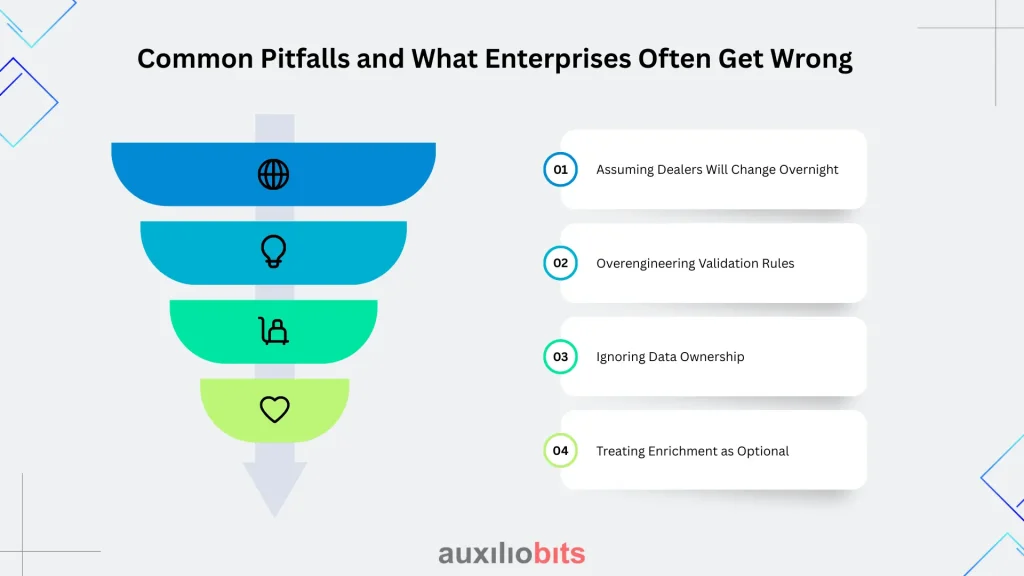
1. Assuming Dealers Will Change Overnight
Partner ecosystems evolve slowly. Expecting hundreds of dealers to instantly adapt to new automated systems almost never works. Gradual rollout usually performs better.
2. Overengineering Validation Rules
Some companies create excessively strict validation frameworks.
The result? Dealers cannot submit data without constant errors. Validation should improve quality, not block operations.
3. Ignoring Data Ownership
Who owns dealer data? Sales teams? Channel managers? Operations? If governance isn’t clear, automation tools struggle to enforce consistent standards.
4. Treating Enrichment as Optional
Organizations often focus heavily on validation but skip enrichment. That’s a missed opportunity. Clean data is useful. Enriched data is strategic.
Business Impact of Validated and Enriched Dealer Data
The benefits extend far beyond operational efficiency. Improved dealer data quality directly affects business outcomes. Some impacts are immediate. Others take time to surface.
Operational Improvements
- Faster reporting cycles
- Reduced manual data cleaning
- Improved inventory visibility
- Accurate incentive program calculations
Strategic Insights
- Better demand forecasting
- Dealer performance benchmarking
- Regional market opportunity analysis
Customer Experience
- Faster warranty claim processing
- Improved product availability
- More targeted marketing campaigns
And perhaps the most underrated advantage: trust in analytics. When executives trust the underlying data, they rely on dashboards more confidently. When they don’t, decisions revert to gut instinct, which can lead to inconsistent outcomes and missed opportunities for data-driven insights, ultimately hindering the organization’s ability to make informed strategic decisions based on reliable analytics.
Final Thoughts
Many organizations approach dealer data automation as a technology upgrade. But the deeper shift is cultural. Automation exposes data issues that were previously hidden under manual processes, such as outdated information or incorrect entries that can significantly impact decision-making. Validation rules reveal inconsistencies.
Enrichment highlights missing context. Some teams initially resist this transparency. It feels uncomfortable.
Yet over time, organizations realize something important. Clean, enriched dealer data isn’t just an operational improvement—it becomes a strategic advantage.
Competitors may have similar dealer networks. They may even sell identical products.
But the companies that truly understand their partner ecosystems—who sells what, where demand is emerging, and which dealers perform best—operate with a different level of insight.
And that insight begins with something deceptively simple: collecting dealer data properly.




