






Key Takeaways
- Skill matching must go beyond certifications. Performance history and first-time fix rates matter more than static tags.
- Location optimization requires dynamic intelligence. Real-time travel variability and job clustering outperform simple proximity rules.
- SLA optimization is a trade-off problem. AI agents simulate downstream impact rather than reacting to the loudest escalation.
- Continuous re-planning differentiates AI agents. Unlike static optimizers, they adapt to live operational changes.
- Human governance remains essential. AI enhances scheduling decisions but must operate within clear guardrails and operational context.
There’s a difference between assigning a technician and deploying the right technician at the right moment for the right outcome. Most field service organizations encounter this challenge firsthand.
On paper, scheduling looks straightforward: match skill sets, check availability, factor in location, honor SLAs. In reality, it’s a multi-variable optimization problem that keeps shifting. Traffic changes. Jobs overrun. A “simple” maintenance call reveals a deeper issue. A technician calls in sick. A high-priority Service Level Agreement (SLA) is rapidly approaching its expiration date.
This scenario is where technician scheduling AI—specifically AI agents rather than traditional rule engines—starts to matter.
The significance lies not in its ability to automate dispatching. That’s been automated for years.
It matters because it factors across skill, geography, and service-level commitments dynamically and adapts when the world doesn’t behave.
Why Traditional Scheduling Breaks Down
Most organizations rely on one of three approaches:
- Manual coordination via dispatch teams and spreadsheets
- Rule-based scheduling inside a field service management (FSM) platform
- Optimization engines that calculate a daily or weekly plan
All three work—until they don’t.
The problem is not the absence of logic. It’s the rigidity of it.
1. Skill Matching Isn’t Binary
In most systems, technicians are tagged with skills:
- HVAC Level 1
- Electrical certified
- Fiber splicing
- Biomedical calibration
The system filters for a job requirement and assigns the “best match.” But skill isn’t binary.
A Level 2 technician might be overqualified but geographically closer.
A Level 1 technician might handle 80% of the issue, but escalate the rest.
A specialist might be needed only if diagnostic results confirm a certain fault.
Real-world scheduling is probabilistic, not categorical.
Rule engines struggle with nuance. AI agents, by contrast, can learn patterns like:
- This technician resolves similar tickets 25% faster.
- That technician’s first-time fix rate is higher for this equipment model.
- Another tech performs better under tight SLA windows.
Those differences add up.
2. Location Is Not Just Distance
Distance calculations are deceptively simple. Most systems compute:
The closest technician plus the required skill determines the assignment.
But geography is more complex:
- Urban congestion patterns
- Known parking constraints
- Site access windows
- Multi-job route clustering
- Historical travel time variance
A 12 km route in Mumbai at 5 PM isn’t the same as 12 km at 11 AM. Anyone who’s dispatched technicians in a dense metro knows that.
Technician Scheduling AI agents continuously re-evaluate travel conditions, re-sequence tasks, and cluster jobs based on emerging constraints. They don’t simply calculate optimal routes at 8 AM and rely on luck.
And, importantly, they don’t panic when reality diverges from plan.
3. SLA Optimization Is a Balancing Act
SLA management introduces tension.
Imagine:
- 4-hour response SLA for a premium client
- 24-hour SLA for a standard maintenance call
- Preventive maintenance due this week
- Emergency breakdown at a manufacturing plant
You can’t optimize everything simultaneously.
Human dispatchers often prioritize the loudest escalation. Algorithms often prioritize SLA timers mechanically. Neither approach consistently maximizes overall service performance.
AI agents can simulate trade-offs:
- If we divert Technician A now, what downstream SLA risks increase?
- If we delay Job B by 2 hours, does it breach?
- If Technician C handles two nearby jobs first, can we preserve three SLAs instead of one?
This is not theoretical. In utilities and telecom networks, these decisions happen hundreds of times per day.
Also read: AI Agents for Critical Parts Inventory Monitoring
What Makes AI Agents Different from Optimization Engines
There’s a misconception that AI scheduling is just a more powerful optimizer. It’s not.
Traditional optimizers:
- Ingest constraints
- Generate a plan
- Output a schedule
- Stop
AI agents operate continuously. They:
- Monitor live events (job status updates, traffic feeds, parts availability)
- Detect emerging risk (SLA drift, technician idle time, overload)
- Re-plan autonomously
- Escalate only when thresholds are breached
Think of it less as a solver and more as a digital operations coordinator.
In large service organisations—think telecom rollouts or industrial equipment maintenance—the difference is significant.
Skill-Based Scheduling: Where AI Adds Real Depth
Let’s break this down properly.
Beyond Certification Tags
A skill matrix typically includes:
- Certifications
- Training levels
- Equipment familiarity
- Safety clearance
That’s necessary but insufficient.
Technician Scheduling AI can layer:
- Historical resolution rates by equipment model
- Average job duration variance
- Customer satisfaction scores
- First-time fix probability
- Escalation frequency
Suddenly, skill becomes performance-informed rather than HR-record-based.
Location Intelligence: More Than GPS
Geographic optimization is often treated as a routing problem. It’s more of a situational awareness challenge.
Factors AI Agents Continuously Weigh
- Real-time traffic patterns
- Job clustering potential
- Parts pickup proximity
- Technician shift boundaries
- Overtime thresholds
- Urban vs rural productivity differences
A static schedule cannot account for midday variability.
For example:
- A job expected to take 90 minutes extends to 2.5 hours.
- Another job cancels.
- A high-priority request enters the system.
Traditional dispatchers scramble. AI agents recompute and sequence across the network.
There’s a practical benefit here: reduced dispatcher cognitive load. Experienced dispatchers are valuable. But they are finite.
SLA Optimization: Where Trade-offs Get Political
Let’s be honest. SLA discussions are often strategic. They’re commercial.
Premium contracts demand priority. Strategic accounts expect special handling. Internal KPIs emphasize response time. Finance emphasizes overtime reduction.
Technician scheduling AI can model trade-offs across:
- Revenue impact
- Penalty exposure
- Customer lifetime value
- Workforce utilization
- Technician fatigue
It doesn’t remove politics. But it surfaces quantified implications.
In one heavy equipment service organization, AI-driven re-prioritization reduced SLA penalties by 22% while slightly increasing average travel distance. Finance initially objected. However, comparing the penalty savings against marginal fuel increases made the case clear.
Optimization without business context is incomplete. Agents trained on operational and financial outcomes perform better.
When AI Scheduling Fails
There’s a tendency to romanticize AI. In technician scheduling, failure typically happens when:
- Skill data is outdated or inaccurate
- Historical job classification is inconsistent
- Technicians resist real-time resequencing
- Parts inventory is disconnected from scheduling logic
- SLAs are poorly defined
Also, constant re-optimization can destabilize technicians. If the system reshuffles their schedule every hour, trust erodes. Some stability constraints are necessary.
This is where human-in-the-loop still matters. AI agents should propose and execute within guardrails and escalate edge cases.
Implementation Considerations That Often Get Overlooked
Most technology discussions focus on algorithms. The operational realities are more nuanced.
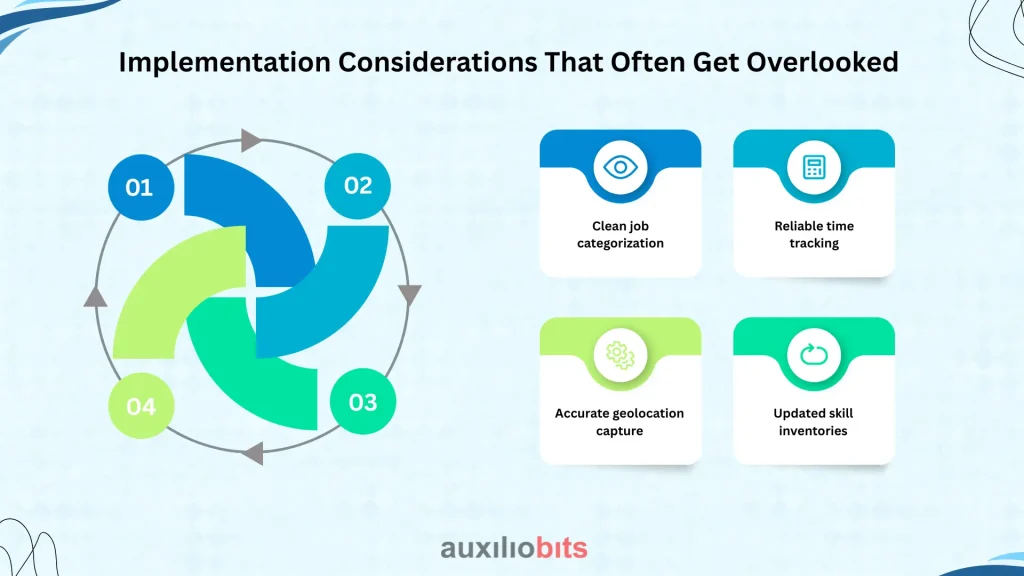
Data Foundation
- Clean job categorization
- Reliable time tracking
- Accurate geolocation capture
- Updated skill inventories
Without that, performance modeling is compromised.
Change Management
Technicians must trust the system. If they feel micromanaged, they override it.
Practical steps:
- Provide transparency into why assignments changed
- Show performance improvements
- Maintain limited schedule stability windows
Integration Points
Technician Scheduling AI usually exists in conjunction with other technologies. It interacts with:
- FSM platforms
- ERP systems
- Inventory management
- CRM systems
- Traffic APIs
Latency and synchronization matter. A 15-minute delay in parts status can break optimization logic.
Practical Optimization Levers
From experience, the following levers produce measurable impact:
- Prioritize first-time fix probability over pure proximity
- Balance technician utilization against burnout risk
- Model overtime as a cost, not a binary constraint
- Incorporate cancellation likelihood
- Use predictive job duration rather than static averages
Each of these introduces probabilistic reasoning. And that’s precisely where AI agents outperform rule engines.
A More Realistic View of ROI
Organizations often expect dramatic cost reductions. Sometimes they get them. More often, improvements are incremental but compounding:
- 5–10% travel time reduction
- 8–15% SLA compliance improvement
- Lower revisit rates
- Reduced dispatcher headcount growth
- Higher technician productivity
The compound effect across thousands of monthly jobs is significant.
In utilities and telecom, even a 3% improvement in on-time response can change regulatory compliance metrics.
Where Human Judgment Still Wins
Despite all this, AI does not replace operational leadership.
There are situations where intuition overrides data:
- Sensitive VIP customers
- Safety-critical escalations
- Unstructured service scenarios
- Labor union constraints
AI agents perform best when embedded within governance frameworks, not as autonomous dictators.
Looking Ahead
As AI capabilities mature, scheduling agents will:
- Predict failure likelihood before tickets are raised
- Pre-position technicians geographically
- Align training programs with predicted skill shortages
- Optimize workforce hiring based on demand forecasts
Skill, location, and SLA optimization will merge with workforce planning.
The dispatch center of the future may look less like a call hub and more like an operations intelligence cockpit.
Final Thought
Technician scheduling has always been a coordination challenge. What’s changing is the tolerance for inefficiency.
Margins are tighter. SLAs are stricter. Customers expect faster responses. Field service complexity is increasing, not decreasing.
Technician Scheduling AI is not a shiny add-on. It’s becoming operational infrastructure.
This is not because AI assigns tasks more quickly, but rather because it comprehends context, weighs trade-offs, and continuously adapts.
And in field service operations, adaptability is the real competitive advantage.