







Key Takeaways
- True Service Request Automation manages the full lifecycle—from intake to validated resolution—not just ticket logging.
- Well-designed intake and automatic data enrichment prevent downstream delays, misrouting, and rework.
- Integration across ERP, CMMS, MES, and CRM systems determines whether automation delivers real operational value.
- Tracking patterns—recurring failures, downtime impact, supplier trends—turns service management into a strategic lever.
- The strongest automation models enhance human judgment rather than attempting to replace it.
Manufacturing plants usually have sufficient systems. They complain about too many systems—and not enough clarity.
Walk into any mid-to-large facility and you’ll see it immediately. An operator logs a maintenance issue in one portal. A quality engineer emails a supplier about a defective lot. A production supervisor pings IT because the MES screen froze again. Meanwhile, customer service is tracking field complaints in a CRM that barely talks to the ERP.
All of these are service requests. Most of them are still managed manually. And that’s where the friction starts.
Service request automation in manufacturing isn’t about building a fancy ticketing dashboard. It’s about controlling the entire lifecycle—from ticket intake to resolution—without losing context, accountability, or speed. That lifecycle is where margins quietly erode or get protected.
The Real Nature of Service Requests in Manufacturing
In IT, service requests are often predictable: access requests, password resets, and incident tickets. In manufacturing, they’re messier.
They cut across functions:
- Maintenance requests from the shop floor
- Quality deviations requiring cross-functional review
- Tooling change requests
- Supplier non-conformance escalations
- Engineering change clarifications
- Customer service claims tied to production batches
Some are urgent and production-critical. Others look minor but carry compliance implications. Many require coordination across departments that don’t share the same KPIs.
And here’s the subtle problem: manufacturing environments are optimized for physical flow—materials, parts, assemblies—not information flow. When information breaks down, physical processes slow down in ways that are hard to diagnose.
Also read: Why Manufacturing CXOs Are Moving from Automation to Agentic AI
Ticket Intake: Where Chaos Begins
Most organizations underestimate the intake stage. They focus on resolution SLAs, escalation matrices, or reporting dashboards. But if intake is inconsistent, everything downstream suffers.
In many plants, tickets enter the system through:
- Email inboxes
- WhatsApp or Teams messages
- Phone calls to supervisors
- Sticky notes (yes, still)
- ERP service modules
- Third-party service portals
There is usually more than one point of entry.
The result?
- Duplicate tickets
- Missing data (machine ID, batch number, priority)
- Incorrect categorization
- Requests assigned to the wrong function
Automation at the intake stage must do more than capture a request. It needs to:
- Standardize submission fields without slowing the operator down
- Auto-classify issues using contextual cues (machine code, shift, department)
- Detect duplicates or recurring patterns
- Enrich the ticket with data from ERP, CMMS, MES, or CRM
For example, when an operator reports “Conveyor 3 overheating”, the system should automatically pull:
- Asset history from CMMS
- Last maintenance activity
- Open quality holds related to that line
- Current production order
Without this, resolution teams waste 30–40% of their time just gathering context.
And here’s the nuance: if the intake form is too rigid, operators bypass it. If it’s too open, data becomes unusable. Service Request Automation works only when it respects human behavior on the shop floor.
Intelligent Routing: The Hidden Efficiency Lever
Once tickets are logged, routing decisions determine whether resolution is fast—or painfully slow.
In many plants, routing still depends on:
- Manual triage by a coordinator
- Static rule-based workflows
- Escalations triggered only after SLA breaches
This approach breaks down when:
- Multiple departments share responsibility
- Issues span quality and maintenance
- External vendors are involved
- Capacity fluctuates across shifts
Automation can evaluate routing based on:
- Skill matrix and technician availability
- Severity tied to production impact
- Compliance risk classification
- Historical resolution data
A practical example: a tier-1 automotive supplier faced chronic delays in resolving tool breakdown tickets. Analysis showed that requests were always routed to senior technicians, even for routine calibration issues. Automated routing, based on issue classification and skill tagging, redistributed workload. Resolution time dropped by 28% in three months.
No new headcount. Just smarter routing.
Still, it’s worth noting: over-automating routing without feedback loops can create blind spots. Machines classify based on patterns; unusual events still require human oversight. The best systems allow supervisors to override routing decisions—and learn from those overrides.
Resolution: More Than Fixing the Issue
Resolution in manufacturing service management is rarely linear.
A maintenance request might require:
- Spare part availability check
- Vendor dispatch scheduling
- Production rescheduling
- Quality verification post-repair
In a manual setup, each of these steps involves separate emails, spreadsheets, or calls. Information gets fragmented. Accountability becomes vague.
Service Request Automation can orchestrate this sequence by:
- Triggering inventory checks in ERP
- Auto-raising procurement requests if spares are unavailable
- Notifying planning teams of potential downtime
- Scheduling post-repair quality inspection
This orchestration ensures resolution isn’t just technical closure—but operational recovery.
There’s a difference.
Cross-System Integration: The Non-Negotiable Foundation
Without integration, Service Request Automation becomes a fancy ticketing layer sitting on top of disconnected systems.
In manufacturing environments, relevant systems typically include:
- ERP platforms such as SAP S/4HANA or Oracle ERP Cloud
- Manufacturing Execution Systems (MES)
- Computerized Maintenance Management Systems (CMMS)
- CRM platforms
- Supplier portals
Automation must:
- Pull asset, order, and batch data in real time
- Push status updates back into ERP or CRM
- Sync vendor communications
- Maintain audit trails for compliance
Where projects fail is in underestimating integration complexity. Legacy systems may lack APIs. Data fields may not align. Master data might be inconsistent across modules.
It’s rarely a technology limitation. It’s usually a data governance issue.
Before implementing automation, organizations need to answer uncomfortable questions:
- Are asset IDs consistent across systems?
- Is ownership of ticket categories clearly defined?
- Do we trust our master data?
Without this groundwork, automation amplifies existing chaos.
SLAs, Escalations, and the Psychology of Urgency
Manufacturing service requests don’t all carry the same weight. A breakdown in a bottleneck process deserves immediate escalation. A cosmetic panel defect in a non-critical assembly? Maybe not.
Automated SLA management should reflect operational realities:
- Production-impacting incidents tied to OEE loss
- Quality-related tickets tied to compliance deadlines
- Customer-facing issues linked to contractual obligations
Modern systems can:
- Adjust SLA clocks based on production schedules
- Pause timers during planned downtime
- Escalate automatically based on severity thresholds
But here’s the human side: if every ticket is marked “urgent,” nothing is urgent. Automation can counter this by restricting priority selection or requiring justification for critical classification.
It sounds small. It isn’t. Priority inflation kills responsiveness.
Field Service and External Stakeholders
Service request automation doesn’t stop at plant walls.
In industries like heavy equipment, automotive components, or industrial machinery, field service requests often originate from customers. These requests:
- Reference serial numbers or installation sites
- Require warranty validation
- Trigger reverse logistics
- Demand coordination between service engineers and plant teams
Automating this flow means:
- Linking field complaints directly to production batches
- Auto-validating warranty eligibility
- Scheduling service visits based on geography and skill
- Feeding defect data back into quality systems
One manufacturer reduced warranty claim cycle time by 35% after integrating field tickets with internal production data. The key wasn’t faster technicians—it was eliminating manual reconciliation between CRM and ERP.
And yes, there were initial hiccups. Incorrect serial mappings caused misrouted cases. But once master data stabilized, the process became far more predictable.
Analytics: Beyond “Open vs. Closed”
Most service dashboards show:
- Number of open tickets
- Average resolution time
- SLA adherence
Useful, but insufficient.
Manufacturing leaders should ask:
- Which assets generate recurring tickets?
- Which shifts report the highest volume of issues?
- Are certain suppliers associated with higher service demand?
- What percentage of tickets result in production downtime?
Service request automation platforms can surface patterns such as:
- Repeat breakdowns within 30 days of preventive maintenance
- Clusters of quality complaints linked to specific batches
- Escalation frequency by department
These insights inform:
- Preventive maintenance optimization
- Supplier performance reviews
- Training gaps
- Capital investment decisions
Without analytics, automation becomes transactional. With analytics, it becomes strategic.
Where Automation Fails
It would be misleading to suggest that every automation initiative succeeds.
Common pitfalls include:
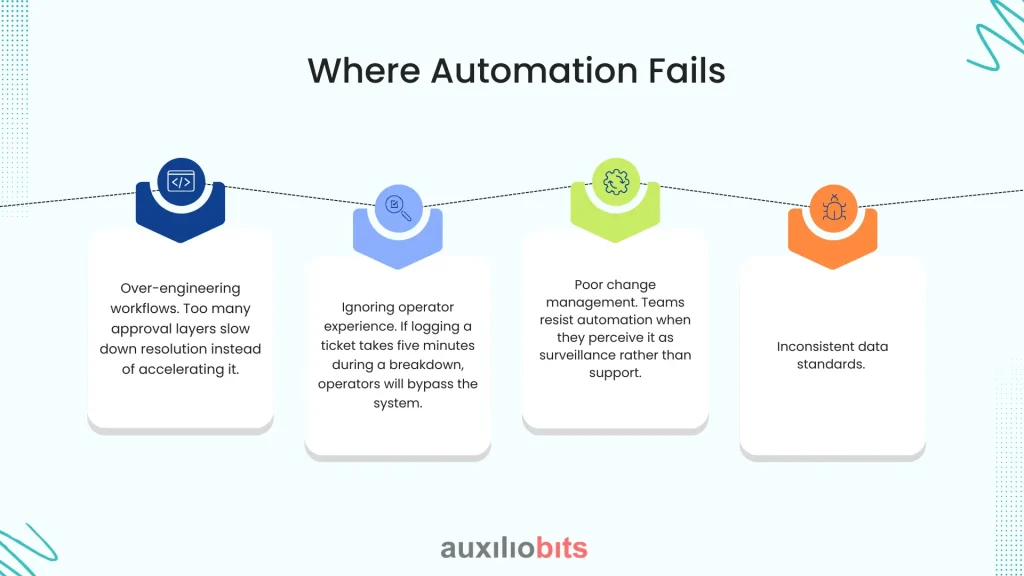
- Over-engineering workflows. Too many approval layers slow down resolution instead of accelerating it.
- Ignoring operator experience. If logging a ticket takes five minutes during a breakdown, operators will bypass the system.
- Poor change management. Teams resist automation when they perceive it as surveillance rather than support.
- Inconsistent data standards.
There’s also a subtle cultural dimension. In some plants, informal escalation through personal relationships works surprisingly well. Automation can disrupt that dynamic. The trick is not to eliminate human collaboration but to formalize accountability without suffocating flexibility.
Designing a Practical Automation Roadmap
The rollout of service request automation in manufacturing should be phased.
Start with:
- High-volume, repetitive ticket categories
- Clear ownership and measurable SLAs
- Minimal cross-system complexity
Then expand toward:
- Multi-departmental workflows
- Vendor integrations
- Advanced analytics and predictive triggers
A sensible roadmap might look like:
- Standardize ticket intake and categories.
- Automate routing and SLA tracking.
- Integrate with ERP and CMMS.
- Add analytics and trend-based triggers.
- Extend to field service and supplier ecosystems.
Skipping foundational steps often leads to rework later.
The Strategic Value: More Than Efficiency
Manufacturing leaders often justify automation in terms of cost savings or faster turnaround. Fair enough. But the deeper value lies elsewhere.
Effective service request automation:
In environments where margins are tight and downtime is expensive, even small improvements compound. And perhaps more importantly, it shifts service management from reactive firefighting to controlled orchestration.
That shift is cultural as much as technical.
A Final Perspective
Manufacturing organizations already invest heavily in machinery, robotics, and production optimization. Yet service workflows—the connective tissue between teams—remain surprisingly manual.
Automating ticket intake to resolution isn’t glamorous. It doesn’t photograph well for annual reports. But it addresses a daily operational reality that quietly influences OEE, customer satisfaction, and employee frustration.
The nuance? Automation should support judgment, not replace it. The goal isn’t to remove humans from service management—it’s to remove unnecessary friction.
When done thoughtfully, Service Request Automation doesn’t just close tickets faster. It makes the entire manufacturing ecosystem more predictable, accountable, and resilient.
And in this industry, predictability is worth more than most dashboards admit.