






Key Takeaways
- Scrap is usually organised. What appears unpredictable usually hides multi-variable interactions that traditional RCA methods struggle to uncover.
- Pattern recognition is the differentiator. Scrap Reduction AI identifies weak signals and compound parameter effects that humans would not manually test.
- Data quality determines success. Without structured defect labelling, traceability, and synchronized timestamps, even advanced AI models will mislead.
- AI augments engineers—it doesn’t replace them. The best results come from collaboration between domain experts and data teams.
- Artificial intelligence is becoming strategic. As margins tighten and quality expectations rise, continuous AI-driven root cause analysis shifts from optional improvement to competitive necessity.
Enquire with the head of manufacturing operations about the challenges they face. The immediate answers might be missed dispatches, supplier delays, or labor turnover. However, the true, often unspoken, concern soon emerges: the silent drain on margin caused by scrap bins and rework loops. The result is the “hidden factory” operating within the main plant.
Scrap isn’t just wasted material. It’s wasted machine time, quality inspections, expediting costs, and customer confidence. Rework is worse. It consumes capacity you thought you had already earned.
The truth? Most plants still treat root cause analysis as a periodic exercise instead of a continuous capability. That’s where scrap reduction AI is beginning to change the economics of quality.
Not through magic. Through pattern recognition.
Why Traditional Root Cause Analysis Falls Short
Anyone who has led a quality review knows the ritual.
A spike in defects triggers a cross-functional meeting. The team uses a fishbone diagram and the Five Whys technique on a whiteboard to determine the root cause, leading to the creation of a corrective action plan.
Sometimes it works. Sometimes the issue quietly resurfaces three months later.
Manual root cause analysis depends on what people remember, what data they choose to examine, and which variables they consider important. Humans are good at causal storytelling. We’re less good at noticing subtle statistical relationships buried across thousands of production cycles.
Especially when:
- Multiple process parameters drift simultaneously
- Environmental variables interact in non-obvious ways
- Equipment wear progresses gradually
- Operator behavior varies by shift
In complex production systems, defects rarely have a single cause. They’re emergent.
And emergent problems demand pattern recognition at scale.
What Scrap Reduction AI Does
There’s a misconception that AI in manufacturing means predictive maintenance or visual inspection. Those are valuable. But scrap and rework reduction sit one layer deeper.
Scrap reduction AI focuses on correlating process conditions with defect outcomes across time, batches, shifts, and equipment states.
It ingests:
- Machine parameters (temperature, pressure, torque, speed)
- SPC metrics
- Material batch data
- Maintenance history
- Operator logs
- Environmental readings
- Inspection results
Then it searches for patterns humans wouldn’t think to test.
It doesn’t simply state that “high temperature causes warping”.
More like: Warping probability increases 18% when temperature exceeds threshold only when humidity is above 70%, using supplier B’s resin, on Line 3, during the third shift.
That’s not obvious in a spreadsheet.
Pattern recognition models—like random forests, gradient boosting, and anomaly detection frameworks—find connections between different factors that relate to defect formation The models don’t guess. They learn from historical production data.
And they keep learning.
Also read: Smart predictive maintenance agents powered by NVidia sensors and Azure ML
The Power of Pattern Recognition
Manufacturing defects often look random at first glance. But randomness is usually structured variability we haven’t decoded yet.
AI-driven root cause analysis excels in three areas:
1. Detecting Weak Signals
Early-stage defect trends rarely trigger alarms. The shift in vibration amplitude might be tiny. Scrap rate might move from 1.2% to 1.6%. Easy to dismiss.
AI models, however, evaluate deviation across thousands of data points simultaneously. They recognize statistically meaningful shifts before humans perceive operational pain.
That matters. This is because it is easier to correct a process at 1.6% scrap than it is at 5% scrap.
2. Understanding Interaction Effects
In injection molding, for example, cooling time and melt temperature individually appear stable. But together, in certain combinations, they produce micro-cracks visible only after downstream testing.
Traditional SPC monitors variables independently.
Scrap reduction AI model interactions. That’s a profound difference.
3. Learning From Rework Loops
Rework data is often messy and poorly coded. Still, it holds gold.
AI can analyze rework outcomes and connect them to upstream production parameters. It doesn’t care whether documentation is elegant. It looks for correlations across history.
Plants that feed rework data back into AI systems typically see faster defect containment because the feedback loop shortens dramatically.
A Real-World Example: Automotive Stamping Line
An automotive Tier-1 supplier was struggling with fluctuating scrap rates on a high-speed stamping line. The scrap hovered around 4%, occasionally spiking to 7%. Engineering teams suspected tool wear. Maintenance cycles were shortened. Scrap barely improved.
When a scrap reduction AI model was deployed, it surfaced a more nuanced pattern:
- Scrap probability increased significantly when press speed exceeded a specific threshold
- But only after 36–48 hours of continuous operation
- And only when coil material from one supplier batch was used
The issue wasn’t tool wear alone. It was a compound interaction:
- Micro-variations in material hardness
- Cumulative thermal expansion
- High-speed press cycles
Once press speed was dynamically adjusted based on runtime and material batch, scrap dropped below 2.5%.
No new equipment. No major redesign. Just pattern recognition.
Would a traditional RCA (Root Cause Analysis) session have uncovered that? Possibly. Eventually. But not quickly.
Where Scrap Reduction AI Delivers Measurable Impact
Not every process benefits equally. High-variability environments gain the most.
Industries seeing strong ROI include:
- Discrete manufacturing (automotive, aerospace components)
- Electronics assembly with fine tolerances
- Injection molding operations
- Metal fabrication
- Pharmaceutical batch production
In these contexts, process complexity outpaces manual analytical capacity.
What typically improves:
- Scrap rate reduction (10–40%, depending on baseline variability)
- Rework cycle time compression
- Improved first-pass yield
- Stabilized OEE
- Fewer customer complaints tied to systemic quality drift
The gains are rarely linear. They accelerate as models learn.
Implementation Realities
Implementing AI-driven root cause analysis is not a simple task.
It requires:
- Historical data integrity
- Clean timestamp alignment across systems
- Operator cooperation
- Governance around corrective action decisions
And here’s the thing: AI can identify correlations that are operationally inconvenient.
For instance, the model may indicate that defect rates correlate with a specific shift. That’s sensitive. It might point to process shortcuts, inconsistent setup routines, or training gaps.
Organizations must be culturally prepared to act on findings without defaulting to blame.
Otherwise, the model becomes an expensive dashboard.
When Scrap Reduction AI Fails
AI does not solve poorly instrumented processes.
If critical variables aren’t measured, the model cannot infer them reliably. Garbage data still produces misleading insights, just faster.
Common failure modes include:
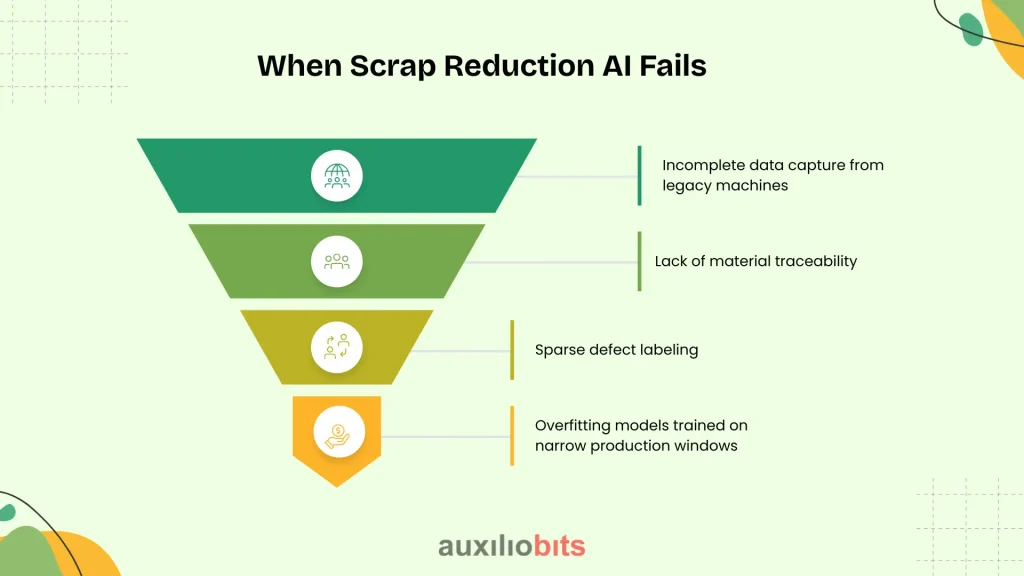
- Incomplete data capture from legacy machines
- Lack of material traceability
- Sparse defect labeling
- Overfitting models trained on narrow production windows
Another trap: treating AI as a replacement for process engineers.
It’s not. It augments them.
The strongest deployments involve collaboration between data scientists and plant engineers who understand physics, tolerances, and operational constraints.
Pattern recognition is powerful. Domain knowledge decides which patterns matter.
Beyond Detection: Prescriptive Adjustments
The real evolution of scrap reduction AI isn’t just identifying root causes—it’s prescribing real-time adjustments.
Imagine:
- Dynamic parameter optimization based on live defect probability scoring
- Automatic alerting when process combinations approach risk thresholds
- Adaptive control loops that adjust variables before defects form
Some advanced facilities are already experimenting with closed-loop quality control systems where AI feeds directly into machine controllers.
That requires confidence. And robust testing. No one wants autonomous systems making incorrect adjustments on critical lines.
Still, the trajectory is clear. Root cause analysis is moving from reactive investigation to proactive prevention.
Building a Sustainable Scrap Reduction AI Program
Organizations that sustain gains typically focus on:
- Continuous model retraining as new data accumulates
- Embedding AI outputs into daily production meetings
- Standardizing corrective action workflows
- Linking defect patterns to cost-of-poor-quality metrics
One overlooked tactic: quantify scrap cost in real financial language. When AI reduces scrap from 5% to 3%, it’s not a “2% improvement”. It’s millions in recovered margins.
Financial framing secures executive buy-in.
And without executive buy-in, these programs stall.
Why This Is Becoming Strategic, Not Optional
Global supply chains are tighter. Tolerance expectations are stricter. Customers demand traceability. Regulatory scrutiny is increasing in many sectors.
Scrap isn’t just cost. It’s a risk.
AI-driven root cause analysis provides:
- Faster containment of emerging defects
- Evidence-backed corrective actions
- Greater production stability
- Competitive differentiation in high-quality markets
And frankly, once competitors adopt it, operating without it becomes a disadvantage.
Manufacturing has always been about control—controlling variation, cost, and throughput. Scrap Reduction AI enhances control in manufacturing processes by identifying issues and inefficiencies that humans may overlook due to the complexity of the systems involved.
Not because humans are incapable. Because complexity has grown beyond intuitive reasoning.
A Final Thought
Some leaders hesitate. They worry about over-reliance on algorithms. That’s fair.
But consider this: scrap and rework are already controlled by patterns—physical, material, behavioral patterns. We simply don’t perceive all of them unaided.
AI doesn’t create new complexity. It reveals existing complexity.
Used thoughtfully, with engineering judgment and disciplined data practices, Scrap Reduction AI turns quality improvement from episodic investigation into continuous learning.
And in environments where margins are thin and tolerances unforgiving, continuous learning isn’t a luxury.
It’s survival.