






Key Takeaways
- Stabilization, not SOP or first shipment is the true milestone of Production Ramp-Up. Revenue becomes predictable only when process capability, yield, and escalation cycles stabilize.
- Ramp-up instability is driven by variation interacting with fragmented systems. Automation reduces decision latency between signal detection and corrective action.
- Time-to-stability is a competitive lever. Compressing ramp convergence by even a few weeks can significantly reduce scrap, freight premiums, and engineering overload.
- Smart automation focuses on control loops, not dashboards. Version synchronization, parameter drift detection, and structured escalation matter more than flashy analytics.
- Human usability determines success. If ramp automation adds friction or alert fatigue, teams will bypass it—slowing stabilization instead of accelerating it.
There’s a moment in every factory when a new product moves from PowerPoint to the production line. It’s rarely graceful.
The engineering team believes the design is mature. Supply chain insists materials are secured. Operations has allocated line time. Leadership wanted revenue yesterday.
And then the first batch rolls through. Suddenly, scrap rates spike. Cycle times drift. Operators improvise. Quality opens containment. Engineering initiates the tracking of issues in spreadsheets, which quickly grow in number. What was supposed to be a controlled launch becomes a daily triage exercise.
The reality of Production Ramp-Up is often uncomfortable.
The industry has improved at product design and simulation. We can model thermals, stress loads, tolerances, and even supply risk. But the transition from “design intent” to “repeatable production” remains messy. And that’s exactly where Production Ramp-Up Automation matters—not for flashy dashboards, but for faster stabilization.
Stabilization is the real milestone. Not SOP. The first customer shipment is not the real milestone. Stabilization means:
- predictable throughput
- controlled defect rates
- repeatable process capability
- stable takt adherence
- minimal engineering firefighting
Without it, ramp-up drags. With it, margin recovers.
Why Production Ramp-Up Is So Unstable
Ramp-up instability isn’t usually caused by incompetence. It’s caused by complexity interacting with variation.
Three dynamics tend to collide:
1. Process Immaturity
Early builds expose things you don’t see in pilot runs:
- Tool wear behavior under sustained volume
- Minor fixture misalignments magnified at speed
- Operator interpretation differences across shifts
Design may be robust. The process often isn’t.
2. Data Fragmentation
Engineering tracks deviations in PLM. Quality logs defects in QMS. Operations monitors output in MES. Supervisors message issues informally.
No one sees the whole picture in real time.
3. Human-Dependent Escalation
When something goes wrong:
- An operator flags a concern.
- A supervisor checks yesterday’s numbers.
- Engineering reviews drawings.
- Quality evaluates impact.
- A decision happens hours—or days—later.
During ramp-up, hours matter.
Automation doesn’t remove complexity. It reduces the latency between signal and correction. That’s the difference between controlled acceleration and chaos.
Faster Stabilization: What It Means
Stabilization is often misunderstood as “hitting target volume.” That’s only part of it.
True stabilization during production Ramp-Up includes:
- Process capability consistently above threshold (e.g., Cpk > 1.33)
- Defect Pareto narrowing week over week
- Downtime events becoming predictable instead of random
- ECO-driven changes no longer causing downstream disruption
- Operators following defined standard work without improvisation
It’s the moment when daily management replaces crisis management.
Automation, when done properly, compresses the time between initial production and this steady-state condition.
However, this is not achieved by simply adding more dashboards. That’s the lazy approach.
Where Production Ramp-Up Automation Makes a Difference
Automation during ramp-up shouldn’t focus on generic digitization. The ERP already exists. The MES is already deployed. The issue isn’t the absence of systems. It’s the friction between them.
The most effective automation strategies concentrate on four pressure points.
1. Real-Time Deviation Detection (Before Scrap Compounds)
During ramp-up, defect rates don’t just increase—they compound.
A slight torque variation in hour one becomes:
- Rework backlog by hour three
- Missed shipment by day two
- Customer anxiety by week one
Automation helps by:
- Pulling live process parameters from machines
- Comparing them against ramp-specific tolerance windows (not steady-state limits)
- Triggering contextual alerts tied to specific SKUs or build stages
- Auto-assigning investigation tasks to engineering or quality
The nuance here: ramp-up thresholds should be dynamic. Early builds require tighter monitoring and faster escalation. Static SPC limits often react too late.
When automated workflows detect drift at the parameter level—not just final inspection failures—stabilization accelerates dramatically.
2. Engineering Change Propagation Without Lag
New products rarely stay frozen during ramp-up. Engineering updates are common.
A drawing revision changes. A BOM component swaps. A routing step adjusts.
Without automation, change propagation becomes dangerous.
Someone updates PLM. Operations prints old work instructions. The procurement releases the prior material version.
You end up building yesterday’s configuration.Automated change synchronization can:
- Validate version alignment across PLM, ERP, and MES
- Flag mismatched BOM releases before production orders launch
- Push updated digital work instructions directly to operator stations
- Lock outdated routings from execution
It sounds obvious. Yet many plants rely on email notifications and manual confirmations.
The result? Version confusion causes stabilisation delays,not technical limitations.
3. Early-Phase Root Cause Acceleration
Ramp-up failures are different from steady-state failures. They’re often multi-factorial.
Example: In an electronics assembly ramp, yield instability wasn’t a solder profile issue alone. It was:
- New supplier laminate thickness variation
- Slight stencil misalignment
- Operator unfamiliarity with inspection criteria
No single dashboard showed that relationship.
Automation can accelerate root cause discovery by:
- Aggregating process data, inspection data, and supplier batch traceability
- Correlating defect clusters with upstream parameter shifts
- Identifying pattern anomalies across shifts or lines
- Ranking probable contributors instead of dumping raw data
It doesn’t eliminate engineering judgment. It sharpens it.
When investigations shrink from five days to one, ramp stabilization moves weeks earlier.
4. Automated Ramp Metrics (Not Just Volume Tracking)
Leadership often tracks:
- Daily output
- On-time delivery
- Scrap rate
Useful, yes. Sufficient? Not really.
Ramp-up automation should monitor stabilization indicators such as:
- First-pass yield trend acceleration
- Repeat defect recurrence frequency
- Engineering deviation closure time
- Change implementation cycle time
- Process capability variance slope
These metrics reveal whether the system is converging toward stability—or oscillating.
Oscillation is common. Teams fix one issue, inadvertently trigger another, and spend cycles reacting.
Automated analytics that visualize convergence patterns provide a clearer trajectory view. You see whether you’re stabilizing or merely firefighting more efficiently.
Also read: Warehouse Automation Beyond Robotics
What Fails in Production Ramp-Up Automation
Not all automation improves stabilization. Some efforts backfire.
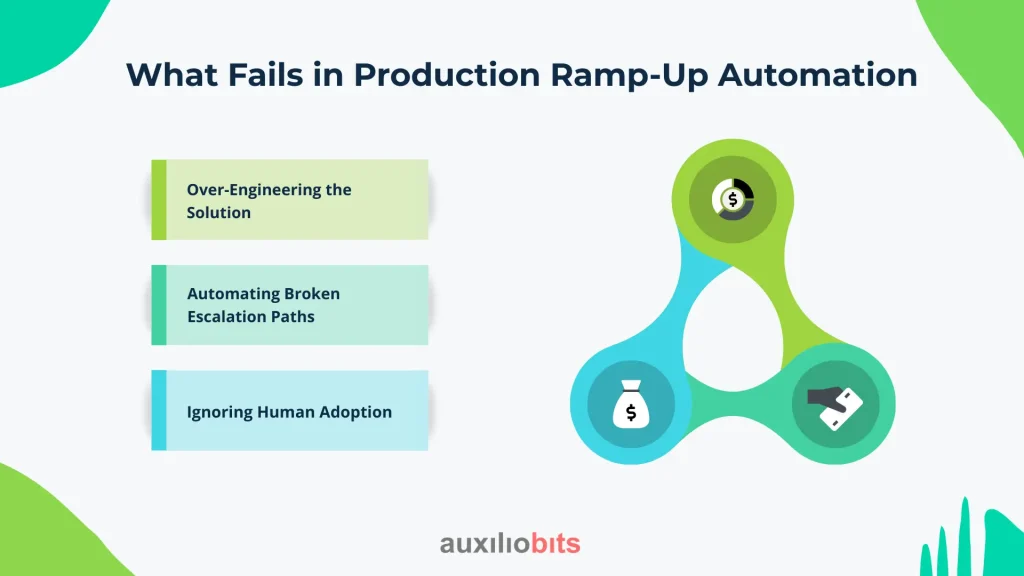
Over-Engineering the Solution
Massive AI deployments during early ramp often overwhelm teams. Operators need clarity, not complexity. Start with workflow automation and structured data integrity. Advanced models can follow once baseline visibility exists.
Automating Broken Escalation Paths
If engineering reviews deviations only once per week, automating ticket creation won’t help. It will simply create more digital backlog. Escalation response time must align with automation speed.
Ignoring Human Adoption
Operators on the ramp are already under pressure. If systems:
- Add extra data entry
- Trigger excessive false alerts
- Interrupt normal workflow
They’ll bypass them. Stabilization depends as much on usability as technical capability.
The Real Impact: Time-to-Stability as a Strategic Lever
Companies obsess over time-to-market. Fewer measure time-to-stability.
Yet profitability doesn’t meaningfully improve until processes stabilize.
Consider a simplified scenario:
- Product launches at 60% target yield
- Weekly yield improvement of 5% without structured automation
- Stabilization (95% yield) achieved in 7 weeks
Now compare with automated deviation control and change synchronization:
- Weekly yield improvement of 10%
- Stabilization in 4 weeks
That three-week difference can represent:
- Millions in avoided scrap
- Reduced premium freight
- Fewer customer escalations
- Less engineering overtime
More importantly, engineering resources can shift to the next program instead of lingering in reactive mode.
Production Ramp-Up isn’t just operational—it’s strategic bandwidth management.
Field Example: Automotive Component Launch
In one automotive program, a supplier ramping a new braking subassembly faced recurring dimensional variation during the first month.
Symptoms:
- 12% scrap in early lots
- Frequent containment
- Operator adjustments undocumented
Automation intervention focused narrowly on stabilization:
- Machine parameter drift auto-logged and linked to serial numbers
- Operator adjustments digitally captured instead of handwritten
- Automated correlation between parameter shifts and final inspection results
- Escalation tasks routed instantly to process engineering
Within three weeks:
- Scrap reduced below 4%
- Engineering deviation cycle time cut by 40%
- Daily firefighting meetings reduced from 90 minutes to 30
The technology wasn’t revolutionary. The structured, automated feedback loop was.
Production Ramp-Up in High-Mix Environments
High-mix, low-volume environments complicate stabilization further.
Different SKUs share:
- Tooling
- Operators
- Fixtures
- Limited line time
Ramp-up interference becomes a risk. One unstable product destabilizes others.
Automation helps isolate ramp-specific instability by:
- Segregating performance baselines per SKU
- Auto-adjusting tolerance thresholds by product variant
- Flagging cross-product parameter contamination
- Preventing shared resource drift from cascading
Without this isolation, teams misattribute root causes. I’ve seen stable legacy products blamed for ramp failures simply because reporting lacked granularity.
Practical Areas to Automate During Ramp-Up
If prioritization is required—and it always is—focus on these levers first:
- Automated version control validation across systems
- Parameter drift detection tied to SKU context
- Structured deviation logging with mandatory metadata
- Real-time defect clustering analysis
- Escalation routing with defined SLA tracking
Then expand into:
- Predictive process capability modeling
- Supplier lot impact simulation
- Adaptive ramp thresholds
- AI-assisted root cause ranking
Trying to deploy everything at once rarely works. Ramp-up environments reward incremental control improvements.
When Production Ramp-Up Automation Is Most Critical
Not every launch demands advanced automation. It becomes critical when:
- Product complexity is high (multi-layer assemblies, electronics, precision machining)
- Regulatory traceability requirements are strict
- Customer tolerance for launch instability is low
- Concurrent new product introductions overlap
- Engineering bandwidth is constrained
In these environments, stabilization speed directly affects competitiveness.
Final Thoughts
Anyone who has stood beside a line during week two of a launch understands the tension.
Whiteboards fill with open issues. Engineering notebooks overflow. Supervisors juggle targets and morale.
Ramp-up will always carry stress. It should. You’re compressing uncertainty into production reality.
But uncontrolled ramp-up is optional.
Production Ramp-Up Automation—when focused on faster stabilization rather than flashy digitization—creates structure around uncertainty. It doesn’t promise perfection. It creates convergence.
And in manufacturing, convergence is what turns a launch from survival mode into scalable growth.