







Key Takeaways
- WIP problems are usually constraint visibility problems. Excess inventory builds when shifting bottlenecks aren’t actively monitored and managed.
- Static bottleneck assumptions are dangerous. Constraints move with product mix, staffing, and variability—monitoring must be continuous.
- Automation must enforce behavior, not just display data. Dashboards alone don’t reduce WIP—release controls and policy discipline do.
- Variability drives congestion more than averages. Cycle-time variation, rework, and material delays inflate queues faster than most leaders expect.
- Start simple before adding advanced analytics. Stabilize constraint control first—then layer predictive modeling, AI, or digital twins for optimization.
On a typical Wednesday afternoon, a quiet tension is palpable in almost any manufacturing plant. You’d see pallets waiting between work centers, supervisors anxiously watching a machine about to resume operation, and a whiteboard highlighting yesterday’s production figures with a troubling red circle.
No one calls it chaos. But everyone feels it.
Work-in-progress inventory has a way of creeping up when no one is looking. It builds slowly—one rush order, one changeover delay, one maintenance slip at a time—until the floor is saturated with half-finished goods. And then someone says, “We need better WIP Optimization.”
That’s usually code for, “We’re losing control of constraints.” This isn’t really a WIP problem. It’s a constraint visibility problem.
The Constraint Hides in Plain Sight
Most operations leaders can point to their bottleneck. Or at least, they think they can.
- “It’s always the CNC cell.”
- “Assembly can’t keep up with machining.”
- “Paint is our choke point.”
But constraints move. They shift with product mix, staffing levels, material availability, and even weather (I’ve seen humidity disrupt curing time enough to flip the entire flow dynamic).
The mistake isn’t failing to identify a constraint. The mistake is assuming it’s static.
WIP Optimization, in a serious operational context, means continuously aligning release rates, processing capacity, and flow variability around the current constraint. That requires monitoring. This monitoring must be active rather than passive.
Also read: Mapping Regulatory Requirements into Automation Design
Why WIP Bloats Around Bottlenecks
There’s a pattern most plants follow, even if they don’t articulate it.
- A downstream process slows.
- Upstream keeps running to “stay productive”.
- Inventory accumulates in front of the constraint.
- Lead times stretch.
- Expedites increase.
- WIP grows further to buffer unpredictability.
It’s rational behavior at the local level. But globally? It’s destructive.
Excess WIP masks problems:
- Queues bury quality issues.
- Changeovers appear less urgent.
- Cycle time variability gets normalized.
- Supervisors focus on utilization, not throughput.
And here’s the uncomfortable truth: many ERP systems unintentionally encourage this behavior. They track completions, labor absorption, and planned output—but they rarely enforce real-time constraint discipline.
Automation changes that dynamic—but only if it’s built around constraint monitoring rather than generic dashboards.
Constraint Monitoring: The Real Lever Behind WIP Optimization
Traditional reporting is retrospective. You learn about yesterday’s bottleneck today. By then, the damage has already occurred.
Constraint monitoring, done properly, is live and predictive.
It answers:
- Is the constraint currently overloaded?
- Is starvation likely in the next hour?
- Is variability increasing queue depth beyond safe limits?
- Are we releasing too much upstream?
These aren’t static KPIs. They’re dynamic system signals.
This is where automation proves its worth—not by producing additional reports, but by implementing behavioural guidelines.
What Automation Should Do
There’s a misconception that automation equals robotics or AI vision systems. In many plants, the most powerful automation layer is digital flow control—integrated signals that regulate work release and monitor constraint health.
Effective WIP Optimization systems typically automate:
- Real-time queue monitoring in front of the bottleneck
- Dynamic WIP caps by product family
- Automated upstream throttling when constraint utilization exceeds thresholds
- Alerts triggered by flow imbalance, not just downtime
- Predictive congestion modeling based on cycle-time variance
Notice what’s missing? No fancy language models. No hype. Just disciplined control.
That said, more advanced implementations layer machine learning to forecast constraint saturation based on:
- Order mix
- Historical downtime patterns
- Shift-level productivity
- Material availability variability
When done right, upstream processes slow down before queues explode. That’s the difference between reacting to WIP and controlling it.
Why WIP Optimization Fails in Many Automation Projects
It’s tempting to install monitoring dashboards and assume improvement will follow. It rarely does.
Three recurring failure modes:
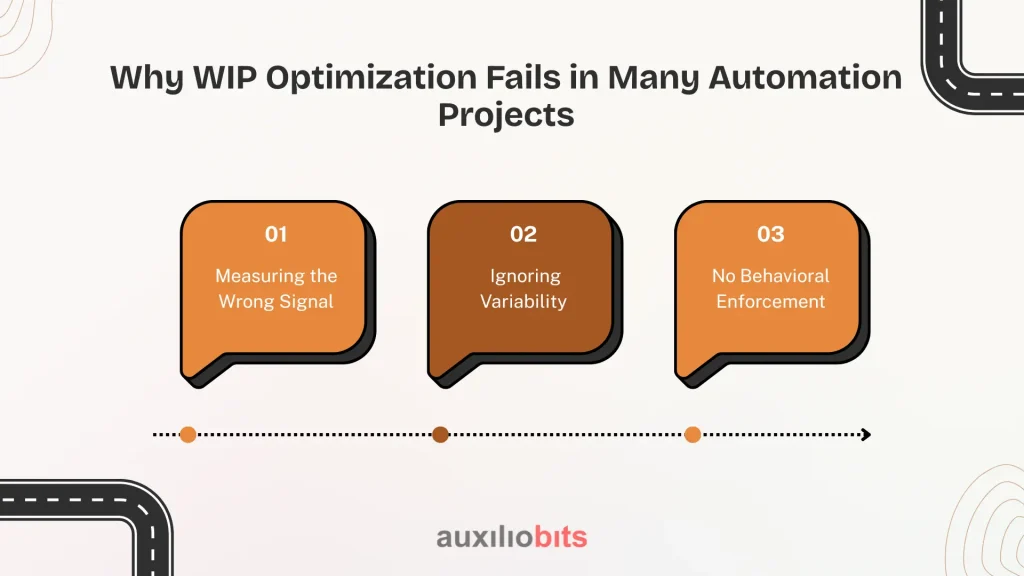
1. Measuring the Wrong Signal
Tracking overall utilization instead of constraint throughput is a common trap. High utilization everywhere doesn’t mean flow is optimized. It often means everything is busy and nothing is finishing on time.
2. Ignoring Variability
Average cycle time is a comforting lie. Variability is what inflates queues. Automation must account for:
- Changeover frequency
- Batch size fluctuation
- Quality rework loops
- Material delays
If constraint monitoring uses static averages, it will underpredict congestion.
3. No Behavioral Enforcement
If supervisors can override “just this once” release caps, the system erodes quickly. WIP Optimization requires policy discipline embedded in workflow systems—not optional compliance.
Automation works when it shapes behavior, not just informs it.
Digital Constraint Control in Practice
In mature operations, constraint monitoring becomes an operational rhythm.
Typical structure:
1. Constraint Dashboard (Live View)
- Queue depth (absolute and relative to target)
- Throughput vs. takt alignment
- Variability index
- Starvation probability
2. Upstream Release Control
- Automated gating logic tied to constraint capacity
- WIP caps by SKU class
- Exception handling for expedite orders
3. Predictive Alerts
- “Queue likely to exceed cap in 90 minutes”
- “Constraint idle risk within next hour”
Some organizations push this further with automated scheduling adjustments triggered by constraint state. Others prefer human-in-the-loop control. There’s no universal answer.
In high-mix, low-volume environments, fully automated throttling can backfire. Experienced planners often outperform rigid logic when product mix is volatile. Context matters.
Subtle Trade-Offs Nobody Talks About
WIP reduction isn’t free.
Lower WIP increases sensitivity to disruption. If the constraint goes down, you don’t have excess buffer to absorb shock. That’s the point—but it can feel risky.
There’s also political resistance. Some managers equate visible activity with productivity. Reducing WIP can make areas look “less busy,” which unnerves leadership unfamiliar with flow principles.
And occasionally, WIP is strategically justified. For example:
- Long supplier lead times
- Batch-process economics
- Regulatory hold periods
WIP Optimization isn’t about eliminating inventory blindly. It’s about aligning it with system constraints intentionally.
Overly enthusiastic automation pitches often overlook this nuance.
When Advanced Analytics Make Sense
Once baseline constraint monitoring is stable, more sophisticated models can unlock additional gains.
Examples include:
- Simulation modeling of flow under demand variability
- Reinforcement learning for dynamic work release
- Digital twins that model constraint sensitivity to shift staffing changes
- Multi-constraint optimization across interconnected lines
But deploying advanced AI before stabilizing basic constraint control is like installing a smart thermostat in a building with broken windows.
Sequence matters.
Integrating WIP Optimization with Enterprise Systems
Automation rarely lives in isolation. For meaningful impact, constraint monitoring must integrate with:
- ERP production orders
- MES execution data
- Maintenance systems
- Labor scheduling platforms
- Quality tracking systems
Integration challenges are real. Data latency, inconsistent timestamps, incomplete routing definitions—these derail elegant models quickly.
A surprising amount of WIP distortion originates from inaccurate master data. If routing times are wrong, constraint detection becomes unreliable.
Indicators of a Constraint Problem
Sometimes WIP looks manageable, but the system is still misaligned.
Watch for:
- Expedited orders consistently bypassing queues
- Frequent schedule reshuffling
- High overtime in non-bottleneck areas
- Repeated firefighting around the same work center
- Excessive buffer stock in specific SKU families
These signals often precede visible WIP explosion.
Automation should flag these patterns early—before inventory physically accumulates.
Constraint Monitoring in Non-Manufacturing Environments
The same logic applies beyond factory floors. In distribution centers, the constraint may be a picking zone. It could be diagnostic imaging in the medical field. In finance operations, the constraint may be underwriting review capacity.
Queues build. Throughput fluctuates. Variability drives congestion.
WIP Optimization in these environments focuses on digital task queues instead of physical pallets. The principles remain intact:
- Identify the true constraint.
- Regulate inflow.
- Monitor variability.
- Enforce caps.
Automation simply changes the medium.
A Practical Roadmap for Implementation
For organizations serious about constraint-driven WIP Optimization, a staged approach works best.

Phase 1: Visibility
- Map actual routing and cycle times.
- Identify shifting constraint patterns.
- Establish live queue tracking.
Phase 2: Policy Design
- Define WIP caps.
- Align release rules with constraint capacity.
- Set escalation thresholds.
Phase 3: Controlled Automation
- Implement automated gating logic.
- Integrate alerts into supervisor workflows.
- Monitor behavioral compliance.
Phase 4: Predictive Enhancement
- Add variability modeling.
- Introduce short-horizon forecasting.
- Simulate demand surges.
Skipping Phase 2 is a common mistake. Technology without policy clarity produces confusion.
Final Thought
Managing WIP isn’t about inventory math. It’s about flow discipline around constraints.
Automation doesn’t magically eliminate bottlenecks. It makes them visible, measurable, and harder to ignore.
In my experience, the plants that succeed aren’t the ones with the most advanced algorithms. They’re the ones that respect the constraint enough to organize the entire system around it.
WIP Optimization becomes less of a project and more of an operating philosophy.
And once that shift happens, the floor feels different. Calmer. More intentional. Not because work disappeared—but because it’s finally moving the way it was meant to.