






Key Takeaways
- Detection without workflow is incomplete. Early defect identification only creates value when containment and escalation are system-enforced.
- Workflow design determines ROI. Digitizing NCR forms isn’t transformation—structured routing, accountability, and integration are.
- Verification closes the loop. Corrective actions must be tied to measurable outcomes, not just task completion.
- Integration prevents defect escape. MES, ERP, and QMS alignment is essential to enforce holds and traceability.
- Quality automation reduces surprises, not just scrap. The real impact is faster response cycles, stronger control, and fewer repeat failures.
Walk any production floor long enough and you’ll notice something: most quality problems aren’t dramatic. They’re repetitive. Small deviations. Slight shifts. A recurring scratch in the same corner of a housing unit is a common occurrence. This type of issue is commonly referred to as “normal”. That’s usually where cost hides.
There have been plants with sophisticated ERP and MES environments still running quality control on spreadsheets and email chains. The inspection might be digital, but the response is manual. And that gap—between detection and disciplined resolution—is where quality automation actually matters.
Not as a buzzword. As an operating model.
Let’s break it down the way it happens in real operations: detection first, then workflow, then resolution. Miss one, and the whole thing degrades into digital paperwork.
Detection: Where Most Organizations Think They’re Strong
Ask a quality manager whether they have inspection covered and you’ll usually get a confident yes. There are gauges. Vision cameras. Sampling plans. SPC charts.But detection isn’t just about finding a defect. It’s about catching instability early enough to change behavior.
Also read: Operationalizing ESG Strategy with Continuous Agent Surveillance
Embedded Inspection vs. End-of-Line Policing
End-of-line inspection is comfortable. It feels controlled. The process involves checking the finished part to determine if it passes or fails.
The issue is timing. If you discover a machining drift after 600 units, containment becomes a logistical problem. Rework, scrap, traceability checks. Suddenly the quality team is chasing serial numbers.
With properly configured quality automation, detection shifts upstream:
- In-process dimensional checks trigger when trend lines shift, not just when limits are breached.
- Vision systems log defect types in structured categories instead of the generic “fail.”
- Machine parameters are automatically correlated with defect occurrences.
In one precision components facility, bore diameter drift was being caught only at final inspection. Scrap levels were creeping up, but not alarmingly. Once they tied automated SPC triggers directly to tool wear thresholds, the system began flagging drift hours earlier. Scrap dropped—not because inspection improved—but because reaction time shortened.
That’s a subtle distinction.
When Detection Overreaches
There’s another side to this. There have been over-automated inspection setups where every micro-variation generates an alert. Operators stop trusting the system.
If your line is producing 1,200 alerts per shift and 1,150 are noise, the remaining 50 won’t get attention either. Quality automation has to respect production reality. Sensitivity needs to be tuned to defect risk, not theoretical perfection.
High-risk aerospace assembly? Tight thresholds. Plastic consumer packaging? Slightly more tolerance.
Context matters.
Workflow: The Part Nobody Designs Properly
Here’s where most automation efforts fall apart. Companies digitize their Non-Conformance Report (NCR) forms and call it transformation. What they’ve actually done is move paper into a portal.
A workflow is not a form. It’s a sequence of enforced actions. When a defect is detected, three things must happen quickly:
- Containment
- Accountability
- Structured analysis
If even one of those depends on someone remembering to send an email, you don’t have automation. You have administrative assistance.
Automated Containment That Holds
Containment sounds simple. Put affected parts on hold.
In practice:
- Inventory systems may still allow shipment release.
- Warehouse teams may not see updated status.
- Parallel systems may not sync in real time.
A batch of non-conforming assemblies gets quarantined in the QMS but remains available in ERP for shipping. The absence of integration between the two systems results in a predictable outcome.
Effective quality automation enforces containment at the system level:
- Lot status is updated instantly across MES and ERP.
- Shipment blocks applied automatically.
- A traceability tree identifies upstream raw materials and downstream assemblies.
This isn’t flashy technology. It’s disciplined integration.
Intelligent Case Routing
Not every defect needs five signatures.
Automation allows routing logic based on:
- Severity score
- Customer impact classification
- Recurrence frequency
- Regulatory exposure
Is there a cosmetic blemish on internal components? Production engineering review.
A recurring solder void in safety circuitry? Escalate to design and supplier quality.
Without structured routing, organizations default to over-escalation. Meetings multiply. Ownership blurs. Resolution slows.
One electronics manufacturer reduced average NCR cycle time by nearly 30% simply by eliminating unnecessary approval layers in their automated workflow. The insight wasn’t technological—it was organizational.
Quality automation forces you to confront bureaucratic inefficiencies.
Root Cause Analysis: Where Discipline Gets Tested
Let’s be honest—root cause documentation is often weak.
- Operator error
- Material variation
- Equipment issue
Those aren’t causes. They’re placeholders.
Structured automation improves this process by requiring:
- Failure mode classification
- Contributing factor tagging
- Equipment ID linkage
- Environmental condition capture
Drop-downs and structured metadata aren’t glamorous, but they create analyzable history.
That said, overly rigid templates can oversimplify complex failures. Some quality issues don’t fit neatly into predefined categories. The system should enforce structure without eliminating technical judgment.
That balance is harder than vendors admit.
Resolution: The Difference Between Closure and Correction
Closing an NCR is easy. Correcting the process isn’t.
Resolution in quality automation should not stop at task completion. It should validate the outcome.
Corrective Action with Verification
After identifying root cause:
- Assign corrective tasks with deadlines.
- Tie actions to measurable indicators.
- Monitor defect rate post-implementation.
- Reopen automatically if recurrence crosses threshold.
Feedback into Broader Systems
Mature Quality Automation feeds insights upstream:
- Recurrent supplier defects adjust supplier scorecards.
- Tool wear patterns inform preventive maintenance schedules.
- Design tolerances were flagged for engineering review after repeated drift cases.
In one molded plastics operation, increasing flash defects were traced to gradual mold wear. Instead of waiting for catastrophic failure, defect frequency data began triggering preventive mold servicing earlier. Maintenance scheduling improved—not because maintenance changed—but because quality data became predictive input.
That’s resolution turning into prevention.
Where It Delivers Tangible Impact
Let’s avoid inflated ROI claims. Realistic impact usually shows up in:
- Faster containment of defective lots
- Shorter investigation cycles
- Reduced audit preparation time
- Improved traceability confidence
- Fewer repeat failures
What’s harder to quantify—but noticeable—is cultural shift.
When data flows automatically and transparently, arguments reduce. Production sees trends earlier. Engineering has structured evidence. Leadership gets leading indicators instead of quarterly summaries.
Quality discussions become less emotional and more analytical.
A Regulated Environment Example
Consider a medical device manufacturer managing strict documentation requirements.
Before automation:
- NCRs moved through email threads.
- Risk classification depended on manual interpretation.
- CAPA effectiveness reviews were periodic, not data-driven.
After implementing structured quality automation:
- Detection events triggered risk scoring automatically.
- Review panels were assigned based on classification rules.
- CAPA validation is linked directly to real-time defect metrics.
Unexpected friction came from management layers accustomed to discretionary escalation control. Automation removed ambiguity. It also removed gatekeeping.
Not every resistance is technical.
Why Automation Sometimes Underperforms
Quality automation struggles when:
- Process definitions are vague.
- Defect taxonomy is inconsistent.
- Leadership tolerates recurring “temporary fixes”.
- Data integrity at the source is unreliable.
If inspection results are inaccurate, automation only accelerates error propagation.
There’s also the human factor. If operators perceive automated detection as surveillance rather than support, workarounds emerge quickly.
Successful programs position automation as a stability mechanism—not a policing tool.
Practical Design Principles
From experience, sustainable implementations share certain traits:
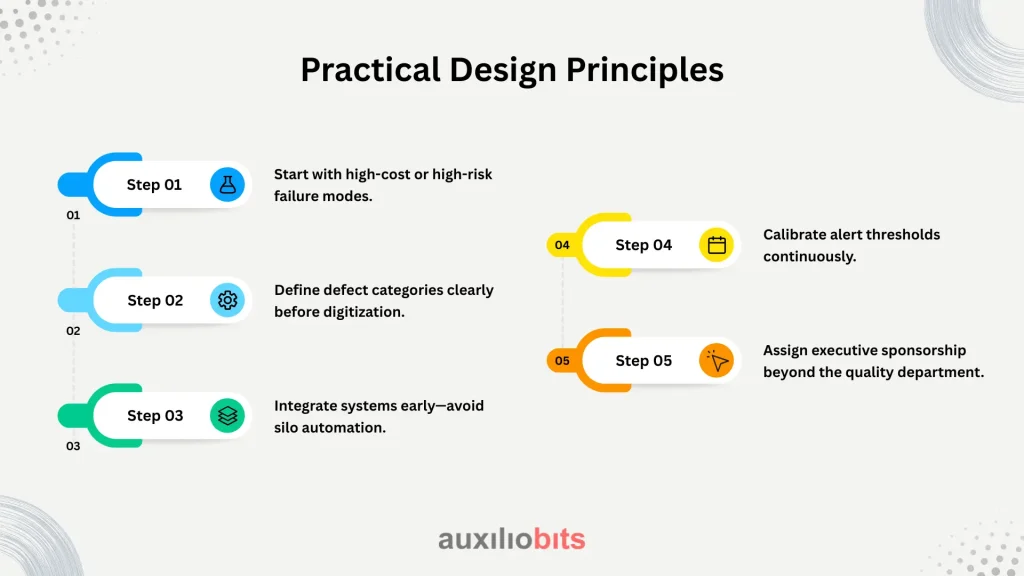
- Start with high-cost or high-risk failure modes.
- Define defect categories clearly before digitization.
- Integrate systems early—avoid silo automation.
- Calibrate alert thresholds continuously.
- Assign executive sponsorship beyond the quality department.
Trying to automate everything at once usually backfires. Focus builds credibility.
The Larger Operational Shift
When detection, workflow, and resolution operate as a connected loop, quality becomes proactive rather than reactive.
Over time, something interesting happens: Inspection frequency may decrease.
Why? Because process variation declines. Automated feedback stabilizes operations upstream.
The goal isn’t more alerts. It’s fewer surprises.
A Final Perspective
Quality automation isn’t about replacing inspectors with algorithms. It’s about eliminating lag between signal and action.
Detection must be early. Workflow must be enforced. Resolution must be validated.
When those three elements connect tightly, recurring defects decline—not because people work harder, but because systems respond faster.
And in competitive manufacturing environments, response speed often determines profitability more than defect rate alone.
If there’s one misconception, it’s this: companies invest heavily in detection technology but neglect workflow design. That imbalance limits impact.
Automation only works when the entire loop is engineered—end to end.
Otherwise, it’s just a faster way to document problems you already had.