






Key Takeaways
- Static scheduling fails because factory constraints change constantly. Agentic AI enables production scheduling automation to adapt continuously instead of relying on fixed optimization cycles.
- Constraint-aware scheduling improves real-world execution, not just theoretical efficiency. By dynamically managing machine, material, and labor constraints, manufacturers achieve more stable and feasible production plans.
- Agentic AI reduces planner firefighting by autonomously adjusting schedules. This allows planners to focus on strategic decisions instead of constantly fixing disruptions.
- Throughput and delivery performance improve without adding new equipment. Intelligent sequencing, changeover management, and real-time rescheduling unlock hidden production capacity.
- The real value of agentic AI is operational stability. It ensures production continues smoothly despite disruptions, which is ultimately more valuable than generating a theoretically optimal but fragile schedule.
Production scheduling automation has always lived in an uncomfortable middle ground between theory and reality. On paper, it’s a math problem. In practice, it’s a negotiation between machines, materials, labor, and uncertainty—none of which behave as cleanly as models assume.
Most manufacturers already have scheduling tools. ERP systems generate planned orders. APS (Advanced Planning and Scheduling) platforms optimize sequences. Excel sheets—despite decades of digitization—still quietly orchestrate daily execution in many plants.
And yet, schedules break. Constantly.
A material arrives late. A critical machine goes down. A high-priority customer order jumps the queue. Suddenly, the carefully optimized plan from last night becomes irrelevant by 9:30 AM.
What’s missing isn’t optimization. It’s adaptability.
Agentic AI introduces something fundamentally different: constraint-aware, continuously adaptive scheduling that behaves less like a static calculator and more like an experienced production planner who never sleeps.
Also read: Harnessing Agentic AI for Decentralized Digital Transformation
Why Traditional Production Scheduling Automation Struggles with Reality
Scheduling problems are deceptively complex. Even moderately sized plants deal with millions—sometimes billions—of possible scheduling permutations.
Constraints pile up quickly:
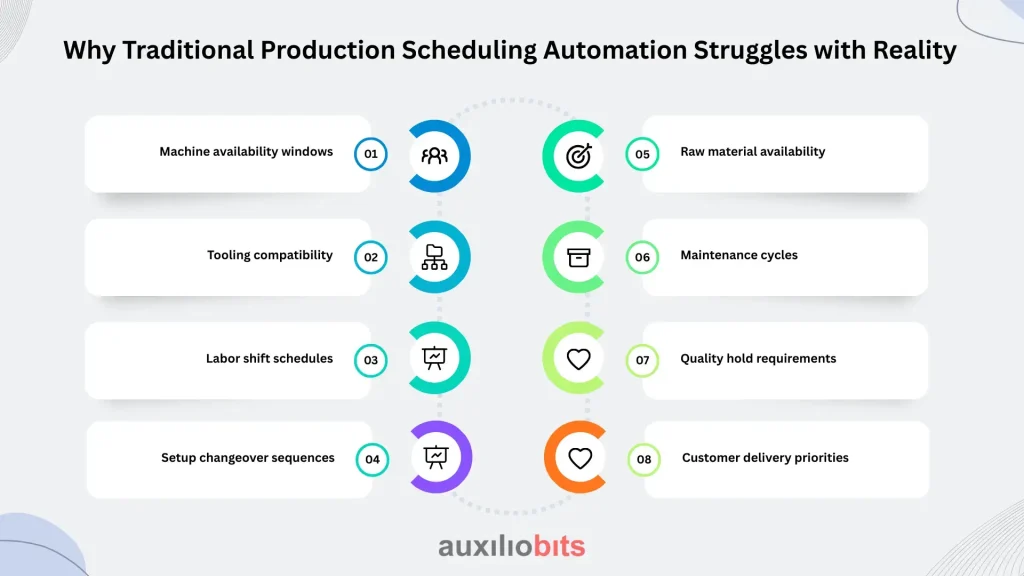
- Machine availability windows
- Tooling compatibility
- Labor shift schedules
- Setup changeover sequences
- Raw material availability
- Maintenance cycles
- Quality hold requirements
- Customer delivery priorities
The more constraints you add, the more fragile the schedule becomes. Traditional production scheduling automation systems handle constraints using optimization algorithms. These systems generate the “best possible plan” given available data at a point.
But here’s the flaw: they assume stability. Production environments are anything but stable.
A Tier-1 automotive supplier I worked with had invested heavily in APS software. The system generated optimal schedules overnight. Theoretically impressive.
In practice? Planners manually adjusted 40–60% of the schedule every day. This was not due to errors in the software. The world had undergone significant changes since midnight.
The Hidden Complexity of Constraint-Aware Scheduling
Constraint-aware scheduling isn’t just about identifying constraints. It’s about managing trade-offs between competing constraints.
Consider a simple scenario: A high-priority order needs Machine A.
Machine A is technically available.
But:
- Tooling required for the order is currently installed on Machine B
- Switching tooling will require 4 hours of changeover
- Machine B is already running another urgent order
- Material for that urgent order expires if not processed within 24 hours
Which constraint matters more?
Traditional systems struggle because they optimize against static priorities. Human planners resolve these conflicts through judgment, experience, and intuition.
They ask questions algorithms don’t naturally consider:
- Will delaying this order damage customer relationships?
- Is the changeover worth the lost capacity?
- Can we rearrange downstream processes to compensate?
This is where agentic AI becomes transformative.
What Makes Agentic AI Different in Production Scheduling Automation
Agentic AI doesn’t just generate schedules. It actively manages them. It continuously evaluates constraints, monitors changes, and takes action to maintain feasible execution.
Instead of static optimization, it operates as a dynamic scheduling agent.
Its capabilities include:
- Monitoring machine telemetry for availability changes
- Tracking material flow in real time
- Evaluating constraint violations as they emerge
- Simulating alternative scheduling scenarios continuously
- Adjusting schedules autonomously when conditions shift
- Escalating only genuinely ambiguous decisions to human planners
This fundamentally changes how production scheduling automation operates. The system doesn’t assume stability. It assumes disruption. And that assumption turns out to be correct most of the time.
Constraint Awareness: The Core of Autonomous Scheduling
Constraint-aware scheduling requires deep operational visibility. Without accurate constraints, automation makes incorrect decisions faster—which is worse than manual scheduling.
Agentic AI continuously builds and updates a live constraint model of the factory.
This model includes:
Hard Constraints:
- Machine capacity limits
- Tool compatibility
- Physical process dependencies
- Safety restrictions
- Material availability
Soft Constraints:
- Preferred sequencing rules
- Efficiency targets
- Labor balancing goals
- Customer priority tiers
- Energy optimization objectives
The distinction matters. Traditional systems often treat soft constraints too rigidly, resulting in suboptimal execution.
Agentic systems understand nuance. Sometimes violating a soft constraint improves overall throughput. Sometimes it doesn’t.
Experienced planners intuitively understand this. Agentic AI learns it from operational history.
Real-Time Adaptation: The Missing Layer in Traditional Scheduling
A real production schedule has a half-life measured in hours.
What happens when disruption occurs?
Traditional workflow:
- Disruption detected manually
- The planner investigates the impact.
- The planner evaluates alternatives
- Planner updates schedule
- The planner communicates changes
This process may take 30 minutes—or several hours. During that time, machines may sit idle. Downstream operations become misaligned.
Agentic production scheduling automation compresses this timeline dramatically.
It performs these steps automatically:
- Detect constraint violation immediately
- Simulate multiple rescheduling options
- Evaluate impact on throughput, delivery, and utilization
- Implement optimal adjustment
- Notify stakeholders
This happens continuously. It happens multiple times per day.
Practical Example: Electronics Manufacturer with High Product Variability
An electronics contract manufacturer producing industrial control boards faced severe scheduling volatility.
The challenges were familiar:
- High product mix variability
- Frequent engineering change orders
- Component availability fluctuations
- Shared SMT lines with different tooling requirements
Their existing scheduling system produced theoretically optimal plans. But planners spent most of their day firefighting.
Agentic AI transformed scheduling execution by introducing continuous constraint evaluation.
Key operational changes included:
- Automatic schedule adjustment when components failed incoming inspection
- Tool-aware sequencing optimization to reduce changeover frequency
- Dynamic reprioritization based on downstream assembly readiness
- Real-time machine availability integration from MES systems
Results observed over six months:
- 23% reduction in line idle time
- 18% increase in schedule adherence
- 32% reduction in planner intervention workload
- Significant improvement in on-time delivery consistency
The most telling change wasn’t efficiency. It was stability. Schedules stopped collapsing multiple times per day.
How Agentic Systems Handle Changeovers More Intelligently
Changeovers are often the largest hidden constraint in production environments.
Traditional scheduling systems minimize changeovers based on predefined optimization logic.
Agentic systems go further. They consider operational context dynamically.
For example:
- Should the system group similar orders together to minimize changeovers?
- Or prioritize urgent orders even if it increases setup frequency?
- Should it delay a changeover if downstream processes are currently congested?
These decisions depend on real-time operational conditions—not static optimization rules. Agentic production scheduling automation continuously evaluates these tradeoffs. Sometimes it intentionally increases changeovers to protect delivery commitments.
Sometimes it delays urgent orders to improve overall throughput.
This kind of contextual decision-making historically required experienced planners.
Now it can operate autonomously.
Integration with Existing Manufacturing Systems
Agentic AI doesn’t replace ERP or MES platforms. It orchestrates around them.
ERP systems provide order demand and planning context. MES systems provide real-time execution visibility. IoT systems provide machine state information.
Agentic scheduling systems consume these signals and manage execution decisions.
Typical integration points include:
- ERP planned orders and demand forecasts
- MES machine status and job completion events
- Maintenance system schedules
- Inventory and material availability systems
- Quality inspection systems
The AI agent acts as an orchestration layer across these systems. This architecture avoids replacing core manufacturing infrastructure. Instead, it enhances coordination across systems that already exist.