






Key Takeaways
- Static forecasts are fragile. Volatile markets demand continuous scenario simulation, not single-number projections.
- Scenario simulation shifts planning from prediction to preparedness. The goal isn’t accuracy—it’s optionality.
- Capacity planning automation reduces reaction time. Systems that rebalance resources automatically outperform manual review cycles.
- Bottlenecks matter more than averages. AI models that simulate constraint behavior deliver stronger operational results.
- Resilience beats optimization. In volatile markets, adaptive capacity planning consistently outperforms perfectly optimized but rigid plans.
Capacity planning used to be a calendar exercise. Forecast demand, map it against available production or operational capacity, identify gaps, and adjust. Most organizations still follow some version of this logic—even those running modern ERP systems. The difference is that the assumptions behind those plans are no longer stable enough to survive contact with reality.
Volatility isn’t episodic anymore. It’s structural.
Supplier delays, sudden demand spikes, geopolitical disruptions, and commodity price swings are no longer isolated events. They’re routine operating conditions. The uncomfortable truth is this: static forecasts fail not because the math is wrong, but because the world refuses to stay still long enough for the math to matter.
This is where AI-driven capacity planning changes the conversation. Instead of perfectly predicting the future, which is still impossible, AI-driven capacity planning simulates multiple plausible futures and continuously adjusts capacity decisions in response.
The shift toward scenario simulation isn’t incremental. It fundamentally redefines how planning works.
And it’s the foundation of what serious organizations now call capacity planning automation.
Also read: Warehouse Automation Beyond Robotics
Why Traditional Capacity Planning Breaks Under Volatility
Most planning systems assume one future. In rare cases, an organization may consider two potential futures if it is exceptionally disciplined. Best case. Worst case.
Reality tends to land somewhere inconveniently in between—or outside both.
The issue isn’t tools. Even companies using sophisticated platforms like SAP or Oracle still struggle. These systems are excellent at recording capacity, tracking utilization, and managing execution. But they weren’t designed to continuously simulate alternative futures.
They assume input stability.
Which doesn’t exist anymore.
Common failure patterns show up repeatedly:
- Production plans optimized for average demand collapse under sudden spikes
- Staffing models fail when absenteeism rises unexpectedly
- Logistics capacity becomes insufficient when transit times fluctuate
- Inventory buffers calibrated for historical variance become irrelevant
The deeper problem is structural: traditional planning answers the question, “What should we do?”
AI-driven planning answers a different question entirely:
“What should we do under each possible future—and how quickly can we switch?”
That difference matters more than most executives realize.
Scenario Simulation: The Missing Layer in Planning Systems
Scenario simulation isn’t new. Operations research teams have used it for decades.
What’s new is the ability to simulate continuously, at scale, and in real time.
Instead of running quarterly simulations manually, AI systems now evaluate hundreds or thousands of scenarios automatically:
- Supplier delay by 2 days vs 7 days vs 21 days
- Demand increase of 10% vs 40% vs 80%
- Workforce reduction due to absenteeism or turnover
- Machine downtime patterns across production lines
- Transportation constraints or routing disruptions
This isn’t academic modeling. It directly influences operational decisions.
For example, instead of asking:
“How much capacity do we need next quarter?”
Organizations now ask:
- If demand increases 35%, which facilities become bottlenecks?
- What happens if supplier lead time doubles?
- How much overtime or alternate sourcing would offset the disruption?
- When should production shift between facilities?
Scenario simulation transforms planning into an adaptive process instead of a fixed commitment.
It replaces certainty with preparedness.
That’s a healthier operating model.
How AI Changes Capacity Planning from Static to Adaptive
Traditional planning models rely heavily on averages. The models heavily rely on averages, such as average demand, average lead time, and average utilization.
But averages are often misleading.
AI systems operate differently. They model distributions, not averages.
This technique enables several important capabilities:
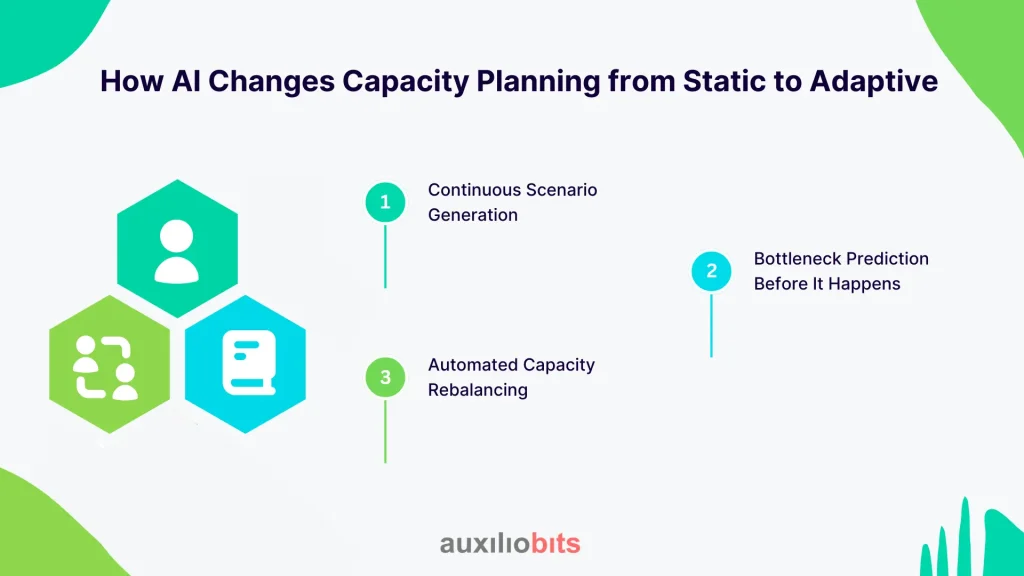
1. Continuous Scenario Generation
AI models generate scenarios automatically based on real operational signals:
- Changes in order patterns
- Supplier performance deterioration
- Market demand signals
- Operational constraints emerging in production systems
No human planner could realistically track all of these simultaneously.
2. Bottleneck Prediction Before It Happens
This is where scenario simulation becomes practical, not theoretical.
Instead of identifying bottlenecks after capacity utilization exceeds thresholds, AI predicts when bottlenecks will emerge under different scenarios.
Example signals include:
- Increasing queue time at production workstations
- Gradual rise in cycle times
- Capacity utilization trending toward saturation
The system identifies future constraints before they disrupt operations.
Not afterwards.
That distinction saves money—and credibility.
3. Automated Capacity Rebalancing
This is the core of capacity planning automation.
The system can recommend or execute adjustments such as:
- Production redistribution across facilities
- Workforce scheduling adjustments
- Inventory pre-positioning
- Supplier allocation changes
These aren’t static rules. They adapt dynamically.
Real-World Case: Semiconductor Capacity Planning During Shortages
The semiconductor shortage between 2020 and 2023 exposed weaknesses in global capacity planning.
Production capacity wasn’t the only constraint for companies like Intel and TSMC; planning visibility also played a significant role.
Demand signals shifted unpredictably:
- Automotive demand collapsed early in the pandemic
- Consumer electronics demand surged unexpectedly
- Automotive demand then returned rapidly
This created conflicting capacity requirements.
Traditional planning models couldn’t adjust fast enough.
Organizations that implemented scenario-based capacity planning did several things differently:
- Simulated multiple demand recovery curves simultaneously
- Modeled wafer production allocation across product categories
- Evaluated alternate sourcing and fabrication options
- Adjusted capacity allocation dynamically
They weren’t predicting exactly what would happen. They were preparing for what could happen.
That subtle difference allowed faster recovery.
Types of Scenarios That Actually Matter in Operations
Not all scenarios are equally valuable.
Some look impressive in presentations but offer little operational value.
The most useful scenario simulations focus on constraints—not just demand.
Key scenario categories include:
1. Supply-Side Disruptions
- Supplier lead time variability
- Material shortages
- Logistics delays
- Supplier capacity constraints
These often cause more damage than demand volatility.
2. Internal Capacity Constraints
Production bottlenecks emerge from multiple factors:
- Machine downtime
- Maintenance delays
- Workforce availability
- Skill-specific labor shortages
Even small disruptions can cascade.
3. Demand Volatility
Demand scenarios must include:
- Gradual demand increases
- Sudden spikes
- Regional demand shifts
- Product mix changes
Product mix changes are particularly dangerous because they affect capacity differently.
Not all products consume equal capacity.
4. Operational Policy Changes
Seemingly minor policy changes have a disproportionate impact:
- Reduced overtime availability
- Labor regulation changes
- Inventory policy adjustments
Scenario simulation reveals second-order effects that planners often miss.
The Architecture Behind AI-Driven Capacity Planning Automation
AI-driven planning systems require integration across multiple operational layers.
This isn’t just a forecasting model sitting in isolation.
Key architectural components include:
1. Data Integration Layer
Combines signals from multiple systems:
- ERP systems like Microsoft Dynamics or SAP
- Manufacturing execution systems
- Supply chain platforms
- Workforce management tools
Without integrated data, simulation accuracy collapses.
2. Simulation Engine
This is where scenario modeling happens.
The engine evaluates:
- Capacity utilization trajectories
- Constraint propagation across operations
- Impact of disruptions under different conditions
It’s computationally intensive—but necessary.
3. Decision Layer
Outputs actionable recommendations such as:
- Capacity adjustments
- Scheduling changes
- Resource allocation decisions
The system doesn’t just simulate—it influences operations.
4. Automation Layer
This enables capacity planning automation.
It can execute changes automatically:
- Workforce scheduling updates
- Production routing adjustments
- Inventory allocation changes
Human approval may still be required—but increasingly, systems operate autonomously within defined limits.
Where Scenario Simulation Fails—and Why
Scenario simulation is powerful. But it’s not magic.
Several common failure modes exist.
Poor Data Quality
Simulation accuracy depends entirely on input quality. If lead time data is outdated or inaccurate, simulation outputs become unreliable.
Overconfidence in Predictions
Some organizations assume simulation outputs are definitive predictions. They’re not. Simulation provides probability-informed guidance—not certainty. Misinterpreting simulation results can lead to poor decisions.
Ignoring Behavioral Factors
Operational systems include human behavior. Workers respond to pressure, incentives, and fatigue. Simulation models often underestimate this variability. This elucidates why even the most well-thought-out plans can occasionally falter during execution.
Excessive Model Complexity
Ironically, overly complex simulation models can reduce effectiveness. They become difficult to interpret and maintain. Simple, well-maintained models often outperform complex, poorly understood ones. Such behaviour isn’t always intuitive.
Capacity Planning Automation in Supply Chain, Manufacturing, and Services
Capacity planning automation applies beyond manufacturing. Different industries benefit in different ways.
1. Manufacturing
Automated planning enables:
- Production capacity rebalancing across plants
- Bottleneck prevention through proactive scheduling
- Improved equipment utilization
Companies like Toyota have long emphasized adaptive capacity management—even before AI. Modern systems simply make it scalable.
2. Supply Chain and Logistics
Simulation helps optimize:
- Warehouse capacity allocation
- Transportation resource planning
- Inventory positioning
Organizations like Amazon rely heavily on continuous capacity modeling to manage fulfillment operations. Without simulation, scaling fulfillment capacity would be chaotic.
3. Service Operations
Service industries face capacity challenges too:
- Call center staffing
- Healthcare resource allocation
- IT infrastructure scaling
Simulation prevents both understaffing and overstaffing. Both are expensive.
The Role of Autonomous Decision Systems in Continuous Planning
Capacity planning automation becomes significantly more powerful when combined with autonomous decision systems.
Instead of generating reports, systems actively adjust operations.
Examples include:
- Automatically redistributing production when utilization crosses thresholds
- Adjusting staffing schedules dynamically
- Allocating inventory based on predicted regional demand
This reduces reliance on manual intervention. Which is necessary. Humans cannot continuously monitor complex systems at scale. Autonomous planning systems function more like operational copilots than traditional tools. They assist, recommend, and increasingly execute.
Why Most Organizations Are Still Planning Blind
Despite clear benefits, many organizations still rely on static planning models.
Several reasons explain this:
- Organizational inertia. Planning processes often remain unchanged for years.
- Data fragmentation occurs across multiple systems.
- Resistance to automated decision-making.
- There is a misconception that forecasting accuracy alone can solve planning problems.
It doesn’t. Forecasting accuracy helps—but without scenario simulation, planning remains fragile. Some organizations believe volatility will decrease. It probably won’t. Volatility is now a structural characteristic of modern supply chains and markets. This implies that planning systems need to adjust accordingly.
The Strategic Impact of Scenario-Driven Capacity Planning
The most significant benefit of AI-driven planning isn’t efficiency.
It’s resilience. Organizations using scenario-based capacity planning respond faster to disruptions. They avoid cascading failures. They maintain operational continuity under stress.
Not perfectly—but better. And that difference matters. Capacity planning automation allows organizations to shift from reactive crisis management to proactive operational adaptation. That’s the real transformation.
Not smarter forecasts. Smarter preparation. The future is unpredictable.
But it is simulatable.