







Key Takeaways
- Multi-ERP environments aren’t the problem—manual coordination between SAP, WMS, and TMS is. Automation removes human dependency from routine system synchronization.
- Integration moves data, but orchestration moves processes forward. Without orchestration, deliveries, shipments, and inventory updates stall even when systems are technically connected.
- SAP WMS automation ensures financial, warehouse, and transportation systems stay aligned continuously. This prevents inventory mismatches, shipment delays, and billing inconsistencies.
- The highest-value automation opportunities are operational, not strategic. Automating delivery releases, goods issue posting, and shipment triggers delivers faster ROI than large-scale system replacement.
- Operational stability—not technology modernization—is the real outcome. When orchestration works, supply chains scale smoothly without adding coordination overhead or operational friction
upply chains rarely run on a single ERP. That’s the uncomfortable truth most transformation decks conveniently ignore.
A manufacturer acquires a regional distributor — now there’s another ERP. A logistics division implements a top-tier warehouse platform due to the ERP warehouse module’s inability to keep pace. Transportation teams implement a TMS to control freight costs. Suddenly, you have SAP managing financial truth, a WMS controlling physical movement, and a TMS orchestrating logistics execution.
Each system works well. Together, they often don’t.
Multi-ERP supply chain automation isn’t about replacing systems. It’s about orchestrating them — ensuring material movement, order execution, and logistics decisions flow without human coordination acting as glue.
And that’s where SAP WMS automation becomes less about automating tasks and more about automating decisions across systems.
Why Multi-ERP Supply Chains Exist
Most enterprises don’t choose multi-ERP environments intentionally. They inherit them.
Common scenarios include:
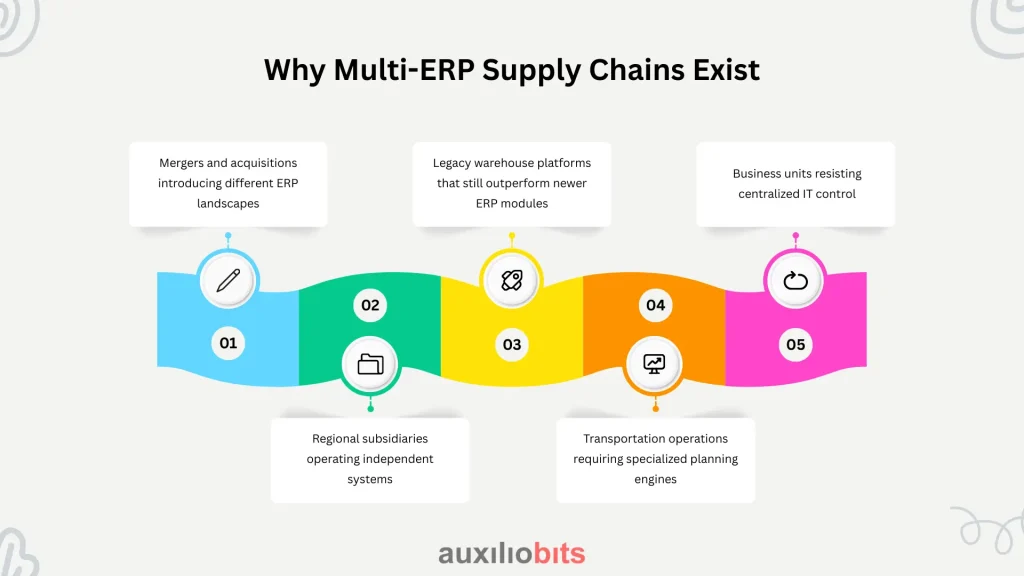
- Mergers and acquisitions introducing different ERP landscapes
- Regional subsidiaries operating independent systems
- Legacy warehouse platforms that still outperform newer ERP modules
- Transportation operations requiring specialized planning engines
- Business units resisting centralized IT control
Even organizations standardized on SAP often operate alongside external warehouse or logistics systems like Manhattan Associates, Blue Yonder, or legacy ERP instances from Oracle.
The result isn’t fragmentation by accident. It’s fragmentation driven by operational necessity.
The problem isn’t multiple systems. The issue lies in the need for manual coordination among these systems.
Also read: Supply Chain Visibility: Why Dashboards Are Not Enough
Where Multi-ERP Supply Chains Break
From the outside, integration appears to exist. Orders flow. Inventory updates. Shipments close.
But operational reality tells a different story.
Hidden coordination work happens everywhere:
- Warehouse teams manually releasing blocked deliveries
- Transportation planners re-keying shipment details
- Inventory controllers resolving mismatches between SAP and WMS
- Customer service confirming shipment status across multiple systems
The systems are technically connected. Operationally, humans still orchestrate them.
This becomes painfully visible in SAP + WMS + TMS environments.
Consider this real scenario:
Order execution example
- Sales order created in SAP
- Delivery generated
- Delivery transferred to WMS
- Warehouse completes picking
- Shipment created in TMS
- Goods issue posted in SAP
That’s the intended flow.
What actually happens?
- Warehouse finishes picking, but SAP delivery isn’t updated
- TMS cannot plan shipment due to missing confirmation
- Logistics coordinator manually checks WMS
- Updates SAP manually
- Shipment planning resumes
The process didn’t fail technically. It failed operationally.
Understanding SAP + WMS + TMS Roles (And Why Coordination Matters)
Each system controls a different layer of reality.
SAP ERP
Controls financial truth and transactional integrity.
- Sales orders
- Deliveries
- Goods issue postings
- Inventory valuation
- Billing
WMS
Controls physical truth.
- Picking
- Packing
- Bin movements
- Warehouse inventory accuracy
- Task execution
TMS
Controls logistics truth.
- Shipment planning
- Carrier selection
- Route optimization
- Freight cost calculation
- Shipment execution
These systems don’t just exchange data. They exchange operational state.
And an operational state requires orchestration, not just integration.
The Difference Between Integration and Orchestration
Most companies stop at integration. Integration moves data. Orchestration moves processes forward automatically.
Example:
Integration approach – WMS sends pick-up confirmation to SAP. SAP receives a message. The process stops if validation fails. A human intervenes.
Orchestration approach – WMS sends picking confirmation. The automation agent validates SAP delivery status. If a mismatch exists:
- Correct delivery block
- Reprocess delivery
- Trigger shipment planning
No human required. That difference changes operational scalability completely.
SAP WMS Automation: Where It Delivers the Most Value
SAP WMS automation isn’t about replacing SAP EWM or external warehouse systems. It focuses on automating the coordination layer between SAP and execution platforms.
High-impact automation points include:
Delivery Release and Warehouse Synchronization
Delivery delays are among the most common operational delays.
Delivery exists in SAP.
WMS cannot process it due to:
- Missing warehouse assignment
- Incorrect status
- Delivery block
Automation can:
- Monitor delivery creation
- Validate readiness conditions
- Correct status inconsistencies
- Automatically release deliveries
This eliminates hours of daily coordination work.
Goods Issue Automation
Goods issue posting often depends on warehouse confirmation.
Typical manual flow:
- Warehouse completes picking
- The user confirms completion in SAP
- Goods issue posted manually
With SAP WMS automation:
- The system detects completed warehouse tasks.
- Validates delivery readiness
- Posts goods issue automatically
- Updates TMS
This ensures financial and physical inventory remain synchronized.
Inventory Reconciliation Across Systems
Inventory mismatches between SAP and WMS are surprisingly common.
Causes include:
- Failed transaction posting
- Partial confirmations
- Interface delays
- Exception handling gaps
Automation can:
- Detect mismatches proactively
- Validate warehouse movements
- Correct SAP inventory records automatically
- Escalate only genuine exceptions
This feature improves inventory reliability.
TMS Orchestration: The Most Overlooked Automation Layer
Transportation planning often depends on accurate warehouse execution and ERP status.
But shipment planning fails frequently due to incomplete process synchronization.
Examples include:
- Delivery exists in SAP but not confirmed by WMS
- Shipment created before goods issue
- Incorrect shipment quantities
- Missing delivery linkage
Automation ensures correct sequencing.
Automation agents can:
- Trigger shipment creation when delivery reaches correct state
- Validate shipment readiness automatically
- Correct delivery inconsistencies
- Synchronize shipment execution status
This reduces planning delays significantly.
Real-World Example: Multi-ERP Distribution Network
A global industrial distributor operated:
- SAP ERP managing order and finance
- External WMS managing warehouse execution
- TMS managing freight planning
Operational symptoms included:
- Shipment planning delays averaging 3–5 hours daily
- Inventory discrepancies across systems
- Manual intervention required in 30% of deliveries
The root cause wasn’t integration failure. It was process orchestration gaps.
Automation addressed:
- Delivery release automation
- Warehouse confirmation synchronization
- Automated goods issue posting
- Shipment creation triggers
Results observed:
- 70% reduction in manual coordination work
- Shipment planning delays nearly eliminated
- Inventory accuracy improved significantly
Interestingly, none of the core systems were replaced. Automation simply orchestrated them properly.
Common Automation Patterns in SAP + WMS + TMS Environments
Automation follows predictable patterns. Some patterns work consistently well. Others fail quietly
Pattern 1: Event-Driven Process Automation (Highly Effective)
Examples:
- Delivery created
- Picking completed
- Shipment planned
- Goods issue posted
Automation reacts immediately. This prevents process stagnation.
Pattern 2: State Monitoring and Correction (Critical in Multi-ERP Environments)
Automation continuously monitors system states. Detects issues like:
- Delivery stuck in incorrect status
- Shipment planning failure
- Inventory mismatch
Automatically resolves problems. This process eliminates the need to wait for human detection.
Pattern 3: Exception-Based Escalation (Reduces Operational Noise)
Automation handles routine corrections automatically.
Only escalates when:
- Business logic fails
- Data integrity issues exist
- Human decision required
This prevents operational teams from becoming bottlenecks.
Where Automation Often Fails
Automation isn’t magic. Poorly designed orchestration causes new problems.
Common mistakes include:
Automating transactions without understanding dependencies
Posting goods issue automatically without validating warehouse completion creates financial inconsistencies.
Automation must respect process sequencing.
Over-reliance on ERP integration middleware
Middleware connects systems. It doesn’t fix operational exceptions. Middleware passes messages. Automation resolves process state. They serve different roles.
Ignoring operational exception patterns
Not every exception should be automated.
Examples requiring human review:
- Negative inventory scenarios
- Warehouse damage reporting
- Shipment quantity discrepancies
Automation should resolve predictable issues. Not replace operational judgment.
Reference Architecture for Multi-ERP Supply Chain Automation
Effective orchestration includes four logical layers.
1. ERP Layer (SAP)
Controls financial and transactional system of record.
2. Execution Layer (WMS + TMS)
Controls physical and logistics execution.
3. Orchestration Layer (Automation and Decision Agents)
This layer coordinates systems.
Responsibilities include:
- Process state monitoring
- Exception handling
- Transaction triggering
- Cross-system synchronization
Automation platforms like UiPath or orchestration frameworks built on Microsoft Azure often operate here.
4. Visibility Layer
Provides operational monitoring and reporting. This layer ensures process transparency. Without visibility, automation becomes difficult to trust.
Practical Automation Opportunities Most Companies Overlook
Some of the highest-ROI automation opportunities are surprisingly mundane.
Delivery Block Resolution
Deliveries frequently get blocked due to minor issues.
Automation can:
- Detect blocked deliveries
- Identify root cause
- Correct status automatically
Humans rarely add value here.
Shipment Failure Recovery
Shipment planning failures occur regularly.
Automation can:
- Detect failed shipment creation
- Correct delivery inconsistencies
- Reattempt planning automatically
This prevents delays cascading across operations.
Automated Inventory Adjustment Coordination
Inventory adjustments occur frequently.
Automation ensures:
- Adjustments reflected consistently across systems
- Financial and physical inventory aligned
- No orphan transactions remain
This dramatically reduces audit risks
SAP WMS Automation: Why It Matters More in Multi-ERP Environments
In single-system environments, coordination is implicit. In multi-ERP environments, coordination becomes explicit. Every system transition becomes a potential failure point.
SAP WMS automation ensures:
- ERP financial state matches physical warehouse reality
- Shipment planning reflects accurate execution state
- No process remains stalled due to missing system synchronizatio
Without orchestration, operational scale hits a ceiling quickly. Human coordination becomes the bottleneck. Automation removes that bottleneck.
Automation Doesn’t Replace Systems — It Enables Them
Many ERP transformation initiatives focus on replacing systems. But system replacement rarely fixes coordination problems. Even companies running SAP S/4HANA with SAP EWM and SAP TM still experience orchestration gaps. This is due to the fact that the issue is not related to system capabilities. It’s operational coordination. Automation bridges that gap. Automation eliminates the need for disruptive system migrations.
What Operational Teams Notice First
When SAP + WMS + TMS orchestration works properly, the change is subtle.
People notice:
- Fewer blocked deliveries
- Fewer shipment planning delays
- Less reconciliation work
- Fewer manual status updates
They don’t notice automation directly. They notice absence of friction. That’s the real measure of success.
A Final Practical Observation Most Architects Learn
Supply chains fail less often because systems lack features. They fail because systems lack coordination. SAP manages financial truth. WMS manages physical truth. TMS manages logistics truth. Automation ensures those truths remain aligned.
And that’s what makes multi-ERP supply chain automation valuable—not the technology itself, but the operational stability it quietly creates.