






Key Takeaways
- Freight billing leakage accumulates quietly through fuel miscalculations, accessorial inflation, and contract drift.
- AI enables proactive cost leak prevention by detecting patterns and anomalies traditional audits miss.
- Continuous contract monitoring ensures carriers and shippers both adhere to negotiated terms.
- The biggest value comes from preventing leakage early—not recovering it after payment.
- Clean contract data, structured integrations, and disciplined workflows are essential for successful AI validation.
In most manufacturing and distribution organizations, transportation spending quietly sits among the top five operating expenses. It rarely receives the same scrutiny as direct material cost. That’s a mistake.
Freight billing errors, misapplied accessorials, expired rate cards, incorrect fuel surcharges, duplicate invoices—none of these show up dramatically in a single month. Instead, they accumulate. A few thousand here. The difference can be as little as a few percentage points. Over a year, the leakage is measurable. Five years later, it is structural.
And here’s the uncomfortable truth: much of it is preventable.
Transportation rate validation and contract monitoring, when powered by AI, can shift freight management from reactive auditing to proactive cost control. However, this can only occur if the implementation is based on a comprehensive understanding of the real-world behaviour of contracts and carriers’ billing practices.
The Reality of Freight Cost Leakage
Freight invoices are complex. The following factors influence billing, even in relatively stable lane networks:
- Base rates (per mile, per shipment, per hundredweight)
- Fuel surcharge indices (weekly updates)
- Accessorial charges (detention, layover, liftgate, residential delivery, etc.)
- Minimum charges
- Volume commitments
- Contract-specific exceptions
- Spot rate overrides
- Market adjustments
Now imagine validating this manually.
In many companies, the process still looks like this:
- The invoice arrives via EDI or PDF.
- The AP or logistics analyst cross-checks against rate sheets in Excel.
- The fuel index was manually verified against DOE publications.
- If time permits, the analyst compares the accessories with the contract terms.
- Disputes raised via email.
It works. Sort of. Until shipment volume scales, contract variations multiply, and exceptions become the norm.
Manual validation rarely catches nuanced discrepancies such as:
- The incorrect zone-based rate tier is being applied.
- Fuel surcharge calculated against an outdated index.
- The accessorial charge is applied without providing proof of service.
- The contract term expired but is still used for billing.
- Incorrect minimum charge logic.
- The contracted carrier is billing at spot market rates.
These are not dramatic errors. They are subtle. And subtle errors are dangerous because they don’t trigger alarms.
Also read: Supply Chain Visibility: Why Dashboards Are Not Enough
Why Traditional Freight Audit Misses the Mark
Many organizations invest in freight audit and payment (FAP) services. These services catch obvious errors—duplicate invoices, incorrect totals, mismatched PO numbers. They’re necessary. But they are not sufficient.
The limitation lies in logic rigidity.
Traditional audit rules are deterministic:
- If the invoice amount ≠ the expected amount → flag.
- If duplicate reference number → reject.
- If missing BOL → hold payment.
The problem? Transportation contracts are rarely deterministic.
Consider detention billing. A contract might state:
- First two hours free.
- After that, the rate would be $75 per hour.
- But waived if the delay is caused by the consignee’s scheduling system.
- The fee may also be adjusted if a temperature-controlled trailer is used.
- Or capped per incident.
That’s not a simple rule. That’s contextual validation.
Human analysts struggle with scale. Rule engines struggle with nuance.
AI systems—particularly those trained on historical billing patterns and contract metadata—operate differently. They don’t just compare totals. They evaluate consistency, probability, and context.
AI-Driven Rate Validation: What Changes
AI-based rate validation doesn’t replace contractual logic. It augments it.
The foundation usually includes:
- Contract digitization (structured extraction from PDFs, amendments, and email confirmations).
- Historical billing data ingestion.
- Lane-level performance baselines.
- Fuel index synchronization.
- Accessorial frequency modeling.
From there, intelligent systems begin detecting patterns humans miss.
1. Contract Drift Detection
Contracts evolve. Amendments are emailed. Temporary market surcharges are negotiated verbally. Rate cards are updated mid-quarter.
AI monitors:
- The system tracks any discrepancy between the agreed and billed rates over a period of time.
- Frequency of “temporary” surcharges.
- Gradual cost creep on specific lanes.
If a lane billed at $2.10 per mile suddenly averages $2.23 without a documented amendment, that drift is surfaced—even if individual invoices appear “reasonable”.
Humans rarely notice gradual deviation. Algorithms do.
2. Fuel Surcharge Anomaly Monitoring
Fuel surcharges are one of the most common leakage sources. The DOE index changes weekly. Carriers may use lagged indices, regional adjustments, or proprietary tables.
AI systems cross-reference:
- Shipment date
- Contract-defined fuel index baseline
- Applicable week’s index
- Correct percentage escalation
More importantly, they flag patterns such as:
- Carrier consistently applying next week’s index.
- Using the wrong base price threshold.
- Applying a surcharge to accessorial charges (which may not be contractually allowed).
A two percent miscalculation on fuel may not seem large. On an annual freight spend of $50 million, a two percent miscalculation is significant.
3. Accessorial Charge Intelligence
Accessoires are where disputes multiply.
Detention, lumper fees, reclassification charges, residential surcharges, redelivery attempts—these are often billed based on carrier-reported events.
AI validation models analyze:
- AI validation models analyse historical accessorial frequency per lane.
- The models also analyse the average dwell time at facilities.
- Carrier-specific patterns.
- Facility operating hours.
- Appointment adherence metrics.
If one carrier suddenly reports 40% more detention events at a warehouse that has stable dwell metrics, the anomaly becomes visible.
This doesn’t automatically accuse the carrier. It prompts investigation.
That distinction matters.
4. Duplicate and Fragmented Billing Detection
Duplicate invoices are easy to detect when invoice numbers match. But sophisticated leakage appears as fragmented billing:
- Base freight billed on one invoice.
- Accessorial bundled separately.
- Fuel surcharges are rebilled after adjustments.
AI clusters invoices by shipment ID, BOL, date, carrier, and route to detect fragmentation patterns. Sometimes this fragmentation is legitimate. Sometimes it is double billing disguised by process noise.
Traditional systems rarely catch this unless totals visibly exceed expectations.
Contract Monitoring Beyond Invoice Matching
Rate validation is transactional. Contract monitoring is strategic.
Contracts are not static documents. They define performance expectations:
- Volume commitments.
- Service level agreements.
- On-time delivery thresholds.
- Capacity guarantees.
- Market adjustment clauses.
AI-enabled monitoring tracks whether both parties adhere to these parameters.
For example:
- Carrier guaranteed capacity for 2,000 loads per month. Actual tender acceptance is 72%.
- Volume commitment from shipper was 80% of awarded lane. Actual routing guide adherence is 54%.
- Market index fell 15%, but carrier rates remain unchanged despite renegotiation clause.
Without data synthesis across TMS, contracts, and market indices, these issues remain invisible.
AI platforms connect:
- Transportation Management Systems (TMS)
- ERP billing data
- Market rate benchmarks
- Contract repositories
- Fuel indices
They create a living contract view rather than a static PDF archive.
Real-World Case: Mid-Sized Manufacturer, Hidden Drift
A heavy equipment manufacturer operating across North America had annual freight spend of roughly $180 million. They believed their freight audit provider was catching discrepancies.
When AI-based monitoring was introduced, three patterns emerged:
- Fuel surcharge misalignment: 0.8–1.2% average variance across LTL carriers.
- Accessorial inflation: Detention billed on lanes with stable dock performance.
- Spot rate creep: Temporary surcharges applied during pandemic peaks were never rolled back.
None of these were dramatic individually.
Collectively? The annual recoverable spending amounts to approximately $6.4 million.
The interesting part: 70% of the leakage was not malicious. It was process inertia. Temporary adjustments that were never reversed. Fuel tables that were not synchronized. Operational exceptions normalized over time.
That’s why cost leak prevention is less about fraud detection and more about behavioral pattern recognition.
Where AI Works — and Where It Doesn’t
There is a tendency to overpromise.
AI excels in:
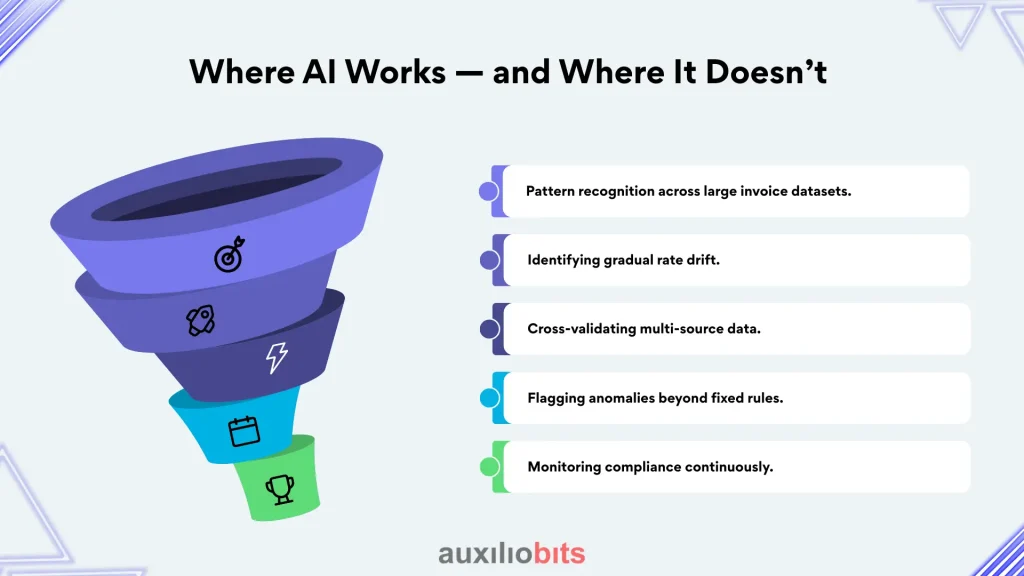
- Pattern recognition across large invoice datasets.
- Identifying gradual rate drift.
- Flagging anomalies beyond fixed rules.
- Cross-validating multi-source data.
- Monitoring compliance continuously.
It struggles when:
- Contracts are poorly structured.
- Amendments are undocumented.
- Shipment metadata is inconsistent.
- TMS integrations are incomplete.
- Organizations lack clean historical data.
Preventive vs. Reactive Cost Control
Most freight audits operate post-payment. Even prepayment validation often happens late in the cycle.
True cost leak prevention shifts are left in the process:
- Validate rate logic at the load tender stage.
- Monitor contract adherence weekly—not quarterly.
- Detect drift before invoices accumulate.
- Alert procurement when renegotiation clauses trigger.
Imagine detecting lane-level cost creep within two weeks instead of after fiscal close.
That shift alone changes the conversation between logistics and finance.
Implementation Realities: What It Takes
This is not a plug-and-play software installation.
Effective AI-driven rate validation typically requires:
- Contract ingestion (including amendments).
- Accessorial taxonomy standardization.
- Fuel index API integration.
- Historical invoice normalization.
- Exception workflow design.
- Dispute management integration
Some organizations underestimate the change management element.
When AI flags 12% of invoices as anomalous, teams can feel overwhelmed. Threshold tuning becomes essential. You do not want noise fatigue.
The goal is not maximum flagging. It is high-confidence intervention.
Metrics That Matter
Organizations often track:
- Invoice discrepancy rate.
- Recovery percentage.
- Dispute cycle time.
Useful, but incomplete.
More meaningful indicators include:
- Rate drift percentage by lane.
- Accessorial frequency variance.
- Contract adherence ratio.
- Fuel index compliance accuracy.
- Spot rate vs. contracted rate utilization.
- Prevented leakage vs. recovered leakage.
Prevented leakage is the real KPI. Recovery is remediation. Prevention protects margin.
Benefits That Don’t Get Advertised
There are secondary effects that rarely appear in sales brochures.
Carrier relationship clarity
When disputes are data-backed rather than anecdotal, conversations improve.
Procurement leverage
Historical drift evidence strengthens renegotiation position.
Operational discipline
Warehouses with consistent detention spikes become visible.
Financial forecasting accuracy
Reduced billing volatility improves spend predictability.
Reduced manual audit fatigue
Analysts shift from spreadsheet validation to exception analysis.
Interestingly, AI monitoring sometimes reveals internal process failures more than carrier discrepancies. That can be uncomfortable. But it is necessary.
Nuances in Market Volatility
Transportation markets are cyclical. During tight capacity periods, shippers tolerate temporary premiums. They anticipate reductions when markets are weak.
AI systems can benchmark contracted rates against external indices and highlight misalignment.
However—and this is important—blindly enforcing market benchmarks can damage strategic partnerships. Long-term carrier relationships often justify premium rates in exchange for capacity stability.
AI should inform negotiation, not dictate it.
There’s a difference between preventing leakage and commoditizing partnerships.
Integration with Broader Supply Chain Intelligence
Rate validation should not exist in isolation.
When integrated with:
- Demand forecasting systems,
- Network optimization models,
- Warehouse dwell analytics,
- Supplier lead time tracking,
AI can correlate cost anomalies with operational drivers.
For instance, higher detention on certain lanes may correlate with production schedule variability. Fixing the production plan may reduce freight leakage more effectively than disputing invoices.
This systems-level thinking separates mature implementations from checkbox deployments.
Final Thought
Transportation rate validation and contract monitoring with AI is not glamorous. It does not generate headlines like autonomous vehicles or warehouse robotics.
But it protects margin. It forces discipline into agreements that were previously static documents. It exposes drift that human reviewers normalize over time. And perhaps most importantly, it shifts freight cost management from reactive dispute handling to continuous financial control. Is it perfect? No. Poor data undermines it. Weak contract governance limits it. Over-automation can create noise.
Still, ignoring silent cost leakage is more expensive.
Freight may never be your largest line item. But unmanaged, it quietly erodes profitability. AI, when applied thoughtfully, turns that erosion into measurable, preventable variance.
And in tight-margin industries, variance control is strategy