









Key Takeaways
- Validation delays are the primary bottleneck in reverse logistics, not physical return handling. While most returned goods arrive promptly, the process of financial and policy validation causes delays in closure.
- Automated validation removes human latency by executing predefined eligibility, shipment, and policy checks instantly across ERP, WMS, and CRM systems.
- Credit processing automation ensures faster and more accurate financial reconciliation, reducing credit issuance time from weeks to hours while improving audit reliability.
- Automation significantly improves supply chain visibility by synchronizing operational and financial return status in real time, eliminating blind spots in reverse flow tracking.
- The greatest impact of reverse logistics automation comes from connecting warehouse receipt, validation, and credit processing into a continuous, event-driven workflow rather than isolated manual steps.
Reverse logistics doesn’t fail because trucks are late. It fails because nobody wants to take financial responsibility for what just came back through the door.
In most logistics environments—3PLs, distribution networks, spare parts supply chains—the physical return shows up before the organization is ready to make a decision about it. The warehouse receives it. Someone scans it. It gets placed in a returns area. And then… it waits.
The product doesn’t require inspection. This delay occurs because validation and credit processing are not connected. And that’s where automation, when done properly, makes a very specific kind of difference. Not flashy. Not robotic arms. There are no ubiquitous AI vision systems. There should be fewer individuals waiting on each other to confirm what everyone already knows.
The Validation Problem Isn’t Complexity. It’s Hesitation
When a return comes in, validation sounds straightforward:
- Was this authorized?
- Is it within policy?
- Does the serial number match?
- Is this the same customer?
- Has it already been credited?
Simple questions. Yet in real operations, answering them requires touching multiple systems. Customer service checks CRM. Warehouse checks WMS. Finance checks ERP. Sometimes operations checks transport records.
Each team sees part of the truth. No one sees all of it at once. So what happens?
They email. They wait. They escalate. They create side spreadsheets. And validation takes days.
There have been spare parts returns that physically arrive in 36 hours but sit in validation status for a week because finance hasn’t “confirmed eligibility”.
The product was sitting there. Everyone knew it belonged to the customer. But credit couldn’t move without manual cross-verification. That’s not a technology limitation. That’s workflow friction. Automation fixes that friction by executing policy logic immediately when events occur. Not eventually. Not after someone checks their inbox. Immediately.
Also read: Reverse logistics automation: agentic handling of returns and restocking
What Automated Validation Does
There’s a misconception that automation “decides” things. It doesn’t. It executes already defined rules without waiting for humans to reconfirm them. In reverse logistics validation, that usually means:
- Matching return against original shipment
- Confirming it falls within contractual window
- Verifying serial/batch identity
- Checking for duplicate credit attempts
- Ensuring physical receipt confirmation
When systems are integrated properly, the moment a warehouse scan occurs, validation logic can fire automatically. If everything matches, the return moves forward instantly. If something doesn’t match, it gets flagged—with context. Humans then deal only with exceptions. That’s the difference. Not removal of people. Removal of latency. And latency is expensive in supply chains.
The Quiet Damage of Slow Validation
Most leadership dashboards don’t track “validation delay”. But they should. Slow validation affects:
- Inventory accuracy
- Working capital
- Customer trust
- Finance reconciliation cycles
If validation lags, returned inventory remains unusable in the system—even if physically present. Operations might reorder stock that’s already sitting in the returns cage. Finance might delay recognizing revenue adjustments. Customer service gets dragged into “Where is my credit?” conversations that shouldn’t exist. Supply chain visibility collapses specifically in reverse flow. Forward flow is usually clean and instrumented. Reverse flow? Fragmented. Automation doesn’t just speed things up. It stabilizes visibility. Once validation is event-driven instead of email-driven, status becomes real-time. And that changes planning decisions.
Credit Processing: Where Finance Loses Patience
If validation is operational friction, credit processing is financial tension. In many logistics organizations, even after validation is complete, credit processing remains manual.
Why? Control. Finance teams don’t trust operational inputs. So they re-check everything. This procedure makes sense, as errors in credits can lead to audit exposure. But the result is double work. The warehouse confirms receipt. Operations validates the RMA with Finance and then manually verifies it again. Then, a credit memo is manually created.
And here’s the truth: humans are not more accurate than well-designed automated checks.
They’re just slower.
Automated credit processing, when properly governed, does this:
- Pulls original invoice data automatically
- Calculates credit amount accurately
- Applies correct tax treatment
- Prevents duplicate issuance
- Posts to ERP in correct accounting period
There is no need to manually recreate the data. No re-keying. No spreadsheet cross-reference. And most importantly—no waiting.
What Changes When Credit Processing Is Automated
Two things shift immediately.
- The time between warehouse receipt and financial closure shrinks dramatically.
- The number of status enquiries drops.
Customers don’t complain about returns when credits are processed predictably. They complain when credits are opaque. In one logistics-heavy industrial distribution network I worked with, average credit issuance was 12–15 days after receipt. After automating validation-to-credit workflows, that dropped below 48 hours. Customer escalation tickets related to returns dropped by more than half. Finance didn’t lose control. They gained structured oversight.
Reverse Logistics Visibility: The Missing Half of Supply Chain Visibility
Everyone talks about supply chain visibility in terms of shipments and inbound materials. Very few organizations have real visibility in reverse flow.
Ask basic questions in many companies:
- How many returns are pending validation?
- What is the financial value of unprocessed credits?
- How long do returns sit before financial reconciliation?
- What percentage of returns are exception cases?
You’ll get estimates. Not real-time answers. Automation provides traceable state changes. Each RMA moves through defined stages: Requested → Authorized → Received → Validated → Credited → Closed
When these transitions are system-driven rather than person-driven, visibility becomes reliable. Operations sees bottlenecks. Finance sees liability exposure. Leadership sees return trends clearly.
That’s real supply chain visibility—not just tracking shipments.
Fraud and Duplicate Credits: A Quiet Drain
Manual validation is inconsistent. Some teams check serial history. Others don’t. Some tracks duplicate return attempts. Others rely on memory. Automation can enforce consistency:
- Serial number history check
- Duplicate RMA detection
- Invoice linkage verification
- Return frequency anomaly flagging
It’s not about assuming fraud everywhere. It’s about removing variability in enforcement. And variability is where leakage happens.
What Automation Won’t Fix
It won’t fix poor return policies. It won’t fix vague contractual language. It won’t fix inconsistent inspection standards. Automation enforces what you define. If policies are unclear, automation will amplify confusion. That’s why the best reverse logistics automation projects start with process clarity—not tool deployment.
A 3PL Example: Where the Bottleneck Wasn’t the Warehouse
A regional 3PL handling automotive components believed their return delays were due to warehouse capacity. They considered expanding return processing space. Instead, analysis showed the warehouse processed returns within 24 hours. The real delay was between warehouse confirmation and finance credit issuance. Emails. Manual ERP updates. Approval queues. After implementing event-driven validation and automated credit generation tied directly to WMS receipt events, the average return-to-credit cycle dropped from 11 days to 2 days. They didn’t expand warehouse space. They removed financial workflow lag. This type of inefficiency can be easily overlooked.
Where Automation Delivers the Most Impact in Reverse Logistics
Not everywhere. Specifically here:
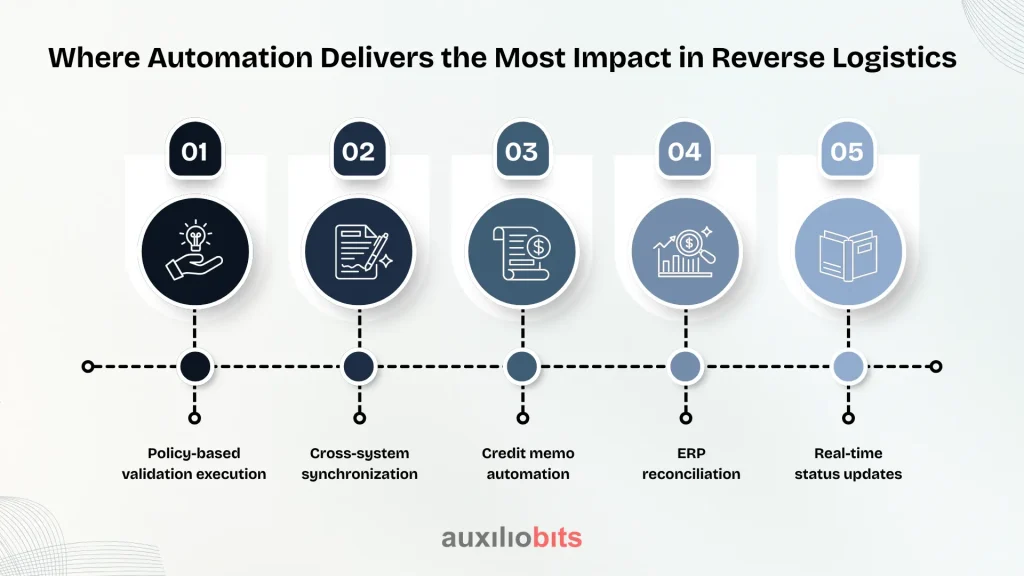
- Policy-based validation execution
- Cross-system synchronization
- Credit memo automation
- ERP reconciliation
- Real-time status updates
It’s less impactful in physical inspection or damage grading—at least today. Reverse logistics automation is about coordination, not conveyor belts
Why This Matters Strategically
Reverse logistics used to be treated as operational cleanup. Now it’s financially material.
Returns affect:
- Revenue recognition
- Customer retention
- Inventory planning
- Cash flow timing
Delays in validation and credit processing distort the financial and operational picture. Automation aligns physical reality with financial systems in near real time. And once that alignment exists, decision-making improves across the board. Finance closes faster. Operations plans better. Customers escalate less.
It’s not glamorous work. But in supply chain and logistics, the companies that automate reverse validation and credit processing quietly outperform those that don’t.
This is not due to their ability to move goods faster. This is due to their ability to eliminate hesitation from the decision-making process. And hesitation is expensive.