








Key Takeaways
- Stock-out prevention is fundamentally a decision problem, not a forecasting or reporting problem—alerts without context don’t change outcomes.
- Priority-based alerts matter more than alert volume; knowing which shortage will stop operations is more valuable than knowing all shortages exist.
- AI agents connect weak signals humans miss—maintenance behavior, supplier patterns, schedule shifts—long before thresholds are breached.
- Critical parts fail outside planning cycles, which is why continuous monitoring beats periodic MRP logic for high-risk inventory.
- The biggest value of AI agents is invisible: when they work, nothing breaks, nothing stops, and no one panics.
Critical parts inventory is one of those topics everyone claims to have under control—right up until a line goes down. Then suddenly, the ERP reports look suspiciously optimistic, the safety stock logic feels theoretical, and someone is calling a supplier at 2 a.m. hoping for a miracle shipment.
Most organizations don’t actually monitor critical parts. They track balances, review alerts, and trust forecasts. That distinction matters. Tracking assumes the system will tell you when something is wrong. Monitoring assumes something will go wrong and stays ahead of it.
This is where AI agents quietly change the game—not by predicting the future with some mystical accuracy, but by handling the messy, ongoing decision work that humans and static rules are bad at sustaining.
And yes, stock-out prevention is the real value here. Not inventory optimization theater. Not prettier dashboards. Preventing the one shortage that stops production.
Also read: AI Agents in Strategic Scenario Simulation for Executive Decisioning
Why Critical Parts Are a Different Beast Altogether
Anyone who’s worked in manufacturing, utilities, aerospace, pharma, or heavy engineering knows this already: critical parts don’t behave like normal SKUs.
They have a few inconvenient traits:
- Low volume, irregular usage
- Long or uncertain lead times
- Single or fragile supplier dependencies
- High downtime cost if unavailable
- Often poorly forecasted because consumption is event-driven, not demand-driven
Traditional inventory systems treat them like awkward exceptions. Safety stock formulas don’t like sparse data. Reorder points drift into irrelevance when demand spikes are tied to breakdowns, not sales.
So what do teams do instead?
They add buffers.
They create manual watchlists.
They rely on tribal knowledge. This isn’t a tooling gap. It’s an attention gap.
The Hidden Failure Mode: Alert Fatigue and Missed Priorities
Most ERPs and inventory platforms already generate alerts. Low stock warnings. Reorder suggestions. Exception reports.
The problem isn’t lack of alerts. It’s that everything looks equally urgent on a screen.
A missing ₹2 fastener and a soon-to-be-unavailable turbine component often show up as the same color—red.
Procurement teams learn to ignore half of it. Planners export spreadsheets. Maintenance keeps its own lists. And the system quietly becomes background noise.
Stock-outs don’t happen because nobody knew inventory was low. They happen because nobody knew which shortage would actually hurt.
That’s where priority-based alerting—done properly—earns its keep.
What AI Agents Do
Let’s be clear about terms, because “AI” gets abused fast.
An AI agent in inventory monitoring isn’t just a predictive model. It’s a system that:
- Continuously observes inventory, usage signals, and external constraints
- Evaluates risk based on context, not just thresholds
- Takes actions or escalates decisions without waiting for a human to notice
Think of it less as a forecasting engine and more as a junior operations analyst who never sleeps.
Where traditional systems ask: “Is stock below reorder point?”
An agent asks, “If this part runs out in the next three weeks, what actually breaks—and how likely is that scenario?”
That shift—from quantity-based logic to consequence-based logic—is everything.
Stock-Out Prevention Is About Timing, Not Prediction Accuracy
There’s a myth that better forecasting alone prevents stock-outs. In reality, most critical part shortages happen despite forecasts, not because of their absence.
Why?
Because the decision window closes faster than the planning cycle.
By the time a weekly MRP run flags an issue:
- Supplier capacity may already be committed
- Expediting costs have doubled
- Maintenance has locked the schedule
AI agents work differently. They don’t wait for a planning run. They react to signals.
Some of the signals that actually matter in real environments:
- A maintenance work order opened earlier than expected
- A production schedule tweak for a high-margin SKU
- A supplier confirmation email hinting at partial shipment
- Consumption velocity changing, not just absolute stock
- A related component failing more frequently (yes, correlation matters)
None of these live neatly in one system. Humans connect them instinctively—when they have time. Agents do it continuously.
Priority-Based Alerts: Not All Red Flags Are Equal
Here’s where most implementations fail: they stop at “smart alerts” and never address priority logic.
A useful alert answers three questions immediately:
- What part is at risk?
- Why does it matter now?
- What happens if nothing is done?
AI agents score risk dynamically, using factors like:
- Time-to-stock-out vs time-to-replenish
- Downtime cost of affected assets
- Availability of substitutes or alternates
- Supplier reliability patterns (not just lead time averages)
- Current operational context (shutdowns, peak production, audits)
This allows alerts to sound like: “If unaddressed, Part X will halt Line 3 within 9 days. Alternate supplier lead time exceeds window. Recommend escalation.”
That’s a very different experience from: “Inventory below minimum.”
And yes, fewer alerts is a feature, not a limitation.
A Real-World Scenario: When “Enough Stock” Isn’t Enough
One automotive supplier we worked with had a part that never showed as critical in the ERP.
On paper:
- Stock: 240 units
- Average usage: 20/month
- Lead time: 60 days
Plenty of buffer.
What the system didn’t account for:
- That part was consumed only during unplanned maintenance
- Failure rates spiked in humid months
- Two lines depended on it, not one
- The supplier had quietly shifted production to quarterly batches
An AI agent monitoring maintenance tickets, environmental data, and supplier confirmations flagged risk three weeks before planners noticed anything odd.
No forecasting model predicted demand.
No reorder point was crossed.
But a stock-out was prevented—because someone (or something) paid attention to nuance.
Where AI Agents Outperform Humans
It’s tempting to oversell autonomy. Let’s not.
Agents are excellent at:
- Watching dozens of weak signals simultaneously
- Re-prioritizing alerts as conditions change
- Remembering edge cases humans forget
- Escalating early without panic
They are less good at:
- Navigating supplier politics
- Deciding when to intentionally violate policy
- Understanding one-off strategic exceptions
That’s fine. Stock-out prevention isn’t about replacing planners. It’s about making sure planners only deal with problems worth their time.
In practice, the best setups let agents:
- Detect
- Rank
- Recommend
Humans still approve, negotiate, and override
Agents Don’t “Trust” Master Data Blindly
If you’ve lived inside an ERP long enough, you know master data lies. Not maliciously—just quietly.
Lead times are outdated. Min/max values were set during a different production mix. Alternate parts exist on paper but not in reality.
AI agents learn from behavior, not declarations.
If a supplier says 30 days but always delivers in 45, the agent adjusts risk scoring accordingly.
If consumption spikes whenever a certain machine crosses a usage threshold, it notices—even if nobody documented it.
This doesn’t make systems obsolete. It makes them less naïve.
Stock-Out Prevention Across the Lifecycle, Not Just Reordering
Most inventory tools focus on replenishment. Agents look wider.
They intervene at different points:
Before procurement
- Flagging parts that shouldn’t wait for MRP
- Highlighting risks caused by schedule changes
During ordering
- Suggesting split orders or partial expedites
- Warning when supplier confirmations contradict assumptions
After receipt
- Detecting quality-related delays that impact availability
- Adjusting future risk profiles based on actual outcomes
Stock-outs rarely come from a single failure. They come from small delays stacking up. Agents are good at spotting stacks forming
When Priority-Based Alerting Fails
A word of caution: priority logic can backfire if implemented lazily.
Common failure modes include:
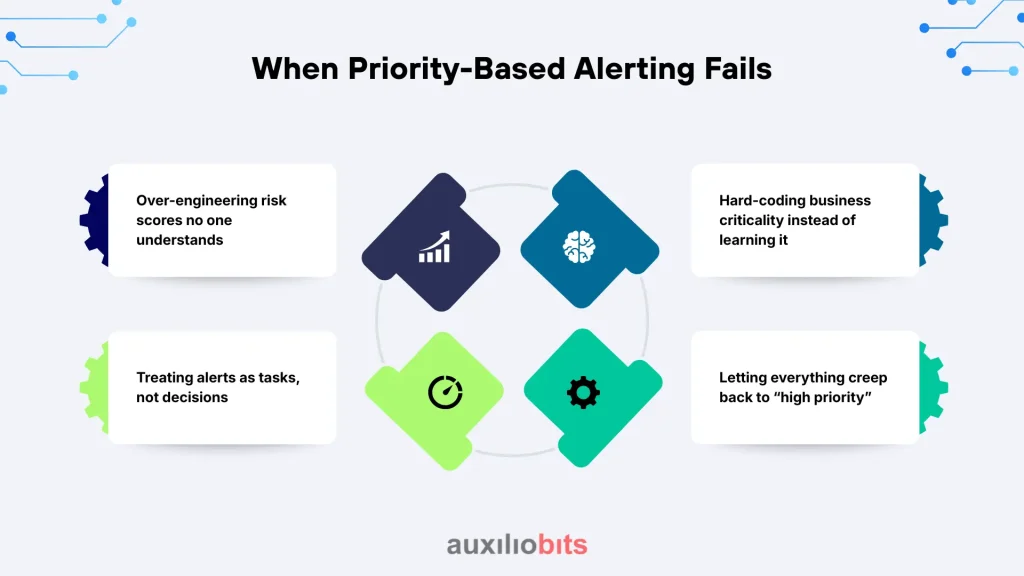
- Over-engineering risk scores no one understands
- Hard-coding business criticality instead of learning it
- Treating alerts as tasks, not decisions
- Letting everything creep back to “high priority”
The irony? You end up recreating alert fatigue—just with fancier math.
The fix isn’t more sophistication. It’s clear accountability.
If an alert fires, someone should be able to say, “I see why this matters.”
If they can’t, the agent isn’t helping yet.
Why This Matters More Than Inventory Turns or Carrying Cost
Executives love inventory metrics. Turns. Days on hand. Working capital.
Critical parts don’t move those needles much. They sit quietly, tying up cash and justifying themselves once a year during an outage.
But when they’re missing, the impact isn’t incremental—it’s binary.
Production stops. Commitments slip. Trust erodes.
AI agents earn ROI not by shaving percentages, but by preventing catastrophic exceptions that never show up neatly in annual reports.
And yes, those savings are hard to model. That doesn’t make them imaginary.
Final Thought
Most organizations already have enough data to prevent critical part stock-outs. What they lack is sustained, contextual attention.
AI agents don’t bring magic. They bring persistence.
They notice the things humans mean to watch—but can’t, week after week, across hundreds of parts, systems, and suppliers.
If your inventory strategy still depends on someone remembering to “keep an eye on it,” that’s not a strategy. It’s hope.
And hope is a terrible safety stock policy.