









Key Takeaways
- Foundation models excel at pattern recognition, but without agentic context, they lack judgment, accountability, and the ability to act under real-world constraints.
- Most enterprise failures with LLMs are due to a lack of situational awareness, not the quality of the model. This is especially true when decisions affect multiple systems, time, and competing goals.
- Agentic context embeds models into feedback-driven decision loops, enabling perception, action, consequence tracking, and adaptation—not just fluent responses.
- Prompt-heavy architectures collapse at scale because they entangle rules, observations, and intent, making systems brittle, opaque, and difficult to govern.
- Enterprise AI impact comes from situated intelligence—where models operate within organizational reality—rather than standalone reasoning detached from consequences.
Spend enough time in enterprise AI conversations and you’ll notice a pattern. Someone mentions a large language model—often with a benchmark score attached—and the room quietly assumes the hard part is done. The model can summarize contracts, write SQL, generate emails, and maybe even reason step-by-step. So why is operational impact still uneven? Why do so many “AI pilots” stall after the demo phase?
This phenomenon is due to the fragility of intelligence without context. And foundation models, powerful as they are, operate largely without lived situational awareness unless we give it to them—systematically, persistently, and with guardrails.
This is where agentic context enters the conversation. Agentic context serves not as a mere buzzword or a wrapper, but rather as the missing layer that bridges the gap between raw generative capability and practical decision-making.
Foundation models are impressive—but they’re also naïve
Let’s be honest: modern foundation models are extraordinary pattern recognizers. They compress enormous swaths of language, code, and human behavior into a probabilistic engine that can generalize surprisingly well. But generalization isn’t the same as judgment.Ask a model how to respond to a customer complaint, and it will give you something plausible. Ask it to decide whether to issue a refund, escalate to legal, or trigger a compliance workflow, and things get murky. Not because the model is “dumb”, but because it lacks grounding in:
- Organizational policies that conflict with one another
- Historical exceptions that matter more than the written rule
- Risk tolerances that shift depending on market conditions
- Accountability structures (who is blamed if this goes wrong?)
In other words, the model lacks the ability to adapt to evolving contexts.
A foundation model doesn’t know it’s operating inside a logistics firm during peak season with fuel prices spiking and a key customer threatening churn. It can be told that information—but it doesn’t carry it forward, reason about it over multiple steps, or reconcile it against competing objectives unless something else orchestrates that reasoning.
The difference between knowing and acting
This distinction matters more than people admit. Most enterprise problems aren’t about generating text. They’re about deciding what to do next, under constraints, with incomplete information.
Considercredit risk assessment in mid-market lending. A language model can summarize financial statements, extract red flags, and even explain why a loan might be risky. But approving or rejecting credit involves:
- Comparing the applicant against evolving internal risk bands
- Adjusting thresholds based on portfolio exposure that week
- Factoring in informal signals (“this customer always pays late but always pays”)
- Triggering downstream actions: collateral requests, pricing adjustments, monitoring schedules
None of that lives inside the model by default. And trying to stuff it all into prompts turns brittle fast.
This is why early “LLM-only” systems feel impressive in demos and disappointing in production. They answer questions well. They struggle for their own outcomes.
Also read: Behavior Trees for Managing Agent Logic Hierarchies
Agentic context is not just memory—it’s situational awareness
There’s a temptation to reduce agentic context to “long-term memory” or “state management.”. That’s part of it, but it misses the point.
Agentic context is about embedding the model inside a decision loop:
- It perceives signals from the environment (systems, events, humans)
- It reasons over goals, constraints, and prior actions
- It chooses actions—not just responses
- It observes the consequences and adapts
Without that loop, a foundation model remains a very articulate consultant who never actually touches the controls.
In manufacturing, for example, a model might know that machine vibration above a threshold indicates wear. But an embedded agent understands:
- Which machines are critical this shift
- Whether maintenance staff is available right now
- If stopping the line violates a customer SLA
- How similar situations were handled last quarter
That context isn’t static. It changes hourly. And it’s often implicit—spread across MES logs, maintenance tickets, tribal knowledge, and a dozen dashboards no one fully trusts.
Why prompt engineering doesn’t scale
Some teams try to solve this with ever-more elaborate prompts. Policy documents pasted in. Decision trees encoded in natural language. “If this, then that” instructions stacked until the context window groans.
It works… until it doesn’t.
Prompts are fragile for a few reasons:
- They’re hard to version and audit
- They don’t adapt when conditions shift
- They conflate instruction with observation
- They assume the model should reason about everything every time
More importantly, prompts don’t create accountability. When something breaks, you can’t easily tell whether the failure came from bad data, a misinterpreted rule, or an unforeseen edge case.
Agentic systems separate these concerns. The model reasons. The agent decides when and how that reasoning is applied.
Signs you need agentic context
If any of these feel familiar, a standalone model probably isn’t enough:
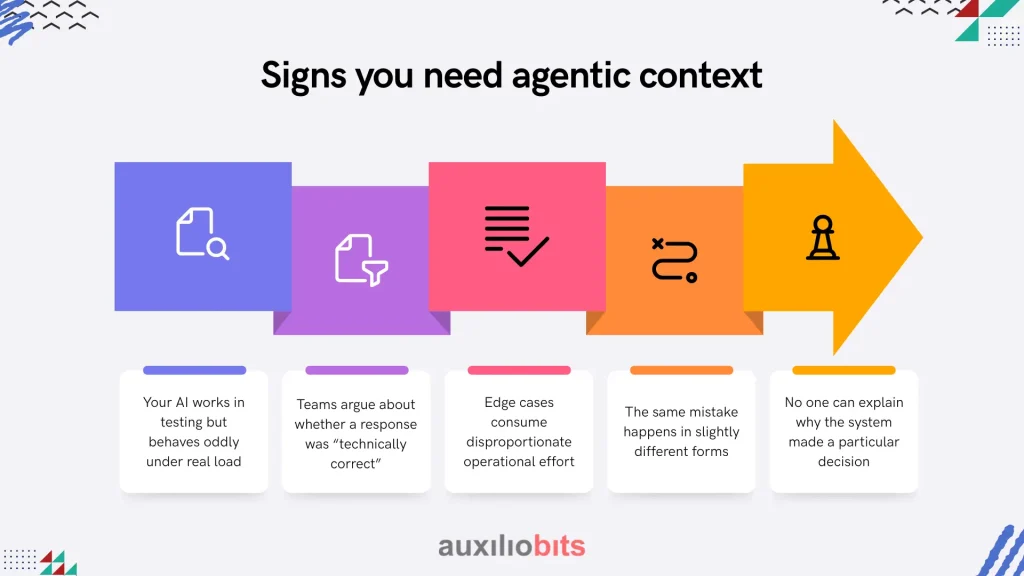
- Your AI works in testing but behaves oddly under real load
- Teams argue about whether a response was “technically correct”
- Edge cases consume disproportionate operational effort
- The same mistake happens in slightly different forms
- No one can explain why the system made a particular decision
These aren’t model problems. They’re context problems.
Foundation models changed what’s possible. There’s no going back. But treating them as standalone decision-makers misunderstands both technology and organizations.
Intelligence needs context the way judgment needs experience. Without it, even the smartest systems behave like interns—eager, articulate, and occasionally dangerous.
Agentic context doesn’t make models smarter in the abstract. It makes them situated. And in enterprise settings, being situated is the difference between insight and impact.
If that sounds messier than a single API call, it is. Real work usually is.