








Key Takeaways
- Agents fail not from weak planning, but from poor learning. Without structured reflection, real execution failures and human corrections never translate into durable behavioral improvements.
- Execution logs are behavioral ground truth, not debugging residue. They capture decisions under real constraints—latency, partial data, system errors, and human intervention—signals prompts never reveal.
- Reflection evaluates behavior; memory merely stores artifacts. Systems that equate vector recall with learning remember more history but fail to improve decision quality or policy accuracy.
- Enterprise-grade agent improvement is deliberate, not clever. Guardrails, thresholds, and preconditions consistently outperform prompt experimentation by producing scalable, predictable, and resilient behavior.
- Durable learning requires separating execution from judgment. Actor-critic separation, asynchronous reflection, versioned policies, and auditability keep learning controlled, explainable, and regulator-safe.
Most teams building agentic systems obsess over planning. The components of agentic systems include prompt graphs, tool schemas, memory strategies, and orchestration layers. All important. But if you’ve shipped even one real agent into production, you know something uncomfortable: planning quality matters far less than learning excellence.
Agents don’t fail because they lack a plan. They fail because reality diverges from assumptions—and nothing in the system notices, internalizes, or adapts.
This is where the role of reflective agents becomes crucial. Reflective agents, not the academic version that sounds elegant in papers, are the gritty, production-grade agents that read their execution exhaust—logs, traces, retries, errors, and user corrections—and gradually become less incorrect over time.
Execution logs are the most underutilized training signal in modern agent architectures. And yes, that’s ironic given how much money enterprises spend on observability
This piece is about building agents that actually learn from what they do, not just what they were told.
Reflection Isn’t Memory
It is important to understand that reflection is not memory.
Memory stores facts:
- Customer preferences
- Past conversations
- Retrieved documents
- Cached outputs
Reflection evaluates behavior.
A reflective agent asks questions like:
- Why did that step fail?
- Was the tool choice wrong, or the input malformed?
- Did the plan assume data freshness that didn’t exist?
- Did the user intervene because the agent misunderstood intent?
Most agent systems today conflate the two. They add a vector store, log conversations, maybe replay past trajectories, and call it learning. That’s not learning. That’s hoarding.
Reflection requires judgement. And judgement requires structure.
Also read: Why Agentic AI Will Accelerate the Age of Outcome-Based Work
Why Execution Logs Are a Gold Mine
In most enterprises, execution logs are treated as disposable exhaust:
- Debug when something breaks
- Archive for compliance
- Occasionally sample for QA
Then they’re forgotten.
But execution logs contain something far more valuable than conversation transcripts or prompt histories: grounded evidence of decision-making under constraint.
Logs show:
- Which tools were invoked, versus which were planned?
- Latency spikes that changed downstream behavior
- Retry cascades caused by partial failures
- Human overrides that quietly corrected agent behavior
- Silent degradations no alert ever fired for
What “Reflective” Means in Production Systems
Reflection isn’t a single capability. It’s a pipeline.
At minimum, a reflective agent needs four distinct layers:
- Observation capture
- Outcome evaluation
- Attribution of cause
- Policy or behavior adjustment
Most systems barely do step one.
1. Observation Capture: Logging With Intent
Not all logs are created equal. Stack traces alone won’t help an agent improve.
You need logs that capture:
- Decision points (why tool A over tool B)
- Assumptions (input completeness, data freshness, authority)
- Environmental context (timeouts, rate limits, permission scopes)
- Human interventions (edits, rejections, re-routes)
This requires semantic logging, not just technical logging.
Examples that actually help:
- “Selected CRM lookup assuming email was unique identifier”
- “Skipped validation step due to low confidence threshold”
- “User corrected entity classification from ‘vendor’ to ‘partner’”
Yes, this adds overhead. No, you can’t bolt it on later.
2. Outcome Evaluation: Defining “Good” Without Lying to Yourself
Reflection fails most often at evaluation. Teams define success too narrowly:
- Task completed?
- Response returned?
- No exception thrown?
That’s table stakes.
Real evaluation asks:
- Was the outcome correct or merely plausible?
- Did it increase downstream workload?
- Did it require human cleanup later?
- Did it violate an unstated business norm?
In finance ops, an agent that posts an invoice correctly but triggers a reconciliation exception is worse than an agent that escalates early.
Reflective agents need access to post-execution signals, including:
- Downstream system errors
- Manual rework events
- SLA breaches
- User dissatisfaction markers (not just thumbs-down)
Without this, reflection becomes self-congratulatory.
How Agents Actually Learn From Logs
There are several learning loops that work in practice. None are magical.
1. Pattern Reinforcement
- Successful trajectories are clustered
- Common decision paths are weighted higher
- Rare but catastrophic failures are overweighted intentionally
This improves reliability, not creativity.
2. Heuristic Refinement
- Update decision thresholds
- Adjust tool selection criteria
- Introduce precondition checks where failures cluster
It’s boring. It works.
3. Prompt Evolution
- Modify reasoning instructions based on observed failure modes
- Add negative examples from logs
- Remove steps that consistently add latency without benefit
Blind prompt mutation based on outcomes is dangerous. Seen that go sideways more than once.
4. Human-in-the-Loop Codification
- Experts annotate failure clusters
- Annotations become rules, guards, or policies
- Agents learn what not to attempt
This is where enterprise agents outperform consumer chatbots. Constraints beat cleverness.
When Reflection Backfires
Reflection is not free. There are failure modes.
- Overfitting to recent errors: Agents become overly conservative after a bad incident.
- Feedback loops with biased data: If humans only correct certain mistakes, others persist invisibly.
- False causality: Correlation in logs mistaken for causation. This is known as the classic observability trap.
- Performance degradation: Excessive reflection steps increase latency and cost.
Architecture Patterns That Hold Up Under Scale
A few patterns that consistently survive production reality:
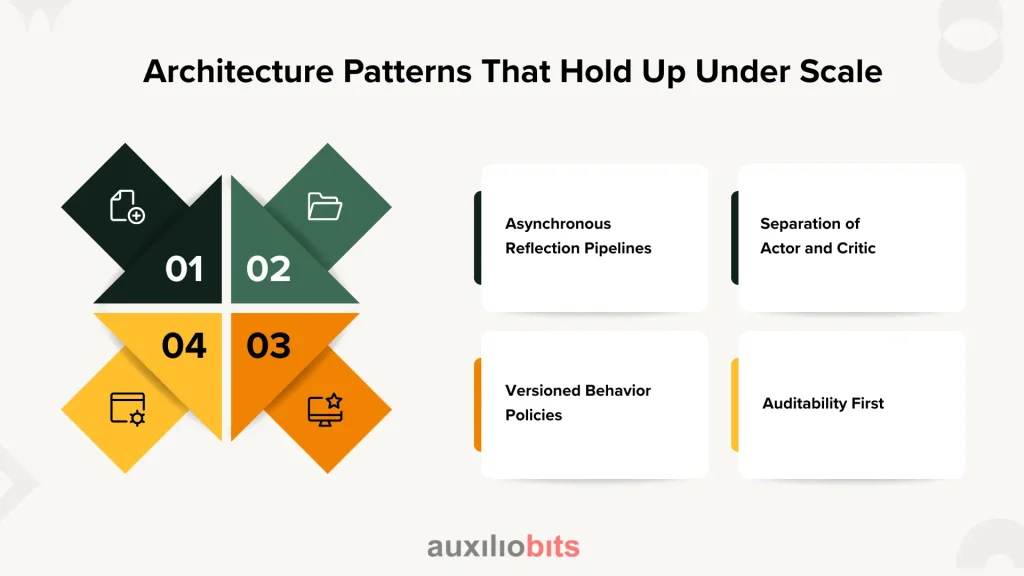
1. Asynchronous Reflection Pipelines
Reflection runs after execution, not inline. Learning updates propagate later.
2. Separation of Actor and Critic
One component executes. Another evaluates. Mixing them leads to self-justification.
3. Versioned Behavior Policies
Agents don’t “learn continuously” in real time. They adopt new policies in controlled releases.
4. Auditability First
Every behavioral change must be traceable to evidence. Regulators care. So should you.
We’re not moving toward agents that self-improve endlessly. That’s fantasy.We are moving toward systems where:
- Execution generates learning artifacts
- Failures leave behind structured insight
- Humans and agents share the burden of adaptation
- Logs stop being a dead weight.
The teams that win won’t be the ones with the fanciest prompts. They’ll be the ones who treat execution logs as a first-class training signal.
Most don’t. Yet.
Which is, frankly, an opportunity.