









Key Takeaways
- Loyalty fails when it optimizes responses over relationships. Most programs chase clicks and redemptions instead of trust. Agent-led loyalty works because it knows when not to act.
- Advisory agents manage moments, not campaign calendars. Loyalty isn’t about scheduled pushes. It’s about responding to hesitation, context, and timing—sometimes with restraint.
- Agentic loyalty layers judgement on existing systems. Successful implementations don’t replace CRMs or loyalty engines. They correct blind spots by deciding timing, suppression, and relevance.
- Judgement matters more than intelligence in trust-driven brands. Retail rewards tone and consistency, not raw prediction accuracy. Agents trained as junior advisors outperform conversion-obsessed systems.
- Organizational alignment is harder than the technology. Agent-led loyalty shifts control away from rigid campaigns. Teams that govern this shift succeed; others blame the model.
If you ask about the management of loyalty in any midsize retail organisation today, you’ll likely hear a familiar narrative. There’s a points engine. There’s a CRM. There are email campaigns that trigger birthdays, cart abandonment, or six weeks of inactivity. On paper, it all looks thoughtful. In practice, loyalty often feels strangely impersonal—automated, polite, and forgettable.
What’s changing is not the loyalty math. It’s who—or rather, what—stands between the brand and the customer.
Intelligent agents are quietly moving into the frontline advisor role in retail loyalty programs. They are not chatbots that answer FAQs, nor are they just another recommendation widget added to the website; instead, they are systems that interpret behaviour, context, and intent in real time and respond with judgement. Sometimes good judgement. At times, these systems may exhibit poor judgement. And occasionally, surprisingly human judgement.
That shift matters more than most retailers realize.
Also read: Operationalizing ESG Strategy with Continuous Agent Surveillance
Loyalty Has Always Been Advisory—We Just Pretended Otherwise
Retail loyalty was never only about rewards. Even in the pre-digital era, the most loyal customers were built through advisory relationships.
- The store associate who knew your size without checking.
- The beauty counter representative would gently steer you away from a product that didn’t suit your skin type.
- The electronics salesperson who said, “You don’t need the premium model.”
Those interactions created trust. Points programs came later, mostly because trust didn’t scale.
Digital loyalty programs tried to replicate advisory behavior using rules: If a customer spends X, send offer Y. If category A purchased, recommend B. If inactive for 90 days, send 20% off.
It worked until it didn’t. Customers learnt the pattern. Offers felt generic. Discounts trained price sensitivity instead of loyalty. And the systems themselves became brittle—constantly tuned, constantly behind behavior.
Agent-based systems change the dynamic because they don’t just execute rules. They reason across signals.
Not perfectly. However, they perform sufficiently to create a distinct impression.
What “Frontline Advisor” Means in a Retail Context
There’s a tendency to over-romanticize AI agents as omniscient digital concierges. In retail loyalty, the role is far more grounded.
A frontline advisory agent:
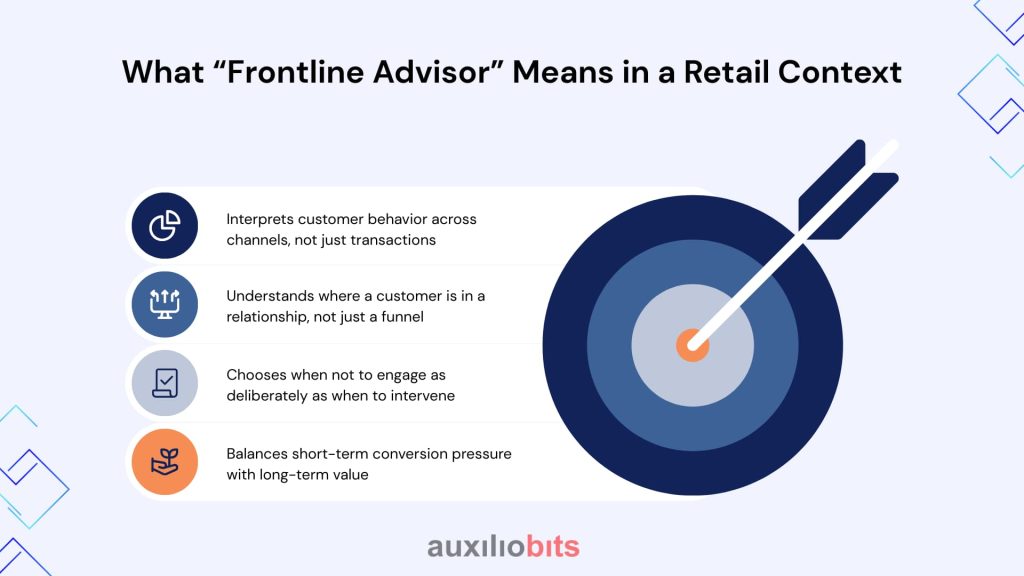
- Interprets customer behavior across channels, not just transactions
- Understands where a customer is in a relationship, not just a funnel
- Chooses when not to engage as deliberately as when to intervene
- Balances short-term conversion pressure with long-term value
This is less about generating offers and more about managing moments.
Consider a loyal apparel customer who browses winter jackets three times over two weeks, abandons carts, then buys nothing. A traditional system fires a discount email. An advisory agent might:
- Recognize hesitation around fit or price sensitivity
- Surface a sizing guide, return policy reassurance, or peer reviews
- Offer an exchange guarantee instead of a discount
- Alternatively, you could choose not to take any action, as historical behaviour indicates that these customers tend to make their purchases offline.
None of those responses are dramatic. That’s the point. Advisory value often lives in restraint.
Why Rule-Based Loyalty Systems Hit a Ceiling
Most loyalty stacks today still depend on deterministic logic, even when dressed up with “AI-powered” labels.
They fail in predictable ways:
- Over-triggering: Customers bombarded with nudges until they mute the brand entirely
- Context blindness: Promotions sent during returns, complaints, or post-purchase remorse
- One-dimensional optimization: Everything optimized for redemption or conversion, not trust
- Lagging adaptation: Rules updated quarterly; customer behavior shifts weekly
Retail teams know this. They compensate manually—campaign exceptions, suppression lists, endless tuning meetings. It keeps the system afloat, but it doesn’t make it smarter.
Agents introduce probabilistic reasoning into loyalty decisions. Not just “what worked last time,” but “what’s likely to work now, given this person, in this situation.”
That nuance is what rules can’t capture without becoming unmanageable.
Where Agents Sit in the Loyalty Stack
There’s a misconception that agent-based loyalty requires ripping out existing systems. In reality, most deployments sit around the stack, not at its core.
Typical architecture looks like this:
- Existing CRM, CDP, POS, eCommerce systems remain unchanged.
- Loyalty engine still handles points, tiers, redemptions
- Agent layer ingests signals:
- Transaction history
- Browsing behavior
- Service interactions
- Campaign responses
- Contextual signals (seasonality, location, inventory pressure)
- Agent decides:
- Whether to engage
- Through which channel
- With what message or offer
- Or to stay silent
Think of it as a judgement layer, not an execution engine.
That distinction matters. Agents don’t replace loyalty mechanics. They orchestrate how—and whether—those mechanics surface.
What Agents Are Good At
There’s a tendency to oversell agent intelligence. In retail loyalty, their strengths are specific.
They excel at:
- Pattern recognition across fragmented data
- Timing decisions under uncertainty
- Managing trade-offs between competing objectives
- Learning from longitudinal behavior, not just recent clicks
They struggle with:
- Brand nuance without careful training
- Ethical edge cases (e.g., vulnerable spending patterns)
- Cold-start customers with no signal depth
- Poor data hygiene (they amplify noise as easily as insight)
The most successful teams accept these limitations upfront. They design guardrails, escalation paths, and human override mechanisms. They don’t treat agents as autonomous geniuses. They treat them as junior advisors who learn fast.
Why This Matters More in Retail Than Other Sectors
Retail loyalty lives at the intersection of emotion and habit. Customers don’t rationalize every purchase. They prefer to avoid deep thought about each interaction. Advisory agents succeed when they reduce cognitive load, not increase it.
Compare that to banking or telecom, where loyalty often revolves around switching costs. Retail has no such luxury. A better experience is often one tap away.
Agents that act as frontline advisors help in three quiet ways:
- They prevent over-optimization that burns goodwill
- They personalize behavior, not just messaging
- They make loyalty feel earned, not gamified
None of this shows up immediately in quarterly results. It shows up when a customer chooses your brand without thinking. That’s the real loyalty benchmark, even if no one wants to admit how hard it is to measure.
Retail loyalty doesn’t need more intelligence. It needs better judgment.
Agents are valuable not because they’re smarter than humans, but because they’re less worn out, less reactive, and more consistent. They don’t panic at end-of-quarter numbers. They don’t chase vanity metrics. They can afford patience—if you let them.
When used effectively, they do not make loyalty appear flashy. They make it calmer. More respectful. They make it slightly less desperate.
And honestly, that’s probably what customers wanted all along.