








Key Takeaways
- The biggest divide is not model quality or vendor choice—it’s whether AI was foundational or retrofitted. Organizations that assumed autonomous decision-making early behave very differently under scale and uncertainty than those layering intelligence onto legacy systems.
- Startups default decisions to machines and correct later. Enterprises default to control and loosen gradually. Neither approach is inherently superior—but confusing one for the other leads to failed expectations and poorly designed AI programs.
- Many agent-enhanced enterprises deploy capable agents that never truly act. Without clarity on decision rights, escalation rules, and accountability, agents become passive advisors instead of operational contributors.
- Event-driven, probabilistic systems align naturally with agentic behavior. Approval-heavy cultures and deterministic workflows resist it. Trying to change only the tech—or only the culture—creates silent failure modes.
- The winning pattern is not full autonomy or full control but bounded decision-making: agents act freely within defined confidence, risk, or impact thresholds. This approach scales trust without destabilizing core operations.
A quiet but meaningful split is emerging in how organizations adopt artificial intelligence. It’s not about who has the best models or the biggest cloud contract. It’s about the moment when AI became an integral part of the company’s operations.
Some firms were founded with agents at their core. Others are retrofitting intelligence into systems that were designed long before “agentic” became a word anyone used seriously. Both can succeed. Both can fail. But they behave very differently under pressure, scale, and ambiguity.
We’ll call the first group born-agentic companies. The second: agent-enhanced enterprises.
This distinction isn’t a value judgement. It’s an architectural, cultural, and operational distinction that shows up everywhere—from product decisions to hiring plans to how incidents are handled at 2 a.m.
What “Born-Agentic” Means
Born-agentic companies are not just “AI-first.” That phrase has been abused to the point of uselessness.
They are organizations where autonomous or semi-autonomous agents were assumed from day one:
- Agents negotiate, route, decide, and learn as part of the default operating model.
- Human workflows exist, but often as exception paths.
- Decision latency is treated as a design flaw, not an inconvenience.
Stripe, for instance, didn’t start as an “AI company”, but its internal philosophy around automation and programmatic decision-making made it trivial to layer agentic fraud detection, dispute handling, and pricing optimization later. The system already assumed machines would act, not just observe.
More recent examples are even clearer:
- AI-native customer support startups where no ticket is ever “assigned” in the traditional sense—agents collaborate, escalate, or close issues dynamically.
- Autonomous sales tooling companies where lead qualification, outreach sequencing, and follow-ups are handled by a mesh of agents coordinating against revenue goals, not static CRM stages.
These companies don’t “deploy AI.” They are AI systems with a legal entity attached.
And yes, that sometimes creates chaos.
Born-agentic environments tend to ship fast, break abstractions, and occasionally learn painful lessons about guardrails after the fact. But their core advantage is hard to replicate later: AI is not an add-on. It’s the operating logic.
Also read: Why Agentic AI Will Accelerate the Age of Outcome-Based Work
Agent-Enhanced Enterprises: Intelligence as an Overlay
Now contrast that with agent-enhanced enterprises—banks, manufacturers, healthcare networks, and logistics providers.
These organizations already run on:
- ERP systems
- Shared services models
- Approval chains refined over decades
- Risk controls that exist for good reasons, even if they’re slow
When they introduce AI agents, it’s rarely greenfield. It’s more like open-heart surgery while the patient keeps running payroll.
Typical patterns look like this:
- An AI agent reviews invoices before they enter SAP.
- A procurement copilot suggests vendors but doesn’t select them.
- A finance agent flags anomalies, but humans still approve journal entries.
This is not a weakness. It’s realism.
Enterprises carry regulatory, reputational, and operational baggage that startups simply don’t. An autonomous agent making a disastrous call in a fintech startup is an incident. The same mistake in a global bank is a headline.
So agent-enhanced enterprises move cautiously. Sometimes frustratingly so. And yet, when done well, they achieve something born-agentic firms struggle with: controlled autonomy at scale.
The Real Differences
The distinction becomes sharper when you stop talking strategy decks and start looking at how work actually gets done.
1. Decision Ownership
Born-agentic:
- Decisions default to machines.
- Humans review patterns, not individual outcomes.
- Escalation is an exception, not the norm.
Agent-enhanced:
- Decisions remain human-owned, at least formally.
- Agents recommend, simulate, and monitor.
- Trust is earned incrementally, often process by process.
There’s a subtle irony here. Born-agentic companies often reintroduce human checkpoints later, once they’ve been burnt. Enterprises spend years trying to remove them.
2. System Architecture
Born-agentic stacks are usually:
- Event-driven
- API-native
- Loosely coupled
- Comfortable with probabilistic outcomes
Agent-enhanced environments look more like:
- Layered architectures
- Heavy systems of record
- Deterministic workflows with AI stitched in
Neither is “better.” But they fail differently. When a born-agentic system fails, it’s usually spectacular and fast. When an enterprise agent fails, it often fails silently—reverted to manual work, ignored recommendations, shadow processes creeping back in.
3. Talent Expectations
Born-agentic teams hire for:
- Comfort with ambiguity
- Systems thinking
- Debugging behavior, not just code
Agent-enhanced enterprises need:
- Translators between business and AI
- Process owners who view agents as colleagues rather than tools are essential.
- Governance leaders who can respond with “yes, but…” are crucial. intelligently
This area is where many large organizations stumble. They hire brilliant data scientists and expect magic, without changing decision rights or incentives.
Practical Signals to Watch (If You’re Evaluating or Building)
Forget marketing language. Look for these indicators instead:
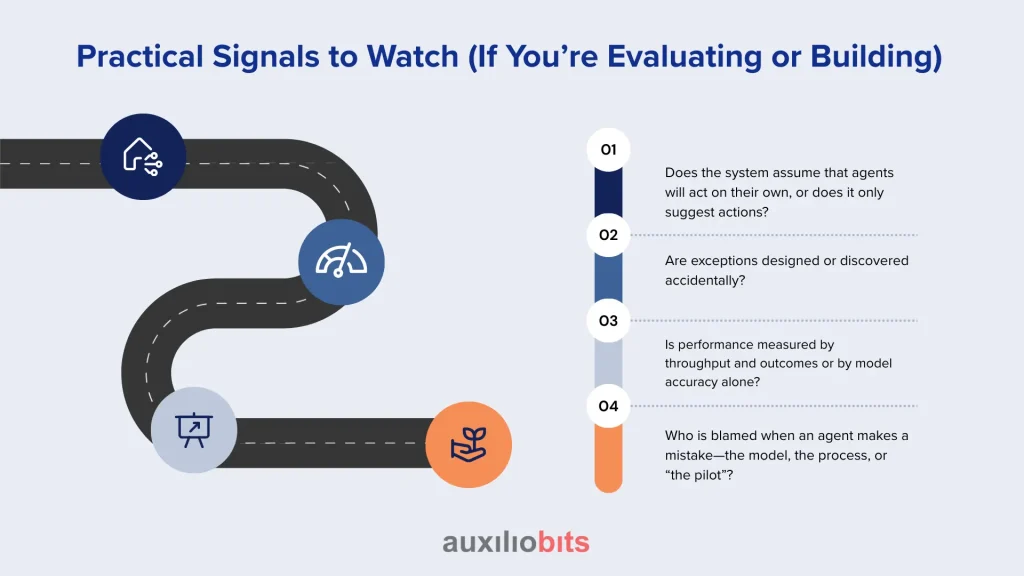
- Does the system assume that agents will act on their own, or does it only suggest actions?
- Are exceptions designed or discovered accidentally?
- Is performance measured by throughput and outcomes or by model accuracy alone?
- Who is blamed when an agent makes a mistake—the model, the process, or “the pilot”?
Those answers tell you far more than whether a company calls itself AI-native.
Here’s the part people don’t always like hearing.
Most large enterprises will never be fully born-agentic—and that’s fine. Chasing that ideal can be reckless.
But many also underestimate how much structural change is required to benefit meaningfully from agents. You cannot bolt autonomy onto a culture optimized for approvals and expect miracles.
The work is more about permission than models: who decides, under what conditions, and with what consequences?
Born-agentic companies answered those questions early, sometimes accidentally. Agent-enhanced enterprises must answer them deliberately.
That’s harder. However, this approach could potentially be more resilient.
And if you’re somewhere in the middle—trying to modernize without destabilizing everything—you’re not behind. You’re just dealing with reality.
Regrettably, this is where the majority of transformation occurs.