







Key Takeaways
- Circularity fails without connectivity. Most sustainability programs crumble due to fragmented data and disjointed systems—agents solve this by linking, interpreting, and acting across silos.
- Agents make sustainability operational. They move circularly from dashboards to decisions—managing returns, optimizing logistics, and triggering real-time workflows instead of static reporting.
- The balance between autonomy and oversight is crucial. Human judgment remains essential for ethical, contextual, and cultural trade-offs that agents alone can’t evaluate.
- Integration—not ambition—is the real barrier. Agents succeed when they augment existing ERP, IoT, and compliance systems instead of demanding full-scale digital transformation.
- Circularity creates compounding intelligence. Each agent-driven decision feeds back into the system, making future operations smarter, more transparent, and financially sustainable.
You can tell when a company is serious about circularity. It’s rarely mentioned in their press release or ESG statement. It’s in the way their supply chain teams talk about inventory waste, or how product managers obsess over material recovery rates. Circular economy models aren’t slogans—they’re logistical headaches wrapped in good intentions.
And yet, something’s shifting. Behind the scenes, quiet new actors are stepping into the chaos: agents. Not human consultants or procurement negotiators, but intelligent digital entities designed to make sense of fragmented systems. They don’t sleep, they don’t wait for approvals, and—when configured well—they can make circularity actually work.
It’s odd, isn’t it? For all our talk about sustainability, most corporate circular initiatives still depend on manual reporting, static dashboards, and compliance checklists. The irony is thick. The circular economy is supposed to be dynamic—adaptive, regenerative, and responsive. But our tools are linear: fill out this form, upload this PDF, and run this monthly audit.
Agents offer a way out of that contradiction.
Also read: How to Choose Between Autonomous and Human-in-the-Loop Agents
Circularity’s Core Problem: It’s Operational, Not Ideological
Everyone agrees the circular economy makes sense in theory. The logic is beautiful—reduce waste, keep materials circulating, and design for reuse. But the theory collapses the moment it meets supply chain reality.
Here’s what usually happens:
- Data lives in silos—the factory’s IoT sensors speak one language, and the procurement system another.
- No one has visibility beyond their tier of the chain.
- Compliance varies by region, product, and regulator.
- And when something breaks, the fix is an email thread or another spreadsheet.
This is where the linear economy still wins: it’s simpler to throw things away.
But the circular model can’t thrive on simplicity; it thrives on connection. That’s why agents—software entities that can perceive, decide, and act—are starting to take root in serious sustainability programs.
They aren’t rule-followers like traditional bots. They’re context-aware intermediaries that handle ambiguity: matching materials, negotiating logistics, and recalculating plans when a shipment fails or a partner backs out.If automation were about efficiency, agents would be about resilience.
The Limits of Dashboards and the Rise of Living Systems
Most companies already have sustainability dashboards. They’re beautiful, data-rich, and mostly useless after the first board meeting. They describe circularity but don’t perform it.
Circular models are living systems—materials move, regulations change, and weather affects supply. They demand constant sensing and adjustment, not quarterly reports.
Agents thrive in this kind of environment because they’re designed for continuity, not periodic oversight.
- They read from IoT sensors to monitor asset usage or product returns.
- They weigh costs and carbon impact before rerouting materials.
- They trigger logistics workflows automatically—without waiting for human nudges.
A practical case: a well-known fashion brand used AI agents to manage textile returns across regions. Instead of sending all unsold clothes back to one warehouse (which used to cost them weeks and tons of emissions), the agents assessed resale potential locally. They redirected items where demand still existed, cutting reverse logistics emissions by more than a quarter.
That’s what happens when sustainability stops being an audit and starts being an action.
Agents as Middlemen, Not Machines
Circularity fails when systems can’t talk to each other—when recyclers, manufacturers, and transporters operate in isolation. No single platform can fix that. What can help, though, are agents that mediate.
They don’t just automate a single task; they facilitate collaboration across incompatible systems.
Picture this:
- A procurement agent connects with multiple suppliers and automatically recommends vendors offering recycled inputs that meet both price and quality standards.
- A recycling agent verifies whether waste classifications comply with local regulations before pickup.
- A logistics agent spots partial truckloads and consolidates shipments to reduce empty miles.
This isn’t science fiction. Some manufacturers already use agent networks to coordinate cross-company sustainability workflows where trust is limited and contracts are fluid.
And no—it’s not about “AI taking over.” It’s about removing the friction of coordination, something humans never had the bandwidth to optimize in the first place.
Agents in the Circular Economy—What They Actually Do
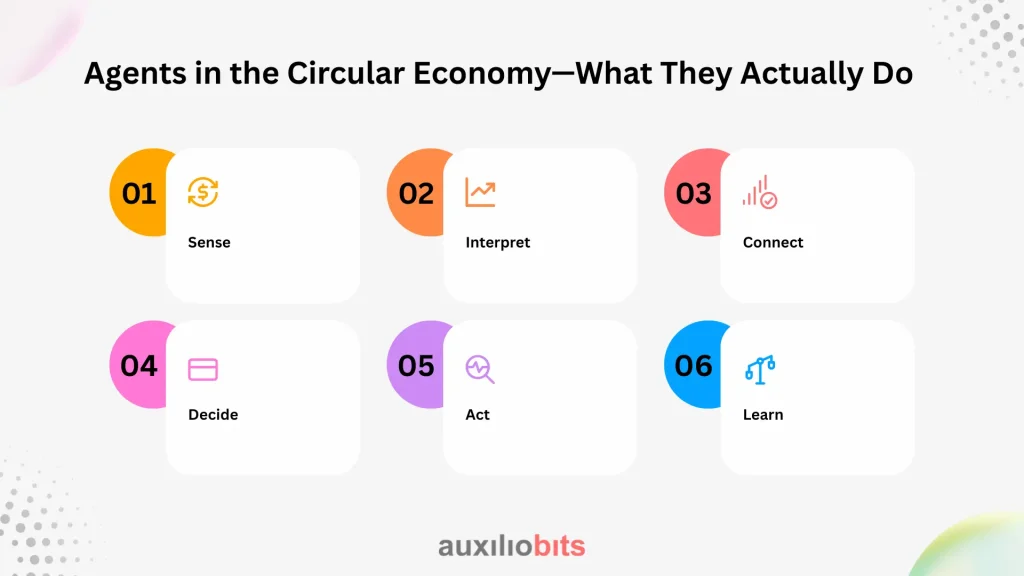
- Sense: Continuously monitor product usage, degradation, and return data from IoT and ERP systems.
- Interpret: Analyze unstructured sustainability data—from waste manifests to supplier reports—to find actionable patterns.
- Connect: Bridge fragmented systems (procurement, logistics, and compliance) without full-scale software replacement.
- Decide: Recommend optimal reuse, repair, or recycling routes based on dynamic cost–carbon trade-offs.
- Act: Trigger reverse logistics, initiate procurement of recycled materials, or reassign assets autonomously.
- Learn: Refine decision models with every cycle completed, turning operations into self-improving feedback loops.
The Truth About Circular Data
Every circular-economy white paper talks about “data-driven sustainability.” But anyone working in this field knows the data is a mess.
Product information is incomplete. Waste manifests are handwritten. Lifecycle assessments are inconsistent. Half the material flow data sits in supplier emails.
Agents can’t fix the mess overnight, but they can interpret and stitch it together. They can read PDFs, extract metadata, infer missing attributes, and reconcile unstructured inputs. In short, they turn chaos into action.
For example, an asset recovery agent might pull maintenance records from an equipment management system, compare them to component reuse criteria, and recommend whether the asset should be refurbished or recycled. That decision, once manual, can now happen in near real time.
Of course, this isn’t perfect. Agents rely on the quality of data they consume, and sometimes they’re too confident for their own good. But that’s the beauty of a circular mindset—even digital systems must learn, adapt, and evolve rather than discard mistakes.
When Machines Shouldn’t Decide
There’s a dangerous temptation to hand off everything to automation. Circularity exposes that risk. Imagine an electronics manufacturer using agents to determine the most sustainable way to handle returned devices. The agent concludes that refurbishment is best for carbon reduction. Great—except that the transport required to move those devices to a distant facility negates the environmental benefit.
Machines can miss those nuances because the real world is full of inconvenient trade-offs. That’s why human judgment must stay in the loop—to handle ethics, culture, and context.
A good model is “human-on-the-loop”:
- Agents handle continuous monitoring and suggestions.
- Humans validate complex trade-offs and exceptions.
- The system learns from those interventions over time.
Circularity needs that tension—between machine precision and human discretion—to stay honest.
Knowledge That Grows With Every Cycle
Here’s something few people talk about: every decision an agent makes creates data about how circularity actually behaves in practice.
Over time, that becomes an asset in itself.
- Agents start predicting which materials will degrade fastest by geography.
- They learn which recyclers deliver on claims and which don’t.
- They detect design flaws early—before they cascade into waste.
This evolving intelligence turns circular systems into feedback-rich organisms. The more loops they complete, the smarter they get. That’s the real promise of agentic sustainability—not automation for its own sake, but continuous learning across the entire value network.
The Governance Question
Autonomous systems raise legitimate trust issues. Can a business trust an agent to decide what’s “sustainable enough”?
The short answer is: not blindly. Every decision must be auditable—from why a transport route was selected to how an emissions trade-off was calculated. Without transparency, automation risks optimizing the wrong thing.
A few companies have learned this the hard way. One industrial manufacturer discovered its agents were routing materials through cheaper recyclers that didn’t meet compliance standards. Technically efficient, ethically unacceptable.
The fix wasn’t to shut the system down but to embed governance logic: human-defined priorities and traceable reasoning. Philips did something similar with its medical equipment refurbishment program, using AI for consistency but enforcing human review for sustainability thresholds. It’s pragmatic, not perfect.
That’s how mature systems operate—they don’t eliminate humans; they formalize their values in code.
Integration Is the Real Battle
Here’s an unglamorous truth: circularity doesn’t fail for lack of ambition. It fails at integration. Every circular initiative touches procurement, logistics, finance, and compliance systems—most of which are decades old. Agents can act as translators, connecting ERP, IoT, and regulatory APIs without forcing a full-scale software replacement.
This approach—automation around existing systems rather than inside them—is what makes agentic models sustainable from a business perspective. It respects legacy while enabling agility.
Circularity, in the end, is less about technology and more about architecture.
Why It Matters to Business, Not Just the Planet
When companies start using agents for circular operations, they notice something unexpected: profits follow purpose.
- Secondary sourcing reduces procurement costs.
- Intelligent routing cuts logistics waste.
- Automated compliance reduces penalties and reporting overhead.
- Transparent sustainability data improves investor confidence.
Circularity becomes a performance lever, not just a marketing badge. Once the numbers start reflecting that, the cultural resistance tends to evaporate.
Beyond Materials: The Circular Mindset
The most interesting part of this transition might not be about materials at all. It’s about information. Knowledge itself is becoming circular. The insights one factory gains from waste reduction feed the next facility’s process design. Agents act as the conduits, carrying not just materials but lessons.
A system that reuses both matter and knowledge—that’s the real circular economy.
A Hard Truth About Readiness
The hardest bottleneck isn’t technology. It’s people. Organizations still treat circularity as a sustainability department’s responsibility when it’s actually an operational discipline. It demands distributed decision-making and a tolerance for imperfection, things traditional corporations aren’t good at.
Agents can accelerate processes, but they can’t fix a culture that refuses to collaborate. Circularity requires trust in distributed intelligence—digital and human alike.
Until that cultural shift happens, agents will remain underused, like solar panels in the shade.
A Loop, Not a Line
Circular systems, by definition, resist neat endings. So does this conversation. Agents won’t solve every waste problem. But they will make it harder for businesses to hide behind complexity. When decision-making becomes distributed, transparent, and self-improving, inefficiency has nowhere to hide.
That’s not a technological revolution. It’s a structural one. And suppose the circular economy is ever going to move from glossy diagrams to daily practice. In that case, it will be because these small, tireless agents kept the loops moving—quietly, consistently, invisibly.